Introduction
Hiring teams in 2026 face a paradox: more applications than ever, but fewer qualified candidates. Inbound job applications are now flooded with AI-generated, fake, or low-quality submissions that consume recruiter time without delivering value. Gartner projects that by 2028, one in four candidate profiles will be AI-generated or fake, making it harder—not easier—to find the right people.
That pressure has turned AI recruiting tools from optional productivity boosters into operational necessities. 51% of organizations now use AI specifically to support recruiting efforts, with adoption up 65% year-over-year.
Today's platforms span the full recruiting stack: outbound sourcing, competency matching, automated screening, interview scheduling, and workforce planning. This guide breaks down five leading AI recruiting tools for 2026 and what to look for when choosing one.
TL;DR
- AI recruiting tools automate sourcing, screening, and scheduling—freeing recruiters to focus on relationships and final decisions
- Top 2026 platforms use competency-based matching and verified profiles to surface better candidates faster than keyword search
- Evaluation priorities: outbound vs. inbound fit, ATS/HRIS integrations, pricing model, and verified data quality
- Different tools solve different problems—sourcing platforms, interview tools, ATS systems, and workforce planning platforms each serve distinct roles
- Use the included framework to match the right tool to your team's size and specific hiring bottleneck
What Are AI Recruiting Tools?
AI recruiting tools are software platforms that use machine learning, large language models (LLMs), and agentic workflows to automate and accelerate stages of the talent acquisition process—from sourcing through onboarding.
Three core technologies power most platforms:
- LLMs enable natural language candidate search, automated job description generation, and resume summarization
- ML analytics provide predictive candidate ranking, skill inference, and hiring outcome forecasts
- Agentic automation handles outreach sequences, interview scheduling, and candidate follow-ups without manual intervention
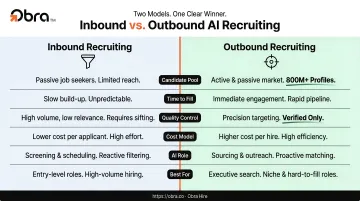
The market has split into two dominant models: inbound tools (ATS-based, reactive, managing candidates who apply) and outbound tools (proactive sourcing platforms that find passive candidates). The biggest 2026 shift is toward outbound-first approaches, driven by declining inbound signal quality as AI-generated applications increased 3x year-over-year.
That outbound shift aligns with broader market data. Gartner identifies high-volume recruiting going AI-first as the top 2026 trend, with recruiter roles moving from administrative work toward strategic advisory and relationship management. By 2027, 75% of hiring processes are expected to include AI proficiency assessments as organizations rethink evaluation for the GenAI era.
Top AI Recruiting Tools for 2026
The tools below cover the full recruiting stack — sourcing, screening, scheduling, and workforce planning. Each was evaluated for AI depth, workflow integration, candidate quality outcomes, pricing transparency, and real-world performance across employer, agency, and HR team contexts.
Obra Hire
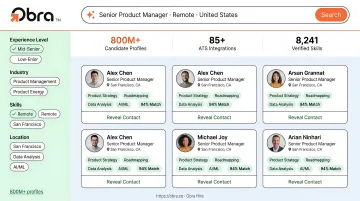
Obra Hire is a low-cost, outbound-first AI recruiting platform that helps teams proactively find and contact pre-vetted candidates without waiting on inbound applications. It provides access to a database of 800M+ verified candidate profiles searchable in one platform.
What sets Obra Hire apart: Competency-based matching powered by SkillsTree (a proprietary taxonomy of 8,241 skills with proficiency levels), verified profile filtering that eliminates AI-generated and fake applicants, and a freemium model with unlimited searches. Teams can preview candidate pool size and individual profiles before spending any contact credits—zero risk before committing.
| Feature | Details |
|---|---|
| Key Features | AI-powered outbound candidate search, SkillsTree competency matching, verified profile filtering, preview before credits, 85+ ATS/HRIS integrations (Workday, Greenhouse, iCIMS, Lever, SAP SuccessFactors, SmartRecruiters, Oracle Recruiting Cloud, Cornerstone TalentLink) |
| Best For | Employers, HR departments, and recruiting agencies of any size looking to replace expensive inbound recruiting with a scalable, self-serve outbound hiring workflow |
| Pricing | Freemium model: Free (unlimited searches, 1,000 profile views, 50 contact credits/month), Explore ($109/month, 500 contact credits), Scale ($169/month, 1,200 contact credits), Enterprise (custom pricing)—no contract or setup required |
Obra Hire reveals email, phone, LinkedIn profile URL, and resume for each candidate. Contact credits are only consumed when you unlock full contact details, ensuring efficient use of your budget. The Scale plan includes team collaboration features with shared credits, pooled contacts, and centralized admin controls.
Paradox (Olivia)
Paradox is a conversational AI recruiting platform best known for Olivia, its chatbot assistant that automates candidate-facing tasks including screening, scheduling, and FAQ responses via SMS, WhatsApp, and web chat.
Its strength is high-volume hiring environments—retail, logistics, hospitality—where speed of initial engagement drives conversion. Paradox operates as an automation layer alongside an existing ATS rather than as a standalone system.
| Feature | Details |
|---|---|
| Key Features | Conversational AI screening in 100+ languages, automated interview scheduling (one-on-one, panel, group, multi-location), high-volume hiring support, customizable chatbot persona, event hiring management, Traitify visual assessments |
| Best For | High-volume employers in hourly or frontline industries needing rapid front-of-funnel automation and candidate responsiveness |
| Pricing | Custom enterprise pricing; contact vendor for quote |
Performance highlights: General Motors reduced scheduling time from 5 days to 29 minutes and saved $2M in Year 1. 7-Eleven cut time-to-hire from 10+ days to under 5 days, saving store leaders 40,000 hours per week. Platform-wide, Paradox schedules over 30 million interviews annually with a 40% decrease in no-shows.
HireVue
HireVue is an AI-powered video interviewing and assessment platform designed to scale early-stage candidate evaluation. It offers on-demand video interviews, structured competency assessments, and AI-supported scoring.
Value is concentrated in the screening and interview stages — tools for building structured rubrics, scoring candidates consistently, and cutting scheduling delays for high-volume roles.
| Feature | Details |
|---|---|
| Key Features | On-demand video interviews, AI-supported competency assessments (19 competencies), game-based assessments, virtual job tryouts, interview scoring rubrics, Assessment Builder (launched Feb 2026), SOC 2 Type 2 and FedRAMP certified |
| Best For | Mid-to-large enterprises running high-volume or multi-location hiring that require scalable, consistent screening processes |
| Pricing | Essential and Premium tiers available; contact vendor for pricing |
HireVue serves 1,100+ customers globally, including over 60% of the Fortune 100. The platform has hosted 40+ million video interviews and 200+ million candidate assessments. Emirates NBD achieved an 80% reduction in time-to-offer and saved 8,000 hours using HireVue's tools.
Workable
Workable is an all-in-one HR and recruiting platform combining an ATS, HRIS, and AI-powered candidate sourcing. It gives teams a single system for the full employee lifecycle from sourcing through onboarding.
Its sourcing spans 200+ job boards across dozens of countries, and its AI recruiter assists with candidate matching and profile summarization. Workable appeals to mid-sized companies wanting to consolidate HR and recruiting in one tool.
| Feature | Details |
|---|---|
| Key Features | Built-in AI recruiter with semantic matching, multi-board job posting (200+ boards), access to 400M+ candidate profiles, HRIS (onboarding, time tracking, performance), ATS workflow automation, anonymized screening for bias reduction, GDPR/EEO compliance |
| Best For | Mid-sized companies seeking a unified HR + recruiting platform that eliminates the need for multiple separate tools |
| Pricing | Subscription-based; Standard ($299/month), Premier ($599/month), Enterprise ($719/month) for 1-20 employees; pricing scales by employee count; 15-day free trial |
Forbes Advisor named Workable the Best AI-Powered Recruiting Platform for 2025. Customers advance 20-30% of AI-sourced candidates in their hiring process and report 30-40% productivity gains when using AI for personalized outreach.
Eightfold AI
Eightfold AI is a talent intelligence platform that uses deep learning on 1 billion+ career trajectories and 1 million+ skills to infer transferable skills, support internal mobility, and enable skills-based hiring decisions at scale.
It's built for organizations investing in long-term workforce planning, diversity strategy, and career pathing. Implementation complexity and enterprise pricing put it firmly in large-organization territory.
| Feature | Details |
|---|---|
| Key Features | Skills inference and matching (1M+ skills, 1B+ career trajectories), internal mobility and career pathing, AI Interviewer (autonomous structured interviews), Talent Design (workforce trend visibility), diversity analytics, available in 155+ countries and 24 languages, ISO/IEC 42001:2023 certified, FedRAMP Moderate Authorized |
| Best For | Large enterprises focused on skills-based hiring strategies, workforce planning, and reducing over-reliance on pedigree-based resume screening |
| Pricing | Custom enterprise pricing; contact vendor |
STMicroelectronics saved 160+ hours in 2 months using Eightfold. Protective Life tripled the number of hires with the same staff and expense footprint. Forrester recognized Eightfold in its Skills Intelligence Solutions Landscape, Q1 2026.
What to Look for When Choosing an AI Recruiting Tool
The right tool depends on where your hiring workflow is most broken. Teams flooded with low-quality inbound applicants need a different solution than teams struggling to screen at volume or schedule at scale.
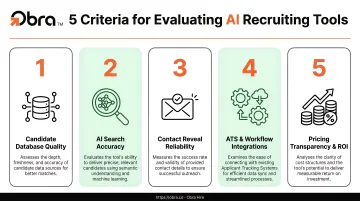
Five practical evaluation criteria:
1. Inbound vs. outbound fit Does the tool proactively surface candidates (outbound sourcing) or manage applications you've already received (inbound ATS)? If 69% of organizations report difficulties recruiting for full-time positions, the bottleneck is often candidate availability, not application management.
2. AI depth Is matching competency-based or keyword-based? Competency-based systems evaluate proficiency levels and skill relationships, not just resume text. Keyword search misses qualified candidates with non-traditional backgrounds.
3. Integrations Does it connect to your existing ATS/HRIS without disrupting workflows? Look for platforms that push candidate data directly into Workday, Greenhouse, Lever, or iCIMS — without requiring manual re-entry or workflow changes.
4. Pricing model Per-seat vs. per-hire vs. credits-based, and how it scales with your team size. Median cost-per-hire is $1,200 for nonexecutive roles—evaluate whether the tool's pricing improves or worsens this metric.
5. Verified data quality Does the platform filter out fake or AI-generated profiles? With Gartner projecting 1 in 4 profiles will be fake by 2028, verified profile filtering is essential for protecting recruiter time.
Knowing what to prioritize is half the battle. Knowing what to avoid is the other half.
Common mistakes to avoid:
- Paying for enterprise features a small team won't use
- Selecting a tool based on brand recognition rather than workflow fit
- Overlooking hidden costs — setup time, training, and onboarding — that erode early ROI
89% of HR professionals using AI for recruiting report saving time or gaining efficiency. The difference between those results and a wasted budget almost always comes down to tool-to-workflow fit.
How We Selected These Tools
Tools were assessed based on practical use across real hiring workflows, not demos alone. Emphasis was placed on where AI genuinely reduces recruiter effort, improves candidate quality, and connects to measurable hiring outcomes.
Selection criteria:
- Goes beyond keyword search — requires competency-based matching, semantic search, or agentic workflows
- Pushes data cleanly into existing ATS/HRIS systems without manual work
- Offers clear pricing or a freemium entry point so teams can validate before committing
- Covers blue, gray, and white collar roles across industries — not just tech or professional hiring
- Usable by non-technical HR teams without extensive training or onboarding
Each platform was then measured against benchmarks from SHRM's 2025 Recruiting Benchmarking Report — median time-to-fill of 44 days, cost-per-hire of $1,200, and a recruiter carrying 20 open requisitions — to assess whether the tool moves the needle on outcomes that actually matter.
Conclusion
AI recruiting tools in 2026 aren't interchangeable. The right platform depends on whether your team's biggest pain point is finding candidates, screening them, interviewing at scale, or planning workforce strategy.
Identify your most time-consuming bottleneck before evaluating tools. Prioritize platforms that integrate cleanly into existing workflows rather than requiring a full-stack replacement. 73% of TA professionals agree AI will change how organizations hire — but that change only pays off when the tool matches your actual hiring model, not just your budget.
For teams whose bottleneck is sourcing — spending too much time waiting on inbound applications or paying premium rates for candidate access — Obra Hire offers an outbound-first alternative. The platform searches 800M+ verified profiles, reveals direct contact information, and integrates with 85+ ATS tools, with a free tier that requires no contract or setup to get started.
Frequently Asked Questions
What is an AI hiring platform?
An AI hiring platform is software that uses machine learning and LLMs to automate and enhance stages of the recruitment process—from candidate sourcing and matching to screening, scheduling, and analytics. These platforms help teams hire faster and with greater accuracy by reducing manual, repetitive tasks.
How can AI be used in recruitment?
AI is used to source candidates from large databases, screen resumes and applications, automate outreach and scheduling, conduct AI-assisted video interviews, rank candidates by competency fit, and generate hiring analytics and forecasts. Recruiters using GenAI save an average of 20% of their work week.
What AI systems do recruiters use?
Recruiters commonly use a combination of tools: outbound sourcing platforms (like Obra Hire), ATS/CRM systems with built-in AI (like Workable), conversational screening tools (like Paradox), video interviewing platforms (like HireVue), and writing assistants (like ChatGPT). The specific stack depends on their workflow needs and hiring volume.
What is an ATS vs CRM?
An ATS (Applicant Tracking System) manages the inbound application pipeline—tracking candidates through hiring stages. A CRM (Candidate Relationship Management) tool is used to proactively build and nurture relationships with passive talent. Some modern platforms combine both functions, but the key distinction is reactive (ATS) vs. proactive (CRM).
Do AI recruiting tools replace human recruiters?
No. AI tools automate repetitive tasks like scheduling, data entry, and initial screening—freeing recruiters to focus on relationship-building and final hiring decisions. 67% of HR professionals say their organization has not been proactive in training employees to work alongside AI, which underscores how much runway remains for teams to get the most from these tools.
How do I know if an AI recruiting tool is worth the investment?
Track time saved per hire, cost-per-hire reduction, and candidate quality improvements. Industry benchmarks give a useful starting point: median cost-per-hire is $1,200 and median time-to-fill is 44 days. A freemium option like Obra Hire's Free tier lets you validate fit before committing to a paid plan.