Introduction
For tech startups, hiring is simultaneously the highest-leverage and most under-resourced function. The right early hires define trajectory, while wrong ones compound quickly at small team sizes. Founders spend approximately 25% of their workweek on hiring-related tasks—roughly 10 hours per week—yet only 10% of startups have an in-house recruiter by the time headcount reaches 10 employees.
That gap is exactly where AI recruitment tools are supposed to help — but the market is flooded with enterprise-grade platforms retrofitted for startups. Most add process where none existed before.
Understanding which features actually matter at each growth stage is what separates a tool that multiplies your effort from one that adds friction. A $200/month platform that saves 15 hours of founder time per hire delivers stronger ROI than a $50/month tool that still requires manual sourcing.
This guide helps you cut through the noise — covering the features that matter, the traps to avoid, and how to match tooling to your actual hiring stage.
TL;DR
- Outbound sourcing, competency-based matching, and verified profile filtering deliver the highest ROI for lean startup teams
- 70% of the global workforce consists of passive talent not actively job searching—making outbound-first features essential
- Gartner predicts 1 in 4 candidate profiles will be fake by 2028—verified profile filtering is now a core requirement
- Sourcing tools without ATS/HRIS integration create data silos and broken hiring pipelines
- Complex enterprise approval workflows add configuration overhead that slows down small teams
Why Startup Recruiting Feature Needs Are Different
Startups don't hire like enterprises. There's no dedicated recruiting function, every open role directly affects product velocity, and founders or generalists carry the hiring load on top of their actual jobs. That dynamic means recruiting features need to eliminate work entirely — not just organize it.
Consider the bandwidth reality: when founders and early employees spend 30-50% of their time on recruiting when scaling from 3 to 15 people, they need automation that removes tasks entirely, not systems that require configuration. Founders at fast-scaling companies routinely report spending the majority of their time on hiring during the early years — time pulled directly from building product.
No Employer Brand Means Inbound Doesn't Work
Without brand recognition, startups can't rely on candidates finding them. Competing against established tech companies for the same talent means waiting for inbound applications is a losing strategy. Platforms built purely around application tracking solve the wrong problem — startups need outbound-first tools that enable proactive, personalized outreach.
AI-Generated Applications Are Flooding Inbound Pipelines
The inbound model faces a second pressure: fake applications. 40% of candidates now use AI to generate resume and cover letter text, and 6% admit to participating in interview fraud. For startups, filtering out that noise manually is not an option. Verified profile filtering and outbound-first architectures aren't conveniences — they're requirements for reliable candidate data.
Feature needs also shift dramatically by stage. A seed-stage team making five hires a year and a Series B team making fifty need completely different toolsets. Choosing features calibrated to the wrong stage means either paying for tools you'll never use or spending weeks setting up a system that's too complex for where you are now.
The Core AI Recruitment Feature Stack for Tech Startups
The core feature stack should be evaluated as a system, not a checklist. Each feature's value depends on how it connects to others across the sourcing-to-hire workflow.
Outbound Candidate Sourcing and Search
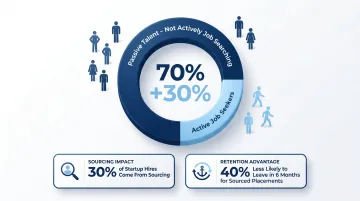
Outbound sourcing—the ability to proactively find and contact qualified passive candidates from large external talent pools rather than waiting for inbound applications—is the single highest-ROI feature for startups competing without employer brand recognition.
70% of the global workforce is passive talent not actively job searching. For startups with fewer than 25 employees, 30% of hires come from sourcing, and placements sourced through proactive outreach are 40% less likely to leave within the first six months.
What to look for in AI sourcing:
- Pool size: Platforms with hundreds of millions of profiles give you far more reach than proprietary databases limited to active job seekers
- Preview capability: Obra Hire surfaces candidates from 800M+ verified profiles and lets hiring teams preview the pool before spending a single credit — removing financial risk from the search
- Source flexibility: Confirm the platform draws from multiple external sources, not just one proprietary database
Time-to-hire drops by almost 30% for smaller startups when a recruiter is involved in sourcing, and 89% of talent says being contacted by a recruiter can make them accept an offer faster.
Competency-Based Matching vs. Keyword Search
Keyword matching returns candidates whose profiles contain exact search terms. Competency-based matching maps skills, proficiency levels, and career signals to role requirements regardless of exact phrasing. This distinction matters most in tech hiring, where skill sets evolve faster than job titles.
Research shows that technical skills have a half-life of approximately 2.5 years, and 44% of workers' core skills will be disrupted between 2023 and 2027. A software engineer who mastered React in 2022 may now focus on Next.js or server components, but keyword searches for "React developer" won't surface them once their profile reflects the shift.
A structured skills taxonomy produces higher-quality shortlists. Organizations using skills-based approaches are 98% more likely to retain high performers and 107% more likely to place talent effectively. Talent pools expand on average nearly 10x when using a skills-first approach compared to job titles alone.
Obra Hire's platform uses structured competency data covering both technical and transferable competencies with proficiency levels, surfacing candidates based on "Must Have" and "Nice to Have" criteria rather than exact keyword matches. This approach reduces manual filtering and increases interview-to-offer ratios.
Verified Profile Filtering
The surge of AI-generated resumes and fake candidate profiles is degrading the signal quality of inbound pipelines. Verified profile filtering cross-references candidate identity and profile data against multiple sources to flag or exclude synthetic profiles. This feature has shifted from differentiator to baseline requirement.
Platforms with verified profile filtering reduce the time hiring managers spend screening out unqualified or fabricated applicants — screening activities currently consume approximately 23 hours per hire on their own.
The volume problem is real:
- The average online job posting receives 250+ candidates, but only 4-6 are invited to formal interviews
- 40% of candidates use AI during the application process
- 25% of profiles could be fake by 2028
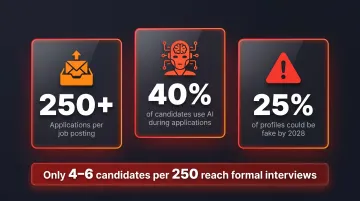
The real cost is recruiter time. When a recruiter spends 10-15 hours on resume review per hire, filtering out synthetic profiles before they hit the review pipeline multiplies available capacity.
Automated Outreach and Multi-Touch Sequencing
Finding a qualified candidate and actually getting a response are two separate problems. Automated outreach features generate personalized messages at the candidate level (based on their profile, role, and context) and manage multi-step follow-up sequences across email and LinkedIn.
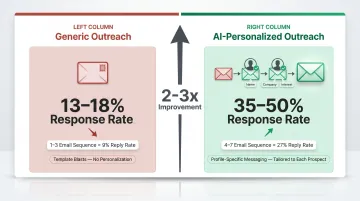
Personalized InMails see a 40% higher response rate than generic messages. Generic InMail response rates benchmark at 13-18%, while AI-assisted outreach achieves 35-50% response rates—a 2-3x improvement. Meanwhile, 72% of candidates ignore outreach that feels templated.
What "personalization" means in an AI outreach context:
- References the candidate's actual background, skills, and career trajectory — not just a first-name mail-merge
- Adjusts follow-up timing and messaging based on engagement signals
- Maintains a consistent tone across a multi-step sequence without manual drafting at each stage
Sequences with 4-7 follow-up emails achieve a 27% reply rate versus 9% for sequences with 1-3 emails. The key is compressing the time between identification and first response without requiring manual drafting at every stage.
ATS/HRIS Integration
ATS integration is not optional even for early-stage teams. Sourcing tools that don't connect to a candidate tracking system create data silos, manual exports, and broken pipelines.
What to look for:
- Native integrations with common platforms (Greenhouse, Lever, iCIMS, Workday, SAP SuccessFactors)
- Bidirectional data sync
- Zero disruption to existing workflows
Obra Hire connects to 85+ ATS/HRIS platforms including Workday, Greenhouse, iCIMS, Lever, and SAP SuccessFactors, ensuring candidate data flows automatically into existing systems.
For startups without an ATS, the sourcing platform should function as a lightweight pipeline tracker from day one. Look for shared projects organized by role, candidate assignment to collaborators, and outreach status tracking — so multiple team members can work the same pipeline without prior ATS infrastructure.
Only 20% of small and mid-sized businesses use an ATS, yet 75% of recruiters use some form of tech-driven recruiting tool. That gap represents teams running on disconnected tools that don't share data — and paying for the inefficiency in every hire.
How to Evaluate AI Recruiting Features for Your Stage
Before comparing features across platforms, identify where your hiring process actually breaks down—finding candidates, getting responses, scheduling interviews, or tracking pipeline. That single bottleneck should drive your platform decision. A targeted fix for your real constraint beats a comprehensive tool that partially addresses everything.
Stage-Based Feature Prioritization
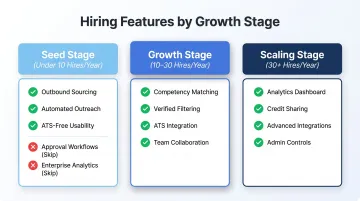
Seed-stage teams (under 10 hires/year):
- Prioritize outbound sourcing, automated outreach, and ATS-free usability
- Skip complex approval workflows and enterprise analytics
- Focus on platforms that work day one without configuration
Growth-stage teams (10-30 hires/year):
- Add competency matching, verified filtering, and structured pipeline tracking
- Invest in ATS integration if not already implemented
- Consider team collaboration features and shared credit pools
Scaling teams (30+ hires/year):
- Add analytics, team-wide credit sharing, and advanced integrations
- Evaluate dedicated support and customization options
- Assess admin controls and user activity insights
Buying ahead of your stage creates unused complexity. Most small businesses use only 30% of their ATS features while paying for 100%.
Total Cost of Ownership vs. Sticker Price
The actual cost of a recruiting platform includes implementation time, training overhead, and the opportunity cost of features that require configuration before they're useful.
Consider the math: Total recruiter time per hire runs 40-51 hours, with 23 hours spent on screening alone. For founders, the stakes are higher—when 25% of your workweek goes to hiring, every hour saved compounds across other functions.
A $200/month platform that saves 15 hours of founder time per hire at $150/hour in opportunity cost delivers $2,250 in value per hire. A $50/month tool that still requires 10 hours of manual sourcing delivers far lower ROI despite the lower sticker price.
Key benchmarks to anchor your math:
- Average cost-per-hire: $5,475 for non-executive roles
- Agency fees: 15-30% of first-year salary — $18,000-$36,000 for a $120,000 software engineer
- In-house recruiter break-even: 8-12 hires per year
Pilot-Before-Commit Principle
Once the ROI math points to a shortlist, test each platform against a real open role before signing anything.
Key pilot metrics to track:
- Number of qualified candidates surfaced within 48 hours
- Response rate on outreach sequences
- Time from search to first contact
- Subjective ease-of-use for non-recruiters
Platforms offering free tiers with meaningful functionality (like Obra Hire's 1,000 profile views and 50 contact credits per month) allow genuine testing without financial commitment.
Integration Compatibility as a Pre-Purchase Checkpoint
Before evaluating features, confirm the platform integrates with the tools your team already uses—calendar, email, and ATS/HRIS. Even the best sourcing engine creates more work than it saves if data doesn't flow automatically into existing systems.
Check for native integration support with named platforms and whether data flows automatically or requires manual export. Bidirectional sync — where updates in your ATS push back to the sourcing platform — eliminates double-entry and keeps pipeline data accurate across both systems.
What Happens When Your Feature Set Doesn't Match Your Stage
The Enterprise Feature Trap
Platforms built for large TA teams require configuration, admin overhead, and dedicated management that consumes the time savings they were purchased to create. More than 70% of ERP implementations fail to meet their original business goals, and RAND Corporation found that more than 80% of AI projects fail—double the failure rate of non-AI IT projects.
Every hour spent configuring approval workflows or managing user permissions is an hour not spent on actual recruiting. For a founder spending 25% of their week on hiring, this represents direct opportunity cost against product development, customer acquisition, or fundraising.
The Cost of Missing Outbound Capability
Startups that rely solely on inbound features (job posting, application tracking, resume parsing) depend on candidates finding them first. This doesn't work without employer brand recognition.
What this means practically:
- Lower pipeline volume from passive candidates who represent 70% of available talent
- Longer time-to-fill (tech roles average 33 days to hire, but extend significantly without proactive sourcing)
- Lower quality applicants—candidates actively job searching may be leaving problematic situations or lack specialized skills
For smaller startups, time to hire drops by almost 30% when active sourcing is involved. The absence of outbound capability means forfeiting this acceleration.
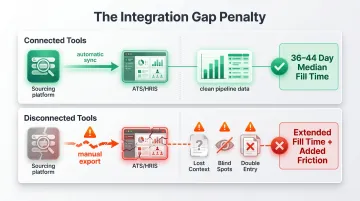
The Integration Gap Penalty
When sourcing tools and tracking systems don't connect, the operational fallout is immediate:
- Candidate data must be manually transferred between systems
- Context gets lost between sourcing and tracking stages
- Pipeline visibility breaks down, creating blind spots in hiring progress
Median time to fill across all industries is 36-44 days. At the speed tech startup hiring requires, every day of added friction from disconnected tools translates directly into lost productivity and delayed revenue.
Common Misconceptions About AI Recruiting Features
"AI Matching" Always Means Competency-Based Intelligence
Many platforms market AI matching that is still fundamentally keyword or Boolean search with a wrapper. To distinguish genuine competency-based matching from relabeled search, ask:
- Does the system use a structured skills taxonomy with proficiency levels?
- Can it surface candidates who don't use specific keywords but possess equivalent competencies?
- Does it map transferable skills across different role contexts?
For tech roles especially, skills rarely map to standardized titles. A platform that only searches for exact keyword matches will miss candidates with equivalent but differently-labeled experience.
More Features Indicate a Better Platform for Startups
Feature breadth signals enterprise orientation, not startup fit. The platforms that work best for lean teams do three or four things exceptionally well with minimal configuration. A tool built for a 500-person TA function is not built for you.
When evaluating platforms, prioritize depth in core features (sourcing, matching, outreach, integration) over breadth of secondary features (compliance dashboards, multi-currency payroll, complex approval workflows).
AI Recruitment Software Eliminates the Need for Human Judgment
Human judgment isn't optional — it's just being applied to the wrong tasks. AI handles the repeatable, time-consuming work. The rest stays with your team:
- Culture fit assessment and values alignment
- Final candidate evaluation and reference checks
- Offer negotiation and closing
At tech startups especially, the founder's personal involvement in final stages is a competitive advantage that AI should free up time to preserve. The goal is to eliminate the 23 hours of manual screening and administrative work per hire — so your team can focus on the conversations that actually close candidates.
Frequently Asked Questions
What features should a tech startup prioritize in AI recruitment software?
Prioritize outbound sourcing, competency-based matching, verified profile filtering, and automated outreach. These features solve the highest-impact problems for lean teams: finding passive candidates, filtering quality signal from noise, and compressing response time. ATS integration becomes critical as headcount grows beyond 10-15 employees.
How is competency-based AI matching different from keyword resume screening?
Keyword screening matches candidates based on exact text in resumes, while competency-based matching maps skills, proficiency levels, and career signals to role requirements. This surfaces qualified candidates even when their profiles don't contain specific search terms—critical when technical skills evolve faster than job titles.
Can AI recruitment software filter out fake or AI-generated applicant profiles?
Yes. Platforms with verified profile filtering cross-reference candidate data across multiple sources to flag synthetic or bot-submitted profiles. With 40% of candidates now using AI during the application process and Gartner projecting 25% of profiles could be fake by 2028, this filtering capability is no longer optional.
What's the difference between inbound and outbound AI recruiting features?
Inbound features handle candidates who apply to you — screening, ranking, and tracking. Outbound features proactively find and contact passive candidates who haven't applied. For startups without established employer brand recognition, outbound capability is essential: 70% of the workforce isn't actively job searching.
How do I know if an AI recruiting platform will integrate with my existing ATS?
Confirm native integration support before evaluating other features. Ask vendors about bidirectional sync with specific platforms (Greenhouse, Lever, Workday, iCIMS, SAP SuccessFactors), whether data flows automatically or requires manual export, and whether the integration is API-based or relies on third-party connectors.
How much should a tech startup budget for AI recruitment software?
SMB-tier platforms typically run $99-$699/month, but the more useful comparison is total cost versus alternatives: agency fees ($18,000-$36,000 per hire), founder time (25% of workweek), or bad hires (30% of first-year salary). Platforms that deliver measurable time savings or better hire quality justify higher monthly costs.