Introduction
According to a Glassdoor survey, 76% of job seekers consider workforce diversity an important factor when evaluating employers — and 32% won't apply to companies that lack it. Meanwhile, McKinsey's Diversity Wins research found that companies in the top quartile for diverse representation are 39% more likely to achieve financial outperformance than bottom-quartile peers.
Most organizations still rely on inbound applications, generic job boards, and manual resume screening — all of which replicate existing demographic patterns. SHRM research makes this concrete: when only one finalist in a candidate pool is non-white or female, that person is statistically never chosen. Change the pool composition, and the outcome changes.
This post covers the top diversity recruiting tools across four categories — candidate sourcing, resume screening, job description analysis, and DEI analytics — what makes each one effective, and how to build the right stack for where your hiring process actually breaks down.
TL;DR
- Diversity recruiting tools fall into three categories: outbound sourcing, bias reduction/screening, and DEI analytics.
- Proactive outbound sourcing of passive candidates consistently produces more diverse pipelines than inbound applications alone.
- The best tools evaluate candidates on verified skills and competencies — not resume keywords or institutional pedigree.
- Key features to prioritize: blind screening, inclusive JD tools, diversity analytics dashboards, and ATS integrations.
- The right tool depends on where your DEI gaps are: pipeline width, screening fairness, or measurement and reporting.
What Are Diversity Recruiting Tools?
Diversity recruiting tools are software platforms that help organizations find, evaluate, and hire candidates from underrepresented or varied backgrounds. They intervene at the specific funnel stages where bias and homogeneity most often enter — going beyond inbound recruiting to build more equitable, higher-performing teams.
These tools fall into three broad categories:
- **Sourcing and candidate discovery platforms** — Enable outbound, proactive outreach to passive diverse talent beyond standard job boards.
- Bias-reduction and screening tools — Include blind screening features, inclusive job description writers, and structured interview support.
- DEI analytics and ATS platforms — Track representation at each funnel stage and support compliance reporting.
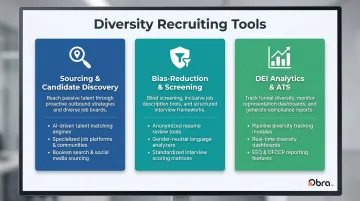
Many platforms span more than one category, and a handful cover all three. Understanding which category your team is weakest in helps narrow the decision.
Why 2026 Is a Particularly Difficult Year
The inbound model has a new problem: between 40% and 80% of applicants now use AI to write resumes and cover letters, per SHRM's November 2025 analysis. AI-generated applications inflate pipeline volumes and obscure authentic candidate signals, which directly distorts DEI data. A sourcing platform that surfaces verified, passive candidates bypasses the problem altogether.
Top Diversity Recruiting Tools for DEI in 2026
The tools below represent a full-funnel approach to DEI hiring — from proactive sourcing to screening fairness to workforce reporting. Each solves a distinct problem in the diversity recruiting lifecycle.
Obra Hire
Obra Hire is an outbound-first candidate sourcing platform built for teams that want to stop waiting for diverse talent to find them. It gives recruiting teams direct access to 800M+ verified candidate profiles, enabling proactive outreach to passive candidates across blue, gray, and white-collar roles — a model that naturally widens pipeline diversity compared to inbound-only approaches.
What sets it apart for DEI: its competency-based matching evaluates candidates on demonstrated abilities rather than resume keywords or educational pedigree. This reduces credential bias and affinity bias at the top of the funnel.
Verified profile filtering on Explore and Scale plans surfaces authentic profiles, reducing the AI-generated application noise that can skew DEI pipeline data — Gartner has flagged this as affecting 1 in 4 profiles by 2028.
The freemium model is a genuine differentiator. Free plan users get unlimited searches across the full database, with 1,000 profile views and 50 contact credits monthly — enough to preview diverse candidate pools before committing any budget. The Scale plan ($169/month) adds shared team credits, centralized admin controls, and pooled contact management, so DEI sourcing efforts can be coordinated across multiple requisitions without duplicating spend.
| Category | Details |
|---|---|
| Best For | Outbound proactive sourcing of passive diverse candidates across blue, gray, and white-collar roles |
| Key DEI Features | 800M+ verified profiles; competency-based matching; AI-generated candidate filter; 85+ ATS/HRIS integrations including Greenhouse, Workday, iCIMS, and Lever |
| Pricing | Free plan available (unlimited searches, 50 contact credits/month); Explore at $109/month; Scale at $169/month; Enterprise custom pricing; no contracts required |
SeekOut
SeekOut is an AI-powered talent intelligence platform built specifically for diversity sourcing. It searches across 1 billion+ profiles — including GitHub, academic publications, and veteran databases — giving recruiters access to talent pools that LinkedIn alone won't surface.
Three features drive its DEI value:
- Blind Hire mode strips names, photos, education, and other identifying details so evaluators focus on skills and experience
- Diversity-focused search filters enable compliant filtering by gender, veteran status, and other dimensions
- Real-time pipeline analytics track representation at every funnel stage and benchmark against external talent pools by geography
| Category | Details |
|---|---|
| Best For | AI-powered diversity sourcing with deep talent intelligence across multiple data sources |
| Key DEI Features | Diversity-focused search filters; Blind Hire mode; pipeline diversity tracking; EEOC reporting support |
| Pricing | Recruit Lite from $179/month; enterprise plans custom-priced from $833/month; no free trial |
Textio
Textio is an augmented writing platform that helps recruiting teams write job descriptions and outreach copy that attract broader, more diverse applicant pools. Its machine learning engine is trained on millions of job postings and their actual hiring outcomes.
Research published in the Journal of Personality and Social Psychology confirmed that masculine-coded job ad language causes women to find those positions less appealing — even when they're fully qualified. Textio's Gender Tone Meter quantifies this in real time, flagging phrases statistically linked to demographic skew. Textio's own analysis of 78,768 engineering listings found that jobs where a man was hired used nearly twice as many masculine-tone phrases as feminine-tone phrases.
The platform provides real-time language scoring, demographic tone analysis, inclusive phrasing suggestions, and a shared document library for standardizing language across all postings.
| Category | Details |
|---|---|
| Best For | Writing inclusive job descriptions and recruiting content that don't discourage underrepresented candidates from applying |
| Key DEI Features | Real-time bias scoring; demographic tone analysis; inclusive language suggestions; browser extension for cross-platform use |
| Pricing | Custom pricing (contact sales); English only; no free trial |
ChartHop
ChartHop is a people analytics and workforce planning platform that visualizes DEI data over time. HR leaders can segment representation by gender, ethnicity, tenure, department, and level — and model how future hiring decisions will affect diversity goals before making them.
Its "time travel" feature lets you view the organization's structure and demographic makeup at any past date. The scenario planning module shows the projected diversity impact of different hiring plans before they're executed. DEI data is integrated alongside compensation, performance, and headcount planning — which makes diversity outcomes part of operational decision-making rather than a separate report.
| Category | Details |
|---|---|
| Best For | Pairing DEI analytics with headcount planning and workforce scenario modeling |
| Key DEI Features | Representation trend tracking; scenario-based DEI planning; segmentation by multiple diversity dimensions; multi-language support |
| Pricing | From $5/employee/month (G2 vendor-provided data); $8–$20+/employee/month per Vendr estimates; annual minimum applies; contact sales for a quote |
Greenhouse
Greenhouse is an enterprise ATS that embeds DEI considerations directly into recruiting workflows. Diversity reporting and structured processes are built into the core workflow — not bolted on afterward.
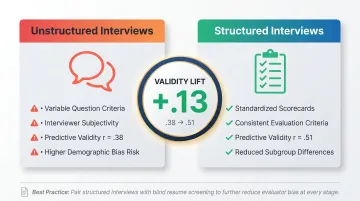
Structured interview scorecards ensure every candidate is evaluated against the same criteria by every panelist. Schmidt and Hunter's meta-analysis found structured interviews have a predictive validity of r = .51 vs. .38 for unstructured interviews, with smaller demographic subgroup differences than cognitive ability tests. Greenhouse also includes built-in EEOC/OFCCP compliance reporting, custom demographic question sets, and candidate funnel analytics that track representation from sourcing through offer. DEI features are available on the Pro subscription tier.
| Category | Details |
|---|---|
| Best For | Enterprise recruiting teams that need DEI reporting, structured interviewing, and compliance built into their core ATS |
| Key DEI Features | Structured interview kits; EEOC/OFCCP compliance reporting; demographic funnel analytics; 500+ integrations including diversity job boards |
| Pricing | Custom pricing; free demo available; scales with company size |
Key Features to Look For in a Diversity Recruiting Tool
The right tool depends on identifying where bias or underrepresentation is actually entering your process. Here's what to evaluate at each stage:
Outbound and Diverse Sourcing Capability
Inbound applications replicate existing demographic patterns. The people in your network refer candidates who look like them, and your current employer brand attracts people who already see themselves represented. Tools that enable proactive outbound outreach to passive diverse candidates break this cycle.
Prioritize tools that offer:
- Verified talent databases with broad demographic reach
- Access to niche communities and underrepresented candidate pools
- Filters that surface diverse profiles beyond general keyword search
Blind Screening and Bias Reduction
Blind screening removes names, photos, graduation years, and other identifiers that can trigger unconscious bias, forcing evaluators to assess skills and competencies instead. An HBR survey of 800+ U.S. HR practitioners found that only 20% of organizations currently use blind hiring despite strong evidence supporting it.
The limitation to know: blind screening's effectiveness decreases at the face-to-face interview stage, where visual and auditory cues reintroduce bias. Pairing blind screening tools with structured interview scorecards (like Greenhouse's) extends bias reduction through later hiring stages.
Inclusive Language and Job Description Tools
Biased language in job postings reduces application rates from women, people of color, and other underrepresented groups before your process even starts. Look for:
- Real-time language scoring and demographic tone feedback
- Inclusive phrasing suggestions (not just a static word blocklist)
- Role-level calibration so suggestions stay relevant to the position
DEI Analytics and Compliance Reporting
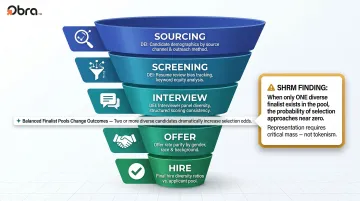
Measuring representation at each funnel stage (sourcing, screening, interview, offer, hire) reveals where diverse candidates drop off. For U.S. employers with 100+ employees, EEO-1 Component 1 reporting is mandatory annually. Federal contractors face additional OFCCP affirmative action obligations.
Beyond compliance, funnel-stage tracking is what drives actual change. SHRM's research found that when only one diverse candidate reaches the finalist stage, the odds of that candidate being hired are statistically near zero. Balanced finalist pools change that outcome directly.
ATS/HRIS Integration
A diversity tool that sits outside your existing workflow won't get used consistently. Look for native integrations with your ATS and HRIS: Workday, Greenhouse, Lever, iCIMS, and SAP SuccessFactors are the common connectors. When DEI data flows through the hiring stack automatically, compliance tracking and funnel reporting stay accurate without adding manual work.
How We Chose These Tools
Tools were assessed across four dimensions:
- DEI-specific functionality — not just general recruiting features
- Sourcing breadth — reach for underrepresented talent across channels
- Bias-reduction mechanisms — structured screening, anonymization, skills-based filters
- Measurability — analytics and compliance support that track real progress
Additional criteria included:
- ATS/HRIS integration depth — does it fit into existing workflows without disruption?
- Pricing accessibility — can teams of different sizes realistically afford it?
- 2026-specific challenges — does the tool address AI-generated applicant filtering and skills-based evaluation rather than credential-based screening?
Two mistakes come up repeatedly in the buying process:
- Choosing by brand name without confirming which DEI features are actually included on the subscription tier being purchased
- Picking only one tool type — say, a job board — when gaps exist across multiple funnel stages
A startup with a thin inbound pipeline needs affordable outbound sourcing. An enterprise under OFCCP compliance obligations needs analytics and ATS-integrated reporting. The best approach combines tools from at least two categories.
Conclusion
No single tool achieves diversity in hiring. The organizations that make measurable progress build coverage across the full recruiting lifecycle: proactively sourcing underrepresented talent outbound, writing inclusive job descriptions, screening on competencies rather than credentials, and measuring representation at every funnel stage — not just at the hire.
Evaluate tools against where your specific gaps are, not which platform has the most features. A startup might need affordable outbound sourcing first. An enterprise may need compliance reporting and ATS-integrated analytics. The tools above each solve a distinct problem; the right combination depends on your actual bottleneck.
If outbound sourcing is your bottleneck, Obra Hire's free plan gives you unlimited searches across 800M+ verified profiles — so you can preview diverse candidate pools and confirm they exist for your roles before committing any budget. You can get started at getobra.com.
Frequently Asked Questions
What are the 4 P's of DEI?
The 4 P's are Purpose (why DEI matters to the org), Pursuit (measurable goals), Process (concrete actions like revised recruiting practices), and People (stakeholders and coalitions). The framework helps teams move DEI from intent to execution across hiring, culture, and operations.
What is diversity recruiting software?
Diversity recruiting software helps organizations source, screen, and hire candidates from underrepresented backgrounds by reducing bias, expanding sourcing reach, and tracking representation metrics throughout the hiring funnel. It ranges from outbound sourcing platforms and inclusive JD tools to full ATS solutions with built-in DEI reporting.
How do AI-powered tools help reduce bias in hiring?
AI tools anonymize candidate data, surface candidates by skills rather than demographics, and flag biased job posting language. Training data and ongoing monitoring still matter — the EEOC confirmed in 2024 that employers are liable for disparate impact from AI tools even when built by third-party vendors.
What features should I prioritize in a diversity recruiting tool?
Prioritize based on your specific gap: outbound sourcing reach if your pipeline is thin, blind screening if shortlisting shows demographic skew, inclusive JD tools if application diversity is low, and analytics if you can't currently measure or report on representation at each funnel stage.
Can diversity recruiting software replace unconscious bias training?
No. Tools reduce bias at specific touchpoints — screening, language review, structured scoring — but they can't replace interviewer training, inclusive culture practices, or leadership accountability. They work best as part of a broader DEI strategy, not as a standalone solution.
What is the difference between a diversity job board and a diversity sourcing platform?
Diversity job boards are inbound channels — candidates come to you after seeing a posting. Sourcing platforms enable proactive, outbound outreach to passive candidates who haven't applied anywhere. Combining both approaches produces stronger pipeline diversity than either channel alone.