Introduction
Recruiting in 2026 looks nothing like it did three years ago. LinkedIn applications surged more than 45% in the past year as candidates use AI tools to mass-submit resumes at scale — one HR consultant reported receiving 1,200 applications for a single remote tech role within days. Meanwhile, recruiters spend 60–80% of their time on administrative tasks, leaving little room for the judgment-heavy work that actually moves candidates through the funnel.
The traditional inbound model — post a job, screen what comes in — is under real strain. Recruitment automation tools now cover the full hiring funnel: outbound sourcing, AI-powered screening, self-scheduling, and onboarding workflows. The right combination can cut cost-per-hire by 30–50% and compress time-to-hire from weeks to days — without adding headcount.
That's what this guide is built for. It covers the best recruitment automation tools in 2026, what makes each one stand out, and a framework for choosing the right fit based on your team size and where your hiring process breaks down.
TL;DR
- Recruitment automation handles repetitive hiring tasks — sourcing, screening, and scheduling — so recruiters focus on decisions that require human judgment
- Top tools in 2026 cover outbound sourcing, AI-native ATS, conversational hiring, and interview scheduling — each solving a different part of the funnel
- Choose based on your biggest bottleneck: top-of-funnel sourcing, mid-funnel pipeline management, or full-funnel consolidation
- Key evaluation criteria: AI capability depth, integration fit, and total cost of ownership
- Obra Hire, Gem, Workable, Greenhouse, Paradox, and Manatal lead the field — each built for a distinct hiring use case
What Is Recruitment Automation Software?
Recruitment automation software uses AI, machine learning, and workflow logic to handle repetitive, rules-based hiring tasks without constant manual input: job posting, candidate sourcing, resume screening, interview scheduling, and candidate communication.
The highest-impact automation targets depend on where you are in the funnel:
| Funnel Stage | What Gets Automated | AI Adoption Rate |
|---|---|---|
| Top-of-funnel | Sourcing, outreach, job posting | 81% (sourcing) |
| Mid-funnel | Screening, scheduling, pipeline management | 73% (screening), 62% (scheduling) |
| Post-offer | Onboarding workflows, reporting | Growing rapidly |
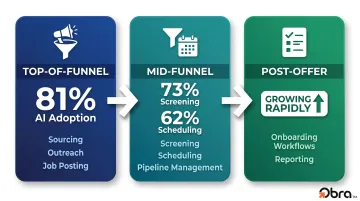
Source: DataRefs AI Recruitment Statistics, January 2026
Different tools specialize in different stages: an enterprise ATS handles mid-funnel orchestration, an outbound sourcing platform addresses top-of-funnel volume, and conversational AI manages candidate engagement at scale. The tools below cover the strongest options across each category, evaluated on AI capability, automation breadth, integration ecosystem, user experience, and cost-to-value.
Best Recruitment Automation Tools in 2026
Tools were evaluated on AI capability depth, automation breadth across the hiring funnel, integration ecosystem, user experience, and cost-to-value ratio across team sizes.
Obra Hire
Obra Hire is an outbound-first hiring platform built specifically for the post-AI application era. Rather than waiting for inbound applications, it gives recruiting teams direct access to 800M+ verified candidate profiles through competency-based AI matching — with a freemium model and zero setup requirement.
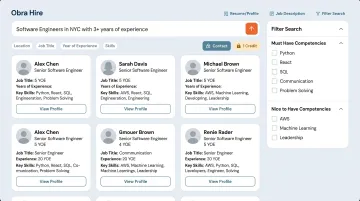
What separates it from a standard sourcing tool is the structural approach to matching. Instead of keyword search, the platform uses structured "Must Have" and "Nice to Have" criteria to score candidates against actual competency requirements.
Recruiters can preview their full candidate pool — including individual profile breakdowns — before spending a single contact credit. That preview-first model is practical: you confirm result quality, adjust filters, and only pay to reveal the contact details (email, phone, LinkedIn) of candidates you actually want to reach.
The verified profile filtering feature directly addresses the AI application crisis. Gartner projects that AI-generated or fake candidate profiles will affect 1 in 4 profiles by 2028 — Obra Hire's verification layer is designed to filter these out before they enter your pipeline.
| Best For | Teams of any size needing outbound sourcing with verified profiles, competency-based matching, and a free or low-cost starting point |
| Key Features | AI search across 800M+ verified profiles; competency-based matching (Must Have / Nice to Have framework); fake/AI-generated profile filtering; candidate pool preview before credit use; contact reveal (email, phone, LinkedIn); 85+ ATS/HRIS integrations; shared team credits with centralized admin (Scale plan) |
| Pricing | Free: unlimited searches, 1,000 profile views, 50 contact credits/month. Explore: $109/month (500 credits). Scale: $169/month (1,200 credits + team admin). Enterprise: custom pricing |
Gem
Gem positions itself as the only AI-first all-in-one recruiting platform — combining ATS, CRM, sourcing, scheduling, and analytics in a single system.
The key architectural distinction is that its AI agents are built into the platform from the ground up, not added onto a legacy system. That means the AI has access to complete candidate history across every interaction: past applications, outreach touchpoints, hiring manager feedback, and fit signals over time.
That context depth enables capabilities that point solutions can't replicate well: talent rediscovery (surfacing previously engaged candidates who are now a fit), duplicate outreach prevention across a team, and personalized sequencing. Gem also includes an AI Fraud Detection Agent, which has become increasingly relevant given application volume inflation.
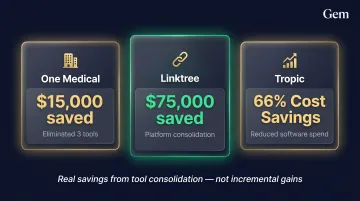
Customer outcomes are concrete. One Medical eliminated three separate tools and saved $15,000 through consolidation. Linktree saved $75,000 after switching. Tropic achieved 66% cost savings. Those are tool consolidation savings — not incremental efficiency gains.
| Best For | Growing and enterprise teams seeking a full-funnel AI-native platform with ATS, CRM, sourcing, and analytics under one roof |
| Key Features | AI sourcing across 800M+ profiles; AI application review; talent rediscovery; AI fraud detection; CRM; full ATS; interview scheduling; end-to-end analytics; 80+ integrations |
| Pricing | Self-Service from $135/month (up to 30 FTEs); Growth and Enterprise tiers at custom pricing; free trial available |
Workable
Workable is the go-to option for SMBs and fast-growing teams that need solid automation without a dedicated recruiting ops team. Its strength is balance: the interface is clean enough that hiring managers can log in independently, and the automation depth covers the essentials — multi-channel job posting across 200+ boards, AI candidate recommendations, automated email/SMS communication, self-scheduling links, and anonymized screening for bias reduction.
Monthly billing is rare in this category. Most enterprise ATS platforms require annual contracts, which creates real risk for teams with variable hiring volumes. Workable's Standard plan at $299/month on monthly billing is a genuine differentiator for teams not ready to commit.
| Best For | SMBs and hyper-growth teams needing a user-friendly ATS with solid automation and no long-term contract commitment |
| Key Features | Multi-channel job posting (200+ boards); AI candidate recommendations; automated candidate communication (email/SMS); self-scheduling; video interviews; anonymized screening; 200+ job board integrations |
| Pricing | Standard: $299/month; Premier: $599/month; monthly billing available; 15-day free trial |
Greenhouse
Greenhouse is a mature, enterprise-grade ATS built around structured hiring workflows. Interview kits, scorecards, and conditional pipeline logic enforce consistency across large recruiting teams and multiple departments — which matters when you have dozens of hiring managers making decisions with wildly different standards.
Its automation strength sits in mid-funnel orchestration: auto-triggered emails, knockout logic that auto-advances or disqualifies candidates based on form inputs, interview self-scheduling, and approval workflow automation. Greenhouse is most valuable for organizations with defined hiring processes who need to execute them at scale, not for teams still figuring out their process.
The integration ecosystem — 400–450+ pre-built integrations — means it plays well with virtually any existing HR tech stack.
| Best For | Mid-size to enterprise internal TA teams with established hiring processes who need structured, consistent, automatable workflows |
| Key Features | Structured interview kits and scorecards; conditional workflow automation; candidate self-scheduling; DEI funnel reporting; 400–450+ integrations; onboarding module; mobile apps |
| Pricing | Custom pricing across Core, Plus, and Pro plans; no free trial |
Paradox
Paradox is a conversational AI platform built around its AI assistant Olivia, which engages candidates via text 24/7 — answering questions in 100+ languages, screening applicants, scheduling interviews, and managing follow-ups without human input.
The use case is high-volume hiring in consumer-facing industries: retail, restaurant, logistics, healthcare. The Chipotle case study is the clearest proof point: time-to-hire dropped 75%, from 12 days to 4, while application volume doubled and completion rates climbed from 50% to 85%.
Their branded assistant "Ava Cado" handles Conversational Apply and Conversational Scheduling, integrated directly with Workday.
For knowledge-worker hiring, Paradox is likely overkill. For employers managing hundreds of hourly hires per month, it's purpose-built.
| Best For | Large enterprises and high-volume hiring teams in consumer-facing industries needing AI to handle screening, scheduling, and engagement at scale |
| Key Features | Olivia AI chatbot (24/7 candidate engagement); text and mobile application entry; automated screening and scheduling; 100+ language support; video interviewing; onboarding workflows; 60+ ATS/CRM integrations |
| Pricing | Custom pricing only; no published pricing floor |
Manatal
Manatal is the most affordable AI-powered ATS on this list, making it the practical choice for budget-conscious SMBs and staffing agencies. At $15/user/month on the Professional plan, it delivers AI candidate scoring based on job descriptions, social media profile enrichment that auto-updates candidate data, drag-and-drop pipeline management, and mass email campaigns with automated follow-ups.
The 14-day free trial with no credit card required allows meaningful evaluation before any financial commitment. For agencies managing multiple client pipelines simultaneously, the shared search filters and referral management system add genuine value.
One limitation to note: AI matching accuracy can be inconsistent with non-English resumes, which matters for international or multilingual hiring teams.
| Best For | Budget-conscious SMBs, staffing agencies, and in-house teams needing affordable AI-powered ATS with candidate scoring |
| Key Features | AI candidate recommendations and scoring; social media profile enrichment; drag-and-drop pipeline; mass email with automated follow-ups; referral management; career pages in 8 languages; Chrome extension sourcing |
| Pricing | Professional: $15/user/month (annual) / $19/user/month (monthly); Enterprise: $35/user/month; 14-day free trial, no credit card required |
How to Choose the Right Recruitment Automation Tool
Start With Your Actual Bottleneck
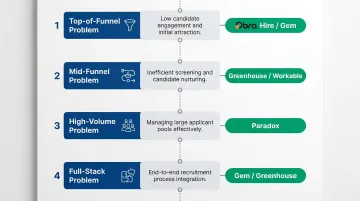
The most common evaluation mistake is buying for features rather than fit. Before comparing platforms, identify where your hiring process actually breaks down:
- Top-of-funnel problem: Not enough quality candidates — you need outbound sourcing (Obra Hire or Gem)
- Mid-funnel problem: Pipeline moves too slowly — you need scheduling, workflow automation, and screening tools (Greenhouse or Workable)
- High-volume problem: Too many candidates, not enough hours — you need conversational AI (Paradox)
- Full-stack problem: Fragmented tools and data silos — you need consolidation (Gem or Greenhouse)
Evaluate AI Depth, Not Just AI Marketing
"AI-powered" is a baseline claim in 2026, not a differentiator. The real question is whether the AI has access to full candidate context — past interactions, history, fit signals over time — or operates only on surface-level data from a single session.
Ask vendors:
- Does your AI learn from our historical hiring data over time?
- Can it surface candidates we previously engaged who are now a better fit?
- How does it handle AI-generated or fraudulent applications?
Calculate Total Stack Cost
Point solutions look affordable individually but create data silos, manual handoffs, and hidden coordination overhead. Before committing, calculate your current recruiting stack cost (sourcing tool + ATS + scheduling + CRM) and compare it against a consolidated platform.
The savings are real: One Medical cut $15,000 by eliminating three separate tools. Linktree saved $75,000 by moving to Gem's consolidated platform. For most teams, consolidation isn't a luxury — it's where the ROI actually lives.
Pilot With Real Hiring Criteria
Once you've narrowed your shortlist on cost and fit, the real test is how each tool performs on your actual work. Demos are controlled environments — run your own evaluation instead:
- Run a live search for an actual open role with your real criteria
- Test outreach sequencing with real candidate profiles
- Have a hiring manager log in independently — without a tutorial
- Check integration behavior with your existing ATS
Tools with free plans or trials — Obra Hire (free tier), Manatal (14-day trial), and Workable (15-day trial) — let you do this without financial commitment.
Conclusion
The best recruitment automation tool solves your actual problem — not the one with the longest feature list or the most brand recognition. The right fit depends on where your hiring process breaks down:
- AI-inflated inbound pipelines: Prioritize platforms that source proactively and verify candidate quality
- Slow mid-funnel movement: Look for workflow automation and integrated scheduling
- High-volume hiring: Conversational AI that operates 24/7 is usually the highest-leverage investment
Before committing to any platform, confirm it fits your existing ATS/HRIS workflows and can scale as hiring volumes shift. A tool that requires a full system overhaul to implement is a liability, not an investment.
For teams ready to test outbound sourcing, Obra Hire integrates with 85+ ATS/HRIS platforms — including Workday, Greenhouse, and iCIMS — so there's no workflow disruption to worry about. The free plan includes unlimited searches, 1,000 profile views, and 50 contact credits per month with no contract and no credit card required. Try it against your next open role before committing to anything.
Frequently Asked Questions
What is recruitment automation software?
Recruitment automation software uses AI, machine learning, and workflow automation to handle repetitive hiring tasks — sourcing, screening, scheduling, and candidate communication. It reduces manual effort so recruiters can focus on high-judgment decisions like interviews, offer negotiations, and candidate experience.
What are the top recruitment automation tools in 2026?
Top tools include Obra Hire (outbound sourcing with verified candidate access), Gem (AI-first all-in-one platform), Greenhouse (structured enterprise ATS), Workable (SMB-friendly automation), Paradox (conversational AI for high-volume hiring), and Manatal (affordable AI-powered ATS for SMBs and agencies).
What's the best tool for sourcing automation specifically?
Outbound-focused platforms like Obra Hire search verified passive candidate profiles using competency-based AI matching. All-in-one platforms like Gem aggregate profiles across multiple data sources and layer sourcing into a broader workflow. If sourcing is your primary bottleneck, a dedicated outbound tool will outperform a general-purpose suite.
Do recruiters still use ATS systems?
Yes — ATS remains the backbone of most recruiting operations for managing applicants, pipeline stages, and compliance. That said, standalone ATS platforms are increasingly being supplemented or replaced by all-in-one systems that add AI sourcing, CRM, and scheduling on top of traditional applicant tracking.
What are the stages of the recruitment process?
The typical stages are: requisition, sourcing, screening, interviews, offer, background checks, and onboarding. Automation delivers the highest ROI at sourcing, screening, and scheduling — the three most time-intensive steps.