Introduction
Hiring teams are dealing with a compounding problem. Application volumes are up, but quality is down — and a growing share of inbound applications are being submitted by AI-generated bots or fake profiles rather than real candidates. According to Gartner, 1 in 4 candidate profiles worldwide will be fake by 2028, while traditional job board applicants yield selection rates below 1%.
The platforms that dominated recruiting five years ago weren't built for this. Most were designed around inbound workflows — post a job, collect applications, filter, repeat. That model is breaking down.
The platforms built for 2026 are designed around a different model entirely. The strongest now combine outbound sourcing, AI-powered matching, verified candidate data, CRM workflows, and deep analytics in one connected system — tools that go find qualified people rather than waiting for them to apply. This guide covers six platforms positioned for how teams will actually hire in 2026: Obra Hire, Greenhouse, iCIMS, SmartRecruiters, Workday Recruiting, and Ashby.
TL;DR
- Talent acquisition software manages the full hiring lifecycle — from sourcing and screening to offers — replacing fragmented manual workflows
- Top 2026 platforms extend well beyond inbound ATS functions: outbound sourcing, AI-powered matching, and verified candidate data are now table stakes
- Key selection factors: AI governance, integration depth, and total cost of ownership relative to your hiring volume
- Platforms covered: Obra Hire, Greenhouse, iCIMS, SmartRecruiters, Workday Recruiting, and Ashby
What Is Talent Acquisition Software?
Talent acquisition software manages the end-to-end hiring process — from sourcing and engaging candidates to tracking applicants, conducting interviews, and extending offers. Unlike standalone ATS tools that only handle active applicants, modern platforms combine ATS and CRM capabilities with sourcing, recruitment marketing, and analytics in one system.
The category got its first formal analyst framework when Gartner published its inaugural Magic Quadrant for Talent Acquisition Suites in April 2025, evaluating 11 vendors across both ability to execute and completeness of vision.
The Shift to Outbound-First Hiring
The bigger story for 2026 is a fundamental model shift. Traditional platforms were built for inbound — candidates apply, teams filter. That model struggles when inbound quality is deteriorating.
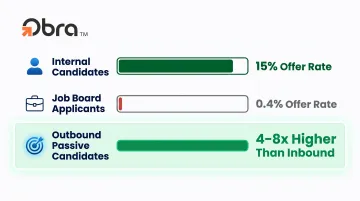
HR.com research puts the gap in stark terms:
HR.com research breaks down where hiring actually converts:
| Candidate Source | Offer Rate |
|---|---|
| Internal candidates | 15% |
| Job board applicants | 0.4% |
| Outbound passive candidates | 4–8x higher than inbound |
Platform selection in 2026 comes down to one question: does the tool support the hiring model that actually produces quality hires, or just the one that's easiest to set up?
The platforms below represent strong options across different hiring models, from enterprise ATS suites to self-serve outbound sourcing tools.
Top Talent Acquisition Software Platforms for 2026
These platforms were selected based on their ability to support modern hiring needs: outbound and inbound sourcing, AI capabilities, integration flexibility, verified candidate data, and cost-effectiveness across different team sizes.
Obra Hire
Obra Hire is a self-serve, outbound-first talent acquisition platform built specifically for the post-AI hiring environment. Teams of any size get direct access to 800M+ searchable, verified candidate profiles without waiting on inbound applications — and without the expensive per-seat licensing models common elsewhere.
Obra Hire's architecture starts outbound. Recruiters can preview their candidate pool size before spending any credits, use AI-powered competency-based matching to surface the strongest fits, and filter out AI-generated or fake profiles — directly addressing the pipeline integrity problem Gartner flagged.
The freemium model removes common adoption barriers: no contract, no setup, no credit card required to start. The free tier includes unlimited searches and 1,000 profile views per month, with contact reveals (email, phone, LinkedIn, and resume) available via credits on paid plans.
| Feature | Details |
|---|---|
| Key Features | AI-powered outbound search, competency-based matching, verified profile filtering, candidate pool preview, shared team credits, 85+ ATS/HRIS integrations |
| Best For | Hiring teams of any size — employers, HR departments, recruiters, and staffing agencies — seeking direct access to pre-vetted passive candidates |
| Pricing | Free plan (unlimited searches, 1,000 profile views, 50 contact credits/month); Explore at $109/month; Scale at $169/month; Enterprise custom |
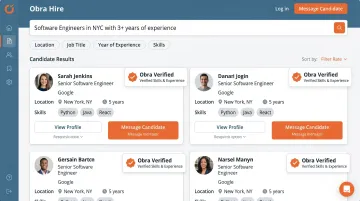
Obra Hire integrates with 85+ platforms including Workday, Greenhouse, iCIMS, Lever, SAP SuccessFactors, SmartRecruiters, and Oracle Recruiting Cloud — plugging into existing workflows without disrupting them.
Greenhouse
Greenhouse is built for structured, evidence-based hiring at scale. It serves mid-market to enterprise teams that need rigorous decision-making — mapping roles to business outcomes before recruiting begins, then guiding teams through standardized interview kits and scorecards.
Its AI governance story is unusually strong. Greenhouse achieved ISO/IEC 42001:2023 certification in February 2026, among the first recruiting platforms globally to do so, making it well-suited for organizations navigating EU AI Act compliance requirements.
| Feature | Details |
|---|---|
| Key Features | Structured interview kits and scorecards, AI decision-support with ISO 42001 governance, 400+ native integrations, advanced pipeline reporting, talent fraud detection |
| Best For | Mid-market to enterprise teams prioritizing structured, defensible hiring decisions with cross-functional adoption |
| Pricing | Quote-based; implementation fees apply; confirm whether AI features are included in base pricing |
Greenhouse serves 7,500+ companies and ranked #1 in 57 G2 reports in Spring 2026. Worth noting: pricing is not published, so teams should request a year-one total cost estimate that includes implementation.
iCIMS
iCIMS is a modular enterprise talent acquisition suite — ATS, CRM, recruitment marketing, onboarding, and AI — designed for large organizations with complex, multi-location hiring workflows. Its configurability is its primary advantage: different teams can run different pipelines without forcing everyone into a single process.
In March 2025, iCIMS became the first enterprise recruiting software provider to earn TRUSTe Responsible AI Certification, covering validity, explainability, accountability, privacy, and bias management. The platform serves a quarter of the Fortune 500 across 200+ countries.
| Feature | Details |
|---|---|
| Key Features | Modular ATS + CRM + employer branding, iCIMS Coalesce AI (candidate ranking, sourcing agent, job description optimization), text engagement, onboarding, analytics |
| Best For | Enterprises with complex, multi-department workflows requiring configurable, modular talent acquisition tools |
| Pricing | Quote-based; modular pricing means costs vary significantly by modules selected |
SmartRecruiters
SmartRecruiters — now an SAP company following the September 2025 acquisition — is built for high-volume hiring across multiple channels. Its Winston AI assistant handles multi-layer screening, conversational engagement across text, voice, and video, and agentic insights that surface hiring bottlenecks proactively.
For SAP SuccessFactors customers, the integration path is clear. Teams not on SAP should clarify how the acquisition affects their pricing and roadmap, as packaging is still evolving post-acquisition. SmartRecruiters was named a Leader in the 2025 Gartner Magic Quadrant for Talent Acquisition Suites.
| Feature | Details |
|---|---|
| Key Features | Winston AI assistant, multi-channel job distribution, candidate self-scheduling, AI talent matching, CRM workflows, SAP SuccessFactors integration (Phase 2 targeting mid-2026) |
| Best For | Mid-market to enterprise teams with high-volume, multi-channel hiring needs; existing SAP SuccessFactors customers |
| Pricing | Quote-based; confirm current terms post-acquisition directly with SmartRecruiters/SAP |
Workday Recruiting
Workday Recruiting is natively embedded within Workday HCM, making it the default choice for large enterprises already standardized on Workday for HR and finance. The recruiting module eliminates point-to-point integrations between HR and finance systems — a real operational advantage at scale.
The trade-off: teams accustomed to purpose-built recruiting platforms may find the workflow depth less flexible. AI capabilities (HiredScore for recruiting intelligence and Paradox's Olivia for conversational frontline hiring) are acquired capabilities, not built-in features, and are separately licensed.
| Feature | Details |
|---|---|
| Key Features | Native Workday HCM integration, multi-location hiring support, enterprise approval workflows, HiredScore AI (separately licensed), Paradox/Olivia (acquisition pending completion) |
| Best For | Large enterprises already standardized on Workday HCM that prioritize data consolidation over recruiting-specific depth |
| Pricing | Bundled within Workday HCM license; AI features separately licensed |
Workday serves 10,000+ organizations, including 50%+ of the Fortune 500, and was named a Leader in the 2025 Gartner Magic Quadrant.
Ashby
Ashby is built for analytics-first, recruiter-led teams. It combines ATS, CRM, sourcing, and scheduling in one platform — but its standout capability is built-in reporting. Time-to-hire, time-in-stage, team activity, and pipeline metrics are available out of the box, without a separate BI tool.
The sourcing Chrome extension pulls candidate data from LinkedIn directly into Ashby workflows. Entry-level plans cap email lookups at 200 per month; advanced analytics and custom dashboards require Plus or Enterprise tiers. For AI governance, Ashby partners with FairNow for third-party bias audits and redacts PII before any third-party model processing.
| Feature | Details |
|---|---|
| Key Features | Built-in analytics dashboards, ATS + CRM + scheduling in one, sourcing Chrome extension, interview plans, quality-of-hire surveys, AI-assisted report builder |
| Best For | Mid-market recruiting teams who want deep reporting without a separate analytics layer |
| Pricing | Foundations at $400/month (up to 100 employees); Plus and Enterprise custom-quoted; AI Notetaker and Advanced Scheduling as paid add-ons |
Ashby serves 2,700+ customers including OpenAI, Shopify, and Notion, and maintains a 4.7/5 rating on G2.
How to Choose the Right Platform
Feature lists and demo impressions get teams partway there. The more useful evaluation framework looks at actual hiring outcomes.
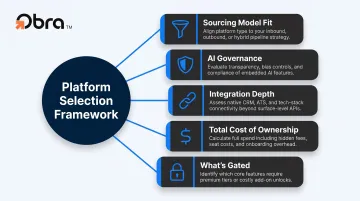
What to Evaluate
- Sourcing model fit — Identify whether your core problem is inbound quality (AI-generated spam, resume inflation) or pipeline management — the answer determines which platform type fits
- AI governance — ISO/IEC 42001 (Greenhouse) and TRUSTe certification (iCIMS) carry specific weight for regulated environments — confirm which standard your compliance team requires
- Integration depth — Native integrations differ from marketplace connectors. Confirm whether your existing ATS/HRIS connects natively or through a third-party middleware
- Total cost of ownership — Published subscription price rarely reflects year-one costs. Add implementation fees, integration setup, and AI add-on licensing to your calculation
- What's gated — AI features, fraud detection, and advanced analytics are frequently locked behind higher tiers or separate add-ons — verify exactly what's included at your target plan before signing
Common Buyer Mistakes
- Selecting based on brand recognition rather than testing against your actual hiring volume
- Forgetting to confirm whether the platform supports your team size's collaboration model (shared credits vs. per-seat)
- Underestimating implementation complexity for enterprise platforms with modular pricing
- Not involving hiring managers in the evaluation — adoption depends on end-user experience, not just admin functionality
Start with the problem, not the feature set. A platform that solves the wrong problem — no matter how polished the demo — adds process without improving outcomes.
Conclusion
The best talent acquisition software for 2026 isn't the one with the longest feature list. It's the one that matches how your team actually hires — whether outbound candidate search, structured inbound workflows, or a combination — and fits into your existing HR stack without inflating cost or operational overhead.
Before committing, test real workflows against your specific hiring volume. Confirm what AI features are included at your target plan tier. Get a full year-one cost estimate covering implementation, integrations, and renewal — not just the base subscription price.
For teams ready to move beyond inbound-only hiring, Obra Hire offers a free, no-contract starting point. Search 800M+ verified profiles, preview your candidate pool before spending anything, and connect to your existing ATS in minutes.
Frequently Asked Questions
What is talent acquisition software?
Talent acquisition software manages the full hiring lifecycle — sourcing, tracking, engaging, and hiring candidates. Unlike a standalone ATS, it typically includes CRM, AI matching, analytics, and recruitment marketing in one connected platform.
What software do recruiters use?
Most recruiters use a combination of an ATS (to manage active applicants), a CRM (to nurture passive candidates), and sourcing tools (for proactive outreach). Modern all-in-one platforms like those covered here increasingly combine these in a single system.
What is the difference between an ATS and talent acquisition software?
An ATS manages active applicants through a hiring pipeline. Talent acquisition software is a broader category that includes ATS plus sourcing, CRM, recruitment marketing, and analytics — covering the full candidate lifecycle before and after the application is submitted.
How much does talent acquisition software cost?
Pricing varies widely. Obra Hire offers a free tier, with paid plans starting at $109/month. Enterprise platforms like Greenhouse, iCIMS, and Workday are quote-based and can reach tens of thousands annually when implementation, integrations, and AI add-ons are included. Request a full year-one cost estimate before signing anything.
What features should I prioritize for 2026?
Focus on these five capabilities heading into 2026:
- AI governance and transparency (know how decisions are made)
- Outbound sourcing so you're not dependent on inbound applications
- Verified candidate data to counter AI-generated fake profiles
- Native integration with your existing ATS or HRIS
- Analytics that go deeper than basic time-to-hire metrics
Can talent acquisition software integrate with my existing ATS or HRIS?
Most modern platforms do. Obra Hire supports 85+ integrations including Workday, Greenhouse, iCIMS, Lever, SAP SuccessFactors, SmartRecruiters, and Oracle Recruiting Cloud. Before committing, confirm whether integrations are native or marketplace-based — the difference affects reliability and setup time.