Introduction
Picture a typical sourcing session: you spend 45 minutes crafting Boolean strings, open 30 LinkedIn tabs, discover half the contact details are outdated, and draft personalized outreach — all before a single qualified conversation happens. According to Totaljobs research, recruiters lose an average of 17.7 hours per vacancy to manual admin tasks, with 72% citing irrelevant application screening as their biggest slowdown.
AI sourcing is the obvious fix — but most recruiters using it can't explain what's actually happening when the software "finds" a candidate. That gap matters, because understanding the mechanics is what separates teams that get real results from those paying for a fancier search bar.
We'll cover what AI sourcing actually is, how the end-to-end process works, what separates good results from poor ones, and when it's the wrong tool entirely.
TL;DR
- AI sourcing automates find-screen-engage workflows using algorithm-driven matching, returning ranked shortlists instead of raw search results
- Quality depends on data freshness, profile verification, skills taxonomy depth, and how precisely the role is defined
- Competency-based matching outperforms keyword/Boolean automation by reading skill context, not just term counts
- Built for outbound hiring of passive candidates — recruiter judgment and closing conversations still close the deal
- Preview-before-spend models let recruiters validate pool quality before committing any credits
What Is AI Sourcing?
AI sourcing is the use of artificial intelligence to proactively identify, evaluate, and initiate contact with potential candidates — without waiting for inbound applications. You give the system a role brief; it searches a candidate database, ranks profiles by fit, and returns a shortlist with contact details ready for outreach.
That's the core loop: input a role, get a ranked shortlist. How well it works depends almost entirely on the quality of the brief you give it.
How It Differs from Related Concepts
Three terms often get conflated — and they're meaningfully different:
| Concept | What It Does | Key Limitation |
|---|---|---|
| AI Sourcing | Proactively finds passive candidates via ML matching | Requires quality input brief |
| AI Screening | Evaluates inbound applicants who already applied | Only works with people who found you |
| Boolean Search | Executes fixed keyword queries you write manually | Literal match only; no semantic understanding |
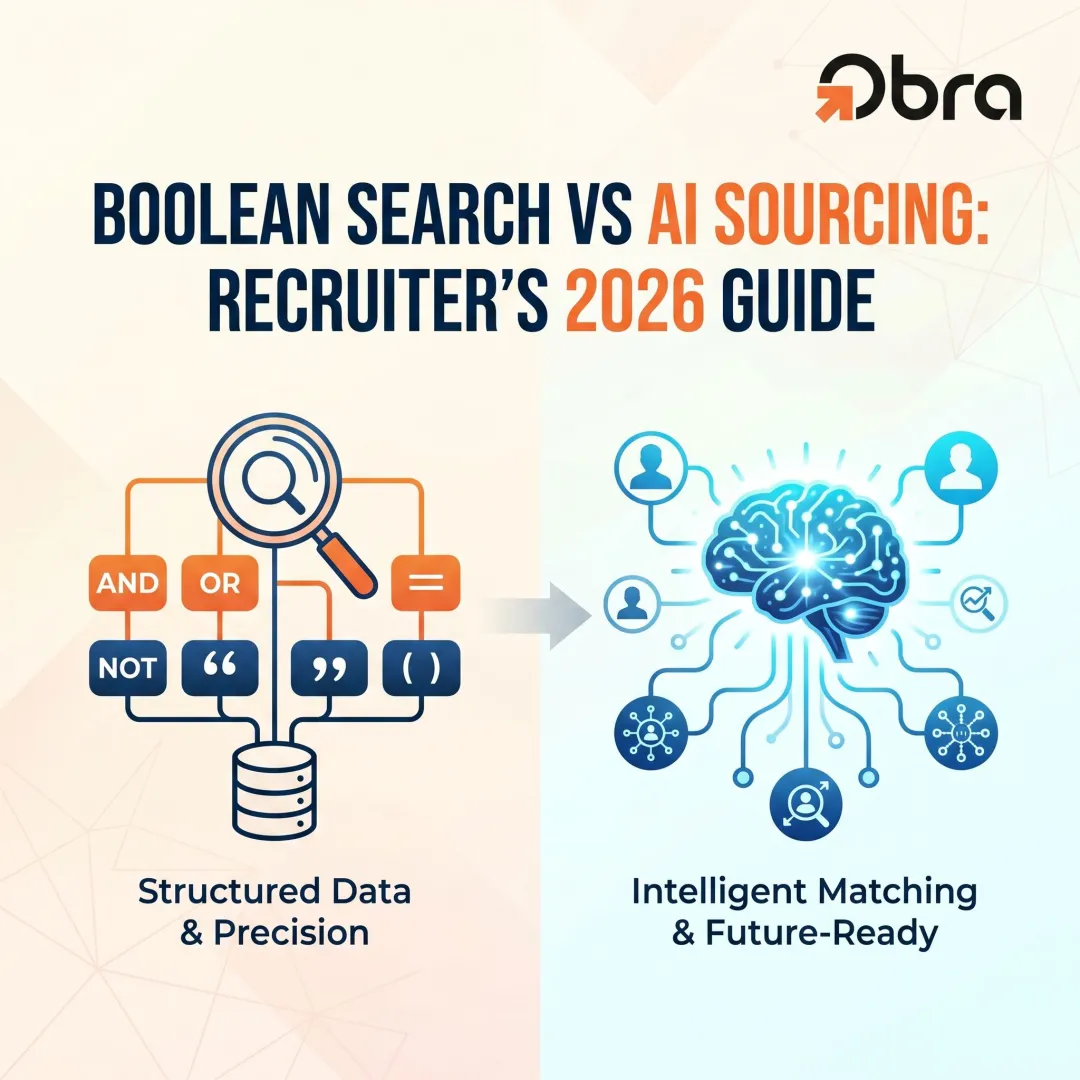
Boolean search automates query execution, not query intelligence. If a candidate writes "account executive" and your Boolean string says "sales representative," Boolean returns nothing. AI sourcing recognizes the overlap.
The practical distinction matters: according to SHRM, AI in talent acquisition is specifically designed to free recruiters from repetitive tasks — sourcing and screening are treated as distinct functional areas where automation serves different purposes.
Why Recruiters Are Turning to AI Sourcing
The pressure is structural, not cyclical. SHRM's 2025 Talent Trends survey found 69% of organizations still report difficulty recruiting for full-time positions, with 51% citing too few applicants and 41% flagging increased candidate ghosting.
Three specific problems drive AI sourcing adoption:
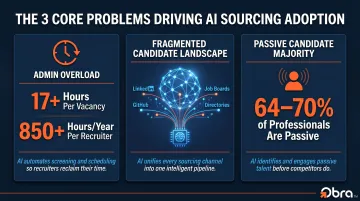
- Admin overload kills throughput. Seventeen-plus hours per vacancy on admin tasks adds up fast — at four open roles per month, that's 850+ hours annually per recruiter. That's time that can't go toward candidate conversations or offer negotiations.
- Qualified candidates are scattered. LinkedIn, GitHub, niche job boards, professional directories, industry databases — no manual search covers all of them at once. AI sourcing aggregates this landscape into a single searchable layer.
- Most strong candidates aren't applying. LinkedIn's research puts the passive workforce at 64–70% of all professionals — reachable, but invisible to inbound job posts. AI sourcing is built specifically to find them.
AI adoption in recruiting is accelerating to close these gaps. SHRM reports AI use in HR tasks climbed from 26% in 2024 to 43% in 2025, with 32% of AI-using organizations now automating candidate searches specifically.
How AI Sourcing Works
The process moves through three phases. What happens in each phase — and how well — determines the quality of what you get at the end.
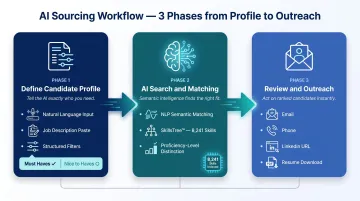
Step 1: Define the Candidate Profile
The recruiter enters role parameters: job title, required skills, experience range, location, and any additional filters like industry background or company type. Most modern platforms, including Obra Hire, support three input modes:
- Natural language descriptions
- Job description paste
- Structured manual filtering
Obra Hire distinguishes between Must Haves (which control who enters the candidate pool) and Nice to Haves (which sort and rank the qualified results). That distinction matters: vague Must Haves inflate your pool with low-relevance candidates; overly restrictive ones shrink it to the point of uselessness.
This step is where output quality is won or lost. The AI amplifies whatever clarity the recruiter provides — a sharp brief produces a useful shortlist; an imprecise one produces noise that wastes time downstream.
Step 2: AI Search and Candidate Matching
The AI searches across its candidate database using natural language processing and machine learning to surface semantic matches — not just literal keyword hits.
Here's the practical difference: a keyword search for "quota-carrying sales rep" returns nothing for a candidate who wrote "account executive" on their resume. Competency-based matching recognizes these as overlapping roles and surfaces the candidate anyway.
Obra Hire's matching engine uses a proprietary skills framework called SkillsTree, covering 8,241 skills with defined proficiency levels. This lets the system distinguish between a candidate who mentioned Python once in a bullet point and one who has demonstrated sustained Python experience across multiple roles and projects — a distinction keyword search cannot make.
Before spending any credits, recruiters using Obra Hire can preview the estimated pool size and individual profiles, adjust filters, and confirm the pool fits their target before committing. Credits are only consumed when contact information is revealed.
Step 3: Review, Contact, and Outreach
The matched shortlist returns with direct contact details revealed in a single credit transaction:
- Email address and phone number
- LinkedIn profile URL
- Resume
This is where human judgment re-enters the process. The AI narrows the field; the recruiter decides who to engage and how to position the opportunity. Reviewing profiles for contextual fit, crafting relevant outreach, and navigating candidate conversations remain with the recruiter. The platform removes the search overhead, not the relationship work.
Key Factors That Affect AI Sourcing Quality
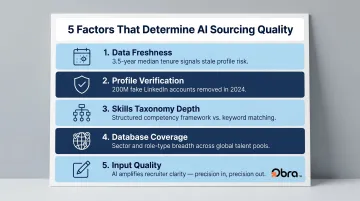
Not all AI sourcing tools produce equivalent results. Five variables explain most of the variance:
1. Data freshness. The BLS reports private-sector median employee tenure at 3.5 years, with annual quit rates running at 2.2% broadly and higher in sectors like accommodation and food services (3.6%). A sourcing database that isn't continuously refreshed sends recruiters after candidates who've already changed roles, companies, or locations. The result: wasted outreach and inflated time-to-hire.
2. Profile verification. LinkedIn removed approximately 200 million fake accounts in 2024 — and in H1 2025 alone, stopped 83.7 million, nearly quadruple the H1 2019 volume. Gartner found 39% of candidates used AI to generate application materials, with 6% admitting to outright interview fraud. Unverified databases inflate apparent pool size while degrading match quality — Obra Hire addresses this with verified-profile filtering on Explore and Scale plans.
3. Skills taxonomy depth. Tools that match only on job titles or resume text miss candidates with equivalent skills described differently and surface false positives who happen to use the right words. A structured competency framework with defined proficiency levels — like Obra Hire's SkillsTree — improves relevance far more than keyword matching alone.
4. Database coverage for your role types. Many sourcing platforms were originally built for tech and professional white-collar hiring and have thin coverage for blue-collar, gray-collar, or non-traditional career paths. Before committing to a tool, verify it actually covers the candidate population you're hiring from. Unusually small pool sizes for what should be a sizeable talent market are a reliable warning sign.
5. Input quality from the recruiter. Tool quality only gets you so far. Even a sophisticated matching engine produces poor results from a vague brief — AI sourcing is a force multiplier on recruiter clarity, not a substitute for it.
Common Misconceptions About AI Sourcing
"AI sourcing replaces recruiters." It replaces the repetitive, high-volume search and initial screening layer — not contextual judgment, candidate relationship-building, or closing offers. What it does is shift recruiter time from administrative tasks to the conversations that actually produce placements.
"It's just automated Boolean search." Boolean executes fixed, manually written query logic against literal keyword matches. AI sourcing applies machine learning to understand semantic meaning, infer skill adjacencies, and improve over time. The two are mechanically different and produce meaningfully different results — especially for roles where candidates describe the same skills in different ways.
"AI sourcing only works for tech roles." This came from first-generation tools being marketed almost exclusively to tech recruiters — not from any limitation in the underlying technology. Modern platforms cover roles across industries and collar types, including:
- CDL-A drivers and transportation workers
- CNAs and other clinical healthcare roles
- Electricians, welders, and skilled tradespeople
- Hospitality, retail, and civil service positions
Obra Hire's 800M+ candidate database spans all of these verticals, making it as useful for a healthcare staffing agency as for a software company.
When AI Sourcing Is Not the Right Approach
AI sourcing is genuinely useful — but not universally applicable. Three scenarios where it underperforms:
Senior Executive and Board-Level Searches
These placements depend on confidentiality, trust, and network depth that database outreach can't replicate. SHRM data consistently shows referrals deliver the highest quality-of-hire — 80% of referred candidates respond versus 18–25% for targeted InMails. At the C-suite level, that gap widens further. AI sourcing adds noise, not signal.
Roles Where Database Coverage Is Thin
If the platform has limited data on a specific profession, geography, or credential type, the AI returns low-relevance results regardless of how well the brief is written. If your pool size looks abnormally small for what should be a healthy talent market, that's a coverage problem, not a brief problem.
When It Becomes a Reflex Rather Than a Decision
AI sourcing is misapplied when it's the default for every open role. It makes sense for:
- Passive candidate pipelines with little inbound flow
- Hard-to-fill roles in shallow talent markets
- Geographies where employer brand awareness is low
For roles with strong organic applicant flow or active referral networks, adding AI sourcing may not move the needle. Use it by design, not by default.
Frequently Asked Questions
What is AI sourcing?
AI sourcing uses artificial intelligence to proactively find, evaluate, and initiate contact with candidates across large profile databases. It replaces manual keyword searches and profile reviews with algorithm-driven matching that returns a ranked shortlist — ready for outreach.
How can AI be used in sourcing?
The four primary applications are: automated candidate search across databases, profile and resume screening for fit, predictive ranking based on job parameters, and assisted outreach to matched candidates. Most modern platforms handle all four in a single workflow — you define the role, the AI handles the search and ranking, and you engage the shortlist.
Which AI is best for sourcing?
The right tool depends on your needs. Evaluate database size, data freshness, matching method (competency-based vs. keyword), profile verification, ATS integrations, and cost relative to hiring volume. Obra Hire covers all five — 800M+ profiles, competency-based SkillsTree matching, verified filtering, and plans from free to $169/month.
Does AI sourcing work for non-tech or blue-collar roles?
Yes. Modern platforms cover white, gray, and blue-collar roles across industries. The misconception stems from early tools being marketed to tech recruiters. Before committing, verify the platform's coverage for your specific role types — small pool sizes are a reliable indicator of thin data coverage.
What are the biggest risks of relying on AI sourcing?
The main risks to watch for:
- Stale or unverified data — LinkedIn removed 200M fake accounts in 2024; always confirm profile freshness
- Keyword-only matching — misses qualified candidates whose profiles use non-standard language
- Default over-reliance — some roles (referral-heavy, niche executive) still outperform AI sourcing with relationship-based approaches