According to benchmark data compiled by Truffle, recruiters spend roughly 13 hours per week sourcing for a single role. That's over 650 hours a year, per recruiter, on a task that increasingly has a faster alternative. But speed isn't the only variable worth examining.
The choice between Boolean search and AI sourcing affects candidate quality, pipeline diversity, whether you're reaching passive talent or recycling the same active applicants, and ultimately your cost-per-hire.
This guide breaks both methods down in plain English — how they work, where each one wins, how they compare head-to-head, and what a practical 2026 sourcing stack actually looks like.
TL;DR
- Boolean search uses AND/OR/NOT operators to filter profiles by exact keywords — precise, but limited to what you type
- AI sourcing uses machine learning to infer skills and surface passive candidates whose profiles don't contain your exact terms
- Boolean wins for regulated roles, standardized credentials, and searches requiring exact inclusion/exclusion logic
- AI sourcing fits best when hiring at volume, discovering passive candidates, or filling roles where titles and skill terms vary across profiles
- Best 2026 strategy: use both — Boolean for precision, AI for reach and scale
Boolean Search vs AI Sourcing: Quick Comparison
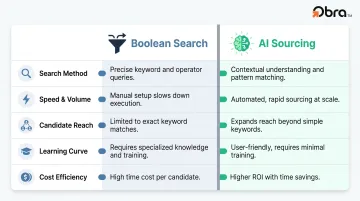
Here's how the two approaches stack up across the dimensions that matter most to recruiters:
| Dimension | Boolean Search | AI Sourcing |
|---|---|---|
| Search Method | Keyword/operator logic, manually constructed | Semantic + competency matching, automated |
| Speed & Volume | Slow — requires string iteration | Fast — scales without proportional time investment |
| Candidate Reach | Active profiles matching exact keywords | Active and passive talent across multiple channels |
| Learning Curve | High — requires expertise to build effective strings | Low — accessible to any recruiter |
| Cost Efficiency | Low platform cost, high recruiter time cost | Higher platform cost, lower time investment per hire |
What Is Boolean Search?
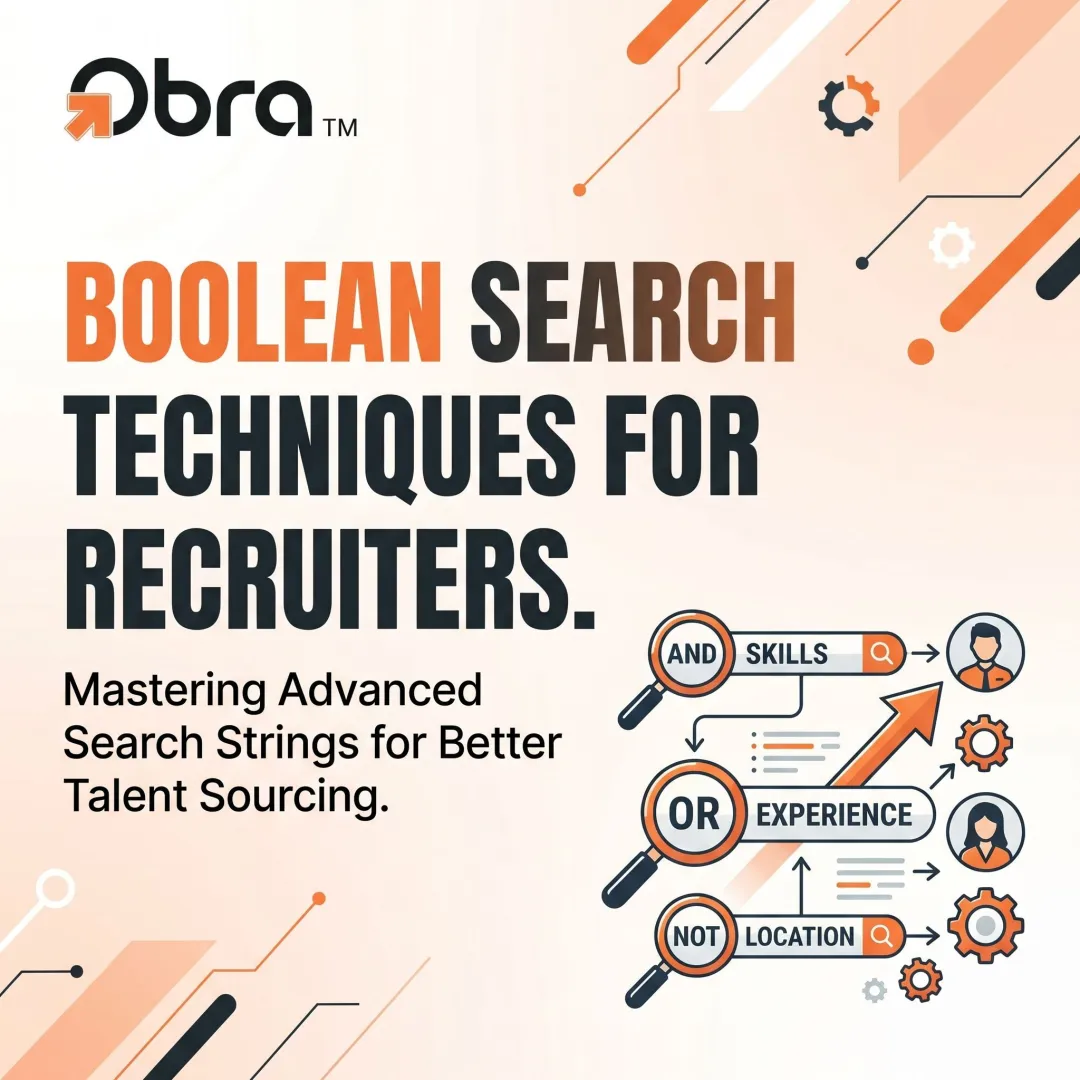
Boolean search is a query method using logical operators — AND, OR, NOT, parentheses, quotation marks — to include or exclude keywords across ATS databases, LinkedIn, and job boards. A recruiter constructs a string like ("registered nurse" OR "RN") AND ("ICU" OR "critical care") AND "ACLS" NOT travel and runs it against a candidate database.
SHRM describes it as searching for people with particular keywords in resumes and online profiles using these operators to refine results. For two decades, this was the gold standard for sourcing precision.
Why Recruiters Still Value It
Boolean's staying power comes from what it gives you:
- Full transparency — you control every operator, every inclusion, every exclusion
- Market knowledge encoding — experienced recruiters can bake in title variants, tech stack names, and certification abbreviations that no algorithm knows
- String reusability — a well-built string for a recurring role can be saved and reused indefinitely
- Auditability — in compliance-heavy environments, you can trace exactly why a candidate appeared or didn't
Approximately 68% of recruiting teams still use Boolean as their primary sourcing method, per SHRM 2025 data. In 2026, that's a signal — not that Boolean is legacy, but that it still solves problems AI hasn't fully replaced.
Where Boolean Works Best Today
- Regulated industries — healthcare (licensure and certification names are standardized), legal (bar admissions, practice areas), finance (Series 7/63/65, CPA)
- Staffing agencies running high-volume, repeatable roles with uniform job titles
- Technical recruiting for well-defined, consistently labeled software stacks
- Any search where geography exclusions or company blacklists matter
Boolean in Practice: Healthcare Example
A healthcare recruiter building a string for a surgical RN in a specific market might write:
("Registered Nurse" OR "RN") AND ("OR nurse" OR "surgical nurse" OR "perioperative") AND ("CNOR" OR "ACLS") AND "New York" NOT travel
Every term maps to a standardized credential or job title — which is exactly why Boolean outperforms AI in fields where language is regulated and consistent. No inference required.
What Is AI Sourcing?
AI sourcing uses machine learning to analyze candidate signals — career trajectory, skills inferred from project history, role progression, published work — to match candidates to a role without depending on exact keyword matches.
Where Boolean asks "does this profile contain these words?", AI sourcing asks "does this candidate have the capabilities this role requires?" That shift in logic is what lets AI sourcing surface candidates who never show up in a keyword search.
Why the Passive Candidate Problem Makes AI Sourcing Critical
73% of professionals are passive candidates — employed, not browsing job boards, and unlikely to appear in a Boolean string that filters for active applicants. Boolean search can't reach them. AI sourcing can.
Beyond passive reach, AI sourcing addresses several problems that keyword-based methods can't:
- Skill synonym gaps — recognizes that "Account Executive" and "Sales Development Rep" share overlapping competencies without requiring OR chains for every variation
- Scale without proportional time — one search can surface ranked candidates across multiple channels simultaneously
- Reduced over-indexing on keyword-heavy profiles from pedigreed backgrounds, which can widen pipeline diversity
The 2026 Fake Profile Problem
Gartner predicts 1 in 4 candidate profiles worldwide will be fake by 2028, and 41% of staffing buyers already experience candidate fraud. Boolean strings have no mechanism to detect synthetic profiles — they match keywords regardless of whether a profile is real.
AI sourcing platforms with anomaly detection can flag suspicious profiles at scale. Obra Hire, for example, includes verified profile filtering on its Explore and Scale plans, specifically designed to reduce exposure to AI-generated fake profiles — a feature that addresses what's becoming one of the biggest signal-to-noise problems in modern recruiting.
What AI Sourcing Looks Like in Practice: Obra Hire
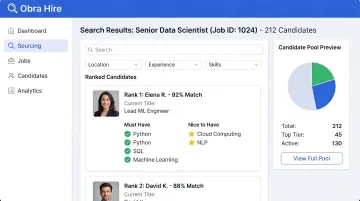
Obra Hire's AI-powered search scans 800M+ verified candidate profiles using competency-based matching rather than keyword filtering. Recruiters can describe a role in natural language or paste a job description, and the system returns ranked, skill-matched results showing clearly which candidates meet Must Have criteria versus Nice to Have preferences.
Recruiters can preview the entire candidate pool — size and individual profiles — before spending a single contact credit. Running a Boolean string blind offers no equivalent checkpoint.
Where AI Sourcing Excels
- High-volume hiring across multiple simultaneous roles
- Roles with nonstandard or evolving skill terminology — tech, marketing, operations
- Passive candidate outreach where the talent hasn't applied and won't
- Diversity-first pipelines that need to expand beyond traditional keyword-matching patterns
Boolean vs AI Sourcing: Which Is Better for Recruiters in 2026?
Neither method is objectively superior. The right answer depends on three variables: role specificity, candidate pool behavior (active vs. passive), and team bandwidth.
Choose Boolean When:
- The role has regulated or standardized credentials (healthcare licensure, legal bar admissions, financial certifications)
- You have deep market knowledge to encode into precise inclusion/exclusion logic
- Candidate volumes are manageable and precision matters more than reach
- The platform you're searching doesn't support AI-based search
Choose AI Sourcing When:
- Sourcing passive talent is a priority (and with 73% of the workforce passive, it usually should be)
- You're hiring at volume or filling multiple roles simultaneously
- Boolean strings keep recycling the same over-indexed profiles
- Diversity goals require expanding beyond traditional keyword pipelines
The 2026 Case for the Hybrid Model
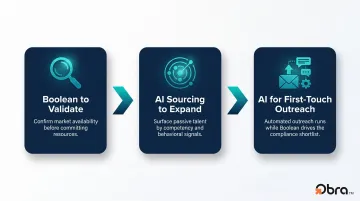
The strongest recruiting teams in 2026 don't choose one or the other. They use both:
- Boolean to validate — build a string to confirm market availability and understand what credentialed talent exists before committing to a search strategy
- AI sourcing to expand — cast a wider net, score candidates by competency fit, and surface passive talent that Boolean misses
- AI for first-touch outreach — automate outreach to passive candidates while Boolean handles the compliance-critical shortlist
The numbers back this up. LinkedIn's Future of Recruiting 2025 report found that TA professionals who integrate AI into their workflows save an average of 20% of their workweek — time recovered by not rebuilding Boolean strings for every new search. Gartner projects AI adoption in talent acquisition will hit 81% by 2027. Teams that haven't built that capability by then won't just be slower; they'll lose access to the passive candidate market entirely.
Real-World Scenarios
Scenario 1: When Boolean Hits Its Ceiling
A staffing agency filling 15 simultaneous roles — customer success managers, operations analysts, and mid-level marketing hires — relies entirely on Boolean strings. After two weeks, they're seeing the same 200-300 profiles recycled across LinkedIn and their ATS. Time-to-fill stretches past 50 days.
The problem isn't the strings. It's that Boolean only reaches candidates using those exact keywords on their profiles. Passive candidates with equivalent competencies — people currently employed and not updating their LinkedIn headlines — are structurally invisible to this approach.
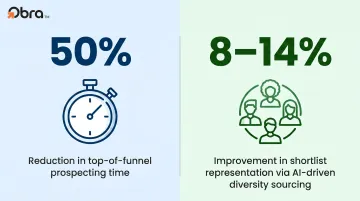
When they layer in AI sourcing, the platform surfaces candidates by competency signal rather than keyword presence. Documented research on AI-assisted sourcing indicates automated tools can reduce top-of-funnel prospecting time by approximately 50%, with AI-driven diversity sourcing improving shortlist representation by 8-14% — outcomes that keyword-only searches consistently miss.
Scenario 2: When Boolean Is Still the Right Call
A healthcare network needs to fill five compliance-specific roles requiring active state nursing licenses, ACLS certification, and surgical OR experience in a single metro area. Here, AI's broader competency matching creates noise — it may surface candidates who are clinically strong but lack the specific credentials required by regulation.
A precisely constructed Boolean string delivers a clean, qualified shortlist faster because the credentials are standardized, consistently labeled, and unambiguous. AI interpretation adds uncertainty where there should be none.
These two scenarios draw a clear line: deterministic criteria favor Boolean precision, while dispersed, passive, or nonstandard talent pools favor AI's broader reach.
Want to test AI sourcing against your current Boolean workflow? Obra Hire's free plan lets you search 800M+ verified profiles and preview your candidate pool — including size and individual profiles — before spending a single contact credit. No contract, no setup required.
Conclusion
Boolean search and AI sourcing serve different purposes. Boolean gives you control and precision when criteria are clear and credentials are standardized. AI sourcing gives you reach and discovery when talent is passive, nonstandard, or scattered across channels that keyword strings can't index.
With AI-generated applications flooding inbound pipelines, passive candidates ignoring job postings, and recruiting teams expected to deliver more on leaner budgets, outbound AI-powered sourcing has moved from nice-to-have to baseline. That's the reality of competitive recruiting in 2026.
The strongest sourcing stacks use Boolean where precision matters and AI where discovery does. Platforms like Obra Hire are built for exactly that second half — searching 800M+ verified candidate profiles with competency-based AI matching, so your team spends time on conversations rather than constructing keyword strings.
Frequently Asked Questions
Is Boolean search still relevant in recruiting in 2026?
Yes. Boolean remains valuable for precision-focused searches with standardized credentials in healthcare, legal, and finance especially. It works best paired with AI sourcing for scale and passive candidate reach, not as a standalone method.
What is the main disadvantage of Boolean search?
Boolean only returns exact keyword matches, which means it misses candidates with equivalent skills who use different terminology. Building strings that don't over-narrow or bloat results also requires significant expertise and regular iteration time.
Can AI sourcing completely replace Boolean search?
AI sourcing handles most sourcing scenarios more efficiently, but Boolean still wins for highly specific credential-based searches where exact inclusion/exclusion control is required. A hybrid approach (Boolean for precision, AI for reach) remains optimal.
How does AI sourcing find passive candidates that Boolean misses?
AI sourcing analyzes signals beyond resume text: career trajectories, inferred competencies, and role progression. This surfaces candidates who are qualified but not actively job-searching or using the exact keywords a Boolean string would require. With 73% of professionals passively employed, that reach advantage is substantial.
What should recruiters look for in an AI sourcing platform in 2026?
Prioritize platforms that offer:
- Verified candidate profiles to filter out AI-generated fakes
- Competency-based matching beyond keyword search
- Passive candidate reach into non-actively-searching talent
- ATS integration with your existing stack
- Transparent pricing with no hidden search limits
Does AI sourcing reduce bias compared to Boolean search?
AI sourcing, when properly configured, can reduce over-indexing on keyword-heavy profiles from pedigreed backgrounds and surface nontraditional talent. However, AI models must be independently audited for bias. A University of Washington study found participants mirrored a biased AI's recommendations approximately 90% of the time, making human review alone an insufficient safeguard.