Introduction
Post a job and wait. That's the inbound model, and for most roles, it's not working.
According to LinkedIn Talent Solutions, 70% of the global workforce is passive — not actively applying to anything. Yet most companies still treat job postings as their primary sourcing strategy, which means they're competing for the same 30% of talent while the best candidates never see their listings.
Top-performing hiring teams operate differently. They go outbound — proactively identifying and engaging candidates before competitors do. That shift produces shorter time-to-fill, lower cost-per-hire, and pipelines built on quality rather than volume.
This guide covers how to build a sourcing strategy that actually reaches the talent you need: from defining candidate profiles and choosing the right channels, to running referral programs, using AI-powered search, and measuring what drives real hiring outcomes.
TL;DR
- Candidate sourcing is proactive — finding candidates before they apply, not waiting for inbound volume.
- Effective sourcing combines multiple channels: outbound outreach, referrals, talent pools, and AI-powered search.
- Start by defining hiring goals, building accurate candidate profiles, and selecting channels based on source-of-hire data.
- AI platforms now let recruiting teams search 800M+ verified profiles in minutes, without waiting on inbound applicants.
- Track quality-of-hire, source-of-hire, and cost-per-hire — not just application volume.
What Is Candidate Sourcing — and Why Most Companies Get It Wrong
Candidate sourcing is the deliberate, proactive process of identifying and engaging potential candidates before they formally apply. It's distinct from recruiting, which converts that pipeline into hires through screening, interviews, and offers.
Many teams conflate the two — and underinvest in sourcing as a result.
Sourcing vs. Recruiting: Understanding the Difference
As SHRM defines it, sourcing is "the proactive searching for qualified job candidates for current or planned open positions — not the reactive function of reviewing resumes sent in response to a job posting."
Sourcing feeds the top of the funnel. Recruiting converts it. Without strong sourcing, your recruiting team has nothing quality to work with.
Why the Inbound-Only Model Falls Short
Relying solely on job postings means competing for a narrow slice of the talent market. The numbers tell the story:
- 70% of the global workforce is passive and not actively job searching
- 87% of both active and passive candidates say they're open to new opportunities — but they won't find your posting if they're not looking
- 3 out of 4 employers globally report difficulty finding the talent they need
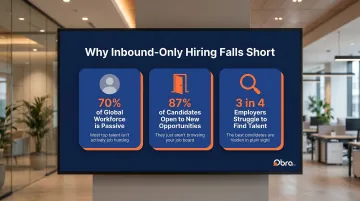
That gap is where proactive sourcing strategy lives. The following sections break down exactly how to close it.
How to Develop a Recruitment Sourcing Strategy
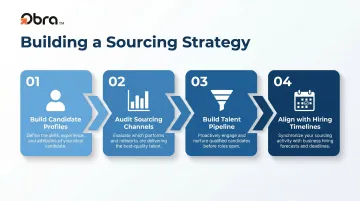
A sourcing strategy must start with clarity on organizational hiring goals: headcount needs, skill gaps, timelines, and experience levels. Without this foundation, sourcing becomes scattered and reactive, burning budget without filling roles.
Step 1: Build Accurate Candidate Profiles
An ideal candidate profile (ICP) goes beyond job title. It should define:
- Core competencies — the skills that actually predict job success
- Experience markers — years in role, industries, company types
- Cultural fit signals — working style, environment preferences
- Where these candidates are — which platforms, communities, and companies they're in
Skills-based profiles consistently outperform keyword or title-based searches. A "Senior Engineer" at one company might be a "Lead Developer" at another — but their competency set is the same. Profile by skills, not labels.
Step 2: Audit and Diversify Your Sourcing Channels
No single channel should carry your entire pipeline. Audit current channels by source-of-hire data — which ones produce retained hires, and which ones only generate volume?
Channels to evaluate:
- LinkedIn and professional networks
- Job boards (Indeed, ZipRecruiter, industry-specific boards)
- Employee referral programs
- Internal ATS / talent pool reactivation
- Niche communities (GitHub, Slack groups, Discord)
- Outbound search platforms (such as Obra Hire's 800M+ profile database)
Cut channels that generate volume without retained hires. Shift that budget toward sources where quality-of-hire data is consistently strong.
Step 3: Build and Maintain a Talent Pipeline
A talent pipeline is a continuously nurtured pool of pre-vetted candidates (past applicants, runners-up from previous roles, passive contacts) so every new req starts with warm leads rather than cold outreach.
Pipeline quality matters more than size. A pool of 50 pre-qualified, engaged candidates beats 500 cold contacts in nearly every scenario. Each hiring cycle builds on the last, and time-to-fill shrinks with each cycle.
Step 4: Align Sourcing Activity with Hiring Timelines
Sourcing must happen ahead of demand, not in response to it. For predictable roles, start building pipelines weeks or months in advance. This applies especially to:
- Seasonal roles — volume spikes with predictable windows
- Recurring backfills — positions with known turnover patterns
- High-volume hiring — where pipeline depth directly controls time-to-fill
Reactive sourcing under deadline pressure leads to rushed hires, lower quality, and inflated cost-per-hire.
Top Candidate Sourcing Best Practices
Whether you're sourcing for a single role or building pipelines at scale, these practices consistently separate effective teams from ones stuck in reactive mode.
Best Practice 1: Prioritize Passive Candidate Outreach
Passive candidates represent the majority of available talent. Reaching them requires outreach that's personal and relevant — not a copy-pasted job description.
What works:
- Reference something specific to their background or current work
- Keep messages short — messages under 400 characters see 22% higher response rates
- Time your outreach carefully: weekday mornings (9–10 a.m.) consistently outperform weekend sends
- Mention a shared connection or former employer — that alone boosts response rates by 27%
Generic bulk messages underperform. Personalized InMails perform 15% better than mass outreach, and candidates connected to someone at your company are 46% more likely to accept your message.
Best Practice 2: Run a Structured Employee Referral Program
Referral hires outperform almost every other source — on quality and retention. Research from iCIMS shows referred hires have a median employment duration of 38 months, compared to 22 months for non-referral hires. In high-turnover industries, that gap widens: referral hires stay 122% longer.
What makes a referral program actually work:
- Simple mechanics — mobile-first sharing, no complicated submission forms
- Tiered incentives tied to retention milestones, not day-one bonuses
- Regular communication about which roles have open referral tiers
- Fast feedback loops — tell employees what happened with their referral
JLL's structured referral program generated over 11,000 referrals, resulting in more than 600 offers. The efficiency is real: roughly 1 in 10 referrals results in a hire, versus 50–60 applicants typically needed per hire from job boards.
Best Practice 3: Use Boolean Search and Talent Mapping
Boolean search builds precise candidate queries using operators (AND, OR, NOT) across LinkedIn, GitHub, and resume databases. Pair it with talent mapping: systematically identify where your target candidates work, what they've built, and how they're reachable before you send a single message.
Example Boolean string for a product marketer:
("product marketing" OR "PMM") AND ("SaaS" OR "B2B") NOT ("intern" OR "student")
Talent mapping turns Boolean results into organized intelligence. You'll know which companies are fishing from the same candidate pool, which titles signal the skills you need, and where qualified candidates are concentrated — before any outreach begins.
Best Practice 4: Leverage Social and Community Channels Strategically
Choose platforms based on where your target candidates actually spend time:
- LinkedIn — professional and mid-to-senior roles across industries
- GitHub — software engineers and open-source contributors
- Slack and Discord communities — specialists in niche technical or creative domains
- Twitter/X — thought leaders in marketing, product, and design
Platform-specific engagement outperforms mass-posting the same job everywhere. Participate in conversations before recruiting from them. Community presence builds trust that cold outreach can't replicate.
Best Practice 5: Re-Engage Silver Medalists and Past Applicants
Every ATS holds candidates who were qualified but didn't get the offer: silver medalists, past applicants who fit a different role, people who declined when circumstances were different.
These candidates have already been screened, know your brand, and often convert faster than cold outreach.
For rediscovery to work in practice:
- Tag rejection reasons clearly in the ATS (not just "not selected")
- Categorize past applicants by role type and skill set
- Set calendar reminders to revisit silver medalists 6–12 months after their last interaction
Clean ATS data is the foundation. Messy data turns a warm pipeline into an unusable archive.
Best Practice 6: Strengthen Employer Brand as a Sourcing Asset
Employer brand doesn't just help with offer acceptance — it makes every piece of outreach land better. According to Glassdoor, 75% of active job seekers are more likely to apply when an employer actively manages its brand, and a strong employer brand can reduce cost-per-hire by up to 50%.
Practical actions that move the needle:
- Publish employee story content (real voices, not polished marketing copy)
- Add salary ranges to job descriptions — candidates notice when you don't
- Keep the careers page updated and accurate
- Respond to Glassdoor reviews, positive and negative
Candidates research you before they respond to you. A credible, consistent brand presence is what converts a curious candidate into a reply.

AI-Powered and Outbound Sourcing Tools: What's Changed
AI has shifted candidate discovery from manual Boolean crawling to competency-based matching across massive pools — instantly. As of 2024, 64% of organizations using AI in HR apply it specifically to recruiting, making talent acquisition the leading HR use case for AI.
The question is no longer whether to use AI sourcing tools, but which ones are worth using.
What to Look for in an AI Sourcing Platform
Not all AI sourcing tools are equal. Key capabilities that separate effective platforms from glorified search bars:
- Competency-based matching — maps skills with proficiency levels, not just keyword hits on a resume
- Verified profile filtering — critical as Gartner predicts 1 in 4 candidate profiles could be fake by 2028
- Pool preview before spending — the ability to see how many qualified candidates match your criteria before committing any budget
Obra Hire is built specifically for outbound sourcing. The platform gives hiring teams access to 800M+ verified candidate profiles with AI-powered, competency-based matching through its SkillsTree taxonomy. Recruiters can preview their candidate pool — including individual profiles — before spending any contact credits, and the freemium model means teams can start searching immediately with no contract and no credit card required.
When a credit is used, it reveals the candidate's email, phone number, LinkedIn URL, and resume — direct access without third-party gatekeepers.
Integrating Sourcing Tools with Existing ATS/HRIS Workflows
Sourcing tools should complement existing hiring infrastructure, not replace it. Look for platforms with native ATS/HRIS integrations so sourced candidates flow directly into existing workflows without manual data entry.
Obra Hire integrates with 85+ platforms — including Workday, Greenhouse, iCIMS, Lever, and SAP SuccessFactors. That makes it practical for enterprise teams and growing organizations alike, without disrupting the hiring processes already in place.
Protecting Against Fake and AI-Generated Candidates
The scale of the problem is accelerating. Beyond Gartner's 2028 prediction, 40% of candidates already report using AI during the application process — generating resumes, cover letters, and assessment responses that don't reflect actual capability.
Outbound sourcing significantly cuts this exposure. When you're proactively reaching candidates rather than waiting for applications, you control who enters your pipeline:
- You select candidates based on verified skills, not self-reported claims
- You bypass the flood of AI-generated applications entirely
- Verified profile filtering surfaces profiles checked against identity and activity signals before you spend a credit
How to Track and Improve Sourcing Performance
Volume metrics (applications received, outreach sent) tell you how busy your team is. Quality metrics tell you whether it's working.
Key Sourcing Metrics to Monitor
| Metric | What It Measures |
|---|---|
| Source-of-hire | Which channels produce actual hires — not just applicants |
| Cost-per-hire | Total investment per filled role (2025 median: $1,200 for nonexecutive roles per SHRM) |
| Time-to-fill | Days from req open to offer accepted (2025 median: ~45 days) |
| Quality-of-hire | New hire performance and retention at 90 days |
| Candidate response rate | Outreach effectiveness by channel and message type |
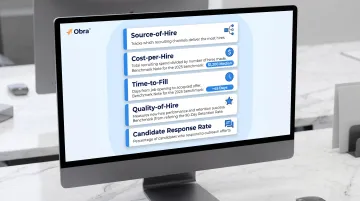
Only 20% of organizations currently track quality-of-hire — a decline from 27% in 2022. That gap represents a real competitive advantage for teams that do.
Using Data to Continuously Improve
Sourcing metrics should flow back into strategy on a set schedule:
- Which candidate profiles convert from outreach to interview to hire?
- Which channels produce retained hires vs. those that just generate early attrition?
- Which outreach messages drive the highest response rates by role type?
Teams that review source-of-hire data quarterly are far less likely to keep funding channels that produce churn. The goal isn't more data — it's building a review rhythm that turns sourcing numbers into sourcing decisions.
| Metric | What It Measures |
|---|---|
| Source-of-hire | Which channels produce actual hires — not just applicants |
| Cost-per-hire | Total investment per filled role (2025 median: $1,200 for nonexecutive roles per SHRM) |
| Time-to-fill | Days from req open to offer accepted (2025 median: ~45 days) |
| Quality-of-hire | New hire performance and retention at 90 days |
| Candidate response rate | Outreach effectiveness by channel and message type |
Conclusion
Effective candidate sourcing is a proactive discipline, not a one-time activity. Teams that build talent pipelines, prioritize passive outreach, and measure what drives quality hires will consistently outperform those still waiting on inbound applications.
The path forward is straightforward: define candidate profiles with precision, diversify your channels based on actual hire data, run structured referral programs, and reach passive candidates through personalized outreach — including those who will never submit an application on their own.
If you're ready to move from reactive posting to proactive outbound sourcing, Obra Hire gives you a starting point with no friction. Search 800M+ verified candidates, preview your pool before spending anything, and start for free — no contract, no sales call required.
Frequently Asked Questions
What is candidate sourcing in recruitment?
Candidate sourcing is the proactive process of identifying and engaging potential candidates before they formally apply, rather than waiting for inbound applications. It forms the top-of-funnel foundation for a strong hiring pipeline, feeding screened, interested candidates into the recruiting process.
How do you develop a recruitment sourcing strategy?
Start by defining hiring goals and building candidate profiles based on skills, not just job titles. Then:
- Audit and diversify sourcing channels using source-of-hire data
- Build a maintained talent pipeline of pre-vetted candidates
- Align sourcing activity proactively, before open reqs arise
What are the 7 steps in the sourcing process?
The typical steps are:
- Define the role and ideal candidate profile
- Identify sourcing channels
- Conduct candidate research and talent mapping
- Engage candidates with personalized outreach
- Qualify interest and fit
- Move candidates into the ATS
- Measure results and refine continuously
How do recruiters search for candidates?
Common methods include Boolean search, AI-powered outbound platforms, employee referral programs, ATS talent pool reactivation, and engagement through professional communities on GitHub, Slack, and Discord. Most high-performing teams combine several of these rather than relying on any single approach.
Where do recruiters source candidates?
Primary sourcing locations include LinkedIn, job boards, internal ATS databases (silver medalists and past applicants), employee referral networks, professional communities, industry events, and outbound platforms with large verified candidate databases — such as Obra Hire's pool of 800M+ profiles.
What is the most effective source for recruitment?
Employee referrals consistently rank among the highest-converting and best-retaining sources, but no single channel wins for every organization. The most reliable guide is your own source-of-hire data, combined with outbound AI-powered search to reach passive candidates alongside inbound channels.