Introduction
Most of the candidates you want aren't applying to your jobs. According to Gallup's 2026 workforce research, 51% of U.S. employees are either actively job hunting or passively watching for the right opportunity — yet most of them aren't submitting applications. They're waiting to be found.
Inbound pipelines aren't picking up the slack. 46% of job seekers now use AI to build resumes, and recruiters report a 15% spike in fraudulent applications — making it harder to trust what's coming in.
Separately, 72% of employers globally still struggle to fill open roles, per ManpowerGroup's 2026 Global Talent Shortage Survey.
The result: high-volume inboxes filled with low-quality applicants, and time-to-fill stretching longer on the positions where it hurts most.
This article breaks down 8 talent acquisition strategies that competitive hiring teams are deploying in 2026 — from AI-powered outbound sourcing to fake candidate filtering — each targeting a specific failure point in the modern hiring funnel.
TL;DR
- Passive candidates dominate the talent market — 40% are open to opportunities but won't apply, making outbound sourcing essential
- AI now underpins every hiring stage — sourcing, screening, and matching — making it table stakes, not a differentiator
- Skills-based hiring is 5x more predictive of job performance than credential filtering, according to McKinsey research
- Fake and AI-generated applications are degrading inbound pipeline quality — verification is now a core recruiting function
- Employer brand and candidate experience directly affect offer acceptance rates — attraction and retention start before the first interview
What's Changing in Talent Acquisition in 2026
Two structural forces are reshaping how hiring actually works.
First: inbound pipelines are compromised. AI tools have made it trivially easy to generate polished resumes and cover letters at scale. With 46% of job seekers using AI to build application materials and recruiters reporting a 15% increase in fraudulent profiles, the inbound funnel is increasingly full of noise. Volume is up; signal is down.
Second: the best candidates aren't applying. Gallup data shows that 40% of U.S. workers are passively watching for opportunities — open to the right move, but not submitting applications anywhere. These are often the highest performers at their current companies. Inbound-only strategies miss them entirely.
Recruitment vs. Talent Acquisition
These terms get used interchangeably, but the distinction matters operationally:
- Recruitment is reactive — filling an open role when it becomes urgent
- Talent acquisition is proactive — building pipelines, workforce plans, and candidate relationships continuously, so hiring starts from a warm shortlist rather than a cold search
Companies still relying on job board postings and ATS inboxes are competing in a shrinking pool of active applicants. Meanwhile, their competitors are sourcing directly from the roughly 51% of the workforce — passive and active combined — that's open to making a move.
The 8 strategies below show exactly how to shift from one camp to the other.
Top 8 Innovative Talent Acquisition Strategies for 2026
These strategies are selected for their measurable impact on sourcing efficiency, hire quality, and recruiter productivity — covering the full spectrum from AI tooling to process design.
Strategy 1: AI-Powered Outbound Candidate Sourcing
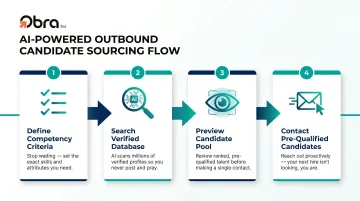
Outbound sourcing means going to find candidates rather than waiting for them to arrive. In practice: recruiters use AI-driven platforms to search verified candidate databases, define search criteria, and proactively contact pre-qualified passive candidates before a competitor does.
SHRM's 2025 benchmarking data puts the median time-to-fill at 45 days — and 61 days for organizations with 5,000+ employees. Outbound sourcing shortens that window by starting from a pre-filtered shortlist of qualified, reachable candidates rather than an empty inbox.
The shift away from gated platforms:
Traditional LinkedIn Recruiter is expensive, seat-limited, and increasingly crowded with recruiters competing for the same visible profiles. Self-serve platforms now give hiring teams direct access to candidate contact information — email, phone number, LinkedIn URL, and resume — without agency fees or platform gatekeeping.
Obra Hire's database covers 800M+ verified profiles searchable by competency, location, experience, and industry. Recruiters can describe their ideal candidate in plain language or paste a job description, and the AI returns ranked, skill-matched results. Before spending a single credit, teams can preview the full candidate pool size and individual profiles — confirming result quality before committing to contact reveals.
Key implementation step: Define competency-based search parameters, not just job titles. "5 years of experience in SaaS sales" produces different results than searching for specific competencies like pipeline management, enterprise deal cycles, and objection handling. The latter surfaces genuinely matched candidates; the former surfaces keyword-stuffed resumes.
Strategy 2: Skills-Based and Competency-Based Matching
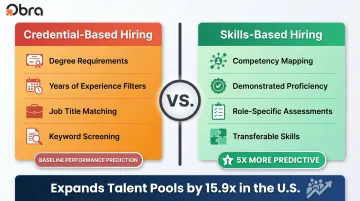
Degrees and job titles are lagging indicators of capability. According to McKinsey, hiring for skills is 5x more predictive of job performance than hiring for education, and more than 2x more predictive than hiring for work experience.
Adoption is accelerating:
- 70% of employers now use skills-based hiring practices, up from 65% the prior year (NACE, 2026)
- 81% of employers used skills-based hiring in 2024, up from 56% in 2022 (TestGorilla)
- 9 in 10 employers say they're open to candidates without four-year degrees (SHRM)
This isn't a fringe trend — it's becoming the default screening framework.
How it works operationally:
Instead of filtering resumes for credential markers ("Bachelor's degree required," "10+ years at a Fortune 500"), competency-based matching maps each role to a defined set of skills and proficiency levels, then filters candidate pools against that framework.
Obra Hire implements this through a Must Have / Nice to Have framework. Must Haves control which candidates enter the pool; Nice to Haves sort qualified results by match strength. Candidates who can genuinely do the job surface regardless of whether their resume contains the right keywords or credentials.
The diversity benefit is significant: LinkedIn's Economic Graph research found that a skills-based approach expands talent pools by 15.9x in the United States — and increases the share of women in AI talent pipelines by up to 24%.
Strategy 3: Proactive Talent Pipeline Building
A talent pipeline is a pre-vetted shortlist of qualified candidates for roles that don't exist yet. When a requisition opens, hiring starts from a warm list rather than a cold search — which directly reduces both time-to-fill and panic hiring.
The two-step process:
- Segment future hiring needs by role type and projected timeline using workforce planning data — identify which roles are likely to open in the next 3–6 months
- Build tagged candidate pools using sourcing tools, organized by role type so they're immediately searchable when a req opens
Obra Hire supports this through its Team Collaboration and Project Management features — shared projects organized by role, candidate pipeline tracking, outreach status per candidate, and collaborative access across the recruiting team.
Keeping pipelines warm: Periodic light-touch outreach — a relevant industry article, a heads-up about a team expansion, a preview of an upcoming role — keeps passive candidates engaged without pressure. When a role opens, you're reaching out to someone who already knows your company, not starting from scratch.
Strategy 4: Employer Branding as a Talent Magnet
Employer brand affects pipeline quality before a recruiter ever sends a message. 83% of job seekers research company reviews before deciding where to apply — and 79% of Glassdoor users are more likely to apply when the employer actively manages its brand presence.
The business case is direct: companies with strong employer brands see:
- 50% reduction in cost-per-hire
- 50% more qualified applicants
- 28% reduction in turnover
- 1–2x faster time to hire
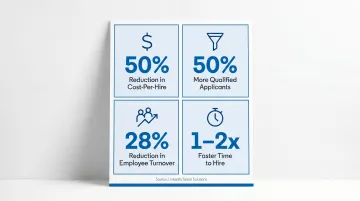
(LinkedIn Talent Solutions)
The two most actionable levers in 2026:
- Employee-generated content — real team stories, candid LinkedIn posts, and authentic Glassdoor responses carry more credibility than polished corporate messaging. Candidates can detect marketing copy immediately
- Transparent candidate experience — a clear hiring process, timely communication, and respectful rejection messaging leave even unsuccessful candidates with a positive impression, which feeds referrals and future applications
The second point is underrated. A poor candidate experience doesn't just lose one hire — it generates negative reviews that compound over time.
Strategy 5: Data-Driven Workforce Planning and Predictive Analytics
Most hiring teams operate reactively: a manager says "I need someone," and recruiting starts from zero. Data-driven workforce planning flips that sequence — using historical hiring velocity, attrition rates, and market availability data to forecast headcount needs 3–6 months before they become urgent.
Core metrics every TA team should track:
| Metric | What It Reveals |
|---|---|
| Time-to-fill by role type | Which roles take longest and need earlier pipeline investment |
| Source-of-hire quality | Which channels produce hires that stay and perform |
| Interview-to-offer ratio | Whether screening criteria are calibrated correctly |
| 90-day retention rate | Whether hire quality is actually translating to outcomes |
SHRM benchmarks put the median cost-per-hire at $1,200 for non-executive roles and $10,625 for executive roles. Tracking these metrics by source reveals which sourcing channels justify their cost — and which ones don't.
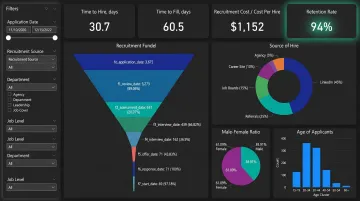
Obra Hire's candidate pool preview gives teams real-time intelligence on talent availability before they commit resources, allowing workforce planners to validate whether a specific role can realistically be filled in a given location and timeframe.
Strategy 6: DEI Embedded in the Hiring System
One-time DEI training rarely changes hiring outcomes. Structural changes — built into how roles are sourced, screened, and evaluated — do.
McKinsey's "Diversity Matters Even More" report (2023) found that companies in the top quartile for gender diversity on executive teams are 39% more likely to financially outperform peers. Companies in the bottom quartile for both gender and ethnic diversity are 66% less likely to outperform.
Practical structural changes that work:
- Structured interviews with standardized rubrics applied consistently across all candidates — meta-analytic research confirms these reduce demographic bias compared to unstructured conversations
- Diverse sourcing channels beyond LinkedIn — niche job boards, professional associations, community organizations, and platforms with broad industry coverage including blue, gray, and white collar roles
- Competency-based screening that evaluates demonstrated skills rather than credential proxies — TestGorilla's 2024 research found that 81% of organizations using skills-based hiring reported improved workforce diversity
Obra Hire's competency-based matching supports this by standardizing the evaluation criteria applied to every candidate in the pool, reducing the reliance on subjective resume interpretation.
Strategy 7: Flexible and Remote Work as a Recruitment Lever
Remote flexibility has shifted from a perk to a baseline expectation for a significant share of the workforce. Gallup's hybrid work data shows that 6 in 10 remote-capable employees want hybrid arrangements, about one-third prefer fully remote, and fewer than 10% want to work on-site full-time. 60% of exclusively remote workers say they'd be extremely likely to job-search if remote flexibility was eliminated.
The strategic hiring implication: Location flexibility isn't just a retention tool — it's a sourcing multiplier. When a team can hire across a national or global candidate pool rather than within commuting distance of an office, the universe of qualified candidates expands dramatically.
This compounds directly with outbound sourcing strategy. An Obra Hire search unrestricted by geography surfaces candidates from across the U.S., Canada, and Mexico — giving hiring teams access to candidates who are qualified and available but simply not local.
For hard-to-fill roles in specialized functions, this can be the difference between a 45-day fill and a 90-day search.
Strategy 8: AI Verification and Fake Candidate Filtering
Fake and AI-generated candidates are now a measurable sourcing problem. With 46% of job seekers using AI to generate application materials, and 91% of recruiters reporting some form of candidate deception, inbound pipelines have become increasingly unreliable as a source of vetted talent.
The FTC received 105,000+ job scam reports in 2024, and Raconteur's 2026 investigation found that recruiter encounters with suspected AI-generated applications have increased substantially since 2024. Gartner projects that AI-generated or fake profiles will affect 1 in 4 profiles by 2028.
The countermeasure: Verification-first sourcing architecture.
Rather than relying on manual detection after fraudulent candidates have already entered the pipeline, platforms built with verification filtering surface only validated profiles from the start. Obra Hire's Verified Profile Filtering — available on Explore and Scale plans — does exactly this, filtering the 800M+ candidate database to profiles that have passed verification checks before a recruiter ever opens them.
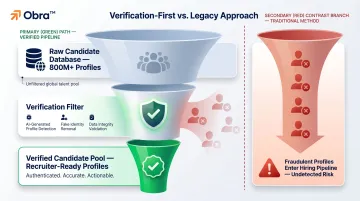
The practical impact: recruiting time gets redirected from spotting fakes to evaluating genuine candidates.
Skills assessments add a second layer of protection. A candidate can claim proficiency on a resume — a structured evaluation shows whether they can actually deliver it.
How to Choose the Right Strategies for Your Hiring Team
The most common mistake: trying to implement all eight at once and executing none of them well. Start by mapping your actual hiring bottleneck. Per SHRM's 2025 benchmarking data, 61% of recruiting executives cite lack of qualified candidates as their top challenge — but that could mean very different things depending on your situation.
Prioritization framework:
| Primary Bottleneck | Start With |
|---|---|
| Low inbound quality / passive-heavy roles | Outbound sourcing + skills-based matching |
| High screening volume + resource constraints | Verified profile filtering + AI screening |
| Slow time-to-fill / reactive hiring cycles | Pipeline building + workforce planning |
| Offer rejection + early attrition | Employer branding + candidate experience |
One more consideration: these strategies compound on each other. A talent pipeline built today reduces time-to-fill six months from now, while employer brand investment lifts pipeline quality across every sourcing channel. Skills-based screening, in turn, produces better quality-of-hire data — which feeds more accurate workforce planning down the line.
Pick the strategy that addresses your most costly bottleneck, measure the impact within 60–90 days, and layer in additional strategies as your process matures.
Conclusion
The hiring teams winning in 2026 stopped waiting. Proactive pipelines, AI-powered outbound, skills-first screening, and verified candidate pools aren't future trends — they're how competitive teams are filling roles now.
Start with the one strategy that addresses your sharpest pain point, measure it, and build from there.
If outbound sourcing is the gap, Obra Hire is a practical place to start — no contracts, no setup required. The free plan includes:
- Search 800M+ verified candidate profiles
- Preview candidate pool size before spending any credits
- Connect to your existing ATS via 85+ integrations, including Workday, Greenhouse, iCIMS, and Lever
Frequently Asked Questions
What is the difference between talent acquisition and recruitment?
Recruitment is reactive — fill the open role, close the req, move on. Talent acquisition is the ongoing function behind it: forecasting workforce needs, building candidate pipelines, and nurturing relationships so hiring starts from a warm shortlist rather than a cold search.
How much does a headhunter typically cost?
Retained search fees typically run 25–35% of the placed candidate's first-year compensation, paid in installments. Contingency models charge 15–25%, but only on successful placement. Self-serve outbound platforms like Obra Hire offer a far lower-cost alternative — starting free — for teams that want direct candidate access without agency markups.
Where do most recruiters find their best talent?
High-performing recruiters increasingly rely on outbound channels: verified candidate databases, passive LinkedIn outreach, and niche professional communities. With 40% of the workforce passively open to new roles but not actively applying, inbound job board traffic misses the largest segment of available talent.
How does AI improve talent acquisition in 2026?
AI improves TA by automating candidate sourcing and matching at scale, filtering fake or AI-generated profiles, personalizing outreach sequencing, and generating predictive data on candidate fit — freeing recruiters to focus on relationship-building, assessment, and closing rather than manual resume review.
What is skills-based hiring and why does it matter?
Skills-based hiring evaluates candidates on demonstrated competencies rather than degrees or job titles. McKinsey research shows it's 5x more predictive of job performance than education-based screening — and it opens the talent pool to qualified candidates who lack conventional credentials.
How do you build a proactive talent pipeline?
Start with workforce planning to identify future needs. Then use outbound sourcing tools to tag pre-qualified candidates by role type and keep them warm through a candidate CRM. When a req opens, you're activating a shortlist — not starting from scratch.