Introduction
Recruiting teams are drowning. Applications per hire tripled between 2021 and 2024, staying above 300 throughout 2025 — meaning the average recruiter now processes roughly 291 applications per open role. More volume, not more signal.
What's made it worse: generative AI has flooded inbound pipelines with polished, optimized applications that are increasingly difficult to verify. According to a 2026 Robert Half survey, 67% of HR leaders say AI-generated applications are actively slowing their hiring — and 84% report heavier workloads as a result.
AI in talent acquisition isn't a future concept. It's the infrastructure separating competitive hiring teams from those still posting jobs and waiting. Today's tools use machine learning, NLP, and predictive analytics to find, evaluate, and engage candidates faster than manual methods can keep up with.
This guide covers the key use cases reshaping hiring in 2026, why the shift from inbound to outbound recruiting is no longer optional, the genuine benefits and compliance risks, and how to implement AI without introducing new blind spots.
TLDR
- Applications per hire have tripled since 2021 — AI screening and sourcing are no longer optional
- The biggest shift in 2026: moving from reactive inbound hiring to proactive AI-powered outbound sourcing
- Key benefits: reduced time-to-fill, lower cost-per-hire, more consistent candidate evaluation
- Key risks: algorithmic bias, data privacy compliance, and AI-generated fake applicant profiles
- Responsible implementation requires clear objectives, human oversight, and ATS/HRIS-compatible tooling
Key AI Use Cases in Talent Acquisition for 2026
AI now touches every stage of the hiring funnel — not just resume review. SHRM's 2025 Talent Trends research found that 66% of HR leaders use AI to generate job descriptions, and 44% use it to screen resumes. Adoption is no longer limited to enterprise teams with dedicated tech stacks.
Automated Resume and Application Screening
NLP-powered screening tools parse applications at scale, rank candidates against defined criteria, and surface a shortlist — eliminating the hours recruiters previously spent manually reviewing every submission. With average inbound volumes above 300 applications per role, this isn't a nice-to-have.
The technology has existed for several years, but improved NLP models have made it meaningfully faster and more accurate. The bigger challenge now: AI-optimized resumes are gaming these systems, which is pushing teams toward assessment-based screening to restore signal quality.
Agentic AI and Autonomous Recruiting Workflows
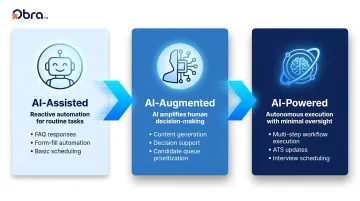
Deloitte's 2025 TA technology trends define a useful maturity model for where teams are headed:
- AI-assisted: Bots handle repetitive tasks — FAQ responses, form-fill, basic scheduling
- AI-augmented: Models support human decisions, generate content, prioritize candidate queues
- AI-powered: Autonomous agents execute multi-step workflows — scheduling interviews, sending follow-ups, updating ATS records — with minimal human intervention
Most organizations are currently in the assisted-to-augmented range. Fully agentic workflows are emerging, but piloting them in low-risk tasks (scheduling, ATS updates) before expanding scope is the right starting point.
Interview Intelligence and AI Notetaking
AI interview tools now transcribe conversations in real time, suggest follow-up questions mid-interview, and generate structured post-interview summaries. Less cognitive load on note-taking means more attention on the actual conversation.
The stakes are real. **42% of candidates declined a job offer due to a poor interview experience**, according to SHL research cited by Forbes. Meanwhile, only 26% of candidates report a great hiring experience overall, with 40% being ghosted after later interview rounds. AI-assisted interview tools close the feedback loop that traditional processes consistently drop.
Predictive Analytics and Talent Intelligence
AI models can now analyze historical hiring data, competitor talent availability, and emerging skills gaps to help TA teams forecast needs before they become urgent requisitions. The World Economic Forum's Future of Jobs Report 2025 projects that 39% of workers' core skills will change by 2030 — which means the talent landscape is shifting faster than most annual hiring plans can track.
Teams using predictive intelligence can act on that shift proactively:
- Identify emerging skill gaps before they stall open requisitions
- Build talent pipelines for roles that don't exist yet
- Adjust sourcing budgets based on real-time market supply data
- Reduce time-to-fill by engaging passive candidates ahead of demand
The Shift to Proactive, Outbound AI-Powered Hiring
The inbound model is broken — not because job boards stopped working, but because the math has inverted. Gem's 2025 recruiting benchmarks show job boards drive 49% of applications but only 24.6% of hires. Sourced candidates, by contrast, are approximately 5x more likely to be hired than inbound applicants.
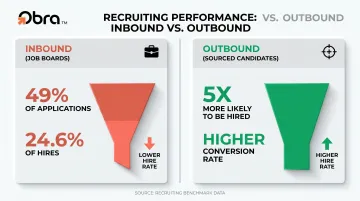
Post a job and you get volume. Sourced candidates produce hires.
Why Keyword Matching Fails
Traditional ATS platforms were designed for inbound. They filter resumes by keyword presence — which creates two structural problems:
- Candidates optimize resumes for keywords, not actual capability — rewarding polish over competence
- Keyword matching misses proficiency levels, transferable skills, and adjacent capabilities entirely
A marketing manager who's built and run paid search campaigns may never appear in a search for "SEM specialist" because the exact phrase isn't on their resume. Competency-based matching, which maps candidates against a structured skills taxonomy with proficiency levels, surfaces those matches.
How Outbound AI Sourcing Works
Instead of waiting for candidates to self-select into an inbound pipeline, AI-powered outbound sourcing searches verified candidate databases to identify people who match a role's competency profile — whether or not they're actively job hunting.
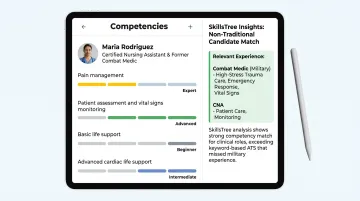
Obra Hire takes this approach. Hiring teams search 800M+ verified candidate profiles using SkillsTree — a proprietary competency taxonomy of 8,241 skills with proficiency levels. The platform replaces guesswork with structured, standards-based evaluation:
- Must Have criteria control who enters the candidate pool
- Nice to Have criteria rank qualified results by match strength
- Recruiters preview pool size and top profiles before spending any credits
- Search parameters can be refined without commitment if results need adjustment
That last point changes the risk profile of outbound sourcing considerably.
The recruiter's job shifts from filtering noise to building relationships with targeted, relevant people — which is where hiring actually gets done.
Benefits of AI in Talent Acquisition
Speed and Cost Efficiency
AI automates the most time-intensive front-end tasks — screening hundreds of applications, scheduling interviews, sending follow-up communications. 36% of HR leaders using AI in recruiting report reduced costs, according to SHRM's 2025 data.
Platforms like Obra Hire further compress cost-per-hire by replacing expensive per-seat recruiting licenses with self-serve access. The Scale plan at $169/month gives a full-time recruiter 1,200 contact credits and unlimited searches — a materially different cost structure than traditional enterprise sourcing tools.
Improved Quality of Hire
When AI evaluates candidates against consistent, structured criteria rather than individual recruiter judgment calls, early-stage screening becomes more reliable. Competency-based matching addresses the core issue with keyword filtering: it evaluates what candidates can actually do, not just what terms appear on their resume.
This matters most for non-traditional career paths and roles that span multiple disciplines — candidates who are routinely screened out by keyword-dependent ATS tools despite being well-qualified.
Better Candidate Experience
40% of candidates are ghosted after later interview rounds. AI-driven engagement tools directly reduce this problem:
- Automated status updates keep candidates informed at every stage
- 24/7 chatbot availability answers questions without recruiter intervention
- Faster response workflows cut the lag between interview rounds
Consistent communication reduces drop-off and protects employer brand — especially in competitive hiring markets.
Challenges and Risks of AI in Talent Acquisition
Algorithmic Bias
AI trained on historical hiring data inherits historical patterns — including biased ones. Amazon's well-documented case demonstrated this clearly: their experimental hiring model penalized resumes that included the word "women's" and downgraded graduates of all-women's colleges, because it was trained on a decade of predominantly male hires.
Automation doesn't neutralize bias. It scales it. Regular audits of AI recommendations and actual hiring outcomes — not just the algorithm's outputs — are necessary, not optional.
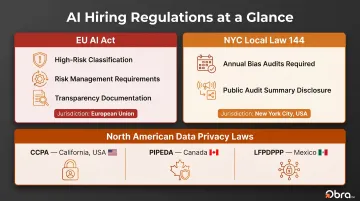
Regulators have responded. The EU AI Act classifies employment AI as high-risk, requiring formal risk management and transparency documentation. New York City's Local Law 144 mandates annual bias audits and public summaries for automated employment decision tools.
AI-Generated Fake Applicants
This is the most 2026-specific challenge in the stack. Generative AI now allows candidates to produce polished, highly optimized application materials at scale — making it genuinely hard to distinguish authentic candidates from AI-fabricated profiles. According to Robert Half's survey, 65% of HR leaders say AI-enhanced resumes make skills harder to verify.
Platforms with verified profile filtering, like Obra Hire, help teams work from authenticated candidate data rather than unvetted inbound submissions. The problem with inbound-only workflows is that every application is unverified by default — a compounding risk when AI-generated profiles are increasingly indistinguishable from real ones.
Overreliance and Data Privacy
Two more risks teams consistently underestimate:
- Over-automation erodes the human connection candidates expect and can damage employer brand. Only 26% of job applicants trust AI to evaluate them fairly, per Gartner's 2025 survey. Transparency about where AI is involved matters.
- Data privacy compliance is non-trivial. US, Canadian, and Mexican hiring teams each operate under distinct data regulations — CCPA, PIPEDA, and Mexico's LFPDPPP — with specific requirements on how candidate data is collected, processed, and retained.
How to Implement AI in Talent Acquisition Responsibly
Start With a Workflow Audit
Before selecting any tool, map which stages of your hiring process are most time-intensive or error-prone. AI delivers real value when it solves an actual bottleneck — layering it onto a broken process just automates the mess.
A phased rollout works better than full deployment. Starting with one team or requisition type surfaces integration issues early and reduces internal resistance before you scale.
Keep Humans at Key Decision Points
AI should recommend, not decide. Keep human judgment in the loop on final screening decisions, and train recruiters to critically evaluate AI outputs rather than accept them as authoritative.
Gallup's research found that 41% of employees say their organization has not implemented AI at all, and 21% don't know — suggesting that most organizations have significant internal communication gaps around AI use. Internal transparency matters as much as external disclosure to candidates.
Choose Tools That Integrate With Your Stack
Data silos and constant context-switching between systems erode any efficiency AI adds. Prioritize platforms with robust ATS/HRIS integrations so insights flow into existing workflows.
Obra Hire integrates with 85+ platforms including Workday, Greenhouse, iCIMS, Lever, and SAP SuccessFactors — so sourced candidates flow directly into your existing system of record without requiring a workflow overhaul.
Frequently Asked Questions
How can AI be used in talent acquisition?
AI covers resume screening, candidate sourcing, outreach personalization, interview scheduling, predictive analytics, and autonomous workflow execution. In 2026, the most impactful use is proactive outbound sourcing — AI finds qualified passive candidates rather than waiting for applicants to arrive.
What is the difference between an ATS and a CRM?
An ATS (Applicant Tracking System) manages active applicants who have already applied. A CRM (Candidate Relationship Management) system manages passive talent pipelines before anyone applies. Modern platforms like Obra Hire blend both into a single interface, with AI powering search and pipeline management throughout.
Will AI replace human recruiters?
No — AI is an augmentation tool, not a replacement. It handles screening and scheduling so recruiters spend time on relationships and evaluation. Most HR leaders treat AI as a support tool — and human judgment remains essential, particularly at final hiring decisions.
What are the biggest risks of using AI in hiring?
The core risks are algorithmic bias, data privacy compliance across jurisdictions, and over-automation that erodes candidate experience. A 2026-specific concern: AI-generated fake applicant profiles are saturating inbound pipelines, making skills verification significantly harder.
How does AI help with passive candidate sourcing?
AI searches large verified candidate databases to identify people who match a role's skill profile but aren't actively applying. It surfaces these candidates for direct recruiter outreach — which produces far higher hire rates than inbound. Sourced candidates are approximately 5x more likely to be hired than inbound applicants from job boards.