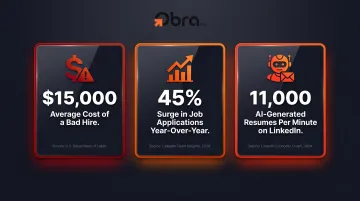
The stakes are real. According to SHRM, a single bad hire costs an average of $15,000 — at least 30% of that person's first-year earnings. Meanwhile, the recruiting environment has gotten harder: job applications surged over 45% year-over-year, with AI-generated resumes flooding inboxes at roughly 11,000 applications per minute on LinkedIn alone.
The good news: the HR tech landscape has matured significantly. Purpose-built tools now cover every function a startup needs — without the enterprise price tag or six-month implementation cycle.
This guide breaks down the top HR tools for startups in 2026 by function, so you can build a stack that matches your current stage.
TL;DR
- Build a modular HR stack — start with your biggest pain point, then layer in tools as you scale
- Obra Hire is the strongest free entry point for outbound talent sourcing — 800M+ profiles, no credit card required
- Gusto handles payroll, benefits, and compliance for US startups with flat-rate, transparent pricing
- BambooHR is the most startup-friendly HRIS for centralizing employee records and people data
- Greenhouse and Lattice add structured hiring and performance management once you hit Series A
Why Startups Need the Right HR Tools in 2026
Startups face HR pressures that established companies don't. Headcount can double in six months. Compliance requirements don't pause while you're still building the team. And now there's a newer problem layered on top: a flood of AI-generated applicants that clogs hiring pipelines before a single real candidate gets reviewed.
The AI Applicant Problem Is Real
The New York Times reported in June 2025 that recruiters are seeing a surge of AI-generated resumes — and the numbers back it up. Roughly 46% of job applicants now use AI tools to assist with applications. For startups without a dedicated recruiter, wading through flooded inboxes is an enormous time tax.
That inbox problem makes tool selection more consequential, not less. The right sourcing setup lets you skip the flood entirely — reaching candidates directly instead of waiting for applications to arrive.
All-in-One vs. Modular Stack
Most early-stage startups make one of two mistakes:
- Over-investing in enterprise platforms (Workday, SAP) before they have the headcount to justify them
- Under-investing in recruiting tools, then scrambling to hire when growth accelerates
A modular approach works better. Start with one or two purpose-built tools — typically payroll and sourcing — then layer in an HRIS and ATS as headcount justifies it. The tools below are organized by function for exactly that reason.
Top HR Tools for Startups in 2026
Tools here were selected on four criteria: ease of setup, pricing transparency, integration capability with common HR stacks, and fit for lean teams. Each solves a specific problem — pick what matches your stage.
Obra Hire — Best for Outbound Talent Sourcing
When inbound applications are flooded with AI-generated submissions — or you're hiring for a niche role no one's actively searching for — the real problem is pipeline, not process. Waiting for the right candidates to apply isn't a strategy. You need to go outbound.
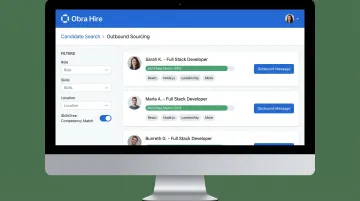
Obra Hire gives hiring teams direct access to 800M+ verified candidate profiles — no application required. Search by job description, natural language, or manual filters, and preview the candidate pool before spending a single credit.
When you're ready to reach out, reveal contact details (email, phone, LinkedIn, resume) on demand.
The platform's SkillsTree taxonomy uses competency-based matching across 8,241+ skills rather than simple keyword scanning — meaning it evaluates how well a candidate's actual capabilities fit the role, not just whether their resume contains the right words. Verified profile filtering specifically addresses AI-generated and fake candidate profiles, a problem Gartner projects will affect 1 in 4 profiles by 2028.
Sabyn Hansen, Manager of People & Culture at Canopy, put it simply: "Sourcing and screening pull you into tasks that slow your day. Obra Hire makes it easy to see the qualified candidates you want without digging through piles of profiles."
| Feature | Details |
|---|---|
| Key Features | AI-powered outbound search, verified candidate profiles, 800M+ database, SkillsTree competency matching, 85+ ATS/HRIS integrations (Greenhouse, Lever, iCIMS, Workday, SAP SuccessFactors) |
| Pricing | Free: $0/month (unlimited searches, 1,000 profile views, 50 contact credits); Explore: $109/month (500 contact credits); Scale: $169/month (1,200 contact credits + team features); Enterprise: custom |
| Best For | Startups proactively sourcing passive candidates; teams replacing or supplementing expensive recruiting agencies |
No credit card required to start. No ATS connection needed before you can begin searching.
Gusto — Best for Payroll, Benefits, and Compliance
For US-based startups, Gusto is typically the first HR tool worth paying for. It handles automated payroll and tax filing across all 50 states, benefits administration, contractor payments, and compliance alerts — all in an interface that doesn't require an HR background to navigate.
What makes Gusto the default choice for early-stage teams is its pricing clarity. There are no surprise fees or custom-quote walls until you need the Premium tier.
| Feature | Details |
|---|---|
| Key Features | Automated payroll and tax filing (all 50 states), benefits administration, self-service onboarding, PTO tracking, ATS on Plus plan, compliance alerts |
| Pricing | Simple: $49/month + $6/person; Plus: $80/month + $12/person; Premium: $180/month + $22/person |
| Best For | US-based startups needing their first integrated payroll and HR system |
Gusto serves 500,000+ small business customers and recently surpassed $1 billion in annual revenue. It holds the #1 rank on G2 for Payroll (Fall 2025). For most founding teams, the Simple plan covers everything needed until headcount exceeds 25.
BambooHR — Best Core HRIS for Growing Teams
Once you're past 10 employees, spreadsheets start breaking. BambooHR replaces them with a centralized system of record for employee data — onboarding, time-off, performance management, and self-service — without overwhelming a lean HR team.
BambooHR's built-in ATS caps at 5 open roles on the Core plan, and its analytics are basic compared to enterprise platforms. For what most startups actually need — a reliable, clean place to store and manage people data — that's a reasonable tradeoff.
| Feature | Details |
|---|---|
| Key Features | Employee records, onboarding, time-off management, performance management, reporting, applicant tracking |
| Pricing | Core: $10/employee/month; Pro: $17/employee/month; Elite: $25/employee/month. Flat rate of $250/month for teams of 25 or fewer |
| Best For | Startups with 10–200 employees needing a reliable, user-friendly HR data hub |
BambooHR holds a 4.4/5 G2 rating across 3,700+ reviews and reportedly serves around 34,000 customers across 190+ countries.
Rippling — Best for HR + IT Automation
Rippling earns its place on this list for a specific type of startup: tech-forward teams where onboarding and offboarding involve more than paperwork. When a new hire needs a laptop provisioned, software access granted, and payroll set up simultaneously, doing that across three separate systems wastes real time.
Rippling connects HR, IT, and Finance in one platform. Start with just payroll or HRIS and add modules as needed — app provisioning, device management, expense management, and more. The tradeoff is cost: pricing gets complex as you stack modules, and you'll need a custom quote for a full picture.
| Feature | Details |
|---|---|
| Key Features | Global payroll, HRIS, benefits, IT management, app provisioning, time & attendance, corporate cards |
| Pricing | Starts at $8/user/month; modular add-ons require a full quote |
| Best For | Tech-savvy startups wanting to consolidate HR and IT into one automated system |
Rippling serves 20,000+ customers and carries a 99.5% year-over-year PEO customer retention rate, which says something about stickiness once teams are fully integrated.
Greenhouse — Best ATS for Structured Hiring
Once you're making 10+ hires per quarter, inconsistent hiring processes become a real liability. Greenhouse is built around the concept of structured hiring — every candidate assessed against the same criteria, with scorecards defined before the search begins and interview kits that give interviewers specific, consistent questions.
The result is better hire quality, less bias creep, and a candidate experience that reflects well on your brand. It integrates directly with outbound sourcing tools like Obra Hire, so candidates found proactively flow straight into your existing pipeline.
Greenhouse isn't a good fit for a 5-person team making two hires a year — it requires commitment to its methodology and has pricing that scales with volume.
| Feature | Details |
|---|---|
| Key Features | Structured hiring workflows, interview kits, candidate scorecards, hiring analytics, job board distribution, integrations |
| Pricing | Custom quote (Core, Plus, or Pro tiers based on company size and hiring volume) |
| Best For | Startups past initial hiring phase, scaling to 10+ hires/quarter with structured processes |
Greenhouse ranked #1 ATS in 57 G2 reports in Spring 2026, including Mid-Market, Enterprise, and EMEA categories.
Lattice — Best for Performance Management and Engagement
Lattice is a dedicated talent management suite covering performance reviews, OKR tracking, engagement surveys, 1:1 tools, career growth frameworks, and compensation management. It's not a first tool — it's the layer you add once you have a core HRIS and need to develop and retain the people you've already hired.
Continuous feedback loops, structured 1:1 templates, pulse surveys, and merit cycle tools all live in one place — which means your managers aren't context-switching between disconnected systems. For Series A+ startups where retention is a strategic priority, that coherence matters.
The barrier worth noting: a $4,000 annual minimum agreement makes Lattice a considered purchase, not a casual trial.
| Feature | Details |
|---|---|
| Key Features | Performance reviews, OKR tracking, engagement surveys, 1:1 tools, compensation management, people analytics |
| Pricing | Performance Management: $8/person/month; Performance + OKRs bundle: $11/person/month; add-ons from $4/person/month; $4,000 annual minimum |
| Best For | Series A+ startups with a foundational HRIS in place, focused on retention and performance culture |
Lattice holds a 4.7/5 G2 rating with 4,095 reviews and is the top-ranked product in G2's Performance Management category.
How We Chose These HR Tools for Startups
Every tool on this list was evaluated against startup-specific criteria, not whether they'd work for a 500-person company:
- Time to value — can a two-person team get it running in a day?
- Pricing transparency — flat-rate or clearly documented, not hidden behind sales calls
- Integration fit — does it plug into common HR stacks without disruption?
- Problem specificity — does it actually solve the most painful problems for lean teams?
A minimum viable HR stack for a startup should cover three functions:
- Talent sourcing — finding and contacting qualified candidates
- Payroll and compliance — paying people correctly and staying legal
- People data — a central system of record for employee information
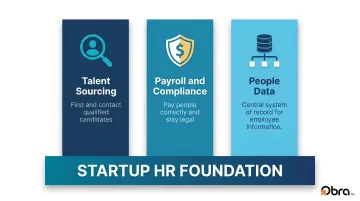
Everything else — ATS, performance management, engagement — can be added as headcount justifies it. The biggest mistake is investing in a polished HRIS before you have the people to populate it. The second-biggest is skipping a recruiting tool and then wondering why every hire takes three months. With that in mind, here's what actually works for startups right now.
Conclusion
The right HR tech stack looks different at 5 employees than it does at 50. A founding team needs payroll and sourcing. A 30-person company adds HRIS. A 75-person team layers in structured hiring and performance management. Dropping an enterprise platform on an early-stage team just slows things down.
Start with free tiers and demos before committing to anything annual. And if there's one place to start first — it's recruiting. Your ability to attract and hire the right people determines the ceiling for everything else.
For startups that want to source passive candidates proactively and at near-zero cost, Obra Hire's freemium outbound platform is worth trying before anything else. No credit card, no ATS setup required — just sign up with a company email and start searching.
Frequently Asked Questions
What's the leading HR software for startups?
No single platform leads across all HR functions. Gusto is widely cited as the top all-in-one for US-based startups covering payroll and benefits, while BambooHR leads in HRIS and Obra Hire leads for outbound candidate sourcing. The strongest approach combines best-in-class tools per function.
What are the 7 C's of HR?
The 7 C's of HR are Competence, Commitment, Culture, Compensation, Communication, Compliance, and Career Development. Practitioners use this framework as a diagnostic checklist when auditing gaps in a people strategy.
What HR tools do startups need first?
Prioritize payroll first (to pay people correctly and stay compliant) and a talent sourcing or ATS tool (to build the team). HRIS and performance management can come later — typically once you're past 15–20 employees and managing records manually is creating real risk.
Is there free HR software for startups?
Yes. Connecteam offers a permanent free plan for up to 10 users with full feature access. Obra Hire offers a freemium plan with unlimited searches and 50 contact credits per month at no cost. Most HRIS platforms like BambooHR offer trials but not permanent free tiers.
When should a startup invest in HR software?
Most teams hit the inflection point at 5–10 employees, when manual payroll and spreadsheet-based records start creating compliance risk and administrative drag that outweighs the cost of tools. The U.S. Chamber of Commerce recommends bringing on dedicated HR resources at 10 employees.
How do outbound hiring tools differ from a traditional ATS?
An ATS manages inbound applicants who've already applied to your posted jobs. Outbound sourcing tools like Obra Hire let teams proactively search and contact passive candidates who haven't applied anywhere — the two work together, not in competition.