Introduction
Recruitment communication is breaking hiring pipelines — and the numbers are hard to ignore. According to data cited by StaffingHub, 40% of candidates drop out of hiring processes due to poor candidate experience — and in 2024, 26% of job seekers declined an offer specifically because of how they were treated during the process. Not because the role was wrong. Because the communication was.
Meanwhile, employer ghosting has reached a three-year high. A Criteria report covered by Fortune found that 53% of job seekers were ghosted by employers in the past year — up from 38% in 2024.
Add AI-generated applications flooding inbound pipelines and passive candidates who never apply at all, and the result is the same: unstructured, reactive communication loses qualified people before they ever reach a hiring decision.
This guide covers what candidate engagement platforms are, how they fix communication breakdowns at each stage of hiring, and which features separate platforms that produce results from those that just add noise.
TL;DR
- 40% of candidates drop from hiring processes due to poor communication — not poor fit
- Candidate engagement platforms automate multi-channel outreach across email, SMS, and LinkedIn with verified contact data and ATS integration
- Outbound sourcing converts candidates at 8x the rate of inbound applications
- Personalized outreach achieves 2x the response rate of generic templates
- The best platforms use automation for sequencing and cadence, then hand off to humans to close the conversation
What Is a Candidate Engagement Platform?
A candidate engagement platform is software built specifically to manage communication between recruiters and candidates across the full hiring funnel — from first contact through offer acceptance. It's not an ATS, a CRM, or a job board, and that distinction matters.
The Gap Standard ATS Tools Leave Open
An ATS was designed to track applications and manage workflow stages. It tells you where a candidate is in your pipeline. It does not help you reach passive candidates, structure follow-up sequences, or contact anyone who hasn't already applied.
Candidate engagement platforms fill that gap. They sit on top of or integrate with existing ATS infrastructure, adding the proactive communication layer that standard workflow tools were never designed to handle.
Two Operating Models
Most platforms operate under one of two models, though the line between them is increasingly blurred:
- Inbound engagement — nurturing candidates who have already applied or expressed interest, keeping them warm through automated updates and timely follow-up
- Outbound engagement — proactively identifying and reaching passive candidates before they apply, using sourcing databases and verified contact data to initiate first contact
Outbound-first platforms like Obra Hire take this further. Recruiters search 800M+ candidate profiles by competency, skill, or job description, preview the matching pool before spending any credits, and contact candidates directly — no waiting for applications to come in. Verified contact details (email, phone, LinkedIn) are revealed on demand.
The global recruitment software market sits at $3.74 billion in 2026 and is projected to reach $7.48 billion by 2034 — a trajectory that reflects how seriously hiring teams are investing in communication and sourcing infrastructure.
How Candidate Engagement Platforms Improve Recruitment Communication
These platforms don't just send more messages. They structure communication into deliberate, trackable sequences that move candidates through the funnel faster and with fewer drop-offs.
Outbound Reach and First Contact
Rather than waiting on inbound applications, engagement platforms let recruiters search verified candidate databases, identify matches by skill or competency, and reach out via email, phone, or LinkedIn — all from one place.
Contact data quality directly shapes how fast that outreach lands. When a recruiter identifies a strong candidate, the gap between discovery and first contact affects response rates immediately. Platforms that surface verified email, phone, and LinkedIn details eliminate delays caused by bounced messages and cold profiles.
Speed matters here too. Per Ninjahire's 2026 benchmarks, responding to engagement signals within 24 hours lifts response rates by 40%. With verified contact data and a single outreach interface, that window becomes achievable.
Automated Nurturing and Follow-Up
Most qualified candidates don't respond to a single message. Experienced recruiters follow up six or more times before moving on from a passive candidate — and multi-touch sequences improve total response rates by 30–50% compared to single-touch outreach.
Manually managing that cadence across 50–150 weekly outreach messages isn't realistic. Engagement platforms handle it automatically, triggering follow-ups based on time intervals or candidate actions, so no one goes cold because a recruiter ran out of bandwidth.
Personalization is what separates effective automation from broadcast spam. Ninjahire's data shows the gap clearly:
| Personalization Level | Response Rate |
|---|---|
| Generic template | ~14% |
| Name + title included | ~21% |
| Role + background relevance | ~32% |
| AI-assisted personalization | 35–50% |
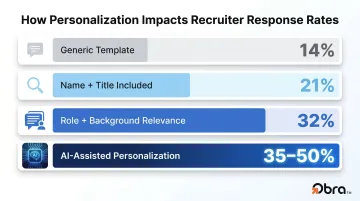
72% of candidates report ignoring outreach that feels templated. The platforms that perform best use candidate-specific signals — role fit, location, experience — to personalize content, not just names.
Real-Time Response and Human Handoff
Higher response rates only matter if someone is ready to act on them. When a candidate replies, the platform notifies the recruiter immediately — because that moment of expressed interest closes fast if no one follows through.
This handoff is what separates effective engagement platforms from automated noise. The goal is for automation to stay invisible: the candidate receives a timely, relevant message, and at the moment they respond, a human picks up the conversation. When it works, candidates engage with a person, not a sequence.
Key Features That Drive Better Recruitment Communication
Candidate engagement platforms vary widely in what they actually deliver. These are the features that separate tools that accelerate hiring from ones that just add another dashboard to manage.
Multi-Channel Communication
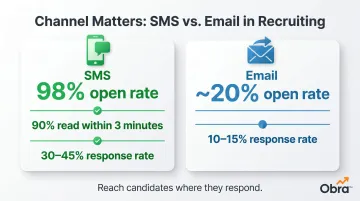
Top platforms centralize outreach across SMS, email, and professional networks into one dashboard. The channel mix matters because reach varies dramatically by medium.
SMS open rates are approximately 98%, compared to roughly 20% for email — and 90% of texts are read within three minutes. In a recruiting context, SMS achieves 30–45% response rates, versus 10–15% for cold email. Platforms without SMS capability are at a real disadvantage for time-sensitive outreach.
Automated Sequence and Workflow Management
If-this-then-that logic enables platforms to trigger specific communication flows based on candidate behavior. A candidate who visited a job page but didn't complete an application gets a gentle nudge. A candidate who opened two messages but hasn't replied gets a follow-up with a different angle. This conditional logic eliminates the manual follow-up decisions that slow recruiters down and often get skipped entirely.
ATS and HRIS Integration
Automation only helps if the data flows back to where your team actually works. Every text, email, and status update should sync back to the candidate record in your ATS automatically — no manual export, no duplicate entry.
Obra Hire's 85+ native integrations — including Workday, Greenhouse, iCIMS, Lever, and SAP SuccessFactors — let teams add engagement and sourcing capability without replacing or restructuring existing hiring infrastructure. The platform fits into the workflow rather than forcing a workflow change.
Verified Contact Data Access
Contact quality directly determines outreach success. Platforms that surface verified direct email, phone numbers, and LinkedIn profiles reduce bounced messages and prevent recruiters from burning time on unreachable candidates.
Obra Hire's contact reveal model works on a credit basis: recruiters preview candidate profiles first, then spend credits only when they choose to unlock contact details. That means every credit goes toward candidates you've already decided are worth pursuing.
Analytics and Engagement Tracking
Meaningful metrics go beyond open rates. The KPIs that actually help teams improve are:
- Response rate per channel — which medium gets replies
- Time from first contact to screening — how fast outreach converts
- Re-engagement rate of prior candidates — how well dormant pipelines are being used
- Recruiter adoption rate — whether the team is actually using the platform
Without these metrics, teams optimize for activity rather than outcomes.
What Communication Gaps These Platforms Are Built to Solve
The Ghosting Problem — Both Directions
Ghosting runs in both directions, and both are expensive. Small recruitment agencies lose an average of $47,000 per year to candidate no-shows attributable to communication breakdowns. The Candidate Experience Institute reports that 62% of candidates now ghost employers — but their research also shows this rate can be cut in half through seven structured communication touchpoints across the hiring journey.
Engagement platforms address recruiter-side ghosting through automated acknowledgment and status updates. Candidates get responses even when the recruiter is managing 20 other roles. On the candidate side, timely and relevant outreach keeps interest alive. Sporadic, generic messages lose candidates to silence.
The Passive Candidate Gap
Approximately **70% of the global workforce consists of passive candidates** — people who aren't actively applying anywhere. Only 4.1% of talent is actively looking at any given time.
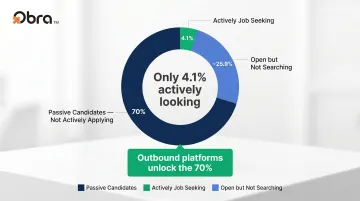
Companies that rely entirely on inbound applications are competing for a narrow slice of the available talent pool. Outbound engagement platforms open access to the majority. The quality differential is real: passive candidates are more likely to make a strong impact and stay long-term — they weren't desperate to leave their last role, they were selectively recruited.
The AI-Generated Applicant Problem
Inbound pipelines are increasingly contaminated. 48% of hiring managers now use AI to screen resumes, largely because AI-generated applications have made manual review unsustainable. When every application looks polished, real screening becomes nearly impossible.
Outbound platforms avoid the problem entirely. Rather than sorting through a flooded inbox, Obra Hire's verified profile filtering surfaces authenticated profiles directly from its search database — reducing exposure to fraudulent or AI-fabricated candidates before contact is ever made. Recruiters spend their communication energy on people who are real, reachable, and qualified — not on triaging a flooded inbox.
Conclusion
Candidate engagement platforms improve recruitment communication by ensuring the right message reaches the right candidate at the right stage. That means verified contact data, automated sequencing, and clean integration with existing hiring infrastructure — not higher message volume.
Teams that understand how these platforms work can select tools that match their actual hiring model, measure communication performance against meaningful KPIs, and stop losing qualified candidates to teams that respond faster. The platforms that deliver on this aren't the most feature-rich — they're the ones that fit how your team actually hires.
Frequently Asked Questions
Frequently Asked Questions
How do you ensure effective communication with candidates during the recruitment process?
Effective recruitment communication requires:
- Verified contact data so messages actually reach candidates
- Multi-channel outreach so you're connecting where they're active
- Automated follow-up so timing gaps don't kill warm leads
Platforms built for this integrate all three — no manual handoffs between tools.
What is the difference between a candidate engagement platform and an ATS?
An ATS tracks application status and manages workflow stages. A candidate engagement platform handles proactive, multi-channel communication — reaching candidates before or during the process rather than just logging where they are. The two tools typically work together: engagement platforms integrate with ATS systems rather than replacing them.
How do candidate engagement platforms help reduce candidate ghosting?
Automated status updates eliminate recruiter-side silence, which accounts for a significant share of candidate drop-off. On the candidate side, personalized and timely outreach maintains interest — candidates who feel informed and valued are far less likely to disengage mid-process.
Can small or mid-sized hiring teams use candidate engagement platforms effectively?
Yes. Many platforms, including Obra Hire, offer freemium models with no setup required and no contract — the free tier includes 1,000 profile views and 50 contact credits monthly. The key is matching the platform's feature depth to your team's hiring volume, not over-investing in enterprise tooling for lean workflows.
How do candidate engagement platforms handle data privacy and compliance?
Reputable platforms include opt-out management, GDPR and CCPA compliance tools, data deletion workflows, and secure storage. Obra Hire supports right-to-deletion, consent withdrawal, and data portability requests. Centralizing candidate conversations in one platform — rather than across personal inboxes — is itself a meaningful compliance improvement.
What metrics should recruiters track to measure engagement platform effectiveness?
The most useful KPIs are response rate per channel, time from first contact to screening, re-engagement rate of prior candidates, and recruiter adoption rate across the team. Email open rates alone tell you almost nothing about whether outreach is actually working.