Introduction
Most high-performers aren't refreshing job boards. They're employed, delivering results, and not looking — which means they'll never see your job posting. According to LinkedIn's Talent Blog, roughly 75% of the employed workforce is passive, including a 15% subset actively open to the right conversation.
That gap is widening. SHRM reports a rise in deepfake interview fraud and AI-generated applicants, which means inbound pipelines are now incomplete and increasingly unreliable. Teams that rely solely on job ads compete for a narrow pool of active candidates while the majority of qualified talent stays out of reach.
Reaching passive candidates requires a different toolset: one that finds professionals before they're in job-search mode, surfaces verified contact information, and fits into your existing hiring workflow without rebuilding it from scratch. This guide covers the top passive candidate outreach platforms — what each does best, where each falls short, and how to choose the right fit for your team.
TL;DR
- Outreach software lets recruiters proactively find and contact employed professionals — no inbound applications required
- The strongest tools combine a verified candidate database, AI-powered competency matching, direct contact info, and ATS integration
- What separates the best from the rest: database quality, AI matching depth, direct email/phone access, and pricing model fit for your team's size
- Tools covered: Obra Hire, Gem, LinkedIn Recruiter, HireEZ, and SeekOut — each suited to different team sizes, budgets, and hiring mandates
What Is Passive Candidate Outreach Software?
Passive candidate outreach software helps hiring teams find, contact, and engage professionals who aren't actively applying — but may be open to the right opportunity. Instead of waiting for inbound applications, recruiters search a database, identify best-fit candidates, and initiate contact directly.
Traditional job postings only reach active seekers — a fraction of the available talent pool. Skilled, employed professionals in competitive roles stay invisible to inbound-only workflows. They're not browsing job boards.
Two forces are compounding this gap:
- AI-generated fake applications are rising, making it harder to trust what's in your inbound queue
- LinkedIn's Economic Graph research shows skills-first hiring can expand talent pools by up to 10x when recruiters look beyond active applicants
Outreach software closes both gaps — giving recruiters direct access to employed professionals with verified profiles and contact data, before any competitor reaches out.
Top Outreach Software for Passive Candidate Engagement
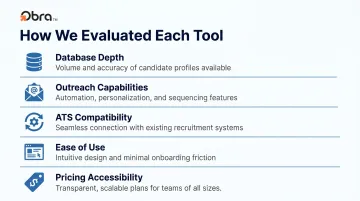
These tools were evaluated across five criteria:
- Database depth — profile volume and coverage across industries and collar types
- Outreach capabilities — email, InMail, sequencing, and direct contact access
- ATS compatibility — integrations with existing hiring workflows
- Ease of use — self-serve access vs. sales-gated procurement
- Pricing accessibility — fit across team sizes and budgets
Obra Hire
Obra Hire is a self-serve, outbound-first hiring platform built to give recruiting teams direct access to 800M+ candidate profiles — spanning blue, gray, and white collar roles across healthcare, logistics, retail, tech, and more. It's designed for teams that want to source without a sales call, a lengthy contract, or a five-figure seat cost.
What sets it apart is the combination of competency-based AI matching and verified profile filtering. Rather than matching on job title keywords, Obra uses structured competency data to assess how well a candidate fits a role — surfacing "Must Have" and "Nice to Have" criteria transparently in every result.
The verified profile filter reduces exposure to AI-generated and fake candidate profiles, a problem that has become increasingly common in sourcing databases.
Recruiters can preview the full candidate pool size before spending a single credit. Credits are only consumed when a recruiter reveals a candidate's full contact details — email, phone, LinkedIn URL, and resume. The platform also supports team-wide shared credit pools on the Scale plan, so no two teammates accidentally purchase the same contact.
| Category | Details |
|---|---|
| Best For | Any-size hiring teams, HR departments, and recruitment agencies wanting affordable, outbound-first access to passive candidates across all industries and collar types |
| Key Features | 800M+ profiles, competency-based AI matching, verified profile filtering, candidate pool preview before spending credits, direct contact info reveal, 85+ ATS/HRIS integrations, shared team credits |
| Pricing | Free plan available (no credit card required); Explore at $109/month; Scale at $169/month; Enterprise pricing custom — verify current plans at obra.co |
Gem
Gem is a talent engagement platform built for in-house recruiting teams that need more than just a sourcing database. It combines CRM-driven pipeline management, multi-touch outreach sequencing, and AI sourcing in one integrated suite — all connected to the team's existing ATS.
Gem's strength is long-term candidate nurturing. It tracks full engagement history, deduplicates outreach across the team, and resurfaces past applicants when new relevant roles open. Its AI sourcing runs natural-language queries across 800M+ public profiles, with match-score explanations and real-time talent pool insights.
Gem's own analysis of 4 million recruiting emails found that four-step sequences double reply rates and lift interested responses by roughly 68% compared to single sends — a strong case for the sequencing capabilities it enables.
| Category | Details |
|---|---|
| Best For | Mid-to-large in-house recruiting teams that prioritize CRM-driven outreach, pipeline analytics, and long-term candidate nurturing |
| Key Features | Talent CRM, AI sourcing agents, multi-channel outreach sequences, ATS integration, response rate analytics, diversity reporting, team performance dashboards |
| Pricing | Startup tiers publicly listed; Growth and Enterprise are custom — requires sales engagement |
LinkedIn Recruiter
LinkedIn Recruiter is the most widely used passive sourcing tool, offering direct search across the world's largest professional network with advanced filters, AI-powered candidate recommendations, and InMail for direct outreach.
The network advantage is real — no other platform matches LinkedIn's profile depth for professional and white-collar roles. But the trade-offs are significant. All outreach runs through InMail, not direct email or phone. LinkedIn also enforces a minimum 13% InMail response rate over rolling 14-day windows, which adds pressure to message quality at scale. And the per-seat cost is high — third-party pricing analysis for 2026 estimates Corporate seats at approximately $10,800–$12,960 per seat per year.
Teams using LinkedIn exclusively also miss candidates who are more active on GitHub, niche communities, or other platforms.
| Category | Details |
|---|---|
| Best For | Teams primarily sourcing professional and white-collar roles who need precision search within LinkedIn's network and are comfortable with InMail-only outreach |
| Key Features | Advanced search filters, AI candidate recommendations, InMail campaigns, Recruiter System Connect (RSC) ATS sync, saved searches and alerts |
| Pricing | No official public list price; Corporate estimated at $10,800–$12,960/seat/year (third-party estimate); Lite approximately $2,040/year — verify directly with LinkedIn |
HireEZ
HireEZ is an outbound recruiting platform built to expand passive candidate discovery beyond LinkedIn by aggregating profiles from multiple public sources, job boards, and databases. Its AI-powered EZ Agent automates sourcing across multi-source talent pools, which makes it particularly useful for diversity sourcing and reaching candidates in less-represented pools.
Built-in diversity filters and insights give enterprise teams visibility into sourcing equity across campaigns. HireEZ integrates with major ATS platforms and supports both email and LinkedIn outreach automation.
The trade-off: pricing isn't public. Procurement requires a sales demo, making it harder to evaluate fit quickly or pilot without a commitment.
| Category | Details |
|---|---|
| Best For | Enterprise recruiting teams focused on multi-source passive candidate discovery, diversity hiring, and outreach automation beyond LinkedIn |
| Key Features | AI EZ Agent for automated sourcing, multi-source talent aggregation, diversity filters and insights, email and LinkedIn outreach automation, ATS integrations, candidate enrichment |
| Pricing | Not publicly listed — requires sales demo |
SeekOut
SeekOut is a talent intelligence platform designed for sourcing highly specialized or technical candidates. It goes beyond conventional resume data to index patents, GitHub contributions, publications, and open-source activity — surfacing signal that keyword-only searches miss entirely.
For a staff engineering search where you want candidates with specific open-source contributions or granted patents, SeekOut's filters produce a materially different (and more relevant) shortlist than generic database searches. It also offers diversity and inclusion filters and talent market analytics.
The caveats: complexity and cost make it better suited for dedicated technical recruiting functions than general or high-volume hiring. SeekOut Recruit Lite is publicly listed at $179/month billed annually; enterprise Recruit plans start around $833/month, with higher tiers custom-priced.
| Category | Details |
|---|---|
| Best For | Technical recruiting teams sourcing specialized engineers, researchers, or niche professionals where conventional search falls short |
| Key Features | AI search across technical signals (patents, GitHub, open-source), diversity filters, email finding and outreach sequencing, talent market analytics, ATS/CRM integrations |
| Pricing | Recruit Lite: $179/month billed annually; Recruit starts at $833/month for enterprise — verify at seekout.com/pricing |
Key Features to Look For
Database Size and Data Quality
A large database is only valuable if the contact data is accurate. With median job tenure at 3.9 years as of January 2024 per the Bureau of Labor Statistics, employment data goes stale fast. High email bounce rates don't just waste recruiter time — they damage sender reputation.
Before committing to any platform, ask vendors:
- How frequently is contact data refreshed?
- What's the platform's email deliverability rate?
- How are AI-generated or fake profiles identified and filtered out?
AI Matching Depth
Keyword search returns candidates whose resumes contain the right words. Competency-based matching goes further — it surfaces candidates who have the right skills regardless of title or career path. For passive candidates especially, that distinction matters. Many employed professionals have adjacent experience that a keyword search won't catch.
Direct Contact Info Access
Passive candidates won't see a message sent to an inbox they never check. Direct contact access puts outreach in the recruiter's hands — not behind a gated channel. Look for platforms that provide:
- Direct email and phone numbers (where legally permissible)
- LinkedIn profile links for additional context
- Resume access without requiring candidate action
ATS and HRIS Integration
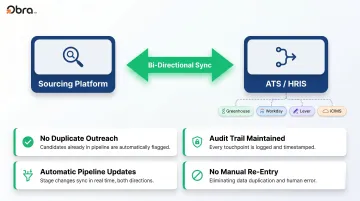
Passive outreach can't live in a silo. Bi-directional ATS sync prevents duplicate outreach, maintains audit trails, and moves candidates into interview pipelines without manual re-entry. Verify native integration with your current stack — Workday, Greenhouse, iCIMS, Lever, and SAP SuccessFactors are the most common requirements.
Pricing Model and Team Scalability
Per-seat annual contracts (like LinkedIn Recruiter's ~$10,000+/seat model) carry significant upfront risk. Usage-based or credit-based models let teams scale more flexibly — especially useful for staffing agencies, lean HR teams, or organizations with variable hiring volume. Freemium entry points let teams validate a platform before any budget commitment.
How We Selected These Tools
The evaluation criteria behind this list:
- Database breadth and verification standards — size matters, but only if the data is accurate and the profiles are real
- AI search and matching capability — competency-based approaches outperform keyword-only for passive talent
- Outreach channel coverage — direct email and phone access, not just platform-gated InMail
- ATS/HRIS integration depth — bi-directional sync with common enterprise platforms
- Pricing accessibility — tools that fit lean teams and agencies, not just Fortune 500 budgets
- Cross-industry suitability — coverage across collar types, not just tech and professional roles
Teams often make one critical mistake: selecting on brand recognition or database size alone, without checking whether the tool provides direct contact info, supports their ATS, or fits their workflow.
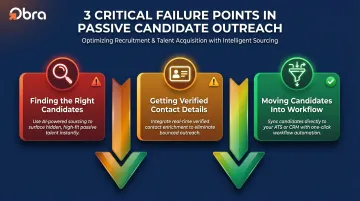
A well-known platform costing $10,000+ per seat per year may be a poor fit for a 3-person HR team or a mid-size staffing firm. The right tool removes friction at three failure points that actually kill passive outreach:
- Finding the right candidates in the first place
- Getting verified contact details without hitting a paywall
- Moving candidates into your workflow without adding administrative overhead
Conclusion
Passive candidate engagement has moved from a specialty tactic to a core recruiting competency. Teams that depend entirely on inbound pipelines are competing for a narrower pool, paying more per hire, and waiting longer to fill roles.
The five platforms covered here each take a different approach:
- Gem and HireEZ — enterprise sequencing and diversity sourcing
- LinkedIn Recruiter — professional network depth
- SeekOut — technical talent intelligence
- Obra Hire — outbound-first sourcing across all collar types and industries
Obra Hire's free plan requires no sales call, no contract, and no credit card — it includes unlimited searches, 1,000 profile views, and 50 contact credits per month. Paid plans start at $109/month and connect directly to 85+ ATS/HRIS platforms. For teams ready to move beyond inbound, it's a low-friction way to start filling roles with candidates who weren't waiting in your queue.
Frequently Asked Questions
What is passive candidate outreach?
Passive candidate outreach is the practice of proactively contacting employed professionals who aren't actively job hunting but may be open to the right opportunity. Recruiters initiate contact with pre-selected candidates rather than waiting for applications to arrive.
What features should I look for in passive candidate outreach software?
The core features to evaluate: a large and verified candidate database, direct contact info access (email and phone), AI-powered search that goes beyond keyword matching, and seamless ATS integration to prevent duplicate outreach and keep candidate records accurate across your hiring workflow.
How does passive candidate outreach software find contact information?
Most platforms aggregate publicly available data across professional networks, job boards, and web sources, then verify and enrich it to reveal direct emails, phone numbers, and LinkedIn profiles — no InMail or platform-gated messaging required.
How is passive candidate outreach different from posting a job ad?
Job ads are inbound — they only reach candidates already searching. Passive outreach is outbound — recruiters contact pre-identified candidates directly, regardless of whether those candidates are browsing openings. The result is a less competitive talent pool with stronger fit, since you're not sorting through hundreds of unqualified applicants.
Is passive candidate outreach software expensive?
Pricing ranges — from enterprise per-seat models costing $10,000+ annually (LinkedIn Recruiter) to usage-based or freemium platforms where teams can start at no cost (Obra Hire). Evaluate total cost of ownership including integrations and recruiter time savings, not just the monthly price.
Can passive candidate outreach software integrate with my existing ATS?
Most leading platforms integrate with Greenhouse, Workday, iCIMS, Lever, and SAP SuccessFactors. Look for bi-directional sync specifically — it prevents duplicate outreach and keeps candidate records consistent without manual re-entry.