But more channels hasn't meant better communication. Both employers and job seekers routinely experience silence, mismatches, and conversations that simply drop mid-funnel. Recruiting teams are managing 93% more applications than in 2021 while operating with 14% smaller teams. Meanwhile, 48% of applicants were ghosted by employers in 2025 — a three-year high.
Understanding how platform communication actually works — the tools, the stages, the failure points — helps both sides get more from the process.
TL;DR
- Hiring platform communication spans every stage: discovery, screening, interview scheduling, and offer delivery
- Employers choose between inbound (waiting for applications) and outbound (proactively searching and messaging candidates) hiring models
- Most platforms handle messaging, scheduling, screener questions, and contact discovery without requiring external apps
- Ghost postings, candidate ghosting, and AI-generated applications are platform-level problems — choosing the right platform reduces all three
What Is Communication on a Hiring Platform?
Hiring platform communication is the structured exchange between employers and job seekers that happens through tools built into a recruitment platform — not through standalone email or phone calls made outside the system.
Posting a job and waiting for applications is one-way broadcasting. Real platform communication is multi-stage and two-way — it spans the full hiring funnel, from first outreach to offer acceptance.
The two parties serve different roles:
- Employers communicate to attract, evaluate, and select — sending outreach, reviewing applications, scheduling interviews, and extending offers
- Job seekers communicate to express interest and demonstrate fit — applying, responding to screener questions, scheduling availability, and negotiating terms
The platform itself shapes how well this exchange works. When both sides operate within the same system, messages don't get lost, timelines move faster, and neither party is left chasing responses through scattered inboxes.
How the Hiring Platform Communication Flow Works
Communication on hiring platforms follows a defined sequence. Each stage uses different tools and serves a different purpose in the employer-candidate relationship.
Initiation: Discovery and First Contact
On an inbound platform, communication starts when a job seeker finds a listing, submits an application, and the employer reviews the notification. On an outbound platform, the employer initiates — searching a candidate database and sending a direct message or connection request to someone who hasn't applied yet.
This distinction matters more than most hiring teams realize. LinkedIn InMail achieves an 18–25% response rate, roughly 3x higher than traditional cold email outreach. Proactive, personalized first contact outperforms waiting for the inbox to fill up.
Screening and Assessment
Once contact is made, platforms facilitate structured back-and-forth through:
- Screener questions embedded directly in job applications
- Automated follow-up messages triggered by application status
- Pre-employment assessments and skills tests that let candidates demonstrate competency
- Employer review of responses inside the platform dashboard
Skills tests function as a structured communication channel — candidates convey their qualifications through results; employers communicate role requirements through assessment design.
Interview Coordination
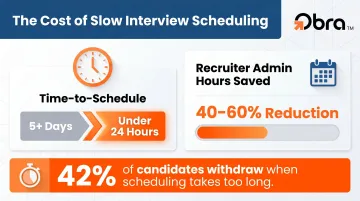
Modern platforms have replaced manual scheduling with integrated calendar links, automated availability matching, and built-in video interview tools. Automating interview scheduling reduces time-to-schedule from 5+ days to under 24 hours and cuts recruiter admin hours by 40–60%.
This stage is also a trust signal. Nearly 42% of job seekers withdraw when interview scheduling moves too slowly, which means speed and clarity here directly affect offer acceptance rates.
Offer and Decision Communication
Final-stage communication typically happens through the platform's messaging system. Employers send offer details — compensation, start date, role specifics — and candidates respond or negotiate through the same channel.
Key capabilities at this stage include:
- Sending and receiving offer letters within the platform (no external email needed)
- Candidate negotiation tracked in a single message thread
- Automatic push of accepted offer data into onboarding workflows via ATS/HRIS integrations
That last point removes the manual handoff between recruiting and HR entirely, which is where offer data most often gets lost or delayed.
Communication Tools Built Into Hiring Platforms
Most hiring platforms now handle employer-candidate communication in one place — faster response times and a complete audit trail without juggling multiple apps.
Messaging and Direct Outreach
Most platforms include in-platform direct messaging — employers send personalized notes to candidates, who can reply, ask questions, or decline. Platforms vary in whether messages land in a platform inbox or route directly to a candidate's email or phone.
Outbound-focused platforms go further. Obra Hire, for example, reveals a candidate's external contact details when an employer spends a contact credit:
- Email address, phone number, and LinkedIn profile surfaced in a single reveal
- Hiring teams reach candidates directly through their preferred channels — no platform-mediated queue
- Credits are consumed only at the moment of reveal, so employers preview candidate pools before committing
Automated Communication
Automation handles the high-volume, time-sensitive tasks that manual recruiting can't keep up with:
- Automated rejection emails (triggered by status change)
- Interview reminders sent to candidates before scheduled calls
- Status update notifications at each funnel stage
- Follow-up nudges for candidates who haven't responded
Together, these keep candidates informed at every stage while cutting recruiter workload on routine follow-ups.
Video and Voice Tools
Built-in video interview functionality and masked phone calling let employers conduct live screening calls without sharing personal contact details. For early-stage screening, that compresses what used to be a multi-day email chain into a single 15-minute call.
Inbound vs. Outbound Communication: Why Direction Matters
The direction of the first message shapes everything that follows.
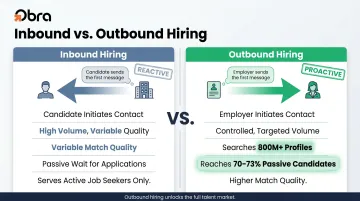
Inbound platforms rely on job seekers to initiate by applying. The employer waits, reviews, and responds. This model works when the talent pool is actively job hunting and volume is manageable.
Outbound platforms let employers initiate by searching a candidate database and sending direct messages — reaching people who haven't applied and may not be looking at all.
That distinction matters because 70–73% of professionals are passive candidates — not actively seeking new roles. Waiting for them to apply means they'll never appear in your inbox.
That's the core case for outbound-first platforms. Obra Hire, for example, lets hiring teams search 800M+ candidate profiles, filter by job title, location, years of experience, and skills, and use competency-based matching to rank results by fit before spending any contact credits. The practical difference in communication quality:
| Model | Volume | Match Quality |
|---|---|---|
| Inbound | High — many unqualified applicants | Variable — anyone can apply |
| Outbound | Controlled — employer selects who to contact | Higher — filtered by specific competencies first |
For teams filling roles with specific skill requirements, the outbound model means every conversation starts with a pre-qualified candidate — not a cold resume pile.
Why Hiring Platform Communication Breaks Down
Most communication failures on hiring platforms are structural. They're predictable, and they're largely platform-dependent.
Ghost Job Postings
According to a 2024 Resume Builder survey of 1,641 hiring managers, 40% of companies posted a fake job listing in the past year, and 3 in 10 currently have active fake listings. The reasons range from collecting resumes for future use (59%) to making staff feel replaceable (62%).
For job seekers, the result is silence. Applications submitted, no response, no explanation. Over 90% of job seekers believe ghost postings distort perceptions of a healthy job market.
Low job ad costs have made this worse. When posting costs almost nothing, there's little friction discouraging employers from maintaining listings they have no immediate intent to fill.
Candidate Ghosting
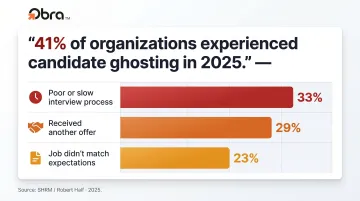
SHRM reported in 2025 that 41% of organizations experienced candidates ghosting mid-process. Robert Half research identifies the primary reasons:
- Poor or slow interview process (33%)
- Received another offer (29%)
- Job didn't match expectations (23%)
When a hiring process drags or communication goes quiet on the employer side, candidates move on without warning.
AI-Generated Applications and Fake Profiles
Job applications have risen 239% since ChatGPT's release in 2022, according to The Economist. Recruiting teams are fielding nearly double the volume with smaller headcounts, and fake candidate profiles — complete with fabricated employment histories and AI-generated answers — are widespread on platforms that lack identity verification. Gartner projects this will affect 1 in 4 profiles by 2028.
Obra Hire's Verified Profile Filtering (available on Explore and Scale plans) filters search results to surface verified candidates, reducing exposure to AI-generated submissions before they reach a recruiter's queue.
Across all three patterns, the common thread is platform design. Verification, outbound search capability, automated follow-up, and ATS integration address the friction points before silence becomes the default on either side.
Frequently Asked Questions
How do companies communicate job offers?
Most hiring platforms let employers send offer details — compensation, start date, and role specifics — through a built-in messaging system. Platforms with ATS/HRIS integrations automatically push accepted offer data into onboarding workflows, cutting out manual handoffs between recruiting and HR.
Which platform is most used by professionals and job seekers?
LinkedIn dominates for professional roles, with 1.3 billion registered members and 78% of recruiters using it for sourcing. Indeed leads for general job search volume. Outbound-focused platforms like Obra Hire are increasingly used by employers targeting passive candidates at scale.
Which method of recruitment involves using social media platforms to attract potential candidates?
Social recruiting uses platforms like LinkedIn, Facebook, and X to post openings, engage talent communities, and evaluate candidates through their public profiles. Currently, 91% of employers use social media for hiring — 82% of them specifically to reach passive candidates.
What is the difference between inbound and outbound hiring communication?
Inbound communication starts when a candidate applies to a job posting. Outbound communication starts when an employer proactively searches for and messages a candidate directly — reaching passive talent who isn't actively job hunting.
What are ghost job postings and how do they affect job seekers?
Ghost job postings are live listings employers have little or no intent to fill quickly — sometimes maintained just to collect resumes or signal growth. They result in no communication with applicants, wasting job seeker time and eroding trust in the hiring process.
How do employers contact passive candidates on hiring platforms?
Outbound hiring platforms like Obra Hire allow employers to search verified candidate databases, filter by skills or experience, and reveal direct contact details — email, phone, and LinkedIn — to initiate conversations without waiting for an application, spending credits only when contact information is unlocked.