Introduction
Engineering roles are among the hardest positions to fill — and 2026 has made the problem worse. Hiring teams are drowning in AI-generated applications while the candidates they actually want rarely respond to job postings. According to Gem's 2025 data, software engineering roles take an average of 62 days to fill — nearly 50% longer than the cross-industry average — and top candidates are off the market within 10 days.
Posting to more job boards won't close that gap. The teams hiring fastest in 2026 have built a deliberate stack: outbound sourcing to find passive candidates, technical screening to filter fast, and scheduling automation to move quickly once interest is confirmed.
Below, you'll find the top tools across four hiring stages — sourcing, assessment, ATS/tracking, and scheduling — plus a selection criteria guide to match the right combination to your team size and budget.
TL;DR
- Engineering roles take 62 days to fill on average; the right tool stack can compress that timeline significantly.
- 73% of software engineers are passive candidates — job boards alone won't reach them.
- AI-generated applications are surging; prioritize tools with verified candidate filtering.
- Effective hiring stacks pair an outbound sourcing tool with an ATS, technical assessment platform, and scheduling solution.
- Obra Hire provides outbound access to 800M+ verified profiles across a freemium model with no contract.
The Software Engineer Hiring Landscape in 2026
Software engineer hiring tools span four categories: candidate sourcing platforms, applicant tracking systems (ATS), technical assessment software, and scheduling automation. Each addresses a distinct stage of the pipeline, and most hiring teams need all four working together.
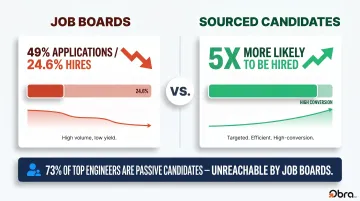
By 2026, inbound-only hiring has broken down on two fronts at once. 73% of professionals are passive candidates according to LinkedIn's own data — meaning they aren't browsing job boards. On the other side, 38% of job seekers now mass-apply using automated tools, and Gartner analysts projected that by 2028, roughly one in four applicants could be fabricated.
The numbers tell the story clearly:
- Job boards generate 49% of applications but only 24.6% of actual hires
- Sourced candidates are 5x more likely to be hired than inbound applicants
- Teams relying on resume review alone face escalating false-positive rates with no reliable filter
The tools below address both problems — evaluated on candidate quality and verification, technical screening capability, ATS compatibility, ease of adoption, and cost relative to outcome.
Best Tools for Managing Software Engineer Hiring in 2026
These five tools were selected for their direct impact on reducing friction across the software engineer hiring pipeline, from finding the right candidates to closing them efficiently.
Obra Hire
Obra Hire is an AI-powered outbound candidate sourcing platform built specifically for the current hiring environment. Rather than waiting for inbound applications, it gives recruiters and hiring managers direct access to 800M+ verified candidate profiles — including software engineers across all specializations — with AI-powered search that uses competency-based matching instead of keyword filtering.
A few things distinguish it from general sourcing tools:
- SkillsTree competency matching maps candidates against 8,241 skills with proficiency levels, so results reflect actual capability alignment rather than resume keyword presence
- Verified profile filtering (on Explore and Scale plans) surfaces candidates with authenticated professional histories, reducing exposure to AI-generated or fabricated profiles
- Preview before committing — recruiters can see pool size and browse full profiles before spending any credits; credits are only consumed when contact details are revealed
- Contact reveal includes email, phone number, LinkedIn URL, and resume — direct access without third-party gatekeepers
- 85+ ATS/HRIS integrations including Workday, Greenhouse, Lever, iCIMS, and SAP SuccessFactors
The team-based Scale plan ($169/month) includes shared credit pools, so when one recruiter unlocks a candidate, the contact details become visible to the entire team — no duplicate credit spending.
| Attribute | Details |
|---|---|
| Key Features | AI-powered outbound search, 800M+ verified profiles, competency-based SkillsTree matching, verified profile filtering, preview before spending credits, 85+ ATS/HRIS integrations |
| Pricing | Free (1,000 profile views + 50 contact credits/month); Explore ($109/month, 500 credits); Scale ($169/month, 1,200 credits + team collaboration); Enterprise (custom) |
| Best For | Hiring managers and recruiters at any company size who want to reach passive software engineering candidates without paying for expensive agency seats or job board distribution |
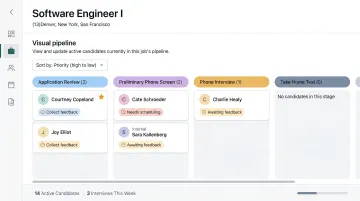
Greenhouse
Greenhouse is a structured ATS purpose-built for scaling engineering hiring across multiple roles and locations. It's the right fit for teams that need consistent, auditable hiring processes — not just a place to track applicants.
What makes it worth the investment for engineering teams:
- Interview scorecards standardize how engineers evaluate candidates, reducing inconsistency across interviewers
- Native integrations with HackerRank and Codility let teams send assessments and view results directly within Greenhouse — no manual data transfer
- Pipeline reporting identifies bottlenecks by role, department, or hiring stage
- Ranked #1 in 57 G2 reports in Spring 2026, including Mid-Market and Enterprise categories
Greenhouse pricing is custom-quoted (Core, Plus, and Pro tiers). Buyer-reported data puts the median annual contract around $12,250, with deals ranging from $5,100 to $36,000 depending on company size.
| Attribute | Details |
|---|---|
| Key Features | Structured interview workflows, scorecards, pipeline reporting, 500+ tool integrations including HackerRank and Codility |
| Pricing | Custom pricing (contact sales); median ~$12,250/year reported |
| Best For | Growing engineering orgs that need a centralized, auditable hiring process with strong integration support |
HackerRank
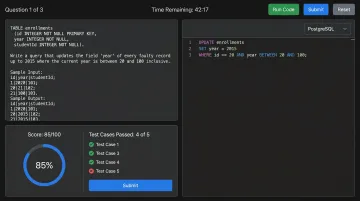
HackerRank is the most widely adopted technical assessment platform for engineering hiring, used by over 2,500 companies and 40% of developers worldwide. It solves a specific problem: non-technical recruiters can't effectively evaluate coding ability from a resume, and unfiltered interviews waste senior engineering time.
Key capabilities:
- 7,500+ assessment questions across 60+ programming languages (Enterprise tier)
- Plagiarism detection and AI proctoring — critical in 2026 given the volume of AI-assisted submissions
- Live coding interview tools for collaborative technical sessions
- Role-specific pre-built tests that let recruiters shortlist candidates before any live interview
WePay used HackerRank to filter applicants to the top 6% of their pool — avoiding manual review of 94% of candidates — while simultaneously increasing female engineering representation to 50%.
Published pricing starts at $1,990/year (Starter, 120 attempts/year) and $4,490/year (Pro, 300 attempts/year, includes ATS integrations). Enterprise is custom-quoted.
| Attribute | Details |
|---|---|
| Key Features | Code assessments, 60+ languages, 7,500+ questions (Enterprise), live coding interviews, AI proctoring, plagiarism detection |
| Pricing | Starter: $1,990/yr; Pro: $4,490/yr; Enterprise: custom |
| Best For | Recruiters and engineering managers who need to validate technical skills early in the pipeline before committing interviewer time |
LinkedIn Recruiter
With 1.2 billion members, LinkedIn Recruiter offers the widest sourcing reach of any platform on this list. Advanced filters for engineering specialization, location, and experience level make it a viable layer for teams that need broad visibility and have the budget to support it.
That said, the honest picture in 2026 has some friction:
- InMail response rates sit below 13% on average — passive engineers are inundated with outreach
- Corporate tier pricing rose ~15% in 2026, now landing at $10,800–$12,960 per seat per year
- LinkedIn does not filter AI-generated or inflated profiles, making cost-per-quality-hire a key consideration versus newer alternatives
The platform's primary advantage is reach and brand recognition. Where it falls short is candidate quality filtering and response efficiency — two areas where the cost-per-quality-hire math gets harder to justify at $10K+ per seat.
| Attribute | Details |
|---|---|
| Key Features | Advanced candidate search, InMail outreach, talent pipeline management, job posting, market insights |
| Pricing | Recruiter Lite: ~$1,680/yr (1 seat); Corporate: $10,800–$12,960/yr per seat |
| Best For | Teams with larger recruiting budgets seeking broad network access and brand visibility alongside passive candidate outreach |
GoodTime
Interview scheduling is where recruiter hours quietly disappear — and GoodTime is built to reclaim them. For engineering roles with 4–6 round technical loops, coordinating availability across candidates and interviewers becomes a genuine bottleneck.
GoodTime automates that coordination:
- Automatically matches candidate availability with interviewer calendars — no back-and-forth email chains
- Interviewer load balancing distributes interview requests equitably across the engineering team
- Scheduling analytics reveal exactly where interview cycles stall
- Integrates with Greenhouse, Workday, Lever, Zoom, Google Meet, and Microsoft Teams
GoodTime clients report an 88% reduction in scheduling time and 75% increase in hiring team productivity (vendor-reported). Pricing is based on annual candidate volume rather than per-seat, with buyer-reported deals ranging from $14,000–$22,000 annually.
| Attribute | Details |
|---|---|
| Key Features | Automated scheduling, interviewer load balancing, candidate self-scheduling, calendar integrations, scheduling analytics |
| Pricing | Custom quote; buyer-reported $14,000–$22,000/year based on candidate volume |
| Best For | Engineering hiring teams running high-volume or multi-stage interview processes who want to cut recruiter coordination overhead |
How We Chose the Best Software Engineer Hiring Tools
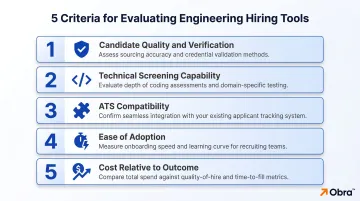
Tools were evaluated on five criteria specific to engineering hiring — not general recruiting:
- Candidate quality and verification — separates real, qualified engineers from AI-generated noise in the applicant pool
- Technical screening capability — gives non-technical recruiters a way to assess coding ability without pulling an engineer off their work
- ATS compatibility — integrates cleanly into existing workflows rather than creating another disconnected data silo
- Ease of adoption — no months-long implementation, no mandatory sales call required to get started
- Cost relative to outcome — measures seat license cost against actual cost-per-hire reduction, not just feature count
Meeting these criteria narrows the field significantly. Before getting to the tools that made the cut, it's worth knowing what disqualified the others.
Common Mistakes to Avoid
Hiring teams frequently make three costly errors when building their tool stacks:
- Choosing general hiring tools that lack engineering-specific features — no skills taxonomies, no code assessments, no technical interview support
- Over-investing in job board distribution when passive candidate outreach delivers lower cost-per-hire and higher offer acceptance rates
- Stacking disconnected tools without checking integration depth — enterprise teams using 18+ disconnected recruiting tools face 43% candidate drop-off rates and an average $2.3M annual loss in missed talent. Each additional disconnected system adds another 12–15% drop-off on top of that.
The highest-performing stacks share the same structure: an outbound sourcing tool that feeds directly into an ATS, an assessment platform with native ATS integration, and scheduling automation that syncs with both. Three tools, no gaps.
Conclusion
Software engineer hiring in 2026 doesn't reward passive strategies. The teams filling roles faster are combining outbound sourcing to reach passive candidates, structured assessment to filter on actual ability, and scheduling automation that compresses interview cycles — not waiting on inbound job posts and manual coordination.
When evaluating tools, look beyond individual feature lists. Ask how each tool integrates with the others in your stack, how the cost scales with hiring volume, and what the true cost-per-hire looks like across the full funnel. Developer cost-per-hire averages $28,548 — a bloated, disconnected stack makes that number worse, not better.
That number is where tool selection becomes concrete. For teams looking to replace expensive recruiting seats with a faster way to reach verified software engineering candidates, Obra Hire offers a free starting point with no contract and no setup required. You can preview your candidate pool before spending a single credit, with access to 800M+ profiles and competency-based matching from day one.
Frequently Asked Questions
What is the difference between a candidate sourcing tool and an ATS for engineering hiring?
Sourcing tools proactively identify and reach passive candidates before they apply — that's outbound. An ATS manages candidates who have already entered your pipeline. Most effective engineering hiring stacks use both: sourcing tools to fill the top of the funnel, an ATS to manage candidates through interviews and offers.
How do you screen software engineers for technical skills without a technical interviewer in the room?
Platforms like HackerRank let non-technical recruiters send standardized coding assessments with automated scoring, filtering candidates by actual ability rather than resume keywords. Engineering time is then reserved for candidates who've already demonstrated baseline competency in a live setting.
How can hiring teams tell if a job applicant's profile was AI-generated?
Manual detection is unreliable as AI-generated profiles grow more sophisticated. Tools with verified profile filtering — like Obra Hire — surface candidates with authenticated professional histories, filtering out fabricated or inflated profiles before they reach resume review.
What does it typically cost to hire a software engineer?
The average cost-per-hire for software developers is approximately $28,548 — roughly 6x the cross-industry average of $4,129 (SHRM, 2025). The right sourcing and assessment tools reduce this by cutting agency fees, shortening time-to-fill, and eliminating wasted interviews on unqualified candidates.
Can these hiring tools integrate with the ATS or HRIS my team already uses?
Most modern tools do. Obra Hire supports 85+ ATS/HRIS integrations including Workday, Greenhouse, Lever, and iCIMS. Look for native integrations specifically — not just Zapier workarounds — to avoid data re-entry overhead that slows recruiting teams down.
What hiring tools are best for small teams or startups hiring their first software engineers?
Start with Obra Hire's free plan (50 contact credits/month) paired with a lightweight ATS like Lever or Ashby. If response rates are low, the Explore plan at $109/month with 500 credits is more realistic for active hiring. Skip enterprise platforms — the setup overhead isn't worth it at small scale.