The cost of getting this wrong is real. According to Deloitte data cited by Tatvic, unfilled technical roles cost companies roughly $500 per day in lost productivity. A 90-day search for an AI/ML engineer — which is close to the current average — can run $45,000 in deferred output before you've made a single hire.
This guide is a practical playbook for hiring teams who need to adapt. It covers how to source proactively, screen accurately, and close candidates before someone else does.
TL;DR
- Inbound job posts are flooded with AI-generated applications — outbound sourcing is now the baseline
- Define roles around skills and competencies, not years of experience or job titles
- Speed, flexibility, and employer brand determine whether top candidates choose you
- Screening must include verification steps to filter fake and AI-generated profiles
- How candidates experience your hiring process shapes retention before day one
Why Hiring Tech Talent in 2026 Is Uniquely Hard
The AI Application Problem
Inbound pipelines have been compromised. Greenhouse reported a 4x increase in application volume driven by AI-enabled tools, with hiring managers now classifying 50% of incoming applications as spam. Auto-apply tools let a single job seeker submit up to 1,000 applications per month. A separate study cited by Forbes put the share of AI-generated job applications at 61%.
High application counts used to mean strong interest. Now they signal the opposite — and screening through the noise consumes recruiting capacity that should go toward actual candidates.
The Supply-Demand Gap
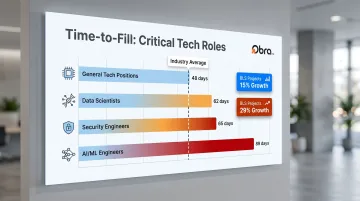
Demand for technical talent continues to outpace supply. The Bureau of Labor Statistics projects 15% growth for software developers through 2034, generating 156,100 annual openings against an existing base of 1.9 million jobs. Information security analysts face 29% projected growth over the same period.
| Role | Avg. Time-to-Fill |
|---|---|
| General tech positions | 48 days |
| Data Scientists | 62 days |
| Security Engineers | 65 days |
| AI/ML Engineers | 89 days |
The Competition Dimension
Remote work turned a regional talent market into a global one. A startup in Austin now competes directly with Google and Meta for the same full-stack developer in Denver. Strong candidates often receive multiple offers within days of becoming available — sometimes before they've even updated their LinkedIn status.
The pattern that consistently loses these candidates:
- Relying on inbound applications as the primary sourcing channel
- Multi-week screening processes with long gaps between touchpoints
- Slow offer timelines that assume candidates will wait
Closing that gap requires a different approach — one built around finding and engaging candidates before they enter the open market.
Before You Source: Define Roles Around Skills, Not Titles
"5 years of experience with React" is not a hiring requirement — it's a filter that eliminates fast learners, attracts resume-padders, and frequently has nothing to do with what the role actually demands.
Build a Skills Profile Instead
Replace title- and tenure-based job descriptions with a structured competency profile. For any tech role, this means identifying three layers:
- Must-have technical competencies — specific languages, frameworks, system design principles, or tools the person genuinely needs on day one
- Behavioral indicators — how they approach ambiguity, collaborate across teams, communicate technical tradeoffs to non-technical stakeholders
- Growth-potential markers — evidence of learning velocity, curiosity, and trajectory rather than just current skill level
These criteria serve double duty: they define who you're looking for and become the evaluation rubric during screening. Hiring managers who've thought through this upfront make faster, more confident decisions.
Align Before You Source
A skills profile is only useful if both sides agree on it. Misalignment between recruiters and hiring managers on what "good" looks like is why tech hiring processes stall or produce poor hires. Before sourcing begins, both parties should agree on:
- Which competencies are true must-haves vs. nice-to-haves
- What a strong portfolio or work history signal looks like for this role
- What the deal-breakers are (and that they're actual deal-breakers, not preferences)
Most teams can align in under 30 minutes. Skipping it tends to cost weeks of misaligned sourcing and stalled decisions.
Where to Find Tech Talent in 2026
Shift from Inbound to Outbound Recruiting
73% of professionals are passive candidates — not applying, not browsing job boards. That statistic alone makes "post and pray" indefensible as a primary strategy.
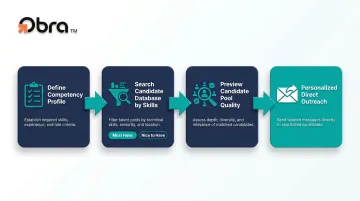
Outbound sourcing means identifying and contacting candidates directly, rather than waiting for them to find you. In practice:
- Define the competency profile (see above)
- Search a large candidate database using skills-based filters — not just job titles
- Preview the pool before committing spend to confirm the results match the target
- Reach out directly with a personalized message that leads with the role's actual technical challenge
Obra Hire's outbound platform gives hiring teams access to 800M+ candidate profiles searchable by competency, role, location, and experience level. Teams can preview the size and quality of a candidate pool before spending a single contact credit, which matters when you're working with a lean recruiting budget. Contact reveals include email, phone, LinkedIn URL, and resume.
The distinction between competency-based search and keyword search is worth understanding. Keyword search returns candidates whose resumes contain a term. Competency-based search, which Obra Hire powers through structured skill data with Must Have and Nice to Have tiers, surfaces candidates who actually demonstrate the skill at a relevant proficiency level — regardless of how their resume is worded.
Tap into Passive and Niche Candidate Pools
Beyond large profile databases, several sourcing channels are underutilized and less saturated than LinkedIn:
- GitHub has over 180 million registered developers globally (36 million added in 2025 alone). Open-source contributors show their actual work, not just a resume summary.
- Niche Slack and Discord communities for stacks like Elixir, Rust, or specific cloud platforms draw tight clusters of strong engineers who rarely post on LinkedIn.
- Coding bootcamp alumni networks offer high learning velocity, often more affordable candidates, and a pool that's frequently underrepresented in traditional sourcing.
- Developer forums and Stack Overflow let you identify active contributors in specific domains — useful for building a targeted outreach list.
Employee referrals remain one of the highest-ROI sourcing channels available. Referred candidates are 10–15x more likely to be hired than job board applicants, and 46% of referral hires stay longer than traditionally sourced counterparts — despite making up only 7% of all applicants. Most companies underinvest here.
How to Attract Top Tech Candidates
Employer Brand and Compensation
Tech candidates research companies before responding to outreach. What they're looking for:
- Visible engineering culture — technical blog posts, open-source contributions, talks at conferences
- Transparent leadership and genuine team diversity
- Social proof from current engineers on LinkedIn or Glassdoor
On compensation: 57% of candidates have rejected offers citing low or unclear pay. Salary benchmarking against tools like Levels.fyi, Radford, or Glassdoor is non-negotiable. In 2026, competitive packages include equity, flexible PTO, remote stipends, and learning budgets — not just base salary. Smaller companies often can't match FAANG base salaries, but can differentiate on equity and ownership alone.
Flexibility and Speed
Two numbers every hiring team should know:
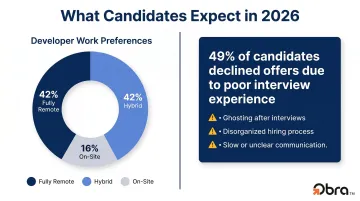
- 42% of developers work fully remote; another 42% work hybrid — only 16% are on-site. Companies mandating full in-office without compelling justification are cutting their addressable talent pool significantly.
- 49% of candidates have declined offers due to poor interview experience — disorganization, ghosting, and slow communication are leading causes.
Slow processes signal dysfunction. Candidates evaluate your company throughout hiring, and a disorganized timeline is its own red flag. A two-week close from first outreach to offer is achievable for most tech roles. Communicate timelines clearly at every stage.
Lead With Impact, Not Job Security
Tech professionals respond to hard problems and clear career trajectory. During outreach and interviews, lead with:
- The specific technical challenges they'd own
- The scope of impact (users affected, systems scale, team influence)
- What growth looks like in 12–24 months
"Competitive salary and great culture" is what every company says. The engineering problem you actually need solved, stated concisely and honestly, is what gets a response.
Screening, Assessing, and Deciding Faster
Filtering Fake and AI-Generated Profiles
Screening now requires verification steps that didn't exist two years ago. Before investing time in any candidate, check for:
- Portfolio or GitHub consistency with claimed experience
- Work history signals that hold up across multiple sources
- Authentic profile details that don't read as AI-generated summaries
Obra Hire's verified profile filtering surfaces authenticated candidates and blocks AI-generated or fake profiles — Gartner projects this will affect 1 in 4 profiles by 2028. Filtering at the sourcing stage keeps these profiles from consuming recruiter time later in the process.
Structured Technical Assessment
A well-designed technical screen should be:
- 60–90 minutes maximum — respect candidates' time
- Relevant to actual work — not abstract puzzles disconnected from the role
- Evaluated with a consistent rubric — standardized scorecards reduce bias and dramatically speed up debrief conversations when multiple interviewers are involved
Research published in PMC found that structured interviews reduce bias, increase diversity, and produce more successful hires. Google adopted structured interviewing as its standard method based on this evidence.
Evaluating Soft Skills
A survey of 1,005 hiring managers found that 62% consider hard and soft skills equally valuable in 2026, with communication, professionalism, and accountability topping the soft skills list.
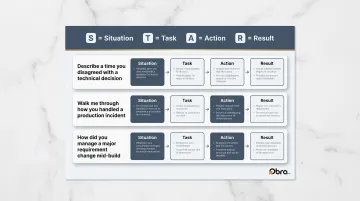
Use the STAR method (Situation, Task, Action, Result) applied to engineering-specific scenarios:
- Describe a time you disagreed with a technical decision and how you handled it
- Walk me through a production incident you led the response to
- Tell me about a project where the requirements changed significantly mid-build
These questions reveal how someone collaborates, communicates under pressure, and navigates ambiguity. For most roles, those qualities predict long-term performance more reliably than coding scores alone.
Close Fast
Once assessments wrap, speed becomes a competitive advantage. Debrief within 24 hours of final interviews and send offers within 48 hours of the decision. Candidates who wait more than a week after final rounds frequently disengage, and the ones who do are usually talking to a team that moved faster.
Retention Starts Before Day One
The signals candidates receive during your hiring process set their expectations for what working at your company will actually feel like. Disorganized interviews, slow communication, and a generic offer letter all predict what comes after day one. Getting retention right means addressing both of these areas before a new hire ever logs in for their first day.
Structured Onboarding
30% of new hires leave within their first 90 days. The fix is well-documented and underused: structured onboarding. Research compiled by Devlin Peck shows structured onboarding improves retention by 82% and increases new hire productivity by 60%. Despite this, only 12% of employees say their company does onboarding well.
For tech hires specifically, effective onboarding includes:
- Connecting new hires to teammates before day one
- Clear 30/60/90-day expectations with defined early wins
- Assigned technical mentors or pairing partners for the first month
Career Pathing
Tech professionals who can see a clear growth and promotion trajectory are significantly less likely to leave within the first year. Raise this during the offer conversation — not after they've started.
Candidates who hear a coherent answer to "what does success look like in two years?" are more likely to accept. Practical ways to make career pathing concrete:
- Share a skills progression map or leveling guide during the offer stage
- Define what a promotion from this role requires — skills, tenure, output
- Schedule a 6-month career check-in as part of the offer conversation itself
Frequently Asked Questions
What is talent acquisition (TA) in a company?
Talent acquisition is the strategic, long-term approach to identifying, attracting, and hiring the right people. Unlike reactive recruiting, TA involves proactive pipeline-building, employer branding, and workforce planning aligned to company growth rather than simply filling open seats as they appear.
What is a tech recruiter?
A tech recruiter is a specialist who sources, screens, and facilitates the hiring of technical professionals. They bridge hiring managers and candidates, requiring enough technical fluency to evaluate roles and enough relationship-building skill to keep candidates engaged throughout the hiring process.
What are the duties of a tech recruiter?
Core responsibilities include: defining role requirements with hiring managers, sourcing active and passive candidates, conducting screening interviews, managing candidate experience, coordinating assessments, and facilitating offer and negotiation conversations.
How long does it typically take to hire a tech employee?
According to a 2025 recruiting benchmarking analysis by Kore1, the U.S. average time-to-fill for tech roles is 48 days, with AI/ML engineers averaging 89 days. Competitive teams using outbound sourcing and pre-built pipelines can compress this to under 30 days.
How can small companies compete with big tech firms for talent?
Lead with what larger companies can't offer: meaningful ownership of real problems, faster career advancement, genuine flexibility, transparent culture, and equity upside. Then move faster than they can — most large companies take 6–8 weeks to close a role. You can do it in two.
What is the biggest mistake companies make when hiring tech talent in 2026?
Relying solely on inbound applications. The best candidates aren't browsing job boards, and the applications flooding your inbox are increasingly AI-generated. Companies that don't proactively source and verify candidates consistently lose to those that do.