Meanwhile, hiring teams are spending more time and budget than ever, with worse results to show for it. The old playbook — post a job, screen inbound applications, repeat — simply doesn't work when the candidates you need aren't looking.
This post breaks down the four challenges hitting IT recruitment hardest in 2026 — talent scarcity, AI-generated fake applicants, slow hiring cycles, and widening skills gaps — and lays out practical, forward-looking solutions for each.
TL;DR
- The IT talent shortage is structural, not cyclical — AI, cloud, and cybersecurity demand far outpaces candidate supply
- Most top IT candidates are passive; they won't find you through a job board
- AI-generated fake applicant profiles are a real and growing 2026 threat that wastes recruiter time and inflates application volume
- Slow hiring cycles (averaging 43 days for tech) push top candidates to faster competitors
- Winning in 2026 means going outbound-first, with proactive sourcing backed by verified candidate data
Challenge 1: The IT Talent Shortage and the Passive Candidate Problem
The numbers paint a stark picture. There are currently 4.8 million unfilled cybersecurity positions globally, according to the ISC2 2025 Cybersecurity Workforce Study. That's one role category. Across all of IT, AI skills have now overtaken every other category as the hardest to source globally, with AI Model and Application Development cited by 20% of employers as their most critical gap.
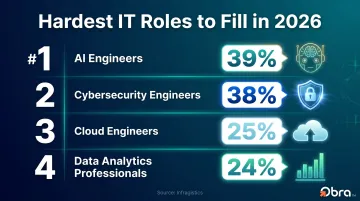
The hardest roles to fill heading into 2026, according to Infragistics:
- AI engineers — cited by 39% of organizations
- Cybersecurity engineers — 38%
- Cloud engineers — 25%
- Data analytics professionals — 24%
What makes this structural rather than temporary? Skill requirements are evolving faster than educational pipelines can respond. Companies adopting AI tools in 2024 are now hiring for roles that didn't exist two years prior. No university curriculum adjusts that quickly.
Why Waiting for Inbound Applications Doesn't Work
The "post and pray" model assumes qualified candidates are browsing job boards. Most aren't. According to LinkedIn's global talent research, approximately **70-73% of professionals are passive candidates** — employed, not actively applying, but potentially open to the right opportunity.
That means when you post a job, you're fishing in roughly 27-30% of the available talent pool. The best candidates — the ones already doing great work somewhere else — rarely see your posting.
Here's what makes it harder: every other recruiter in your space has figured this out too. Passive IT candidates now receive frequent outreach from multiple sources simultaneously. Generic, templated messages get ignored. Personalized outreach referencing a candidate's actual skills or experience increases response rates by 35%, per LinkedIn data.
How Outbound Recruiting Changes the Equation
Outbound recruiting flips the model. Instead of publishing a listing and waiting, you search a verified candidate database, identify people who match your actual requirements, and reach out directly, before they're on anyone else's radar.
Obra Hire gives recruiting teams access to 800M+ candidate profiles with direct contact reveal (email, phone, LinkedIn, and resume) when a contact credit is used. Rather than keyword-matching against resume text, the platform uses competency-based matching, structured data showing how well a candidate's skills align with your defined requirements, broken down into "Must Have" and "Nice to Have" criteria.
Key advantages of that approach:
- Preview the full candidate pool size and browse profiles before spending a single credit
- Avoid committing budget to sparse or misaligned searches
- Spend time engaging qualified candidates instead of filtering out unqualified ones
Challenge 2: AI-Generated Fake Applicants Are Flooding the Funnel
This challenge barely registered two years ago. Now it's one of the defining problems in tech hiring.
Generative AI tools make it trivially easy to fabricate a compelling resume, complete with invented certifications, realistic-sounding project histories, and polished formatting. According to Gartner, by 2028, 1 in 4 job candidates worldwide will be fake. A Resume Genius survey found that 17% of hiring managers have already encountered candidates using deepfake technology to alter their video interviews — and that figure is from 2025.
The practical damage goes beyond embarrassment — it's expensive. SHRM estimates bad hires cost between 100-150% of annual salary for mid-level technical roles. When a fraudulent candidate clears screening and gets hired, the cost of unwinding that decision is significant — lost project time, rework, and a restart of the entire hiring process.
What Makes IT Roles Especially Vulnerable
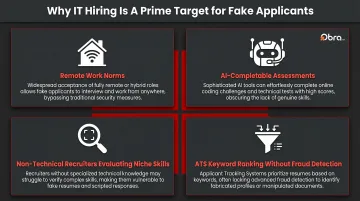
IT positions attract a disproportionate share of fake applicants for several reasons:
- Remote-first hiring norms make identity verification harder — 39% of the technical workforce operates fully remote or hybrid
- Take-home technical assessments can be completed entirely by AI, with no way to detect it after the fact
- Non-technical recruiters evaluating niche domains (machine learning, Kubernetes) are assessing terminology they don't fully understand — misrepresentation is easy to hide
- Traditional ATS systems rank candidates by keyword density, not verified authenticity — they were built for volume filtering, not fraud detection
The result: a hiring funnel that looks productive (high application volume) but is actually compromised. More applications, fewer real candidates.
Screening for Verified, Real Candidates
Practical defenses include:
- Search verified candidate databases that filter out AI-generated and fake submissions before recruiters invest time reviewing them — Obra Hire's Explore and Scale plans include verified profile filtering for exactly this
- Conduct technical assessments live, not asynchronously, so candidates can't use AI tools to complete them on your behalf
- Cross-check claimed skills against portfolio work, public commit history, or verifiable credentials — not just resume text
- Preview candidate pool quality before spending budget — Obra Hire shows pool size and sample profiles before any credits are used, so teams can confirm they're engaging real, relevant candidates
Verified profile filtering requires Obra Hire's Explore ($109/month) or Scale ($169/month) plan — it's not available on Free. Given that a single bad hire at mid-level can cost more than a year's salary to unwind, the filtering capability is worth evaluating early in your process.
Challenge 3: Slow Hiring Processes Are Costing You Top IT Talent
The average time-to-hire for tech roles sits at approximately 43 days according to SHRM benchmarks — and that's the industry average, not the worst case. Small-to-mid-size companies average closer to 83 days, per Employ's 2026 benchmark data.
Top IT candidates don't wait 43 days — most accept offers within a week of starting their search. Per Averity's 2026 hiring data, 26% of candidates have rejected offers specifically because of slow communication or unclear expectations. You can lose a candidate before you've even extended an offer, just by taking too long to respond after an interview.
The most common causes of hiring delays in IT:
- Too many interview rounds with no clear decision criteria
- Misaligned stakeholders (engineering wants a technical bar, HR wants speed, finance wants headcount approval)
- Slow feedback loops between hiring managers and recruiting teams
- Manual screening of inflated application volumes — average applications per opening reached 257.6 in 2025, up from 207 in 2024
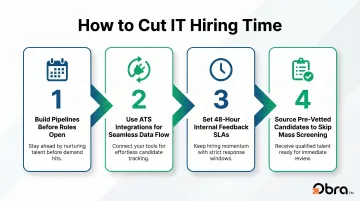
How to close the speed gap:
- Build candidate pipelines before roles open — proactive sourcing means you have qualified candidates ready to contact the day a vacancy is approved, not 30 days after
- Use ATS integrations that connect outbound sourcing directly to your existing workflow — Obra Hire integrates with 85+ platforms including Workday, Greenhouse, iCIMS, Lever, and SAP SuccessFactors, pushing candidate data directly without manual export steps
- Set internal SLAs for feedback — 48 hours post-interview is a reasonable ceiling; anything longer is a structural problem worth fixing
- Source pre-vetted candidates rather than filtering through hundreds of unqualified inbound applications to cut screening time significantly
In practice, the hiring team that moves from first contact to offer in 10 days doesn't just fill the role faster — it fills it with candidates who've already declined slower-moving competitors.
Challenge 4: Widening IT Skills Gaps and Rapidly Shifting Requirements
The shelf life of a technical skill has dropped dramatically. According to CIO.com's analysis of industry data, functional technical skills become outdated approximately every 2.5 years — down from a decade or more in previous generations. The World Economic Forum estimates that 39% of existing skill sets will be transformed or obsolete between 2025 and 2030.
For IT recruiters, this creates a real problem: someone who "knows Python" or "has cloud experience" may be describing skills from three years ago that no longer match current requirements. A job description written in keyword terms — "5 years of AWS experience" — can't tell the difference between someone who deployed production workloads last month and someone who completed an introductory course in 2021.
Non-technical recruiters face this problem acutely. SHRM reports that 22% of hiring managers admit they lack the skills to interview and evaluate candidates effectively — a number that's likely higher in technical domains where the hiring manager has no hands-on expertise.
Solutions:
- Define roles by what the person needs to accomplish, not just what tools they've used. Competency-based job definitions filter out stale credentials before interviews begin.
- Prioritize reskilling for current employees. ManpowerGroup found 27% of employers now treat internal upskilling as their primary response to talent shortages — and it's cheaper than replacing people.
- Drop degree requirements where credentials don't predict performance. SHRM found 76% of companies that removed degree filters successfully hired candidates who'd previously been screened out.
- Use sourcing platforms that match by skill alignment rather than resume keywords. Obra Hire's SkillsTree taxonomy maps 8,241 skills with proficiency levels, so searches return candidates who match current role requirements — not just those who listed the right buzzwords.
How to Build a 2026-Ready IT Recruitment Strategy
Building a 2026-ready strategy means changing your starting position, not just your tactics. Reactive hiring — post a job, screen who applies — made sense when supply exceeded demand. That condition no longer exists in IT.
Go Outbound First
An outbound-first strategy means the recruiting process starts with a search, not a posting. You define your candidate criteria, search a verified database, preview the pool, and initiate contact before a single application arrives.
In practice, this means:
- Define competency requirements, not just job titles, so your search returns meaningful results
- Preview pool size and profile quality before spending any sourcing budget — Obra Hire's free tier includes 1,000 profile views and 50 contact credits, with full preview functionality before upgrading
- Reveal direct contact information — email, phone, and LinkedIn — to bypass third-party gatekeepers and reach candidates directly
- Prioritize personalized outreach over volume; a shorter list of well-matched candidates with tailored messages outperforms blasting 200 generic InMails
Strengthen Employer Brand and Candidate Experience
Outbound recruiting only converts if candidates want to respond — and before they do, IT candidates will look up your company. Per Averity's data, what they find can end the conversation before it starts:
- 42% of tech candidates won't pursue roles that don't match their remote or hybrid preferences
- 70%+ identify culture fit as a decisive factor in whether to engage
- 57% cite unclear pay as a reason for declining an offer
Your employer value proposition needs to address these upfront: visible career growth, compensation transparency, and a clear, fast hiring process. Candidates who receive personalized outreach with clear next steps are far more likely to stay engaged. Slow or vague communication (even from a warm outbound approach) kills conversion.
Integrate Recruiting Tools Into Existing Workflows
Tool fragmentation is a real risk. If your outbound sourcing platform lives in a separate silo from your ATS, recruiters spend time on data entry instead of candidate engagement and hiring data becomes inconsistent.
Obra Hire integrates directly with 85+ ATS and HRIS platforms, pushing candidate data into existing workflows without manual import steps. For teams hiring across multiple departments simultaneously, the Scale plan ($169/month) includes shared credit pooling and centralized account management. Credits revealed by one recruiter are visible team-wide, preventing duplicate purchases and keeping sourcing coordinated.
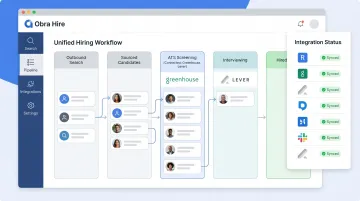
The goal is a single, unified hiring workflow: outbound search → profile preview → contact reveal → candidate data in ATS → interview pipeline. When every step connects, recruiters spend time on candidates — not on process overhead.
Frequently Asked Questions
What are the biggest challenges in recruitment?
For IT specifically: talent shortage, passive candidate access, AI-generated fake applications, slow hiring cycles, and rapidly shifting skills requirements. In 2026, as AI reshapes tech roles, all five have become more pressing — both through new in-demand specializations and through new forms of application fraud.
Why is IT recruitment so much harder than hiring for other roles?
IT sits at the intersection of several compounding pressures: a small qualified talent pool, skill requirements that outpace training pipelines, fierce competition from large tech firms and funded startups, and a workforce where the most capable people aren't browsing job boards.
How do you find and hire passive IT candidates?
Use a verified candidate database to proactively search for profiles matching your skill requirements, then reach out through direct contact information — email, phone, or LinkedIn. Platforms like Obra Hire give recruiting teams access to 800M+ profiles with direct contact details, allowing outreach before candidates enter the active market.
What is outbound recruiting and how is it different from inbound?
Inbound recruiting waits for candidates to find and apply to your job posting. Outbound recruiting means you proactively search for and contact pre-vetted candidates who fit your requirements. In IT hiring, where top candidates are rarely browsing job boards, outbound is often the only reliable path to the best candidates.
How can recruiters identify fake or AI-generated candidate profiles?
Three practices reduce exposure significantly:
- Use sourcing platforms with verified profile filtering (available on Obra Hire's Explore and Scale plans)
- Run live structured technical assessments instead of take-home assignments
- Cross-check claimed skills against verifiable credentials or portfolio work, not resume text
What's the most cost-effective way to recruit IT talent in 2026?
Outbound sourcing platforms cost significantly less than agency fees, which typically run 15-25% of first-year salary. Obra Hire's free tier lets teams preview candidate pools before spending anything, and paid plans start at $109/month — no long-term contracts required.