Introduction
Agency fees don't feel expensive until you add them up. At 15–25% of first-year salary per placement, a company filling 10 mid-level roles annually at $80,000 average salary is spending $120,000–$200,000 on agency fees alone — before accounting for the roles that still don't result in a good hire.
The hesitation is understandable: teams worry that cutting agency spend means cutting off candidate access. That was a reasonable concern five years ago. It's less defensible now.
Advanced recruitment platforms have shifted who controls candidate access. Internal teams can now search hundreds of millions of verified profiles, contact passive candidates directly, and build proprietary talent pipelines — without routing every hire through an agency. The gatekeeping model agencies depended on no longer holds.
This article breaks down how that shift works in practice — from cost-per-hire reductions to pipeline ownership — and how to approach the transition without disrupting your existing hiring process.
TL;DR
- Agency fees of 15–25% per hire become a fixed, predictable cost once even a portion of roles shift to internal sourcing
- Advanced platforms give internal teams direct access to passive candidates — the ~70% of the workforce agencies claim as exclusive territory
- Outbound search capability means teams source proactively, not reactively
- Every candidate relationship and search stays in-house, compounding in value over time
- AI-powered matching and verified profile filtering improve quality, not just speed
What Is an Advanced Recruitment Platform?
An advanced recruitment platform gives internal hiring teams the ability to search, identify, contact, and track candidates directly — without routing requests through a third-party agency.
That distinction matters. Traditional tools — job boards, inbound ATS systems — wait for candidates to apply. Advanced platforms flip the model: recruiters go find the talent, filter by competency, and reach out directly with verified contact details.
Where these platforms have the most impact:
- Repeatable roles hired multiple times per year (developers, account managers, operations staff)
- Volume hiring across consistent role types
- Teams building proactive pipelines before requisitions open
- Organizations where agency submissions regularly miss the mark on role requirements
These use cases share a common thread: the hiring team needs direct access to candidates, not a middleman filtering who gets seen. Obra Hire functions as that infrastructure — providing access to 800M+ candidate profiles with competency-based filtering and verified contact reveal, so internal recruiters have the same sourcing reach agencies charge a premium to provide.
Key Advantages of Advanced Recruitment Platforms
The advantages below focus on measurable outcomes: cost per hire, time to fill, candidate quality, and hiring control. Each one directly addresses a reason companies defaulted to agencies in the first place.
Advantage 1: Direct Access to a Large, Verified Candidate Pool
The primary reason companies use agencies is access. Agencies claim pre-screened, responsive candidates that internal teams can't easily reach. Advanced platforms eliminate this structural advantage.
According to Workable's 2023 research, **37.3% of US workers are passive candidates** — open to new opportunities but not actively applying. Globally, roughly 70% of the workforce falls into this category. That's the pool agencies built their business on. Outbound sourcing platforms make that same pool searchable to any internal team.
The speed difference is significant. Direct sourcing from an existing talent pool can fill a position in 3–5 days versus 2–3 weeks through a staffing agency for repeat roles. When a role opens, teams don't wait for an agency to begin its process — they search immediately.
KPIs impacted: Time-to-fill, time-to-first-qualified-candidate, percentage of target roles filled without agency involvement
When this matters most:
- High-volume hiring across recurring role types
- Situations where agency submissions arrive late or misaligned with actual requirements
- Teams that want to engage passive candidates agencies typically claim exclusive access to
Advantage 2: Structural Cost Reduction Per Hire
Agency fees scale with salary. A senior hire at $120,000 with a 20% agency fee costs $24,000 in placement fees alone. Platforms convert this variable, per-hire cost into a flat subscription.
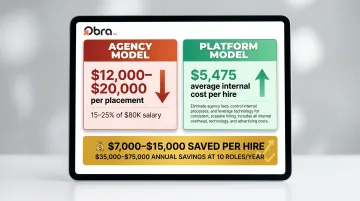
SHRM's 2025 Benchmarking Report sets the average internal cost per hire for nonexecutive roles at $5,475. A typical agency fee for the same $80,000 role runs $12,000–$20,000. The gap per placement: $7,000–$15,000.
For a team filling 10 roles per year, shifting even half of those to internal sourcing generates $35,000–$75,000 in annual savings. That typically exceeds the annual cost of a platform subscription by a wide margin.
What makes this structurally different from agency savings:
- Platform costs are fixed and predictable; agency fees spike during competitive hiring periods
- Each internally filled role builds sourcing capability that benefits the next hire
- Savings compound — the pipeline built for Role 1 makes Role 2 faster and cheaper
KPIs impacted: Cost per hire, recruitment budget variance, agency spend as a percentage of HR operating cost
When this matters most: Scaling companies with consistent hiring volume, teams that route multiple role types through the same agency, and HR functions under budget pressure.
Advantage 3: Candidate Quality, Data Ownership, and Hiring Control
Agencies prioritize placement speed — that's how they generate revenue. This creates a structural misalignment with employers who need the best long-term fit, not the fastest submission.
Two specific quality problems have grown worse recently:
Fake profiles are scaling faster than inbound screening can catch them. Gartner's 2025 research found that 6% of candidates admitted to interview fraud, with projections suggesting 1 in 4 job applicant profiles globally will be fake by 2028. Inbound channels — which agencies and job boards rely on — are most exposed to this risk. Outbound sourcing, where recruiters initiate contact with verified professionals, reduces exposure directly. Obra Hire's verified profile filtering surfaces confirmed profiles on Explore and Scale plans.
Speed-over-fit incentives shift risk entirely to employers. The U.S. Department of Labor estimates a bad hire costs at least 30% of first-year salary. When agencies are paid on placement, not retention, that cost falls entirely on the employer.
Both problems point to the same underlying gap: control. Internal sourcing platforms address it by keeping candidate data where it belongs.
Every search, outreach, and candidate interaction conducted through an internal platform stays with the company. A talent pipeline built today is reusable for the next similar role. Agencies can't offer this — their candidate relationships live in their CRM, not yours.
KPIs impacted: Retention at 6/12 months, offer acceptance rate, mis-hire rate, percentage of roles filled from existing pipeline
What Happens When Agency Dependency Goes Unchecked
The problem with agency dependency isn't visible on a single invoice. It accumulates.
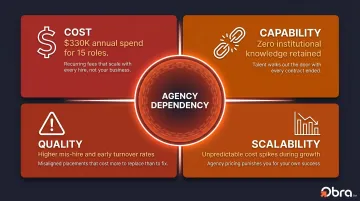
The costs hit on four fronts:
- Cost: A mid-sized company filling 15 roles per year at an average agency fee of $22,000 per placement spends roughly $330,000 annually. That number rarely appears as a single line item, which is why it persists.
- Capability: Every role starts from zero. Institutional knowledge about the candidate market stays with the agency, so internal teams never develop sourcing skills — making the dependency self-reinforcing.
- Quality: Contingency agencies submit candidates quickly because that's how they get paid. Over time, this drives higher mis-hire rates, longer ramp times, and early turnover — costs that don't show up on the agency invoice but do show up in workforce performance.
- Scalability: During high-growth periods, cost spikes become unpredictable and fill times slow down. Agencies prioritize clients with more volume or higher fees. A company without internal sourcing capability has no fallback when it needs to move fast.
How to Get the Most Value from an Advanced Recruitment Platform
Platform ROI is highest when teams shift from reactive to proactive. The model of "open a req, call the agency" should become "maintain a pipeline, fill the req."
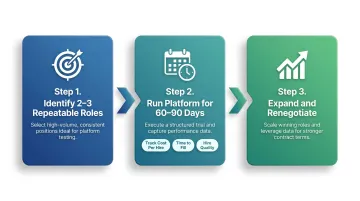
Start with a structured pilot:
- Identify 2–3 role types hired repeatedly that currently go to agencies
- Run those roles through the platform for 60–90 days, tracking cost per hire, time to fill, and hire quality against your agency baseline
- Use that data to expand platform usage and renegotiate or reduce agency contracts accordingly
Adoption sticks when the platform fits into what your team already uses. Obra Hire connects with 85+ ATS/HRIS systems (including Workday, Greenhouse, iCIMS, Lever, and SAP SuccessFactors), so candidate data flows into your system of record without disrupting current workflows or requiring teams to rebuild their hiring process.
Practical tips for compounding platform value:
- Use team collaboration features to build shared pipelines organized by role type
- Preview candidate pool size before spending any credits — validate search criteria first
- Share revealed contact data across the recruiting team to eliminate duplicate credit usage
- Reserve agencies for genuinely specialized, low-frequency, or executive-level searches
A well-maintained talent pipeline reduces time-to-fill by 30–50% for repeat roles. That reduction compounds over time: the more consistently the platform is used, the more your pipeline matures and the less you rely on reactive agency spend.
Conclusion
Advanced recruitment platforms don't eliminate the value of external expertise. They eliminate the dependency on it — by giving internal teams direct access to the candidates, tools, and data that agencies once gatekept.
The gains from platform-driven recruiting aren't one-time wins. Each hire made internally builds a more capable talent function. Each search adds to a proprietary pipeline. Each role filled without an agency lowers your cost on the next one — and the one after that.
The companies that build platform-driven recruiting now aren't just cutting costs. They're building a hiring capability that scales with the business — one that gets faster, cheaper, and smarter with every hire.
Frequently Asked Questions
What tactics can reduce reliance on recruitment agencies?
Build internal sourcing capability through an outbound platform, develop proactive pipelines for roles you hire repeatedly, and activate employee referral programs. Reserve agencies only for executive-level searches or highly specialized roles where internal sourcing can't match.
How will AI and advanced recruitment platforms affect recruitment agencies?
AI is closing the network and speed gap that historically justified agency fees. Platforms now give internal teams comparable candidate access, pushing agencies toward higher-value services: executive search, market intelligence, and hard-to-fill niches. Their role in standard volume hiring will shrink accordingly.
What is the true cost of agency dependency beyond the placement fee?
Hidden costs include internal time spent briefing agencies and managing misaligned submissions, opportunity cost from delayed hires, higher early-turnover from less precisely matched placements, and the absence of any reusable talent pipeline after the fee is paid.
Can advanced recruitment platforms handle niche or hard-to-fill roles?
Platforms with large, searchable databases and competency-based filtering can surface candidates for most niche roles effectively. Highly confidential executive searches may still warrant a specialized agency.
How long does it take to see cost savings after adopting a recruitment platform?
Savings begin with the first role filled internally — immediate elimination of the agency fee for that hire. Compounding returns appear over 60–120 days as teams build pipelines and reduce the proportion of roles routed to agencies.
Do advanced recruitment platforms replace the need for an internal recruiter?
No — they amplify recruiter output. A single in-house recruiter with a capable platform can cover sourcing volume that previously required an agency, while retaining candidate relationships and institutional knowledge that agencies never return.