Introduction
The scale of modern hiring is hard to overstate. Applications per recruiter grew 412% in just two years, while the average job opening now attracts 250 applications — yet only about 2% of applicants ever reach an interview. Manual review at that volume isn't a process challenge; it's mathematically impossible.
AI has gone a long way toward solving this — but the reality is more complicated than most platforms let on.
43% of organizations now use AI in HR workflows, up from 26% just a year earlier. Among Fortune 500 companies, AI touches nearly every hire.
Yet recruiters and candidates alike are experiencing consequences no one fully anticipated — from algorithmic bias to AI-generated fake applications flooding inbound pipelines.
This article examines what AI recruitment platforms actually do, where they genuinely deliver value, where they break down, and how hiring teams can use them without losing the human judgment that still matters most.
TL;DR
- AI recruiting platforms automate sourcing, screening, matching, and outreach across the hiring lifecycle
- Core benefits include faster time-to-hire, lower cost-per-hire, and direct access to passive candidates who never applied
- Key risks include algorithmic bias, AI-generated fake applications, and opaque "black box" filtering decisions
- Inbound pipelines are breaking down: AI-generated applications flooding AI screeners produce a noisy, low-signal loop
- The most effective teams combine AI efficiency with human judgment and proactive outbound sourcing
What Is an AI-Driven Recruitment Platform?
An AI-driven recruitment platform uses machine learning, natural language processing, and predictive analytics to automate talent acquisition — from sourcing and screening to scheduling and matching. Unlike a traditional Applicant Tracking System, which passively collects and organizes applications, these platforms actively find candidates rather than waiting for them to apply.
Inbound vs. Outbound: A Critical Distinction
Most legacy tools were built for inbound hiring: post a job, wait for applications, filter the pile. A newer generation of platforms flips this model.
- Inbound platforms (such as Greenhouse or iCIMS) rank and filter candidates who apply to open roles
- Outbound platforms search existing databases to surface matching candidates — whether or not those people have ever seen the job posting
Obra Hire is built outbound-first, searching across 800M+ candidate profiles using AI-powered, competency-based matching. Recruiters describe their ideal candidate in natural language or paste a job description, and the platform returns ranked results — including passive candidates who aren't actively applying.
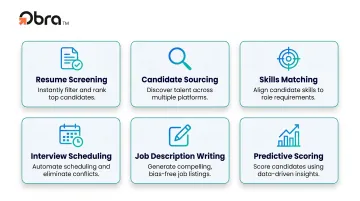
What AI Recruitment Tools Currently Handle
| Task | AI Capability |
|---|---|
| Resume screening | Ranks applicants against predefined criteria at scale |
| Candidate sourcing | Searches profile databases for passive matches |
| Skills matching | Compares competency profiles against role requirements |
| Interview scheduling | Eliminates back-and-forth calendar coordination |
| Job description writing | Generates and optimizes JD language (used by 66% of orgs) |
| Predictive scoring | Estimates candidate quality and potential fit |
How AI Is Reshaping Every Stage of Hiring
Sourcing and Screening
The passive candidate problem is real. 73% of professionals are passive candidates — not browsing job boards, not submitting applications, but potentially open to the right opportunity. Traditional inbound hiring misses all of them.
AI sourcing tools close that gap by scanning large profile databases and surfacing matches before a candidate ever decides to look. For screening, 44% of organizations now use AI to review resumes before human eyes touch them, processing thousands of submissions in seconds against predefined criteria.
Recruiters currently spend 60–80% of their time on administrative tasks — nearly 18 hours of admin per vacancy. AI screening compresses that dramatically.
Matching, Scheduling, and Predictive Analytics
Keyword matching — the old ATS standard — has a well-known flaw: candidates who use the right terms get through; candidates who don't get filtered out, regardless of actual ability. Modern AI platforms use competency-based matching instead, comparing a candidate's actual skill profile against role requirements.
Obra Hire's approach uses structured competency data rather than resume text, displaying a clear breakdown of "Must Have" and "Nice to Have" criteria for each result. This means a career changer with the right skills doesn't disappear just because their resume doesn't use the expected keywords.
On the scheduling side, AI removes the back-and-forth that slows every hire down:
- Automated calendar coordination syncs availability without recruiter involvement
- Personalized outreach scales across hundreds of candidates simultaneously
- Chatbot-based status updates keep candidates engaged throughout the process
The Real Benefits (Backed by Data)
Speed and Cost
The median time-to-fill across U.S. organizations is 44 days, according to SHRM's 2025 Benchmarking Report. For enterprises with 5,000+ employees, that stretches to 60+ days. 89% of HR professionals report AI saves time or increases efficiency.
Cost-per-hire benchmarks from the same SHRM report:
| Role Type | Median Cost-per-Hire |
|---|---|
| Nonexecutive | $1,200 |
| Executive | $10,625 |
For high-volume or recurring roles, the labor cost of manual screening compounds fast.
Replacing multiple expensive recruiting platform licenses with a self-serve tool like Obra Hire — which starts free and scales to $169/month — shifts the unit economics of sourcing in favor of the hiring team.
Broader Talent Access
AI outbound platforms reach candidates that inbound hiring never touches. Obra Hire's 800M+ profile database includes candidates across all industries and seniority levels, with the ability to preview pool size and candidate profiles before spending a single contact credit.
Bias Reduction (With Caveats)
When configured with objective, merit-based criteria, AI screening can reduce the unconscious biases that affect human reviewers — name-based, appearance-based, school prestige. This only holds when the underlying criteria are defined carefully — poorly designed filters can encode bias rather than eliminate it.
The Real Challenges and Limitations
Bias Amplification
Amazon's 2018 AI recruiting tool is the canonical cautionary tale: the system, trained on 10 years of resumes submitted predominantly by men, learned to penalize resumes containing the word "women's" — as in "women's chess club captain." Amazon shut it down before deployment.
A 2022 peer-reviewed study found that AI recruitment tools marketed to eliminate bias "often replicate or even amplify systemic inequalities" when trained on historical data. AI doesn't remove bias — it scales it. That makes regular audits, including disparate impact testing across protected groups, a non-negotiable part of responsible deployment.
AI-Generated Fake Applications
This is the problem reshaping inbound hiring right now:
- 74% of hiring managers have encountered AI-generated content in applications
- 76% say AI makes it harder to assess candidate authenticity
- 50%+ of job applicants now use AI to write resumes and cover letters
The result is inbound pipelines flooded with polished, keyword-optimized materials that pass automated screening but don't reflect real capabilities.
False Negatives and Hidden Workers
Harvard Business School and Accenture estimated 27 million "hidden workers" in the U.S. are systematically excluded by automated hiring systems. In a survey of 2,000 employers, 88% of executives acknowledged their tools reject qualified candidates who don't match exact criteria.
Career changers, self-taught professionals, and candidates with non-linear career paths are disproportionately affected by rigid AI filtering logic.
The Black Box Problem
Part of what makes hidden worker exclusion so persistent is that most AI screening tools can't explain why a candidate was ranked or filtered out. That opacity creates downstream problems at every level:
- Candidates receive no useful feedback
- DEI accountability becomes difficult to maintain
- Legal defensibility is weakening as regulators act
NYC Local Law 144 (enforced July 2023) now requires annual independent bias audits for automated hiring tools. The EU AI Act classifies recruitment AI as "high-risk," requiring transparency, logging, and human oversight. Hiring teams that can't document how their AI tools make decisions are already exposed — and compliance requirements are expanding, not contracting.
The AI vs. AI Arms Race: Why Inbound Hiring Is Breaking Down
Harvard Business Review described today's hiring environment as "a noisy, crowded arms race of automation, often more inhumane for both job seekers and hiring managers." That framing is accurate.
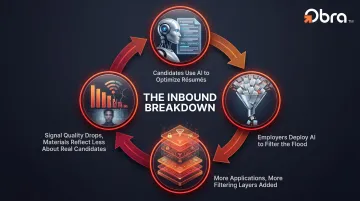
Here's the feedback loop:
- Candidates use AI to generate optimized resumes and cover letters
- Employers use AI to filter the flood of applications
- More applications arrive, more filtering layers get added
- Signal quality drops — application materials tell you less about actual candidates
The Wall Street Journal captured this dynamic in a 2024 headline: "You're Fighting AI With AI: Bots Are Breaking the Hiring Process."
Applications per recruiter are up 412% in two years, and while hires per recruiter have increased too, sourced hire quality has declined. Volume is not the same as value.
The Outbound Shift
Hiring teams are responding by moving away from inbound altogether. Instead of waiting for a flood of AI-polished applications, they're going outbound — proactively identifying and contacting pre-vetted candidates before the AI-vs-AI loop even starts.
Obra Hire is built specifically for this model. Rather than filtering inbound noise, it searches 800M+ verified candidate profiles and surfaces genuine matches. Its Verified Profile Filtering is designed to reduce exposure to AI-generated and fake profiles before recruiters ever make contact.
That protection matters most at the top of the funnel — where fabricated applications currently do the most damage. Starting with validated profiles means recruiters spend time evaluating real candidates, not weeding out bots.
Obra's candidate pool preview feature builds on this further: recruiters can see pool size and full candidate profiles before spending any contact credits, making it easy to validate search quality before committing resources.
How to Get the Most Out of AI Recruiting Platforms
Keep Humans in the Loop
Only 6% of hiring managers allow AI to move or reject candidates with limited human oversight (Resume Genius, 2024). That's the right instinct. AI works as a filter and prioritization tool — it shouldn't be the final decision-maker.
Structured behavioral interviews remain the most reliable signal of candidate quality. AI screening outputs should inform those conversations, not replace them.
Audit Regularly for Fairness
Keeping humans in the loop only works if the process itself is fair. That means auditing regularly:
- Review which candidate demographics are being filtered in and out
- Test for adverse impact across sex, race, and ethnicity (NYC Local Law 144 requires this annually)
- Document your criteria and validation methodology
- Treat bias audits as ongoing maintenance, not one-time compliance
Match the Tool to the Actual Problem
This is where many teams go wrong. Better inbound filtering won't help if the real problem is that not enough qualified candidates are entering the pipeline at all.
- High application volume, low quality signals? Better inbound screening tools help
- Struggling to find qualified candidates in the first place? Outbound sourcing platforms are the right answer
- Both problems at once? Use complementary tools — an ATS for workflow management plus an outbound sourcing platform like Obra Hire for candidate discovery
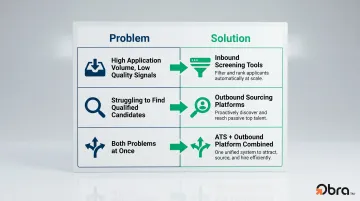
That last scenario is more common than teams expect. Obra Hire integrates with 85+ ATS and HRIS platforms — including Workday, Greenhouse, iCIMS, and Lever — so adding outbound sourcing doesn't disrupt existing workflows.
Frequently Asked Questions
How are AI-driven recruitment platforms impacting hiring processes?
AI platforms automate sourcing, screening, scheduling, and candidate matching across the hiring lifecycle — compressing time-to-hire and expanding reach well beyond active applicants. That said, they've introduced real challenges too: algorithmic bias, AI-generated fake applications, and weaker signal quality in inbound pipelines.
What are the benefits of AI-driven recruitment platforms for hiring?
Key benefits include:
- Faster resume screening and lower cost-per-hire
- Access to passive candidates who never applied
- Reduced early-stage unconscious bias (when properly configured)
- Better candidate experience through automated status updates
Which AI tools are best for recruitment?
It depends on your challenge. ATS-integrated screening tools like Greenhouse or iCIMS help manage inbound application volume. Outbound sourcing platforms like Obra Hire are better suited for proactively finding and contacting pre-vetted candidates who aren't in your applicant pool. Most strong hiring stacks use both.
What is an AI recruiting platform?
Software that uses machine learning and data analytics to automate talent acquisition tasks — from surfacing candidates and ranking resumes to scheduling interviews and predicting hire quality. The critical distinction is whether the platform is built for inbound filtering or outbound candidate discovery, as these serve fundamentally different hiring needs.
Can AI recruiting platforms help reduce hiring bias?
Yes, when configured with objective criteria, AI can reduce certain unconscious biases in early screening. But AI trained on historically skewed data amplifies those biases at scale. Regular audits and human oversight are essential, not optional.
How do AI recruitment platforms integrate with existing ATS systems?
Most modern platforms offer native integrations with popular ATS and HRIS systems. Obra Hire connects with 85+ platforms — including Workday, Greenhouse, iCIMS, and Lever — so teams can push candidate data into existing workflows without replacing their current stack.