](https://file-host.link/website/obra-617n0m/assets/blog-images/010f618a-9322-4129-81ce-7c070eaf90f2/1779123735271795_c0d9b4839c8f4018955063a08a859b6a/360.webp)
That gap is the problem. Most companies are running 44-day processes against a 10-day window.
With hundreds of platforms claiming to "accelerate hiring," the real challenge is knowing which features actually cut time-to-hire versus which ones add administrative overhead dressed up in AI marketing language. This guide covers the features that genuinely move the needle.
TL;DR
- Top candidates disappear within 10 days — platforms that rely on inbound applications can't move fast enough
- AI-powered outbound sourcing and competency-based matching are the highest-impact features at the top of the funnel
- Verified profile filtering protects screening time as AI-generated resumes surge across the industry
- ATS/HRIS integrations determine whether a platform accelerates your workflow or creates friction
- A freemium model lets you validate candidate pool quality before committing any spend
What Is a Fast Hiring Recruitment Platform?
A fast hiring recruitment platform is software designed to compress the time between identifying a hiring need and extending an offer. That means actively eliminating delays at every stage, not just organizing the process after candidates arrive. Most standard ATS tools manage hiring; fast hiring platforms are built to accelerate it.
Inbound vs. Outbound Architecture
Most traditional platforms are inbound-first: they manage candidates who apply to your job postings. You post a role, wait for applications, then work through the pile. This model is reactive by design, which makes speed structurally difficult.
Outbound-first platforms flip that model. Instead of waiting, they proactively surface candidates from large searchable databases — reaching people who aren't actively job hunting but are open to the right opportunity. LinkedIn research shows 70% of the global workforce is passive talent, yet 87% of professionals are open to new roles. Inbound-only platforms structurally miss most of that pool.
Stages a Fast Hiring Platform Should Cover
A genuinely fast platform supports the full hiring cycle without requiring you to stitch together separate tools:
- Candidate discovery and sourcing — AI-powered search across large candidate databases
- Screening and qualification — competency-based filtering, not just keyword matching
- Outreach and engagement — direct contact with candidates, ideally with automation
- Pipeline management — structured stage tracking with team-wide visibility
- ATS/HRIS handoff — seamless data transfer to your existing systems
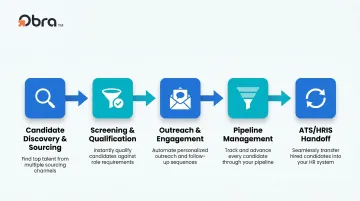
Hiring speed depends on how tightly integrated these stages are. Gaps between tools mean manual handoffs, duplicate data entry, and candidates who go cold while waiting for follow-up.
Why Hiring Speed Is a Competitive Advantage
Top candidates stay available for about 10 days before accepting an offer. When a strong candidate enters the market, the recruiting teams that reach them first win. Everyone else gets a rejection email.
The Compounding Cost of Slow Hiring
Slow hiring isn't just a missed candidate — it's a business cost that compounds at every stage:
- Vacant roles drain productivity — unfilled positions shift workload onto existing team members, increasing burnout and turnover risk
- Extended searches inflate cost-per-hire — SHRM 2025 data puts average cost-per-hire at $5,475 for nonexecutive roles, with executive roles reaching $10,625
- Repeated sourcing cycles strain recruiting teams — HootRecruit data shows recruiters already spend 13+ hours per week just sourcing candidates, with 70–80% of their time consumed by repetitive tasks
The platform a team chooses sets the ceiling on hiring velocity. That's what makes feature selection so consequential — the right tools shorten every step from sourcing to offer, while the wrong ones quietly add days (and costs) to every search.
Top Features to Look for in a Fast Hiring Recruitment Platform
Not all "AI-powered" or "fast hiring" claims are equal. The features below are the ones that measurably accelerate time-to-hire — treat them as non-negotiable during any platform evaluation.
AI-Powered Outbound Sourcing and Competency-Based Matching
This is the most differentiating feature in recruiting platforms today. Instead of waiting for applications, outbound sourcing proactively surfaces candidates from large verified databases using AI — cutting weeks off the top-of-funnel stage.
Keyword-only search is where most platforms fall short. Searching for "Python developer" returns anyone who typed "Python" somewhere on their resume. Competency-based matching goes deeper: it evaluates skills, proficiency levels, and context — returning candidates who actually fit the role rather than candidates who used the right words.
KPIs this feature directly impacts:
- Time-to-first-qualified-candidate
- Sourcing hours per role
- Candidate-to-interview conversion rate
Obra Hire's SkillsTree taxonomy — covering 8,241 skills with proficiency levels across 800M+ profiles — is a practical example of competency-based matching at scale. Searches return a structured breakdown of "Must Have" and "Nice to Have" criteria, so recruiters see exactly where candidates match or fall short before spending a single credit.
Verified Candidate Profile Filtering
AI-generated resumes have become a real operational problem. The New York Times reported in June 2025 that recruiters are seeing surges of ChatGPT-generated resumes, while Mandiant warned that North Korea-backed workers infiltrated dozens of Fortune 100 companies using deepfaked interviews. This isn't theoretical risk.
Verified profile filtering identifies and excludes AI-generated, duplicate, or fraudulent profiles before they reach a recruiter's shortlist. The result: screening time goes to real candidates instead of fictitious ones.
Why this matters operationally:
- Protects screening hours per hire
- Improves quality-of-shortlist ratio
- Reduces the downstream cost of bad hires — SHRM data shows a bad hire can cost up to 30% of first-year salary
This feature was niche 18 months ago. With AI resume generation tools now widely accessible, it's moved from nice-to-have to a baseline requirement.
Applicant Tracking and Pipeline Visibility
Fast sourcing without organized pipeline management creates a different problem: candidates get lost in handoffs. A platform should move candidates through defined stages — sourced, contacted, responded, screened, interviewing, offered — with visibility across the entire recruiting team.
Without this structure, two recruiters can independently contact the same candidate, hiring managers lose track of where strong profiles stand, and drop-off points go undetected.
What good pipeline management provides:
- Stage-by-stage conversion rates (where are candidates falling out?)
- Time-in-stage metrics (where are bottlenecks building?)
- Shared team visibility that prevents duplicate outreach
- Centralized tracking that survives team changes or recruiter turnover
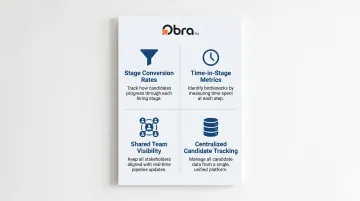
Obra Hire supports shared pipeline projects organized by role, with outreach status tracked per candidate and multiple team members able to work the same pipeline simultaneously — which directly addresses the duplicate outreach problem.
Integration with Existing ATS and HRIS Systems
A fast hiring platform that doesn't connect to the tools your team already uses creates a different kind of friction: manual data transfer. Copy-pasting candidate data between systems isn't just slow — it introduces errors and breaks the approval workflows your HR team depends on.
Nucleus Research found that organizations using unified talent platforms reduced time on key HR processes by 50-60% compared to disconnected stacks. Integration depth matters as much as breadth — bidirectional data sync and candidate status updates flowing both ways are what make an integration genuinely useful versus cosmetic.
Obra Hire connects with 85+ ATS/HRIS platforms, including Workday, Greenhouse, iCIMS, Lever, and SAP SuccessFactors — covering the majority of enterprise and mid-market stacks without requiring teams to replace their existing workflows.
Hiring Analytics and Reporting
Integrated workflows give teams speed — but without analytics, there's no way to know where that speed is being lost. Teams can't see which sourcing channels produce the strongest candidates, where candidates drop out, or whether time-to-hire is actually improving cycle over cycle.
SHRM's 2025 benchmarking report found that only 20% of organizations currently measure quality of hire — down from 27% in 2022. That's a measurable gap, and it's one that analytics-capable platforms can close.
Metrics worth tracking:
- Source quality by channel
- Time-to-hire by role and team
- Candidate response rates by outreach method
- Stage-by-stage conversion and drop-off
- Offer acceptance rates
Analytics are only useful if non-technical users can act on them. Dashboards that require a data analyst to interpret defeat the purpose. Teams that track these metrics consistently — and adjust sourcing, outreach, and screening based on the results — cut cost-per-hire and shorten time-to-fill with each successive hiring cycle.
How to Evaluate a Platform Before You Buy
A Gartner survey of 114 HR leaders found 88% said their organizations hadn't realized significant business value from AI tools, and Sapient Insights Group reports that 1 in 4 HR tech implementations fail to meet adoption expectations. Feature lists don't guarantee outcomes. Adoption does — and that distinction should drive how you evaluate any platform.
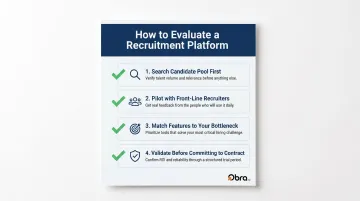
Practical evaluation checklist:
- Search the candidate pool before you spend. Obra Hire's free tier includes unlimited searches, 1,000 profile views, and 50 contact credits — enough to confirm pool quality before any purchase commitment.
- Run the pilot with front-line recruiters, not just leadership. If the people doing daily sourcing find it clunky, consistent adoption won't follow.
- Match features to your actual bottleneck. Top-of-funnel gaps call for AI sourcing and verified profiles; post-contact drop-off calls for pipeline tools and ATS integration.
- Don't sign a multi-year contract before you've closed a single search. Validate fit first, then negotiate terms.
How Obra Hire Can Help You Hire Faster
Obra Hire is a self-serve outbound hiring platform built for hiring teams that can't afford to wait on inbound applications. As AI-generated submissions flood recruiting pipelines, Obra Hire takes the opposite approach: any-size team gets direct access to 800M+ candidate profiles through competency-based matching, without per-seat license fees or contract commitments.
What the platform delivers against the features covered above:
| Feature | Obra Hire Capability |
|---|---|
| Outbound sourcing | AI search across 800M+ verified profiles |
| Competency matching | SkillsTree taxonomy — 8,241 skills with proficiency levels |
| Profile verification | Filters AI-generated and fake profiles from results |
| Pipeline management | Shared projects, outreach tracking, team collaboration |
| ATS/HRIS integration | 85+ platforms including Workday, Greenhouse, iCIMS, Lever, SAP SuccessFactors |
| Contact access | Email, phone, LinkedIn, and resume — direct, no gatekeepers |
| Pricing model | Freemium — no contract, no setup required |
Before spending any credits, teams can preview the candidate pool size and review individual profiles to confirm match quality. Credits are only consumed when contact information is revealed. Shared credit pools on the Scale plan mean all team members draw from the same allocation — no duplicate purchases, no fragmented usage.
As Sabyn, Manager of People & Culture at Canopy, put it: "Sourcing and screening pull you into tasks that slow your day. Obra Hire makes it easy to see the qualified candidates you want without digging through piles of profiles."
Conclusion
Choosing a recruitment platform is a strategic decision. The features it offers directly determine how quickly your team can move from identifying a need to extending an offer — and how often the right candidate is reached before a competitor does.
Pick the platform that eliminates your specific bottleneck — whether that's top-of-funnel sourcing, candidate verification, pipeline visibility, or ATS integration. More features rarely means faster hires. Start with the constraint that's costing you the most.
As AI-generated applications flood inbound queues, the teams filling roles fastest are going outbound — searching verified candidate pools directly rather than waiting for the right resume to arrive. That shift is already underway. The platform you choose should be built for it.
Frequently Asked Questions
What are the 4 pillars of recruiting?
The four pillars are sourcing, screening, selection, and onboarding. A fast hiring platform strengthens each through automation — AI sourcing replaces manual research, competency matching accelerates screening, and ATS integration keeps selection and onboarding workflows running without data gaps.
What are the features of an ATS?
Core ATS features include job posting, candidate pipeline tracking, resume storage, interview scheduling, and reporting. Modern platforms frequently add outbound sourcing, candidate relationship management, and automated outreach — extending well beyond what a traditional ATS covers.
What is the difference between inbound and outbound recruiting platforms?
Inbound platforms manage candidates who apply to posted jobs. Outbound platforms proactively source and contact candidates from talent databases, reaching passive professionals who aren't actively job hunting. For most competitive roles today, where qualified applicant volume is low, outbound is simply the faster path to a hire.
Which recruitment platform features reduce time-to-hire the most?
AI-powered outbound sourcing, automated outreach sequences, and competency-based matching have the highest impact on time-to-hire. They eliminate the manual bottlenecks at the top of the funnel — sourcing and initial screening — where most delays actually accumulate.
How can small businesses benefit from a fast hiring recruitment platform?
Small businesses benefit most from platforms with low entry costs, no required setup, and outbound sourcing built in. Automated candidate discovery and direct contact access let lean teams compete for talent on the same timeline as much larger organizations — no dedicated recruiting staff required.