Introduction
Hiring teams are drowning. In Q1 2024, employers received an average of 222 applications per job opening — nearly triple the volume from 2021 — and candidates using AI tools complete 41% more applications than those who don't. The result: 84% of HR leaders report heavier workloads, and 67% of hiring managers say AI-generated resumes are actively slowing down their hiring process.
Most AI hiring tools make this worse by applying the same generic scoring logic to every candidate, no matter what a specific role demands. A platform trained on broad hiring patterns can't know that your customer success role weights empathy over certifications — or that your compliance analyst position requires a specific regulatory credential as a hard prerequisite.
The solution is AI hiring platforms with customizable evaluation criteria — tools that let your team define what "qualified" actually means for each role. This post covers five platforms that do exactly that, each tackling customization from a different point in the hiring funnel — from sourcing and screening to structured interviews and final scoring.
TL;DR
- The best AI hiring platforms let you set competencies, scoring weights, and proficiency thresholds — not just accept the tool's defaults
- Strong platforms offer control at every stage — sourcing, screening, assessment, and interview scoring
- Skills-based evaluation is 5x more predictive of job performance than education — making criteria depth a measurable hiring advantage
- Platforms covered: Obra Hire, HireVue, Eightfold AI, Vervoe, and Workable
- The right choice depends on where in your funnel you need the most control
What Are AI Hiring Platforms With Customizable Evaluation Criteria?
A customizable AI hiring platform gives hiring teams the ability to configure their own evaluation logic — defining which skills matter, at what proficiency level, and how heavily each factor should influence ranking. This differs from standard AI tools that apply a fixed algorithm trained on generic hiring patterns across all users.
The practical gap between these two approaches is significant. A healthcare company hiring for a patient-facing coordinator role needs to weight interpersonal competencies, clinical terminology familiarity, and compliance awareness. A fintech firm hiring a compliance analyst needs exact regulatory credentials as hard prerequisites. When a platform can't distinguish between these requirements, mismatches increase — and so does cost-per-hire.
According to SHRM, the total cost of recruiting, hiring, and onboarding a new employee can reach $240,000. 43% of managers admit they made a bad hire because they felt pressure to fill a role quickly. Misaligned screening criteria accelerate exactly that dynamic.
Customization isn't a single feature — it exists across multiple funnel stages:
- Sourcing — defining which skills and competencies to search for in a candidate pool
- Pre-screening — setting knockout criteria that exclude candidates who don't meet hard requirements
- Assessment — weighting rubrics so task performance reflects role priorities
- Interview scoring — structured scorecards tied to specific competencies
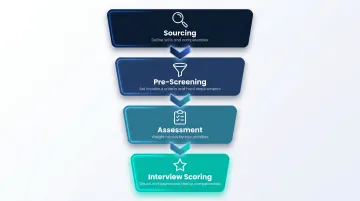
The strongest platforms address more than one of these stages. The five platforms reviewed below vary in where they focus — some start at sourcing, others at assessment — so the right fit depends on where your current process breaks down first.
Top AI Hiring Platforms With Customizable Evaluation Criteria
These platforms were selected based on the depth and flexibility of their evaluation customization — not just their AI capabilities broadly. Each addresses a different hiring context or funnel stage.
Obra Hire
Obra Hire is an outbound AI hiring platform that gives recruiters direct access to 800M+ verified candidate profiles. Rather than waiting for applications to arrive, teams define their evaluation criteria upfront and search for candidates who already match — before spending a single credit.
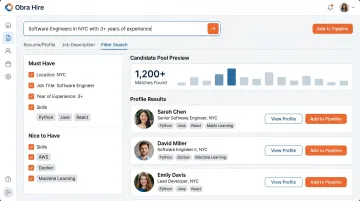
The platform's customization centers on a two-tier filtering system:
- Must Haves — hard filters that control which candidates enter your pool and directly affect candidate count (knockout logic)
- Nice to Haves — scoring weights that rank qualified candidates, surfacing the strongest matches at the top
Teams can configure criteria across skills, years of experience, industries, and previous companies. The platform's competency matching uses structured skill data rather than resume text, so a search for "3+ years React experience with Node.js" evaluates actual competency signals, not keyword overlap.
Before any credits are spent, recruiters can preview the candidate pool size and review individual profiles to confirm the criteria are producing relevant results. This prevents wasted spend on poorly configured searches. Verified profile filtering is also available on paid plans, reducing exposure to AI-generated or fake profiles — a problem Gartner projects will affect 1 in 4 profiles by 2028.
The platform integrates with 85+ ATS/HRIS systems including Workday, Greenhouse, Lever, SmartRecruiters, and SAP SuccessFactors, so custom criteria feed directly into existing workflows rather than living in a silo.
| Details | |
|---|---|
| Key Feature | Competency-based outbound sourcing with configurable Must Have/Nice to Have criteria and verified profile filtering |
| Best For | Teams that want to define evaluation criteria at the sourcing stage, before applications arrive |
| Pricing | Free tier (50 contact credits/month); Explore at $109/month; Scale at $169/month; Enterprise custom |
HireVue
HireVue is an enterprise AI assessment platform built around structured video interviewing, used heavily by large organizations running high-volume hiring programs. It combines video interviews, cognitive game-based tasks, and AI-driven scoring into a single workflow.
What makes HireVue customizable at the evaluation level:
- Recruiters configure competency frameworks tied to specific job families
- Structured interview question sets are built around those competencies
- Behavioral indicators can be weighted differently in scoring based on role priorities
- The HireVue Builder auto-generates job-related proficiencies and evaluation benchmarks, which teams can then modify
The question library is vetted by I/O psychologists and independently audited, and the platform is FedRAMP Certified — relevant for public sector and regulated industry hiring. The configuration depth is genuine, though smaller teams without dedicated HR ops support may find the multi-stage setup requires meaningful upfront investment.
| Details | |
|---|---|
| Key Feature | Configurable competency-based video interview scoring with behavioral analysis and structured evaluation benchmarks |
| Best For | Enterprise teams running high-volume hiring who need structured, multi-stage evaluation with customizable scoring |
| Pricing | Custom enterprise pricing; contact for quote |
Eightfold AI
Eightfold AI is a talent intelligence platform that uses deep learning trained on more than 1.5 billion global data points to match candidates against job requirements. Instead of matching keywords, it infers skills from career trajectory and context — useful for roles where candidates don't use the exact terminology in a job description.
Customization within Eightfold works at the weighting and explainability layer:
- Hiring teams adjust which skills or criteria carry more weight in the match score
- An explainability layer shows which factors drove a candidate's ranking — allowing teams to refine criteria based on actual results
- Internal mobility use cases benefit from the same matching logic applied to existing employees
This approach works best for organizations with structured job architectures and large talent pools. The skill inference model requires enough data to function well, which is why Eightfold is predominantly adopted by large enterprises and public sector organizations.
Smaller teams with fewer roles or less defined job architectures will find the configuration overhead harder to justify.
| Details | |
|---|---|
| Key Feature | Adjustable skill weighting and semantic job-to-profile matching with explainable scoring |
| Best For | Large enterprises focused on skills-based hiring and internal talent mobility across complex role structures |
| Pricing | Custom enterprise pricing; contact for quote |
Vervoe
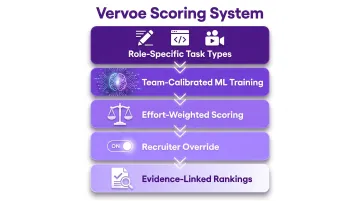
Vervoe replaces resume screening with customizable job simulations and practical tasks. A three-layer machine learning model scores candidates on content quality, interaction patterns, and team-calibrated preferences — with hiring teams controlling how each component weighs into the final score.
The customization depth here is notable:
- Teams build role-specific assessments — writing tasks, coding challenges, spreadsheet simulations, video responses
- The scoring model can be trained on a team's own graded samples, teaching the AI what "good" looks like for that specific organization
- Higher-effort tasks carry greater weight in the final score
- Recruiters can review and override rankings at any point
- Every score is tied to specific response evidence, so candidates aren't just ranked — the reasoning is visible
Vervoe was independently audited by Holistic AI and is designed for compliance with NYC Local Law 144 and the EU AI Act. The calibration investment is real — teams need to grade enough samples for the model to learn organizational preferences accurately.
For roles where demonstrated ability matters more than credentials, it's one of the most defensible scoring approaches available.
| Details | |
|---|---|
| Key Feature | Customizable skills simulations with team-trainable ML scoring and adjustable task weighting |
| Best For | Roles where demonstrated ability matters more than credentials — sales, support, operations, and technical positions |
| Pricing | Enterprise custom pricing; contact for quote |
Workable
Workable is a recruiting platform for SMBs and mid-market teams that combines ATS functionality with an AI screening assistant built on data from 260 million candidates and more than 2 million hires. Forbes Advisor named it the Best AI-Powered Recruiting Platform for 2025.
The AI screening assistant uses semantic matching — not keyword matching — to summarize candidate profiles against role requirements. Customization works through several mechanisms:
- Recruiters configure role-specific and level-specific interview question kits
- Scorecards support configurable rating scales (thumbs, stars, or numerical)
- The AI assistant prioritizes competencies defined by the recruiter for candidate ranking
- Interview kits auto-generate based on job level and company values, and teams can edit them directly
The AI Screening Assistant is available on all plans. More advanced AI features, including the Workable Agent, require higher-tier subscriptions or add-on purchases.
| Details | |
|---|---|
| Key Feature | Semantic AI screening with configurable interview kits and role-specific candidate ranking criteria |
| Best For | SMBs and growing teams that want AI-assisted customization without the complexity of enterprise tools |
| Pricing | Starts at $299/month; advanced AI features on higher tiers; 15-day free trial available |
Key Features That Define True Customizability in AI Hiring Platforms
Not every platform that claims "AI-powered hiring" actually lets you control the evaluation logic. These five features separate genuinely customizable platforms from those that just automate fixed scoring.
Competency and Skill Taxonomy Depth
Platforms that give you a structured skills library — rather than open-ended keyword entry — produce more consistent, role-specific evaluation. A recruiter typing "communication skills" into a free-text field gets a different AI interpretation every time. Selecting from a defined competency taxonomy with proficiency tiers makes the criteria precise and repeatable.
Obra Hire's structured skill criteria, Vervoe's competency extraction from job descriptions, and HireVue's I/O psychologist-vetted question library all reflect this principle.
Adjustable Scoring Weights
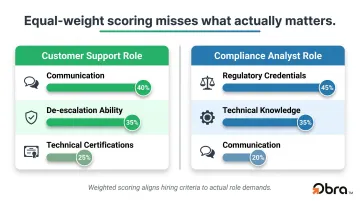
Flat, equal-weight scoring doesn't reflect real hiring intent. A customer-facing support role should weight communication and de-escalation ability above technical certifications. A compliance analyst role inverts that priority entirely.
Platforms with weighted criteria let teams express these priorities explicitly — so the ranking logic mirrors what the hiring manager actually values, not a generic average of what similar job titles have historically required.
Knockout Logic and Screening Thresholds
Pass/fail criteria based on non-negotiable requirements should be defined by the hiring team, not inferred by the AI. Common knockout conditions include:
- A required certification or license
- Minimum years of relevant experience
- Security clearance level
This keeps the screening process defensible and transparent. Obra Hire implements this through Must Have filters at the search stage; HireVue and Vervoe apply similar gates later in the assessment funnel.
Integration With Existing ATS/HRIS Workflows
Precise filtering only matters if the results flow cleanly into the tools your team already uses. Standalone platforms force manual re-entry and break the audit trail. Native integrations — not CSV workarounds — are the standard worth requiring.
Explainability and Audit Trail
Hiring teams need to know why a candidate ranked where they did — both for legal defensibility under frameworks like NYC Local Law 144 and for improving criteria over time. Platforms that surface which specific factors drove a score, rather than outputting an opaque number, give teams a feedback loop that sharpens evaluation quality with each hiring cycle.
Conclusion
Applying the same AI scoring logic to every role produces fast results that are often wrong. The platforms in this list each offer a different entry point into customizable evaluation — some let you define competency thresholds before candidates ever apply, others support weighted rubrics for role simulations or structured interview scoring tied to behavioral indicators.
That range of approaches means the right choice depends heavily on where in your hiring process the evaluation gaps actually live. Before committing to any platform, pilot it on a single role. Define four to six specific criteria, run a small candidate cohort, and measure whether the results reflect what "qualified" actually means for that position. The best platforms make that iteration fast and self-serve.
For teams that want to apply custom competency criteria before candidates ever reach the application stage, Obra Hire lets you search 800M+ verified profiles against your own skill and proficiency requirements — with a free tier to explore, no credit card or contract required. Start searching your criteria-defined candidate pool at getobra.com.
Frequently Asked Questions
How is AI being used in recruitment?
AI is used across the hiring funnel — from sourcing and resume screening to structured interview scoring and candidate engagement automation. The goal is reducing manual workload while improving match quality between candidates and roles. How well it works depends almost entirely on how well teams configure the underlying criteria.
What does "customizable evaluation criteria" mean in an AI hiring platform?
It means hiring teams can define which skills, competencies, or thresholds matter for a specific role — and how heavily each is weighted — rather than accepting a platform's default scoring logic. The ability to configure these settings without developer support is what separates genuinely customizable tools from marketing claims.
What is the difference between keyword matching and competency-based candidate evaluation?
Keyword matching looks for exact text overlap between a resume and a job description. Competency-based evaluation assesses whether a candidate has demonstrated specific skills at defined proficiency levels. Competency-based evaluation is more predictive of actual job performance and harder to game with AI-optimized resume language.
Can customizable AI hiring platforms help reduce unconscious bias?
Platforms with predefined criteria and explainable scoring reduce bias by applying consistent evaluation logic across all candidates. This only holds when the criteria are thoughtfully designed and audited for unintended demographic patterns — structured criteria reduce inconsistency, but don't automatically eliminate bias built into the criteria themselves.
How do I know if an AI hiring platform's evaluation criteria are working?
Track pass-through rates by stage, score-to-hire correlation, and quality-of-hire metrics (manager ratings, 90-day retention) against a pre-implementation baseline. If top-ranked candidates consistently underperform, the criteria need recalibration — not just more data.
Do AI hiring platforms with custom criteria work for non-technical roles?
Yes. Obra Hire and similar competency-based platforms support blue, gray, and white-collar roles by drawing from broad skills taxonomies rather than tech-specific resume patterns — covering roles from CDL drivers and electricians to registered nurses and service representatives.