Introduction
LinkedIn application volume surged more than 45% year over year to roughly 9,500 applications per minute in 2025, yet 70% of hirers say fewer than half of those applications meet the role criteria. Gartner projects that by 2028, one in four job candidates could be fake — AI-generated profiles and deepfakes polluting the inbound pipeline before a recruiter even opens the queue.
Add to that a median time-to-fill of 45 days, 56% more open requisitions than three years ago, and 2.7x more applications per role — and the traditional "post and pray" model isn't just slow. It's structurally broken.
AI recruitment platforms are often positioned as the fix, but most coverage stops at features. This article focuses on operational outcomes: what these platforms actually do to time-to-fill, cost-per-hire, and hiring quality — and what the data shows when teams continue without them.
TL;DR
- AI recruitment platforms automate sourcing, screening, and outreach — freeing recruiters for decisions that require human judgment
- Outbound AI search replaces the broken inbound model by proactively matching candidates before applications arrive
- The measurable wins are faster fill times, lower cost-per-hire, and better match quality through skills-based evaluation
- Teams without AI tools face slower hiring, heavier agency dependency, and manual processes that can't scale
- Value compounds when AI platforms connect directly into existing ATS/HRIS workflows rather than running as isolated tools
What Is an AI Recruitment Platform?
An AI recruitment platform is software that uses machine learning, natural language processing, and predictive analytics to automate and improve how hiring teams find, evaluate, and engage candidates.
These platforms operate across the full hiring funnel:
- Candidate sourcing — proactively searching large profile databases for matching candidates
- Resume and profile screening — evaluating candidates against structured role criteria
- Skills-based matching — ranking candidates by demonstrated competencies, not keyword proximity
- Outreach automation — generating and scheduling personalized candidate communications
- Interview scheduling — coordinating calendars without manual back-and-forth
- ATS/HRIS integration — pushing candidate data into existing workflows without duplication
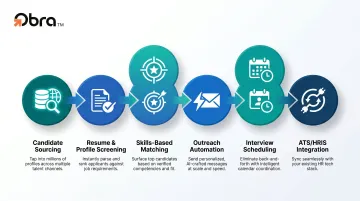
Together, these capabilities serve one purpose: help hiring teams find better candidates faster, at lower cost. AI handles the high-volume, repetitive work so recruiters can focus where human judgment matters most — reading candidates, aligning stakeholders, and closing the right hires.
Key Advantages of AI Recruitment Platforms
The advantages below map directly to metrics hiring teams already track: time-to-fill, cost-per-hire, quality of hire, and recruiter productivity.
Advantage 1: Faster Access to Qualified Candidates Through Outbound Search
Traditional inbound hiring requires patience. Post a job, wait for applications, screen the pile — that model worked when applications were scarce and mostly legitimate. Neither condition holds today.
AI recruitment platforms flip the sequence. Instead of waiting, they proactively search large candidate databases for profiles that match the role's specific requirements — delivering a qualified shortlist before a single application arrives. Obra Hire, for example, searches across 800M+ profiles using natural language input or a pasted job description, returning ranked, skills-matched results with a real-time preview of pool size before any credits are spent.
Why the speed advantage is real:
- SHRM's 2025 benchmarking data shows median time-to-fill at approximately 45 days — a meaningful cost and productivity drain for every open role
- Chipotle's deployment of conversational AI with Workday cut time-to-hire by up to 75%, compressing application-to-start from 12 days to 4
- Gem's 2026 benchmarks show direct sourcing produced 11% of hires from just 2.6% of applications — roughly 4x the yield of inbound
Top candidates don't wait either. Research consistently shows the best-fit people are off the market within 10 days — teams that reach them first win the hire.
Verified profiles matter here too. A fast shortlist is only useful if it contains real people. Obra Hire's verified profile filtering removes AI-generated and fake candidate data from outbound results, so every name on the list is reachable.
This advantage matters most for:
- Hard-to-fill or specialized roles
- High-volume hiring where manual sourcing doesn't scale
- Teams without a dedicated sourcing function
Advantage 2: Lower Cost-Per-Hire Without Sacrificing Quality
Recruiting costs stack up fast: agency fees, job board subscriptions, recruiter headcount, and the ongoing drain of unfilled roles. AI platforms address all of these at once.
The cost baseline is high. SHRM's 2025 benchmarking data puts the median nonexecutive cost-per-hire at approximately $1,200, with executive hires averaging $10,625. External agency fees typically run 15–30% of first-year salary — a significant line item on any hiring budget.
Self-serve AI platforms change the math. A hiring manager or small HR team can run outbound searches, evaluate candidates, and manage outreach independently — no external recruiters, no expensive enterprise contracts required.
The savings are concrete:
- Chipotle reported approximately $1 million per year in manager administrative time saved after deploying AI-assisted hiring workflows
- Replacing agency dependencies with a platform like Obra Hire's Scale plan ($169/month with 1,200 credits) meaningfully cuts per-hire cost on roles that previously required external sourcing
- Shared credit pools across recruiting teams eliminate duplicate spend — one team member's revealed contact is visible to everyone, so no one pays twice for the same candidate
There's also a risk-reduction angle worth noting. Obra Hire lets hiring teams preview candidate pool size before committing any spend. If the pool looks thin, adjust the criteria first — no credits wasted on a role where the pipeline isn't there.
This advantage matters most for:
- Growing companies scaling headcount without scaling recruiting spend
- HR teams managing multiple open roles on a fixed budget
- Organizations looking to reduce agency fee dependency
Advantage 3: Better Hiring Decisions Through Skills-Based Matching
Keyword-based resume screening is fast. It's also a poor proxy for actual job fit.
Harvard Business School research on "hidden workers" found that 48% of employers automatically filtered out middle-skills candidates with resume gaps of six months or more — and leaders estimated that similar keyword filters eliminated half or more of otherwise-qualified applicants. The system surfaces candidates who can write resumes, not necessarily candidates who can do the job.
Competency-based matching works differently. Instead of scanning resume text for keyword matches, it evaluates candidates against structured skill and experience criteria — measuring what candidates have actually done and what they're capable of.
How this translates to better outcomes:
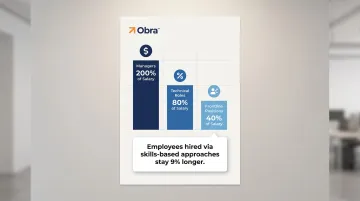
- Gallup estimates bad hire replacement costs at 200% of salary for managers, 80% for technical roles, and 40% for frontline positions — making screening accuracy a direct financial concern, not just a quality metric
- SHRM Labs data shows employees hired through skills-based approaches stay approximately 9% longer than those hired through traditional methods
- AI-driven evaluation applies the same criteria to every candidate regardless of name, presentation, or resume formatting — reducing the effect of unconscious bias at scale
Obra Hire's matching framework operates on a two-tier system: Must Haves control who enters the candidate pool, while Nice to Haves sort the qualified results by strength of fit. Hiring managers see exactly where each candidate meets or falls short of requirements — without digging through unstructured resume text to figure it out themselves.
This advantage matters most for:
- Technical or specialized roles where skills are hard to assess from a resume alone
- High-volume hiring where manual screening is impractical
- Teams prioritizing consistency and fairness in the evaluation process
What Happens When AI Recruitment Platforms Are Ignored
The consequences compound over time, and they're not theoretical.
Here's where teams fall behind when they skip AI:
- Inbound quality drops. Recruiters are processing 2.7x more applications per role than three years ago, with qualification rates falling. Every quarter without AI-assisted screening means more time spent on lower-value work.
- Speed costs you candidates. Teams using AI reach passive talent days ahead of those waiting on job board responses. Top candidates are gone within 10 days — and AI adoption among HR professionals reached 72% in 2025, so that gap is already measurable.
- Costs climb either way. Without AI, you either spend more (agency fees, added headcount) or hire slower (extended vacancy, lost productivity). SHRM reported recruiting costs rose in 2025 even as the labor market softened — manual processes don't get cheaper when conditions improve.
- Volume breaks manual workflows. What works for five open roles falls apart at fifty. More reqs means more applications, more time per hire, more cost per hire. AI decouples hiring volume from operational burden.
How to Get the Most Value from an AI Recruitment Platform
Getting value out of an AI recruitment platform isn't complicated, but it does require intentional adoption.
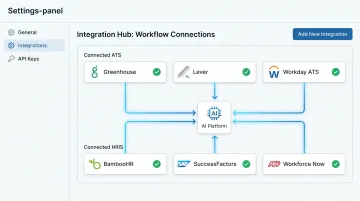
Integrate with existing workflows first. The biggest adoption barrier is disruption to current processes. Platforms with broad ATS/HRIS connectivity — Obra Hire connects with 85+ systems including Workday, Greenhouse, iCIMS, Lever, SAP SuccessFactors, SmartRecruiters, and Oracle Recruiting Cloud — make this transition low-friction. Candidate data flows into existing systems without duplication or manual re-entry.
Use AI insights consistently, not sporadically. A single search produces a shortlist. Consistent use over months builds a more accurate model of what "good" looks like for each role. Value compounds when teams:
- Review match quality across searches over time
- Track which criteria surface the strongest candidates
- Refine parameters based on actual hiring outcomes
Start with low-risk entry points. Freemium models and preview-before-you-spend features remove adoption friction. Obra Hire's Free plan includes unlimited searches, 1,000 profile views, and 50 contact credits — with full pool preview — so teams can validate the candidate pipeline before committing any budget. If the pool doesn't meet the bar, adjust criteria and search again. No spend required.
Conclusion
The value case for AI recruitment platforms isn't speculative — it shows up in metrics hiring teams are already tracking. Faster sourcing compresses time-to-fill. Lower agency dependency reduces cost-per-hire. Skills-based matching improves quality of hire and reduces bad-hire risk.
These advantages build on each other. The more a team uses AI-powered search and matching, the more refined their criteria become and the faster their hiring cycles run. Teams that adopt early don't just close roles faster — they establish a repeatable process that's genuinely difficult for slower-moving competitors to replicate.
For hiring teams that need to fill roles competitively without overspending, AI recruitment is already the default. The gap between teams using outbound AI search and those still sorting inbound applications is widening — and it shows up directly in time-to-fill and cost-per-hire.
Frequently Asked Questions
What is AI-powered recruitment?
AI-powered recruitment uses machine learning and automation to source, screen, and evaluate candidates faster than manual methods. It covers outbound sourcing — proactively searching candidate databases — and inbound screening, applying consistent evaluation criteria to every applicant.
Which AI tool is best for recruitment?
The right tool depends on team size, hiring volume, and workflow. Evaluate platforms on candidate database size, skills-based vs. keyword matching, ATS integrations, and cost structure. For teams that want to test before committing, Obra Hire's free tier lets you run unlimited searches before spending anything.
What companies use AI in recruitment?
Enterprise organizations like Unilever and Chipotle use AI for high-volume hiring, while lean HR teams and staffing agencies use self-serve platforms to scale without adding headcount. AI recruitment tools now serve companies of every size across nearly every industry.
How does AI recruitment reduce cost-per-hire?
AI reduces cost-per-hire by replacing manual sourcing hours, cutting agency fee dependency, and surfacing better-fit candidates earlier. It also shortens vacancy duration — a hidden cost that compounds the longer a role stays open.
Can AI recruitment platforms integrate with existing ATS systems?
Most modern platforms are built with ATS/HRIS integration as a core feature. Obra Hire connects with 85+ systems, allowing candidate data to flow into existing workflows without disrupting current processes or requiring manual re-entry.
How do AI recruitment platforms handle fake or AI-generated applicants?
Leading platforms use verified profile filtering to ensure the candidate database contains real, authenticated individuals. This prevents AI-generated applications from polluting sourcing pipelines — a growing concern given Gartner's projection that one in four candidates could be fake by 2028.