Introduction
Hiring teams today face a strange contradiction. They have more candidate data than ever — yet confidence in hiring decisions keeps dropping.
According to a March 2026 Robert Half survey, 84% of HR teams report heavier workloads as AI-tailored applications increase, and 67% of HR leaders say AI-generated applications are actively slowing hiring. Meanwhile, recruiters spend roughly 23 hours per hire on screening alone — most of that time reviewing applications that don't reflect what candidates can actually do.
The real problem is matching, not volume. Most platforms still run keyword filters that treat the word "Python" on a resume as proof someone can write Python. With AI-generated applications now overwhelming recruiting inboxes, the gap between what's written and what's real has become impossible to ignore.
This guide breaks down how AI-powered talent matching actually works — the four stages, the signals that matter, and what separates a matching engine that finds the right person from one that just counts keyword overlap.
TL;DR
- AI talent matching analyzes skills, proficiency depth, career trajectory, and behavioral signals — not just keyword presence.
- Matching runs through four stages: profile data collection, semantic skill analysis, multi-factor scoring, and feedback-driven learning.
- Competency-based matching evaluates how well someone knows a skill, not just whether they listed it.
- Outbound-first platforms proactively surface passive candidates — no job posting needed to start finding talent.
- Prioritize platforms that offer verified profiles, competency depth, ATS integrations, and passive candidate access.
What Is AI-Powered Talent Matching?
AI-powered talent matching uses machine learning, natural language processing, and structured competency models to evaluate how well a candidate's skills, experience, and trajectory align with a specific role — not just whether their resume contains the right words.
The problem it solves is scale. A recruiter reviewing 300 resumes at two to three minutes each burns 10 to 15 hours on resume review alone — with no guarantee the strongest candidates surface before fatigue sets in.
What It's Not
These terms are frequently confused, so the distinctions matter:
- Resume parsing extracts data from a document — it doesn't evaluate fit
- ATS keyword filtering applies rigid pass/fail rules based on term presence
- Generative AI writing tools help candidates produce better-sounding applications (which is exactly the problem)
AI talent matching is a scoring and ranking system trained on real hiring outcomes. The output is a ranked list ordered by genuine fit, not by which documents happened to contain the right phrasing.
SHRM's research describes keyword-based ATS systems as ones that "bury capable candidates behind keyword matching" — creating a contradiction where skilled workers are rejected not for lacking ability, but for lacking the exact phrasing a filter expected.
How AI Talent Matching Works: The 4-Stage Process
AI talent matching isn't a single algorithm — it's a sequence of interdependent stages. Each one builds on the last to produce a match score that reflects genuine fit.
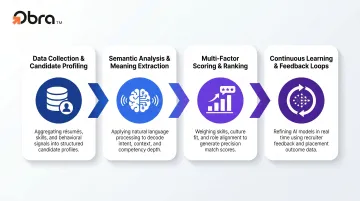
Stage 1: Data Collection and Candidate Profiling
Before any matching happens, the system builds structured profiles from multiple data sources simultaneously:
- Resumes, work history, job titles, and certifications
- Professional profiles and inferred skills from described experience
- Seniority signals and career progression patterns
At the same time, the AI reads the job description and maps it to a structured set of competencies — including context signals the posting implies but never states explicitly (industry norms, team dynamics, seniority expectations).
Platforms like Obra Hire search across 800M+ profiles using this structured approach, with recruiters able to paste a job description or describe their ideal candidate in natural language to trigger the matching process.
Stage 2: Semantic Analysis and Meaning Extraction
This is where modern AI matching separates itself from legacy filters.
Natural language processing (NLP) moves beyond exact keyword matching to understand the meaning behind candidate language. A candidate who "led cross-functional sprints" implies Agile project management experience — even if the word "Agile" never appears anywhere in their resume.
The mechanism behind this is semantic embeddings (mathematical representations of meaning): both candidate profiles and job descriptions are converted into vectors in a shared mathematical space. The system then measures conceptual similarity between the two — not string overlap.
Peer-reviewed research published in Information Sciences found that semantic AI matching achieved similarity scores of 0.74 to 0.88 across domains like software engineering, data science, and project management — compared to 0.17 to 0.35 for keyword-based methods. That's roughly a 2x to 5x improvement depending on the role.
In practice, this means the system can:
- Identify transferable skills that cross industry boundaries
- Recognize equivalent job titles used differently across sectors
- Surface relevant experience that rigid keyword filters would discard entirely
Stage 3: Multi-Factor Scoring and Ranking
Once profiles are processed, the matching engine computes a composite score by weighing multiple factors simultaneously:
- Skill overlap — breadth of matched skills and recency of usage
- Title progression — whether the candidate's seniority aligns with the role
- Industry and company background — relevant sector experience
- Career trajectory — where the candidate appears to be heading, not just where they've been
- Role context signals — competency requirements inferred from the job description itself
Recency weighting is particularly important. A skill used actively in the last 12 months ranks higher than the same skill used once six years ago. This prevents outdated experience from inflating match scores and gives recruiters a more honest picture of current capability.
All of that logic feeds into a ranked candidate list with explainable scores. Obra Hire shows a clear breakdown of "Must Have" and "Nice to Have" criteria for each result — so recruiters can see exactly why a candidate ranked where they did and apply additional filters without losing the AI's core ranking logic.
Stage 4: Continuous Learning and Feedback Loops
When recruiters advance, reject, or hire candidates, those actions feed back into the model as signals that refine future scoring. The more the platform is used, the more calibrated it becomes for that organization's specific hiring patterns — what "strong fit" actually looks like in their roles, at their company stage, within their culture.
By month six, the system should meaningfully outperform where it started — because it has learned which signals actually predict success for that specific organization.
Why Keyword Matching Falls Short — and What Competency-Based Matching Does Differently
Keyword filtering has a fundamental flaw: it treats the presence of a word as proof of a skill.
There's no distinction between a candidate who mentioned "Python" once in an online course description and someone who has built production systems in Python for three years. Both score identically.
The AI-Generated Application Problem
That flaw has gotten much worse. A Gartner survey of 3,290 candidates found 39% used AI during the application process, with 54% specifically using it to generate resume text. Gartner also projects that by 2028, one in four candidate profiles worldwide will be fake.
The result: keyword-matching platforms are now surfacing well-optimized text, not well-matched candidates. The more candidates optimize resumes with AI, the less useful keyword overlap becomes as a signal.
What Competency-Based Matching Evaluates Instead
Rather than counting word matches, competency-based systems evaluate three distinct dimensions:
| Dimension | What It Measures |
|---|---|
| Skill depth | Proficiency level — "familiar with" vs. "expert in" |
| Skill recency | How recently the skill was actively applied |
| Skill context | The environment in which the skill was used (startup vs. enterprise, team size, industry) |
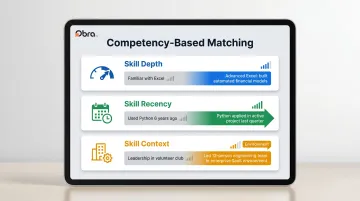
This creates a far more accurate picture of what a candidate can actually do on day one.
Structured skill taxonomies make this possible at scale. Obra Hire's SkillsTree, for example, maps candidates against a proprietary taxonomy of 8,241 skills with proficiency levels, enabling the system to differentiate between surface-level familiarity and genuine expertise across thousands of skill categories simultaneously.
That precision has measurable downstream effects. A Duke University study published in PMC found that implementing a competency-based job framework reduced employee turnover from 23% to 16% — a 30% reduction — compared to the prior three-year period under traditional hiring approaches. When the match reflects genuine capability, not resume polish, retention follows.
What AI Matching Actually Delivers: Outcomes for Hiring Teams
Speed and Scale
The numbers make the comparison obvious. A recruiter reviewing resumes one at a time will always lose to a system processing thousands of profiles simultaneously.
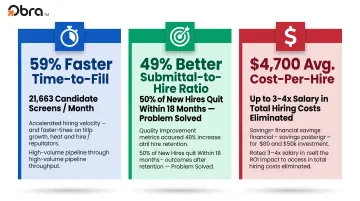
An AI matching engine doesn't get fatigued at resume 150. It applies identical evaluation criteria to every candidate in the pool. Staffing firm IDR, after implementing AI-powered matching through Bullhorn Amplify, reported 59% faster time to fill and 21,663 candidate screens completed per month — numbers no manual process could approach.
Quality of Hire and Retention
Speed means nothing if the wrong candidates surface. The evidence on quality is consistent: nearly 50% of new hires are terminated or quit within their first 18 months, according to SHRM data — a problem that often traces back to poor hiring decisions.
The same IDR case study showed a 49% improvement in submittal-to-hire ratio after implementing AI matching, meaning candidates who were submitted were far more likely to actually get hired. When matching is based on demonstrated competency rather than keyword alignment, the shortlist contains people who can actually do the job.
Cost Reduction
Bad hires are expensive. SHRM estimates the average cost-per-hire at $4,700, with total hiring costs potentially reaching 3 to 4 times the position's salary when training, onboarding, and productivity loss are included. The U.S. Department of Labor puts the cost of a single bad hire at at least 30% of that employee's first-year earnings.
AI matching reduces these costs in several ways:
- Fewer recruiter hours spent screening unqualified applicants
- Faster time-to-fill, reducing vacancy costs
- Lower mis-hire rates, reducing the need for replacement cycles
Bias Reduction — With an Important Caveat
Cost savings are only part of the picture. AI matching also has implications for hiring fairness — though the reality is more nuanced than the marketing often suggests.
When built on verified skill and competency data, AI matching applies identical evaluation criteria to every candidate. There's no unconscious preference influencing who gets a closer look.
But the caveat matters. University of Washington researchers found significant racial, gender, and intersectional bias in how GPT-4, Claude, and Llama ranked resumes — demonstrating that AI systems can inherit and amplify historical bias when trained on flawed data.
Regulatory scrutiny backs this up. The ICO issued 296 recommendations after auditing AI recruitment tools in the UK, finding some tools capable of inferring protected characteristics from candidate names.
Bias reduction is a feature of well-built AI matching platforms, not AI matching in general. Platforms using verified, outcome-based training data are meaningfully different from those that inherited patterns from historical hiring decisions.
What to Look for in an AI Talent Matching Platform
Not all AI matching platforms deliver the same results. Three criteria tend to separate the platforms worth evaluating from those that aren't.
Competency Depth Over Keyword Search
Ask vendors directly: does the system distinguish between proficiency levels, and does it weight recency? Platforms that match on verified skill depth — rather than resume text — produce fundamentally different shortlists.
Obra Hire addresses both dimensions through SkillsTree, a proprietary taxonomy of 8,241 skills with proficiency levels, combined with verified profile filtering that removes AI-generated and fake profiles before they reach a recruiter's screen.
Outbound Access and Passive Candidate Reach
The strongest candidates for most roles aren't actively applying to job postings. Ask whether the platform can proactively surface passive candidates from a large profile database, or whether it only processes inbound applications.
Obra Hire's outbound-first model lets hiring teams search 800M+ profiles directly and reveal contact details for candidates who haven't applied anywhere:
- Email, phone, and LinkedIn contact info revealed on demand
- "Preview before commit" confirms pool size and quality before spending a single credit
- Unlimited searches on every plan, including Free
Integration and Workflow Compatibility
A platform that forces teams to abandon their existing ATS slows adoption and stalls implementation. Look for 85+ native integrations as a practical minimum for enterprise use.
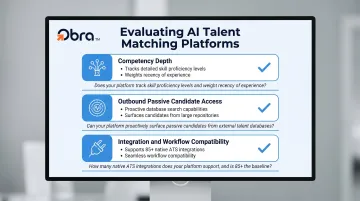
Obra Hire connects with Workday, Greenhouse, iCIMS, Lever, SAP SuccessFactors, and 80+ additional platforms — plugging into the tools teams already use rather than displacing them.
Frequently Asked Questions
What is the difference between keyword matching and AI-powered talent matching?
Keyword matching checks whether specific words appear in a resume. It has no way to evaluate whether the person actually understands or can apply what those words describe. AI matching evaluates the meaning, depth, and context of a candidate's experience, producing shortlists based on genuine competency fit rather than language overlap.
How does AI candidate matching reduce bias in hiring?
AI matching applies the same evaluation criteria to every candidate consistently, focusing on verified skill signals rather than demographic proxies. Bias reduction only holds when the platform's training data is outcome-based and regularly audited. AI systems trained on biased historical hiring data will reproduce those patterns at scale.
Can AI matching find passive candidates who haven't applied to a job?
Yes: outbound-first platforms are built specifically for this. Rather than waiting for applications, they search large profile databases proactively and surface candidates who match your criteria regardless of whether those candidates are actively job searching. Obra Hire operates this way across its 800M+ profile database.
What data does an AI matching system use to score candidates?
Primary signals include:
- Skill overlap and proficiency level
- Title progression and seniority fit
- Career trajectory and industry background
- Recency of skill usage
- Context signals from the job description, including requirements the posting implies but doesn't state explicitly
How do AI matching platforms handle fake or AI-generated resumes?
Platforms with verified profile databases cross-check candidate data against authentic sources to filter out AI-generated or fabricated profiles before they reach matching results. Obra Hire includes verified profile filtering specifically to address this, a growing necessity: Gartner projects one in four profiles worldwide will be fake by 2028.
How accurate is AI talent matching compared to manual screening?
Semantic AI matching achieves similarity scores of 0.74 to 0.88 versus 0.17 to 0.35 for keyword-based methods, roughly a 2x to 5x improvement in match quality. Accuracy continues improving as the platform's feedback loop incorporates your actual hiring outcomes, calibrating results to your specific definition of a strong hire.