Introduction
Enterprise recruiting teams are caught in a bind most CHROs know well: application volumes hit 257.6 per role on average in 2025, up from 207.2 the year before, while recruiting teams are 14% smaller than in 2021. At the same time, between 40% and 80% of those applications may be AI-optimized, keyword-stuffed documents that are nearly indistinguishable from genuine qualification signals.
The candidates most worth hiring often aren't in that pile at all. 73% of professionals are passive — employed, not browsing job boards, and completely unreachable through inbound applications.
Traditional ATS workflows were built to process applicants, not find talent. They filter on keywords, miss non-linear careers, and have no mechanism for reaching candidates who never applied. AI candidate matching changes that equation — not just by screening faster, but by fundamentally rethinking how enterprise teams identify, evaluate, and engage the right people.
What follows is a practical look at how AI matching works at enterprise scale, the real transformations it delivers, and the governance and implementation decisions that determine whether it succeeds or fails.
TL;DR
- AI candidate matching uses NLP and competency-based scoring to evaluate skills in context, not just keywords — far more accurate than legacy ATS filters
- The biggest enterprise win is surfacing qualified passive talent and filtering out AI-generated applicants before they consume recruiter time
- Skills-first matching expands qualified talent pools, supports DEI goals, and reduces reliance on degree or title proxies
- Governance, explainability, and human oversight are non-negotiable under NYC Local Law 144 and the EU AI Act
- Deploy AI matching on top of existing ATS/HRIS infrastructure to augment workflows, not replace them
Why Enterprise Recruitment Breaks Without AI Matching
The Volume Problem Has Outpaced Manual Screening
Recruiters now handle 93% more applications and 40% more open roles than in 2021, with teams that are 14% smaller. The industry standard for a corporate recruiter — 15 to 25 active requisitions — was set before application volumes surged. At 257 applications per role, even a 20-requisition workload means reviewing 5,000+ submissions manually. That's not a productivity problem; it's a structural one.
The AI Resume Crisis Is Making Signals Worthless
Keyword-based screening was already imprecise. Now it's broken entirely. When 40-80% of applicants use generative AI to tailor their resumes to job descriptions, every document starts to look the same — dense with the right keywords, optimized to pass filters, but telling you almost nothing about whether the person can actually do the job.
Traditional ATS systems can't distinguish a genuinely qualified candidate from someone who ran their resume through ChatGPT four times. The result: recruiters spend more time screening and find fewer qualified candidates than before.
The Passive Talent Gap
73% of professionals are not actively applying to jobs. The strongest candidates for most enterprise roles are employed, content enough to stay put, and completely invisible to inbound application workflows. A recruiting strategy built entirely around job post responses is, by design, a strategy that misses most of the market.
The Keyword Trap and Its Hidden Costs
Legacy ATS keyword screening doesn't just miss passive candidates — it penalizes non-linear careers, adjacent roles, and unconventional backgrounds. An operations director who spent five years in consulting before moving in-house may describe the same competencies in completely different language than a recruiter's keyword list expects. That profile gets filtered out automatically.
These rejections aren't random. They systematically disadvantage candidates who describe their experience differently — which often correlates with career path, industry background, and demographic factors.
Research from Brookings Institution (2025) found white-associated names were preferred in 85.1% of AI resume screening cases versus 8.6% for Black-associated names — a pattern that applies to keyword-filtered systems, not just AI ones.
The Coordination Problem at Enterprise Scale
Multi-region, multi-team hiring adds another failure mode: inconsistency. When matching criteria live in individual recruiters' heads rather than a structured system, the same role gets evaluated differently depending on who's hiring and where. The consequences compound across the organization:
- Candidate quality varies unpredictably across business units
- Hiring decisions reflect individual judgment rather than consistent standards
- Quality-of-hire benchmarks become impossible to track or improve at scale
The fix isn't better recruiters — it's a process architecture that doesn't require every recruiter to redefine "qualified" from scratch.
How AI Candidate Matching Works at Enterprise Scale
NLP-Based Job Deconstruction
The first step is turning a job description into structured signals. Modern AI matching uses natural language processing to parse job descriptions and extract competency requirements — not just job titles and years of experience, but the underlying skills and capabilities the role demands.
Obra Hire, for example, automatically processes job descriptions when a recruiter initiates a search. Recruiters can paste a job description, describe what they're looking for in plain language, or apply manual filters — and the AI deconstructs those inputs into structured competency criteria. The result is a search grounded in what the role requires, not just what words appear in the posting.
Semantic Matching vs. Keyword Matching
This is where modern AI matching diverges most sharply from legacy ATS logic:
| Approach | How It Works | The Problem |
|---|---|---|
| Keyword matching | Scans for exact or near-exact word matches | Misses synonyms, adjacent skills, different terminology |
| Semantic matching | Uses meaning to equate related concepts | Understands that "revenue ops" ≈ "sales ops"; "React" implies related JS skills |
| Competency scoring | Evaluates skills at defined proficiency levels | Maps transferable experience; ranks fit, not keyword density |
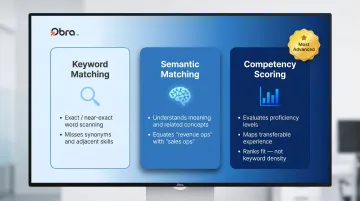
Semantic matching means a candidate who describes their experience as "pipeline management" isn't penalized for not writing "CRM administration" — even if both phrases describe the same work.
Competency-Based Scoring
Obra Hire's matching engine evaluates candidates against structured "Must Have" and "Nice to Have" competency criteria. Must Haves control who enters the candidate pool — they're the hard filters. Nice to Haves sort qualified results, with the AI ranking stronger matches higher when candidates align with them.
Each result shows a clear breakdown of exactly where a candidate matches or falls short, giving recruiters a clear rationale for every recommendation, not just a black-box score.
Verified Profile Filtering
Competency scoring only delivers value when the profiles behind the results are real. At enterprise application volumes, fake and AI-generated profiles are a daily operational problem, not a theoretical risk.
AI matching systems with verified profile filtering cross-reference profile data to flag inconsistencies and surface only candidates whose credentials hold up. Obra Hire's verified profile filtering (available on Explore and Scale plans) addresses this directly — Gartner has flagged fabricated profiles as affecting 1 in 4 candidates by 2028, making this filter increasingly non-optional for enterprise teams.
The Enterprise Hiring Transformations AI Candidate Matching Delivers
Time-to-Fill and Recruiter Productivity
The average US time-to-fill sits at 44 days according to SHRM's 2025 benchmarking data. AI matching compresses that by eliminating the manual screening bottleneck — delivering ranked, evidenced shortlists instead of raw application queues.
Hiring automation tools save recruiters 10+ productive hours every week by automating repetitive screening tasks. Those hours shift to relationship-building, interviewing, and closing candidates who are already confirmed qualified.
Quality-of-Hire Improvement
Faster screening is only valuable if the candidates surfaced are actually better. The data supports that skills-based matching improves this:
- Employers using skills-based hiring report 34% "very satisfied" rates with recent hires vs. 18% for those who don't
- 71% of hiring professionals agree skills testing predicts job success better than resumes
- Non-degreed workers hired via skills-based methods show a 10-percentage-point higher two-year retention rate
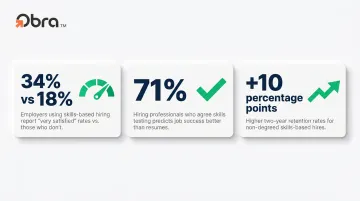
The shift from keyword filtering to competency scoring moves hiring decisions from gut instinct toward evidence-based evaluation.
Skills-First Hiring and DEI Expansion
Skills-first hiring expands qualified talent pools by up to 6.1x compared to degree-centric methods. That math matters: approximately 62% of Americans lack a college degree and get filtered out by traditional requirements — regardless of whether they can do the job.
Obra Hire's competency-based search lets recruiters define role requirements by skill and proficiency level rather than degree or title. The "Must Have" and "Nice to Have" framework makes it possible to run an explicitly skills-first search without manually removing degree language from every job description.
Key DEI outcomes from skills-based approaches:
- 90% of employers using skills-based hiring report diversity improvements
- 34% report a significant positive impact (26-50% improvement)
- LinkedIn data shows skills-first methods increase Gen Z candidate pools by over 10x
Access to Passive Talent Through Outbound-First AI
Traditional ATS platforms optimize for speed on inbound applications. They can't access candidates who never applied.
Inbound screening makes you faster at processing applicants who came to you. Outbound AI matching lets you find the 73% who never will. Obra Hire is built for this model — an outbound-first platform that searches 800M+ verified candidate profiles and surfaces people who match competency requirements, whether or not they've applied, posted to a job board, or are actively looking.
When a recruiter runs a search, results come back ranked and skill-matched. Each profile includes:
- Direct contact details — email, phone, LinkedIn, and resume
- Competency match scores tied to the role's defined requirements
- Pool size and profile quality previews before spending a single credit
That preview capability removes procurement risk from the evaluation process entirely.
Outbound recruiting doesn't improve your access to the talent market — it changes which market you're recruiting from.
Governance, Bias, and Compliance: What Enterprise Teams Must Get Right
The Bias Risk Is Real and Documented
AI matching systems learn from data. If historical hiring decisions were biased — and most organizations' hiring history contains some degree of bias — a model trained on those outcomes can encode and amplify those patterns at scale. The Brookings research cited earlier wasn't theoretical; it was empirical measurement of discrimination happening in real systems.
Enterprise teams must:
- Use only job-related features in matching criteria
- Exclude protected-class proxies (zip code, name patterns, graduation years as age signals)
- Conduct regular adverse impact monitoring by demographic stage
- Ensure every match score comes with explainable reasoning recruiters can review and override
The Regulatory Landscape
Three frameworks enterprise HR and Legal teams need to understand:
- NYC Local Law 144: Requires independent bias audits before deploying an Automated Employment Decision Tool, public posting of audit results, and candidate notice. Active enforcement since July 2023. Penalties run $500-$1,500 per violation per day.
- EU AI Act: Classifies recruitment AI as high-risk. Requires robust data governance, human oversight mechanisms, and detailed decision logging. Main HR AI compliance deadline has been moved to December 2027, though the substance of the law is unchanged.
- EEOC Guidance (Title VII): Employers are legally responsible for adverse impact outcomes from AI tools — even those built by outside vendors. The four-fifths rule applies to AI selection tools just as it does to any other selection procedure.
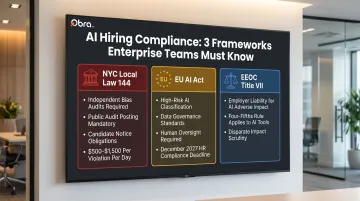
Regardless of which framework applies, documentation requirements overlap significantly. Expect to maintain:
- Feature registries detailing what data inputs drive match scores
- Audit logs with timestamps and decision rationale
- Clear ownership records distinguishing where AI assists versus where humans decide
- Documented human override processes with accountability trails
Human-in-the-Loop Is Non-Negotiable
The enterprise teams getting the best results treat AI matching as a recommendation and prioritization engine — not an autonomous decision-maker. AI surfaces and ranks candidates; humans make the call.
Candidates and hiring managers both need to trust the process. An AI making invisible decisions without human accountability erodes that trust — and fast.
Recruiter accountability for final hiring decisions is both a legal requirement and a prerequisite for adoption. The teams that treat human oversight as a feature rather than a constraint are the ones that get sustained buy-in from both legal and the people actually doing the hiring.
How to Implement AI Candidate Matching in Your Enterprise
Start With a Scoped Pilot
Before enterprise rollout, run a 30-day side-by-side in one role family or business unit. Establish baseline metrics first:
- Current time-to-fill
- Interview-to-offer conversion rate
- Pass-through equity by demographic stage
Run weekly dashboards comparing AI-assisted and human-only screening across both speed and quality dimensions. Don't scale until you have data — not anecdotes — on what's improving.
Address Integration Before Deployment
AI matching fails without recruiter adoption, and recruiters won't adopt tools that require them to leave their existing workflow. Integration with your ATS and HRIS has to work from day one — broken data handoffs kill adoption before it starts.
Obra Hire integrates with 85+ platforms including Workday, Greenhouse, iCIMS, Lever, and SAP SuccessFactors. Before committing to any platform, validate that the specific integrations your team uses are confirmed — and that data flows bidirectionally without requiring manual re-entry.
That same low-friction principle extends to procurement. Obra Hire allows teams to see candidate pool size and profile quality before spending any credits, which means you can validate fit before any financial commitment.
Plan for Recruiter Change Management
The most common implementation failure isn't the technology — it's recruiter distrust of AI-generated scores. A ranked list with no explanation invites skepticism and override. A ranked list that shows exactly which competencies drove the match earns trust over time.
Build adoption through three practices:
- Surface competency evidence with every match score — a number alone won't earn trust
- Train recruiters on what signals mean, not just when to override them
- Frame AI as noise removal so recruiters spend less time on screening and more on relationship-building, interviewing, and closing
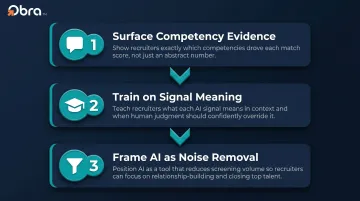
Recruiter judgment doesn't disappear in this model — it gets focused on the candidates who actually warrant it.
Frequently Asked Questions
What is AI candidate matching and how is it different from traditional ATS screening?
AI candidate matching evaluates candidates on skills, competencies, and contextual fit using NLP and machine learning, not exact keywords and job titles. Traditional ATS screening rejects qualified candidates with non-linear backgrounds and can't detect AI-optimized resumes that game keyword filters.
Can AI candidate matching reduce bias in enterprise hiring?
It can, when built with job-related features only and paired with regular adverse impact audits and human decision ownership. Without those governance controls, AI matching can amplify historical bias, particularly if trained on data from organizations with skewed prior hiring patterns.
How does AI candidate matching integrate with existing ATS and HRIS systems?
Most enterprise-grade platforms offer ATS connectors that sync candidate data into existing workflows. Teams should verify specific integrations with their stack — Workday, Greenhouse, iCIMS, and similar platforms — before deployment, and confirm that data flows without manual re-entry between systems.
What are the biggest challenges of implementing AI candidate matching at enterprise scale?
Three failure modes consistently derail implementations:
- Poor data quality feeding the model
- Recruiter resistance to AI-generated recommendations
- Inadequate governance for explainability and compliance
All three are manageable with a phased pilot approach and deliberate change management.
How do enterprise teams measure ROI from AI candidate matching?
Track five metrics: time-to-fill reduction, interview-to-offer conversion rate, 90-day retention of AI-matched hires, cost-per-hire, and pass-through equity by demographic stage. Pass-through equity matters both for DEI accountability and as an early indicator of bias risk.
What is the difference between inbound screening and outbound AI candidate matching?
Inbound screening evaluates applicants who come to you. Outbound AI matching proactively searches verified candidate databases to surface passive talent who fit the role but haven't applied. Combining both delivers the strongest enterprise hiring outcomes: optimizing inbound alone means competing only for the 27% of the market that's actively looking.