Meanwhile, SHRM's 2025 research shows 51% of organizations now use AI specifically for recruiting — up from 26% just a year prior. AI in talent acquisition is no longer experimental. The question isn't whether to use it, but how to use it well.
This guide breaks down where AI hiring outperforms manual methods, where human judgment remains irreplaceable, and how to build a hybrid model that actually works in 2026.
TL;DR
- AI hiring wins on speed, scale, and passive candidate reach — but only with verified data and competency-based criteria
- Manual hiring preserves nuance and relationship-building — but collapses under high application volume
- Fake applicant profiles are a real and growing threat; outbound AI sourcing sidesteps the fake-applicant flood entirely
- The best approach in 2026 is hybrid — AI handles discovery and screening, humans lead relationships and final calls
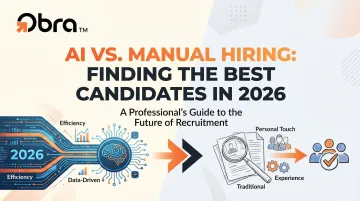
AI vs. Manual Hiring: Quick Comparison
| Dimension | AI Hiring | Manual Hiring |
|---|---|---|
| Speed / Time-to-Hire | Minutes to a ranked shortlist | Days to weeks per role |
| Cost-Per-Hire | Lower — 36% of AI users report reduced hiring costs | SHRM baseline: ~$4,700 per hire |
| Candidate Reach | Active + passive talent across millions of profiles | Mostly active applicants via job boards |
| Accuracy / Consistency | Standardized criteria applied uniformly at scale | Variable — depends on individual reviewer judgment |
| Bias Risk | Reduced inconsistency; algorithmic bias possible with flawed criteria | Unconscious bias common; inconsistent across reviewers |
| Scalability | Handles hundreds of roles simultaneously | Breaks down above ~100 applications per role |
| Fake Profile Defense | Verified outbound sourcing filters AI-generated profiles | Vulnerable — inbound pipelines increasingly polluted |
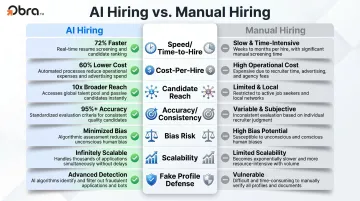
No single method wins across every scenario. A five-person company hiring one senior engineer faces a very different problem than a logistics firm filling 200 driver positions — and the right tool depends on volume, role complexity, and how much of your pipeline is already polluted with AI-generated applicants.
What Is AI Hiring?
AI hiring uses algorithms, machine learning, and automation to source, screen, rank, and engage candidates — handling in minutes what manual processes take days to complete. Two distinct types exist:
- Inbound AI screening — parsing and ranking applications that come to you
- Outbound AI sourcing — proactively searching talent databases for candidates who haven't applied
The operational difference matters enormously in 2026. Inbound screening makes your existing pipeline faster. Outbound sourcing changes who you're looking at entirely.
Why Outbound AI Matters Now
The inbound model has a structural problem: it depends on who shows up. And increasingly, who's showing up includes AI-generated profiles, templated resumes, and fraudulent applications. Gartner's projection of 25% fake profiles by 2028 isn't a distant concern — it's already affecting hiring pipelines today.
Outbound AI sourcing sidesteps this by searching pre-vetted databases rather than waiting for applications. Platforms like Obra Hire search 800M+ verified candidate profiles using competency-based matching, giving recruiters access to talent that never submitted an application — and filtering out the noise before it reaches the desk.
Beyond Keyword Matching
Early AI screening tools scanned resumes for matching text and stopped there. Modern AI hiring evaluates actual competency signals — proficiency levels, adjacent skills, career trajectory — rather than whether a resume contains the right keywords.
Obra Hire's approach uses structured competency data with "Must Have" and "Nice to Have" criteria. Must Haves control who enters the candidate pool; Nice to Haves rank results by fit quality. Recruiters can also preview pool size before spending a single contact credit, validating search criteria before committing any budget.
Use Cases Where AI Hiring Excels
- High-volume roles — manufacturing, logistics, healthcare, and retail where hundreds of applications arrive weekly
- Reaching the 73% of top performers who are open to new roles but not actively applying
- Multi-location hiring — consistent criteria applied across US, Canada, and Mexico simultaneously
- Roles requiring specific skill combinations that are hard to filter manually but straightforward to match with AI
- Teams dealing with polluted inbound pipelines — outbound verified sourcing bypasses fake and AI-generated applications entirely
What Is Manual Hiring?
Manual hiring is the recruiter-led process most organizations have run for decades: post a job, review inbound applications, conduct phone screens, and interview finalists. It's driven by individual judgment, professional networks, and direct relationship-building.
Where Manual Hiring Genuinely Wins
Don't underestimate what experienced recruiters bring to the table. Manual hiring excels at:
- Assessing cultural fit that doesn't show up in a skills matrix
- Interpreting non-linear careers (the marketer who spent two years in operations, the engineer who pivoted to product)
- Building candidate trust — senior candidates don't respond well to automated outreach sequences
- Nuanced judgment calls for executive and C-suite roles where the stakes of a wrong hire are high
These aren't soft advantages. For certain roles, they're decisive.
Where Manual Hiring Breaks Down
The weaknesses are equally real:
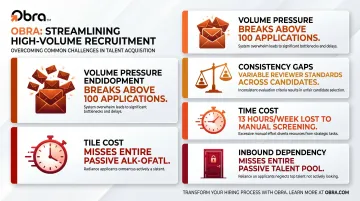
- Volume pressure — manual review becomes unreliable above roughly 100 applications per role
- Consistency gaps — different reviewers applying different standards to the same candidate pool
- Time cost — recruiters spend an average of 13 hours per week on screening tasks alone, a cost that compounds fast across multiple open roles
- Inbound dependency — manual hiring only sees candidates who applied, missing the passive talent pool entirely
Use Cases for Manual Hiring
Manual hiring remains the stronger choice for:
- Low-volume, highly specialized niche searches
- Executive and C-suite recruitment
- Relationship-dependent industries (consulting, financial advisory, law)
- Organizations hiring infrequently where building AI workflows isn't worth the setup cost
Manual hiring still benefits from AI support at the sourcing and scheduling stages. The real decision isn't whether to automate — it's which parts of the process human judgment actually improves.
AI vs. Manual Hiring: Which Is Better in 2026?
The honest answer: neither wins outright. The better question is which method wins for your specific situation.
The Four Factors That Matter
| Factor | Edge | Key Data |
|---|---|---|
| Cost | AI | SHRM 2025: 36% of AI-using orgs report lower hiring costs vs. a ~$4,700 manual cost-per-hire |
| Speed | AI | Josh Bersin/AMS: 2x–3x faster hiring with AI-enabled talent acquisition |
| Candidate quality | Depends on setup | Harvard/Burning Glass: skills-based hiring yields a 10-point higher 2-year retention rate for non-degreed hires |
| Scalability | AI | Manual processes hit a hard ceiling; AI doesn't |
The Bias Question
AI doesn't eliminate bias — it changes where bias enters the process. Well-defined, validated criteria reduce unconscious human bias and inconsistency across reviewers. But AI trained on flawed historical data can encode and amplify existing patterns. Human oversight remains non-negotiable for ethical hiring.
Regulatory pressure is increasing on this front. NYC Local Law 144 requires bias audits for automated employment decision tools, and the EU AI Act classifies hiring and screening systems as high-risk.
Situational Decision Guide
Choose AI hiring when:
- Sourcing passive candidates at scale
- Managing high inbound application volume
- Hiring across multiple locations or markets
- Dealing with AI-generated or fake applicant noise in your pipeline
Choose manual hiring when:
- Filling senior, executive, or C-suite roles
- Hiring for a highly specialized niche where relationship matters
- Building trust with passive candidates in conservative industries
A Real-World Benchmark
Unilever's AI-assisted recruitment saved 50,000+ hours of recruiting time while improving candidate quality metrics. Hilton cut time-to-hire from 42 days to 5 for certain roles after deploying conversational AI screening.
These aren't edge cases. They show what happens when AI handles repeatable top-of-funnel work and humans focus where judgment counts.
The practical takeaway: stop asking which method is better. Those benchmarks point to the real question — which tasks in your hiring funnel still need a human, and which don't.
The Hybrid Approach: Combining AI with Human Judgment
The hiring teams producing the best outcomes in 2026 aren't choosing between AI and human — they're dividing the work intelligently.
How the Division of Labor Works
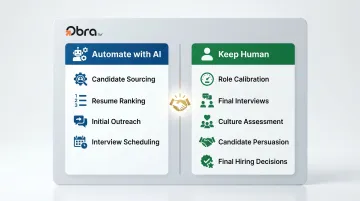
Automate first:
- Candidate sourcing and outbound search
- Resume ranking and shortlisting
- Initial outreach (where appropriate)
- Interview scheduling and coordination
Keep human:
- Intake and role calibration with hiring managers
- Final interviews and offer negotiation
- Culture and values assessment
- Candidate persuasion and relationship-building
- All final hiring decisions
SHRM's data reinforces this direction: 75% of HR professionals agree that AI advancements will increase the value of human judgment over the next five years — not replace it. When AI absorbs the volume work, recruiters spend more time on the conversations that actually close candidates.
Getting Started Without Disrupting Existing Workflows
Most teams hesitate to adopt AI hiring tools because they assume it means overhauling their ATS, retraining staff, or committing to expensive annual contracts. That barrier is lower than it used to be.
Obra Hire's freemium model lets teams run unlimited searches, preview candidate pools, and access 1,000 profile views and 50 contact credits per month — no cost, no contract, no setup required. Before spending a single dollar, a recruiter can see exactly how many verified candidates match a specific role in their target geography.
The platform's 85+ ATS integrations — including Workday, Greenhouse, iCIMS, Lever, and SAP SuccessFactors — mean candidate data flows directly into existing systems. The AI sourcing layer adds capability without touching current workflows.
Starting with outbound AI sourcing for one or two high-volume roles is a low-risk way to measure impact before expanding automation to other hiring stages.
Frequently Asked Questions
What is the difference between traditional search and AI search in hiring?
Traditional search relies on recruiters browsing job boards and reviewing inbound resumes — reactive by nature. AI search continuously scans millions of verified profiles and matches candidates on competency signals. It surfaces active and passive talent in minutes. The core difference: inbound vs. outbound.
Can AI hiring replace human recruiters entirely?
No. AI handles high-volume, repeatable sourcing and screening tasks effectively. But human judgment remains essential for cultural fit assessment, building candidate trust, interpreting nuanced career histories, and making final hiring decisions. The strongest outcomes come from combining both.
How does AI hiring help find passive candidates?
Outbound AI sourcing proactively searches talent databases for candidates who aren't actively applying, matching on skills, experience, and availability signals. This gives recruiters access to a far wider talent pool than inbound job postings alone, including top performers who never check job boards.
What are the biggest risks of using AI in hiring?
The main risks include:
- Algorithmic bias when criteria are poorly defined
- Fake or AI-generated profiles in unverified databases
- Over-reliance on automation without human oversight
- Regulatory compliance exposure
All are manageable with verified data sources, well-defined criteria, and human review at key decision points.
Is AI hiring effective for non-tech or blue-collar roles?
Modern AI hiring platforms match candidates across all industries and role types, including manufacturing, healthcare, retail, and logistics. Obra Hire covers 34 industries with documented hiring activity for CDL-A drivers, registered nurses, electricians, and service roles.
How do I know if fake or AI-generated candidates are affecting my pipeline?
Watch for unusually high application volume with low qualification rates, templated or suspiciously similar responses, and mismatched profile data. The most effective defense is switching to verified outbound sourcing platforms. These filter for authenticated profiles before you ever see results, rather than sorting through inbound applications after the fact.