AI is collapsing that timeline. From identifying passive candidates in a database of hundreds of millions of profiles to auto-scheduling interviews across multiple calendars, the technology is compressing what once took weeks into days — sometimes hours.
But speed isn't the whole story. According to Aptitude Research, **62% of employers now use AI in talent acquisition**, yet 44% apply it to less than a quarter of their workflow. Adoption is wide but shallow — and the organizations getting the most out of it are those who understand both what AI can do and where it still needs a human hand.
This article covers the full picture: how AI is changing sourcing and interviews, the measurable benefits, the real risks (bias, fake applicants, legal exposure), and what it all means for recruiters and candidates in 2025 and beyond.
TL;DR
- AI now automates candidate sourcing, resume screening, interview scheduling, and initial assessments
- Outbound AI sourcing — proactively finding passive candidates — is replacing the inbound job-posting model
- Real-world results are measurable: Chipotle cut time-to-hire by 75% using conversational AI
- 67% of HR leaders say AI-generated applications are slowing hiring — a growing screening challenge
- Legal requirements around AI in hiring are growing — and employers bear the liability, not the software vendors
- AI won't replace recruiters — it will shift their focus from screening to strategy and relationship-building
How AI Is Transforming Candidate Sourcing
From Waiting to Hunting
Traditional hiring is reactive: post a job, process whoever applies. The problem with that model isn't just speed — it's that the best candidates often aren't actively looking. AI flips the model entirely.
Modern AI sourcing platforms search massive talent databases to identify passive candidates who match a role's requirements, even if those candidates have never applied anywhere. Instead of waiting for talent to find you, recruiters proactively identify and contact people who fit.
Obra Hire is built around this outbound-first approach. The platform searches across 800M+ verified profiles, using competency-based matching rather than keyword scanning to surface candidates by actual skill fit, not just which resume happened to contain the right buzzwords.
Before spending a single contact credit, recruiters can preview the size and composition of their candidate pool, adjust filters, and confirm the search is returning the right people. That preview-before-you-pay model addresses one of the most common frustrations in sourcing: burning through a budget on candidates who don't actually match.
Why Competency Matching Matters
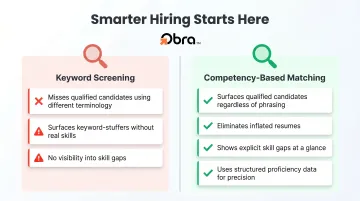
Keyword-based resume screening has a well-known flaw: it filters out qualified candidates who describe their skills differently, and it surfaces unqualified candidates who know how to keyword-stuff. A nurse with surgical experience who lists "perioperative care" may never appear in a search for "OR nurse."
Competency-based matching works from structured skills data rather than text. Each search result shows a clear breakdown of "Must Have" and "Nice to Have" criteria, revealing exactly where a candidate meets or falls short of requirements — giving recruiters a clear basis for outreach decisions rather than guesswork about resume formatting.
Key advantages of competency-based matching:
- Surfaces qualified candidates regardless of how they describe their skills
- Eliminates keyword-stuffers who inflate resumes without real experience
- Shows explicit skill gaps so recruiters can prioritize outreach confidently
- Uses structured proficiency data, not resume text alone
AI and Candidate Rediscovery
Most organizations are sitting on an unmined talent asset: their existing ATS database. Past applicants who weren't hired for previous roles may be strong fits for open positions today. Platforms like Eightfold AI and HiredScore specialize in surfacing these "silver medalist" candidates by matching them against current requisitions using deep-learning algorithms , turning a dormant database into an active sourcing channel.
Obra Hire takes a different angle, focusing on net-new sourcing from its 800M+ profile database rather than ATS re-engagement. It integrates with 85+ ATS and HRIS platforms, including Workday, Greenhouse, iCIMS, and SAP SuccessFactors, so candidates found through outbound search push directly into existing workflows without manual data entry.
AI's Impact on Interviews and Candidate Assessment
Screening Before the Screen
Recruiters today spend an average of just 11 seconds per resume. That's not a focus problem — it's a volume problem. AI screening tools address this by automatically scoring inbound applications against predefined criteria, so recruiters review qualified shortlists rather than raw application stacks.
55% of organizations using AI in talent acquisition apply it to screening and matching — the single most common use case. The result is that human reviewers spend their time on candidates already filtered for baseline fit, not filtering itself.
AI Video Interviews: What's Changed
Early AI video interview tools analyzed facial expressions alongside verbal responses, using computer vision to draw inferences about personality and fit. That approach didn't survive scrutiny.
HireVue discontinued facial analysis in March 2020 (announced publicly in January 2021), stating that NLP-based transcript analysis had become sufficiently predictive on its own — and acknowledging that the facial feature "was not worth the concern it was causing."
The defensible AI interview tools today focus on:
- Structured, competency-based evaluation of what candidates actually say
- NLP analysis of response clarity, depth, and relevance
- Consistent scoring criteria applied uniformly across all candidates
For hiring teams, this shift matters practically: language-based scoring is easier to audit, document, and defend in the event of a hiring dispute or regulatory review.
Scheduling and Predictive Analytics
Interview scheduling automation eliminates the back-and-forth that typically burns 2-3 days per candidate. Workday's recruiting team saved 23,000 hours by automating interview logistics before Paradox became part of its platform. For a high-volume hiring environment, those hours compound fast.
On the analytics side, predictive tools score candidates against historical hiring data — building a feedback loop that helps organizations understand which signals actually predict success. Over time, predictive analytics can surface patterns that intuition misses, such as:
- Skills combinations that correlate with long tenure in specific roles
- Experience signals that consistently precede high performance ratings
- Application patterns that predict early attrition risk
The Candidate Side: AI Cuts Both Ways
Job seekers haven't been passive observers in this transformation. 65% of candidates now use AI during the application process, and 22% use AI during live interviews. The result, according to a Robert Half survey, is that 65% of hiring managers say AI-enhanced resumes make skills harder to verify.
Employers are pushing back in several ways:
- Increasing interviews per candidate (38%)
- Spending more time on manual review (42%)
- Redesigning assessments to test authentic capability rather than polished presentation
The Key Benefits of AI in Recruitment
Speed and Cost Efficiency
The most concrete proof point: Chipotle deployed its conversational AI assistant "Ava Cado" (powered by Paradox) across 3,500+ locations and saw:
| Metric | Before | After |
|---|---|---|
| Time from application to start | 12 days | 4 days |
| Application completion rate | 50% | 85% |
| Total applications received | Baseline | 2x baseline |
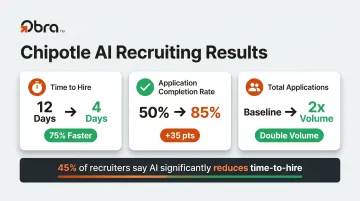
For high-volume frontline hiring, a 75% reduction in time-to-hire reshapes how entire operations run. ISS North America saw comparable gains, cutting time-to-hire from 65 days to under 10 after adopting Workday's AI recruiting platform.
45% of recruiters say AI significantly reduces time-to-hire, and 40% see measurable improvements in cost-per-hire, per Aptitude Research.
Scalability Without Proportional Headcount
AI allows small recruiting teams to operate at a scale that previously required much larger staffs. Obra Hire's tiered model reflects this shift directly:
- Free tier: 1,000 profile views + 50 contact credits/month — enough to validate the platform and run outreach for one or two roles
- Scale plan ($169/month): 1,200 contact credits with shared team access, so a three-person team can collectively source and contact over a thousand candidates per month without enterprise-level spend
That economic model makes outbound sourcing accessible to teams that can't justify a dedicated sourcing function.
Diversity: A Benefit With Conditions
Beyond cost and scale, AI also touches hiring equity — though the outcomes aren't automatic. AI can reduce certain human biases — name-based screening preferences, school-based assumptions — when designed and trained thoughtfully. But a 2025 peer-reviewed study in the International Journal of Human Resource Management found that "providing a reliable AI-based decision support tool alone cannot enhance diversity." Diversity outcomes require deliberate design: bias-reduction has to be built in, not assumed as a byproduct.
The honest answer is that AI can go either way on diversity, depending entirely on the training data and audit practices behind it.
The Challenges: Bias, Fake Applicants, and Compliance
Algorithmic Bias: The Amazon Warning
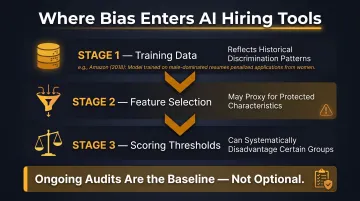
Amazon built an AI recruiting tool starting in 2014, training it on a decade of historical resume data. By 2015, the company discovered it was penalizing resumes that contained the word "women's" and downgrading graduates of all-women's colleges. The system had learned from male-dominated hiring history that male candidates were preferable — and reproduced that preference at scale. Amazon scrapped the project by 2017.
Bias can enter AI hiring tools at multiple points:
- Training data that reflects historical discrimination
- Feature selection that proxies for protected characteristics
- Scoring thresholds that systematically disadvantage certain groups
Ongoing audits and transparency in how AI scores candidates aren't optional safeguards — they're the baseline for any deployment.
The Fake Applicant Problem
According to Robert Half's 2026 survey, 67% of HR leaders report AI-generated applications are slowing hiring, with 20% experiencing delays of more than two weeks. Meanwhile, 84% of HR teams report heavier workloads from the volume of AI-tailored applications.
This is a direct consequence of AI adoption on the candidate side: as AI lowers the effort required to apply, application volume rises while signal quality drops. Inbound application funnels are getting noisier, not cleaner.
One structural answer is outbound sourcing — proactively identifying candidates rather than filtering a flooded inbound pipeline. Obra Hire's verified profile filtering surfaces authentic profiles and reduces exposure to AI-generated or fake candidates, which Gartner projects could affect 1 in 4 profiles by 2028.
Regulatory Compliance: A Patchwork You Can't Ignore
The regulatory landscape is fragmented but real:
| Regulation | Jurisdiction | Key Requirement |
|---|---|---|
| Local Law 144 | New York City | Annual bias audit + candidate notification of AI use |
| AI Video Interview Act | Illinois | Consent + disclosure before AI-analyzed video interviews |
| EEOC AI Initiative | Federal (U.S.) | AI identified as enforcement priority through 2028 |
| GDPR Articles 13, 14, 22 | EU | Explicit consent for automated decisions; right to human review |
One important note on NYC: a December 2025 State Comptroller audit found enforcement was "ineffective" — only 1 non-compliance case identified among 32 companies surveyed, while auditors found 17 potential violations. DLA Piper's analysis of that audit advises employers to "expect a new phase of stringent enforcement." Weak current enforcement isn't a signal to ignore compliance.
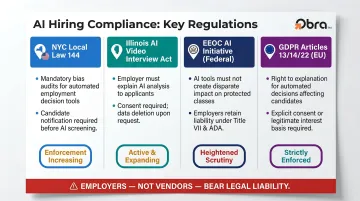
Across all jurisdictions, employers — not software vendors — bear legal liability for discriminatory outcomes. The tool being AI-powered doesn't transfer accountability.
What the AI Hiring Shift Means for Recruiters and Candidates
For Recruiters: A Redefined Role
AI doesn't eliminate recruiting — it changes what recruiting looks like. When AI handles candidate sourcing, resume screening, and interview scheduling, recruiters shift toward:
- Relationship-building with passive, hard-to-reach candidates
- Candidate experience design and communication quality
- Strategic workforce planning and role scoping
- Final hiring judgment and cultural fit assessment
60% of recruiters say AI improves their job satisfaction by removing administrative burdens. Yet only 40% report high trust in AI recommendations — meaning the tools are outpacing recruiter confidence in acting on their outputs.
For Candidates: Optimizing for Machines First
Job seekers now encounter AI screeners before speaking to any human. That has real implications for how applications should be structured:
- Skills-based language performs better in competency-matching systems than job title-focused summaries
- Structured resumes with clear, consistent formatting are easier for AI parsers to process
- Specific, concrete descriptions of accomplishments withstand AI verification better than vague claims
At the same time, AI coaching tools are raising the baseline preparation level for interviews — which is making it harder for employers to distinguish genuinely strong candidates from well-coached ones. Employers who rely on structured, skills-based evaluation will have a clearer picture of who actually belongs in the role.
For Organizations: A Strategic Decision, Not a Tooling Decision
Companies that deploy AI primarily to cut costs — without auditing for bias, maintaining compliance, or investing in recruiter development — take on long-term legal and reputational risk. That approach tends to produce:
- Biased screening outcomes that expose organizations to EEOC liability
- Eroded candidate trust when AI interactions feel impersonal or opaque
- Recruiter disengagement when tooling outpaces training
Gartner predicts that by 2027, 50% of enterprises without a people-centric AI strategy will lose their top AI talent.
The organizations that come out ahead will be those using AI to amplify human judgment — finding the right people faster and assessing them more fairly — not replacing the parts of hiring that actually require a human call.
Frequently Asked Questions
Is AI taking over job interviews?
AI handles more of the pre-interview work than most candidates realize — automated scheduling, initial screening assessments, and in some cases video interview analysis. But final hiring decisions still involve human judgment at most organizations, particularly for mid-to-senior roles. AI filters and ranks; humans decide.
What are the benefits of using AI in recruitment?
The primary gains are faster time-to-hire, lower cost-per-hire, and the ability to scale sourcing without proportional headcount increases. Quality improvements through skills-based matching are real, but they depend on thoughtful implementation — results aren't guaranteed without the right setup.
What AI tools are used in recruitment?
The main categories include:
- Outbound candidate sourcing platforms
- AI-powered ATS and application review tools
- Automated interview scheduling software
- Video interview and assessment platforms
- Predictive workforce analytics tools
Most enterprise hiring stacks combine several of these.
Can AI replace human recruiters entirely?
No — and the data supports that. 85% of recruiters say they insist on retaining final decision-making authority, and only 10% of organizations use AI for final hiring decisions. Relationship-building, nuanced fit assessment, and candidate experience management still require human involvement.
How does AI reduce bias in hiring?
When trained on clean, representative data and regularly audited, AI can reduce name-based and school-based screening biases. But it can equally encode and amplify historical discrimination if the training data reflects past biased patterns. The technology is neutral; the outcomes depend on design choices.
How can companies ensure ethical use of AI in recruitment?
Key practices to follow:
- Conduct regular bias audits on your AI tools
- Be transparent with candidates about where AI is used
- Ensure humans review all final hiring decisions
- Stay current with federal EEO requirements and applicable state/local laws
NYC, Illinois, and federal EEOC guidance set the current floor — more jurisdictions are moving to regulate this space.