The problem isn't just volume. Gartner predicts 1 in 4 candidate profiles worldwide will be fake by 2028, meaning the inbound application pile is increasingly contaminated before a human ever touches it.
Automation promises relief—but results vary widely. Which tasks you automate, which tools you choose, how cleanly they integrate, and whether your underlying process is sound all determine whether automation speeds up great hiring or amplifies existing dysfunction.
This guide covers the exact steps, the key decisions, and the mistakes to avoid.
TL;DR
- Recruiting automation handles sourcing, screening, scheduling, and communications—freeing recruiters for decisions that need context.
- Audit your hiring funnel first—build automation on a sound process, not a broken one.
- Outbound AI sourcing is replacing inbound-only automation as fake applications flood job boards.
- Clean job criteria, verified candidate data, and deep ATS integration determine whether automation actually works.
- Track time-to-hire, cost-per-hire, and 90-day retention as your core automation success metrics.
Step-by-Step: How to Automate Your Recruiting Process
Step 1: Audit Your Hiring Funnel Before Touching Any Tool
Map every stage from job posting to offer. Record average time spent and candidate drop-off rate at each stage. The two stages with the longest elapsed time or highest drop-off are your automation starting points.
Before mapping, separate tasks by judgment requirement:
- Automate first: Sending acknowledgment emails, scheduling reminders, filtering knockout questions, status updates
- Keep human: Final offer decisions, culture fit assessment, exception handling, relationship-building with high-value candidates
One warning: never build automation on top of a broken workflow. If your application form is too long or your job descriptions are vague, automation scales those problems rather than solving them.
Step 2: Automate Candidate Sourcing with Outbound AI Search
Waiting for inbound applications is increasingly unworkable. With fake and AI-generated profiles flooding job boards, proactive outbound sourcing—searching verified candidates rather than processing whoever applies—is now the more reliable path.
Set up an AI-powered outbound sourcing workflow by:
- Defining structured criteria — skills, proficiency levels, experience signals, and knockout conditions for each role
- Previewing candidate pool size before committing any spend — this confirms talent supply for the role and prevents wasted budget
- Configuring personalized outreach sequences — multi-step messages tailored to each candidate rather than bulk templates. LinkedIn data shows personalized InMails perform approximately 15% better than mass-sent messages, and candidates flagged as "Recommended Matches" or "Open to Work" are 35% more likely to respond.
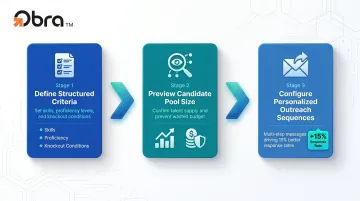
Platforms like Obra Hire support this workflow by searching 800M+ verified candidate profiles with competency-based matching. The ability to preview pool size and quality before spending a single credit addresses the fake applicant problem directly.
Step 3: Automate Screening and Candidate Communications
Two automation layers belong here: filtering and follow-up.
Here's what each layer handles:
- Knockout question filtering — automatically removes candidates who don't meet non-negotiable criteria (required certifications, location, availability) before a recruiter reviews anything. This can eliminate 40–60% of unqualified inbound volume on its own.
- Trigger-based communication sequences — close the follow-up gap that causes ghosting. Candidate ghosting rose from 37% in 2019 to over 60% by 2023, and each incident wastes an estimated 47 recruiter and hiring manager hours.
Automated acknowledgment within minutes of application, stage-transition updates, and interview reminders directly reduce this risk. One case study cut post-interview ghosting from 42% to 17% through structured communication touchpoints alone.
Step 4: Automate Interview Scheduling and Assessments
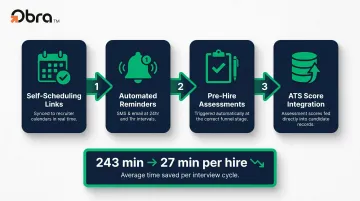
Scheduling is the most underestimated bottleneck. It consumes 38% of total recruiter time—more than sourcing, screening, or any other single activity. The difference is stark: manual interview scheduling takes an average of 243 minutes per interview; self-scheduling tools reduce that to 27 minutes.
Set this up by:
- Implementing self-scheduling links that sync directly with recruiter calendars
- Configuring automated SMS and email reminders at 24 hours and 1 hour before each interview
- Triggering pre-hire assessments automatically at the appropriate funnel stage—don't wait for manual recruiter initiation
- Ensuring assessment scoring feeds directly into the candidate record in your ATS
Step 5: Integrate Your Automation Stack with Your ATS/HRIS
Automation tools that don't talk to your ATS create a new problem: duplicate outreach, missed stage transitions, and candidate experience breakdowns (like receiving a rejection after an offer is extended).
Integration priorities:
- Native, pre-built integrations over custom API builds—less maintenance, faster setup
- Bi-directional data flow: a stage update in your ATS should trigger the corresponding automated action in your sourcing or communication tool
- Real-time sync, not batch exports—lag in sync negates time-to-hire gains
Obra Hire integrates with 85+ ATS and HRIS platforms, including Workday, Greenhouse, iCIMS, Lever, and SAP SuccessFactors, enabling candidate data to flow directly into existing workflows without requiring a platform migration.
Test the full candidate journey end-to-end before going live.
What to Automate vs. What to Keep Human
Getting this line wrong—in either direction—directly harms hire quality and candidate experience.
Automate Without Hesitation
These tasks are high-frequency, rule-based, and require no contextual judgment:
- Multi-board job distribution
- Application acknowledgment messages
- Knockout question screening
- Interview scheduling logistics
- Status update notifications
- Background check initiation
- Document collection requests
Keep Humans in the Loop
These decisions require context that automation cannot reliably replicate:
- Final offer negotiations involving compensation flexibility
- Assessing cultural and behavioral fit beyond structured screening
- Exception handling — visa status, non-standard backgrounds, returning candidates
- Building genuine relationships with high-value or hard-to-reach candidates
The Bias Risk You Cannot Ignore
88% of recruiters acknowledge that qualified candidates slip through the cracks due to poor resume matching or outdated screening processes. Any automated screening layer requires audit logs, fairness testing, and human review of borderline cases.
This is a compliance issue, not just a quality issue. Key regulatory requirements include:
- NYC Local Law 144 — mandates annual bias audits for automated employment decision tools
- EU AI Act — classifies recruitment AI as high-risk under Annex III
- EEOC guidance — addresses algorithmic fairness standards in hiring decisions
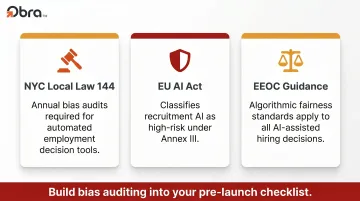
Build bias auditing into your pre-launch checklist before any automated screening goes live.
What You Need Before Automating Recruiting
Preparation quality determines whether automation accelerates or amplifies existing problems. Three things must be in place before buying any tool.
Tech Stack and Integration Readiness
Confirm which ATS, HRIS, and communication tools you currently use, then verify that any new automation platform offers native integrations. Platforms with 85+ pre-built integrations—covering Workday, Greenhouse, iCIMS, and SAP SuccessFactors—let automation layer onto existing workflows without disruptive migrations.
Obra Hire, for example, meets that bar with 85+ integrations and a free tier that includes 1,000 profile views and 50 contact credits — so teams can test candidate pools before committing to a paid plan.
Defined Job Criteria and Competency Standards
Before automating sourcing or screening, translate each role's requirements into structured criteria: specific skills, proficiency levels, experience signals, and knockout conditions.
Vague criteria are the most common reason AI matching returns irrelevant candidates. "Marketing experience" as a search input is not a competency definition—it's a keyword.
Structured interviews show a predictive validity of 0.51 for job performance compared to 0.38 for unstructured interviews (Schmidt & Hunter meta-analysis). Automation built on structured, competency-based criteria inherits that accuracy advantage.
Metrics Baseline and Named Admin Owner
Establish your current benchmarks for time-to-hire, offer acceptance rate, and 30/90-day retention before automation goes live. Without a baseline, you cannot measure ROI.
Assign a single accountable admin owner for each automation workflow—someone responsible for maintaining knockout logic, updating sequences, and auditing results quarterly.
Key Variables That Affect Recruiting Automation Results
Two teams using identical tools can produce vastly different outcomes. Here are the four variables that explain most of the gap.
| Variable | What Drives the Gap |
|---|---|
| Role type & volume | High-volume, repeatable roles benefit from aggressive automation; niche/senior roles need earlier human involvement |
| Competency definition quality | Broad keyword criteria = low-precision pools; structured competency criteria = tighter, higher-quality matches |
| Candidate data integrity | Unverified profiles waste outreach credits and inflate pipeline metrics; verified filtering removes noise before it reaches your screeners |
| Integration depth | Real-time sync triggers right actions at right moments; batch-sync or manual exports introduce lag that kills time-to-hire gains |
The data integrity variable is growing in urgency. Job-related fraud losses jumped from $90M in 2020 to over $501M in 2024—a 457% increase—and 41% of staffing buyers are already experiencing candidate fraud challenges. Platforms that verify profile authenticity before candidates reach your screening stage catch this problem before it consumes outreach credits or inflates your pipeline numbers.
Common Mistakes When Automating Recruiting
Automating a Broken Process
If your application flow is too long, your job descriptions are vague, or your screening criteria are poorly defined, automation amplifies those problems at scale. Map and fix the process first—then automate it.
Skipping the Bias Audit
Automated screening that hasn't been tested for fairness can systematically filter out protected class candidates, creating legal exposure and diversity gaps. This is a pre-launch requirement, not a post-launch fix.
Measuring Activity Instead of Outcomes
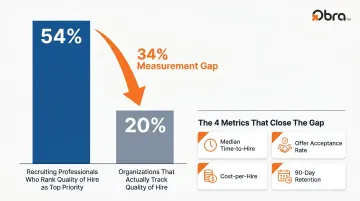
"Emails sent" and "applications received" are not hiring metrics. The right KPIs are:
- Median time-to-hire
- Offer acceptance rate
- Cost-per-hire
- 90-day retention
Only 20% of organizations actually track quality of hire, despite 54% of recruiting professionals ranking it as their top priority. That gap means most teams have no way to tell whether their automation investment is producing better hires—or just moving the same weak candidates through faster.
Over-Automating at the Expense of Candidate Experience
Fully automated funnels can move fast but lose candidates at the offer stage when no human interaction has occurred. Build deliberate human touchpoints into your process—especially for senior roles and at offer stage.
Conclusion
The teams achieving the fastest time-to-hire and lowest cost-per-hire share a common approach. They automate the right tasks—high-frequency, low-judgment work—and keep humans on decisions that require context and relationship. That means getting three things right:
- Process first: automation built on an unmapped process amplifies inefficiency, not speed
- Verified data: outreach to unverified profiles wastes credits and time
- Clean integrations: new tools that fight existing systems slow adoption and create data gaps
The move from inbound automation to outbound AI sourcing is the defining shift in how modern recruiting operates. Processing inbound applications faster doesn't solve the fake profile problem or poor hire quality. Proactively surfacing verified candidates—before a role becomes urgent—does.
Frequently Asked Questions
What is recruiting automation?
Recruiting automation uses technology—both rule-based workflows and AI—to handle repetitive hiring tasks like sourcing, screening, scheduling, and communications. The goal is freeing recruiters to focus on judgment-driven decisions that determine hire quality.
What's the difference between an ATS and a recruiting CRM?
An ATS tracks applicants already in your pipeline — post-application. A recruiting CRM handles relationships with passive candidates before they ever apply. The two serve different stages and work best in tandem.
What is the 7-second rule for resumes?
The 7-second rule comes from a 2012 TheLadders eye-tracking study suggesting recruiters spend roughly 6–7 seconds scanning a resume before deciding whether to continue. Automated screening tools now handle this initial pass at scale, reducing the human time spent on first-pass filtering.
What tasks should NOT be automated in recruiting?
Keep humans in charge of:
- Final offer decisions, especially where compensation flexibility is involved
- Cultural fit assessments that require contextual judgment
- Exception handling for non-standard candidate situations
- Relationship-building with high-value or senior candidates
How do you measure the success of recruiting automation?
Track time-to-hire, cost-per-hire, offer acceptance rate, and 90-day retention—not activity metrics like emails sent. Establish a pre-automation baseline so before/after comparisons are meaningful.
Will AI replace human recruiters?
No — but the role changes. AI takes on high-volume, repeatable tasks: screening, scheduling, and status updates. Recruiters shift toward work that requires judgment: final hiring decisions, exceptions, and building candidate relationships. That's a narrowing of scope, not an elimination of the job.