The structural problem runs deeper than speed. Most recruiting workflows are built around inbound applications, which only capture the ~30% of the workforce actively job hunting. The other 70%—passive candidates, often the most experienced and in-demand professionals—will never submit a resume unprompted. They have to be found.
Meanwhile, recruiters spend roughly 44% of their time just sourcing candidates and another 22% reviewing resumes. That's two-thirds of the workweek consumed before a single real conversation happens.
This article breaks down why manual sourcing fails structurally, which strategies replace it with automation, and how to build a sourcing workflow that runs continuously—even when your recruiters aren't at their desks.
TL;DR
- Automated sourcing uses AI to proactively find, score, and engage candidates before competitors do—no manual searches required
- Manual sourcing misses 70% of the workforce; it only reaches active applicants. Automation finds passive candidates who never apply
- Core strategies include outbound AI search, competency-based matching, intent signal detection, and ATS-integrated outreach sequences
- The right stack layers a search database, enrichment tool, outreach platform, and ATS integration
- Start by defining your ideal candidate profile beyond job titles—automation handles the search, scoring, and first contact from there
Why Manual Candidate Sourcing Is Broken
The Time and Speed Problem
Recruiters are managing a median of 20 open requisitions simultaneously—sometimes as many as 67—while burning most of their week on tasks that haven't changed in a decade: Boolean searches, LinkedIn prospecting, spreadsheet updates.
By the time a manually-sourced candidate gets an outreach message, there's a real chance they've already accepted an offer elsewhere.
The core timing mismatch:
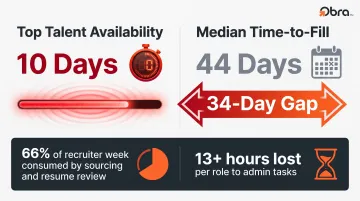
- Top talent is off the market in ~10 days
- Median time-to-fill is 44 days
- Sourcing + resume review alone consume 66% of a recruiter's week
- Recruiters lose an average of 13+ hours per open role to administrative tasks alone
The Passive Candidate Gap
According to LinkedIn's Global Talent Trends data, **70% of the global workforce consists of passive candidates** not actively searching for jobs. Yet 87% of all professionals say they're open to new opportunities—meaning the passive pool is reachable, just not through job boards.
Senior and mid-career professionals are the least likely to apply cold. They move through networks, referrals, and direct recruiter outreach. That means:
- The best candidates rarely show up in your inbound queue
- Job board postings reach only the 30% actively searching
- Outbound sourcing is the only way to access the full talent market
The Quality and Consistency Problem
Manual searches default to keyword matching: find the resume that contains "product manager" and "Salesforce" and "5 years." This produces noisy shortlists, introduces unconscious bias, and generates outreach lists that are too broad to be effective.
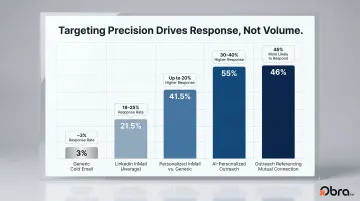
Poor list quality directly tanks response rates. Generic cold email to unvetted candidates achieves as low as 3% response. LinkedIn InMail averages only 18–25%—and that's when the targeting is solid. Better matching upstream is the only fix that actually moves the number.
Key Strategies to Automate Candidate Sourcing
Strategy 1: Outbound AI Search
Instead of waiting for applications, outbound AI search proactively surfaces candidates from large profile databases—without requiring Boolean expertise or platform-by-platform manual hunting.
Modern platforms like Obra Hire let recruiters describe their ideal candidate in plain language or paste a job description directly. The AI searches across 800M+ verified profiles and returns ranked, skill-matched results in seconds. This shifts sourcing from reactive (waiting for applications) to proactive (finding candidates before they start looking).
Unlike traditional keyword search, AI interprets context. It can recognize that a candidate who spent three years scaling a Series B SaaS product is relevant to a VP of Product role—even if their title was "Senior PM."
Strategy 2: Competency and Skills-Based Matching
Job title and years of experience are weak proxies for actual fit. Two people with identical titles can have radically different skills, tool depth, and scope of experience.
McKinsey research shows skills-based hiring is 5x more predictive of job performance than education credentials. The market has noticed: 85% of employers now use skills-based hiring, up from 81% in 2024.
Competency-based matching filters on what candidates can actually do:
- Specific tools and platforms they've used
- Depth of experience at relevant growth stages
- Team scope managed
- Technical certifications or domain expertise
Obra Hire's approach uses structured competency data—not resume text scanning—to produce a clear breakdown of "Must Have" vs. "Nice to Have" criteria for every result. Recruiters see exactly where a candidate matches or falls short, without reading every profile manually.
Strategy 3: Intent Signal Monitoring
The best outreach moment isn't random—it's when a candidate is already quietly considering a move. Automation can detect the signals that precede that decision:
- Tenure patterns: U.S. median employee tenure dropped to 3.9 years in 2024, the lowest since 2002. Candidates approaching that threshold in roles with limited upward movement are prime outreach targets.
- Profile activity: LinkedIn activity from previously inactive users often signals passive consideration
- Company instability: Leadership departures, hiring freezes, or funding gaps at a candidate's current employer create natural openness windows
Timing outreach to these signals—rather than sending the same message to a generic list—significantly improves engagement before a candidate officially enters the market.
Strategy 4: Automated, Personalized Outreach at Scale
The biggest misconception about automated outreach is that volume is the goal. Targeting precision is what actually drives results.
A highly targeted list with basic personalization outperforms a broad list with elaborate copy. Here's why the numbers support that:
| Outreach Type | Avg. Response Rate |
|---|---|
| Generic cold email | ~3% |
| LinkedIn InMail (average) | 18–25% |
| Personalized InMail (vs. generic) | Up to 20% higher |
| AI-personalized outreach (Gem data) | 30–40% higher |
| Outreach referencing mutual connection | 46% more likely to respond |
Automated multi-touch sequences—email plus LinkedIn follow-ups deployed systematically—can increase response rates by up to 450% compared to single-touch outreach. The automation handles follow-up cadence so recruiters don't have to track who heard back and who didn't.
Strategy 5: ATS-Integrated Workflow Automation
Sourcing automation that doesn't connect to your ATS creates a new problem: tool sprawl and manual re-entry. Enriched profiles, verified contacts, and reply data all need to flow directly into the system your hiring team already uses.
Obra Hire integrates with 85+ ATS and HRIS platforms, including Workday, Greenhouse, iCIMS, Lever, and SAP SuccessFactors. Sourced candidates push directly into existing pipelines without duplicate entry. Teams can also use workflow tools like n8n or Zapier to trigger enrichment, route contacts into outreach campaigns, and push replies back into the ATS automatically, turning individual tools into a connected pipeline.
Top Tools for Automating Candidate Sourcing
Most effective sourcing stacks aren't a single platform—they layer four categories of tools:
| Layer | Purpose | Example Tools |
|---|---|---|
| Search / Database | Find and surface candidates at scale | Obra Hire, SeekOut, Gem |
| Enrichment | Add contact data, company context, work history depth | Clay, BetterContact |
| Outreach | Manage multi-touch, multi-channel sequences | Instantly, Lemlist |
| Orchestration | Connect the other tools into a pipeline | n8n, Zapier |
Outbound Search and Candidate Database Platforms
Obra Hire is an outbound-first platform with 800M+ verified profiles searchable via AI, using competency-based matching instead of keyword scanning. Unlike most sourcing tools, it covers blue, gray, and white-collar roles across 34 industries — not just tech.
Key differentiators:
- Verified profile filtering removes AI-generated and fake applicants
- Preview candidate pool size before spending any credits
- Freemium model — no contract, no setup call required
SeekOut offers 1B+ profiles with 300+ filters, strong DEI-specific features including a "Blind Hiring Mode," and is rated the #1 Diversity Hiring Software on G2. It's enterprise-grade and well-suited for large talent acquisition teams.
Gem combines an ATS, sourcing CRM, and AI agents in one platform. Its AI Sourcing Agent generates personalized outreach that drives 30–40% higher response rates, and it includes a built-in Fraud Detection Agent.
Data Enrichment and Contact Verification Tools
Once you've identified candidates, enrichment tools fill the gaps: company funding stage, personal email, phone, and work history depth.
Clay aggregates 75+ data sources through AI research agents, making it useful for building highly detailed candidate profiles before outreach.
BetterContact and similar waterfall verification tools validate email addresses sequentially across multiple providers to maximize deliverability. Verified personal contact details let you bypass LinkedIn InMail entirely — reaching candidates through channels with less competition and better response rates.
Outreach and Orchestration Tools
Instantly and Lemlist manage multi-touch email and LinkedIn sequences at scale while protecting sender deliverability. Both work best when fed a well-targeted, enriched list — bad targeting multiplies errors just as fast as it multiplies results.
n8n and Zapier serve as the connective tissue: triggering enrichment when a candidate is flagged, routing verified contacts into the right outreach campaign, and pushing replies into the ATS automatically.
How to Build Your Automated Sourcing Workflow
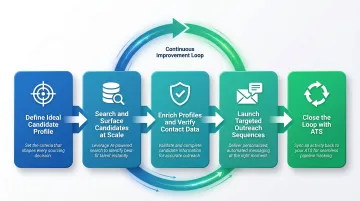
Step 1: Define Your Ideal Candidate Profile
Before any automation, establish deep targeting criteria:
- Specific competencies and tools (not just job titles)
- Growth stage experience (seed vs. Series B vs. enterprise)
- Team scope or management depth
- Must-have technical depth or domain certifications
The precision of this profile determines the quality of everything downstream. Vague criteria produce vague results, regardless of how sophisticated the automation is.
Step 2: Search and Surface Candidates at Scale
With your profile defined, run those criteria through an outbound search platform against a large, verified database. Before committing to outreach, preview your candidate pool size and sample profiles to confirm the search is well-scoped.
Obra Hire's unlimited search on all plans—including Free—means you can run searches, adjust filters, and validate pool size before spending a single contact credit. This eliminates the risk of burning budget on a poorly scoped search.
Step 3: Enrich Profiles and Verify Contact Data
Run shortlisted candidates through an enrichment layer to gather:
- Verified email and phone
- Work history depth and company context
- LinkedIn profile URL
At this stage, filter out AI-generated or fake profiles. 76% of hiring professionals have encountered falsified candidate employment details, and bot-driven mass applications are growing. Platforms with built-in verification (like Obra Hire's Verified Profile Filtering) remove this noise before it reaches your shortlist.
Step 4: Launch Targeted Outreach Sequences
Deploy multi-touch sequences through your outreach tool, keeping each message specific to what you know about the candidate. A well-structured sequence typically includes:
- Personalized first touch referencing their background or role history
- Automated follow-up 3-5 days later if no reply
- Final check-in with a direct call to action
- Positive replies routed back into your ATS with full conversation context attached
Step 5: Close the Loop with Your ATS
Push sourced candidates directly into your ATS via native integration—no manual re-entry. Set up feedback loops so that response rates, conversion data, and hire quality inform future sourcing criteria. Over time, that data sharpens your criteria — response rate patterns reveal which profiles convert, and hire quality data shows which filters to weight more heavily in the next search.
Measuring Success: KPIs for Automated Candidate Sourcing
Top-of-Funnel Metrics
These validate whether your search and enrichment setup is working:
- Candidate pool size by channel — are you generating enough volume for each role?
- Profile match rate — what percentage of surfaced candidates meet your Must Have criteria?
- Contact verification rate — what percentage of sourced candidates have usable, deliverable contact data?
Mid-Funnel Metrics
These reveal whether your targeting and messaging combination is effective:
- Outreach response rate — benchmark against the 3% cold email and 18–25% InMail averages; automated, well-targeted sequences should consistently outperform these
- Positive reply rate vs. bounce rate — separates engaged candidates from dead-end contacts
- Time-to-first-response — faster responses indicate better targeting alignment
Outcome Metrics
The figures that tie sourcing activity to hiring results:
- Time-to-fill for sourced roles vs. inbound-only roles — track separately to isolate the sourcing impact
- Cost-per-hire — SHRM's average benchmark is $4,700 across all roles, $28,329 for executive hires; sourcing automation should compress both figures
- Quality-of-hire — use 60–90 day performance signals or 6-month retention rates to confirm competency-based sourcing outperforms keyword-filtered inbound
Frequently Asked Questions
What is automated candidate sourcing?
Automated candidate sourcing uses AI and workflow tools to proactively find, profile, and engage candidates at scale—replacing manual LinkedIn searches and spreadsheet tracking with systems that run continuously. Rather than keyword matching alone, modern platforms surface best-fit candidates based on defined competencies and structured skills data.
What automated tools are best for diverse candidate sourcing?
SeekOut offers dedicated diversity filters and a Blind Hiring Mode for enterprise teams. Obra Hire's broad database spans blue, gray, and white-collar roles across 34 industries, expanding the candidate pool beyond traditional professional networks. Specialized job boards like Jopwell and PowerToFly complement these platforms—though removing degree requirements and auditing job description language matters just as much as the tools you choose.
How much time can automated candidate sourcing save recruiters?
Recruiters currently spend 44% of their week sourcing and another 22% reviewing resumes. Automated systems process and score candidate lists from databases of hundreds of millions of profiles in minutes—shifting recruiter time from searching to relationship-building and closing conversations.
Can small businesses or lean hiring teams use automated candidate sourcing?
Yes. Platforms like Obra Hire offer freemium self-serve access with no contract, no setup call, and no credit card required. Free plan users get unlimited searches, 1,000 profile views, and 50 contact credits per month.
What's the difference between inbound and outbound candidate sourcing?
Inbound sourcing relies on candidates finding and applying to job postings—capturing only the ~30% of the workforce actively job hunting. Outbound sourcing involves proactively reaching passive candidates via AI search and direct outreach, accessing the 70% of the workforce that will never apply through a job board.
How do you prevent fake or AI-generated profiles from polluting your sourcing pipeline?
Look for sourcing platforms with built-in verified profile filtering—Obra Hire flags and removes AI-generated and fake profiles before they reach your shortlist. Pair this with contact verification tools that validate real email addresses and phone numbers. With 76% of hiring professionals having encountered falsified candidate details, verification belongs in every sourcing stack.