More volume. Less budget. Same team size.
AI recruitment tools are widely discussed as the solution, but the conversation rarely gets specific. Which tasks do they actually automate? What does that mean for a recruiter managing 15 open roles? What happens to cost-per-hire and time-to-fill when these tools aren't in use?
This article breaks down the specific, measurable advantages AI tools deliver to internal recruiting teams — and what it costs when those tools aren't part of the workflow.
TL;DR
- AI recruitment tools automate repetitive admin tasks, freeing recruiters to focus on interviews, decisions, and relationships
- Outbound AI sourcing reaches passive candidates — the 70% of the workforce not actively applying anywhere
- Competency-based matching surfaces better candidates than keyword screening
- Automated communication keeps candidates engaged across large pipelines — no extra recruiter effort required
- AI tools reduce cost-per-hire while improving both hiring speed and quality
What Are AI Recruitment Tools?
AI recruitment tools are software platforms that apply machine learning to specific stages of the hiring process — sourcing, screening, matching, communication, and scheduling — to reduce manual effort and speed up hiring decisions.
They operate across the full internal recruiting workflow:
- Sourcing: Searching candidate databases to surface qualified passive candidates
- Screening: Parsing and filtering applications against defined role criteria
- Matching: Ranking candidates by competency fit rather than keyword frequency
- Communication: Automating status updates, scheduling confirmations, and follow-ups
- Analytics: Generating data on pipeline health, source quality, and time-to-fill
Each of these functions targets a specific place where recruiter time gets lost. Together, they give internal teams direct control over candidate quality, hiring speed, and cost — without needing to grow headcount to handle a higher volume of work.
Key Advantages of AI Recruitment Tools for Internal Recruiters
Each advantage below maps to a metric recruiting teams already measure — time-to-hire, cost-per-hire, quality of hire, and recruiter capacity.
Advantage 1: Automating Repetitive Tasks to Free Up Recruiter Time
Recruiters spend approximately 18 hours on administrative tasks per vacancy — over two full working days per hire. That includes 3.6 hours reviewing applications and 2.5 hours on scheduling alone, before a single qualified conversation happens.
AI recruitment software handles this automatically:
- Parses and filters incoming applications against defined criteria
- Flags candidates who meet minimum requirements without manual review
- Manages scheduling workflows and sends confirmations
- Triggers follow-up communication at each pipeline stage
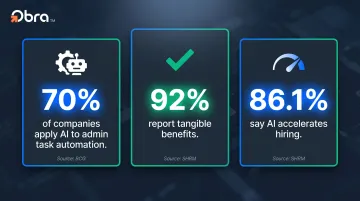
The results are consistent across research. According to BCG, 70% of companies using AI in HR apply it to administrative task automation, and 92% report tangible benefits. SHRM data shows 85% of employers using automation say it saves time and increases efficiency, with 86.1% reporting that AI accelerates the hiring process.
What this changes for recruiters:
Time freed from admin doesn't disappear — it shifts to work that directly improves outcomes. Recruiters spend more hours on qualified candidate relationships, hiring manager alignment, and refining role criteria. Those activities improve offer acceptance rates and quality of hire in ways that faster application processing can't.
When this matters most:
- High-volume hiring cycles with 100+ applicants per role
- Lean teams managing 10+ open requisitions simultaneously
- Fast-growing companies where hiring demand outpaces recruiter headcount
Advantage 2: Smarter Candidate Sourcing and Competency-Based Matching
The inbound model is increasingly unreliable. As AI-generated applications inflate pipeline volume, Gartner projects that by 2028, 1 in 4 job candidates globally will be fake — fabricated identities, generated employment histories, and AI-assisted interviews. Recruiting teams without AI filtering spend more time screening for less signal.
Outbound AI sourcing bypasses this problem entirely.
How it works in practice:
- Recruiter defines role requirements — in natural language, from a job description, or via structured filters
- AI searches a broad candidate database and ranks results by competency fit
- Recruiter receives a ranked shortlist of verified, relevant profiles
- Contact details are revealed only for candidates worth pursuing
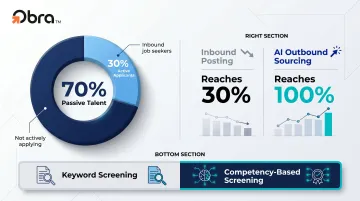
This matters because **70% of the global workforce consists of passive talent** — professionals not actively applying to job boards. Traditional inbound postings reach, at best, 30% of the available talent pool. Outbound AI sourcing accesses the other 70%.
The matching quality differs fundamentally from keyword-based screening. BCG research shows that high-performing talent can produce 4 to 8 times more output than average performers. Competency-based matching — which evaluates actual skill alignment rather than resume text — is how teams find those candidates reliably. Over **54% of companies using AI in HR have implemented candidate matching** as a top use case, according to BCG.
Obra Hire is built specifically for outbound sourcing at this level. Internal recruiting teams search 800M+ verified candidate profiles with AI-powered, competency-based matching. Verified profile filtering removes fake and AI-generated applicants before a recruiter ever sees them. Searches run in natural language or directly from a job description, with results ranked by Must Have and Nice to Have criteria — so recruiters see exactly where each candidate meets or falls short of requirements.
KPIs impacted: Quality of hire, pipeline diversity, offer acceptance rate, time-to-first-qualified-candidate
When this matters most: Niche roles with low organic application volume, any role where inbound quality has declined, teams building proactive talent pipelines rather than reacting to open headcount
Advantage 3: Consistent, Scalable Candidate Communication
Poor communication is one of the most consistent candidate complaints — and one of the most preventable hiring failures.
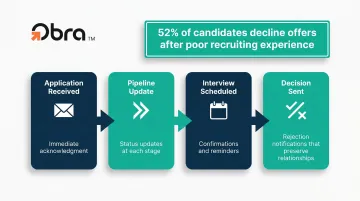
BCG research across 90,000 candidates in 160 countries found that 52% of candidates would decline an otherwise attractive offer after a negative recruiting experience. Silence and slow follow-up are the most common triggers. 72% of candidates share bad hiring experiences online, compounding the damage beyond the individual hire.
AI-powered communication tools maintain pipeline contact without manual recruiter effort:
- Immediate acknowledgment when a candidate applies
- Status updates as candidates move through pipeline stages
- Scheduling confirmations and reminders
- Rejection notifications that preserve the candidate relationship
Why this matters beyond the individual candidate:
Internal recruiters represent their employer's brand in every interaction. When a pipeline has 200 active candidates and the team has capacity to manually follow up with 20, the other 180 experience silence. That silence carries a real cost — offer declines, Glassdoor reviews, and candidates who check the company's hiring reputation before ever applying.
Automated communication solves this at scale. Every candidate gets a consistent experience, regardless of pipeline volume or team capacity, without adding to recruiter workload.
KPIs impacted: Candidate satisfaction, offer acceptance rate, employer brand perception, candidate drop-off rate
What Happens When Internal Recruiters Work Without AI Support
Without AI tools, internal teams default to manual processes that don't scale — and the gaps compound quickly.
The cost picture:
- SHRM benchmarks the average US cost-per-hire at ~$5,475 for non-executive roles
- Recruiting agency fees run 15-25% of first-year salary — on a $100,000 role, that's $15,000-$25,000 per hire
- Hiring managers spend approximately 13% of their total working time on hiring tasks — a hidden cost rarely included in official cost-per-hire calculations
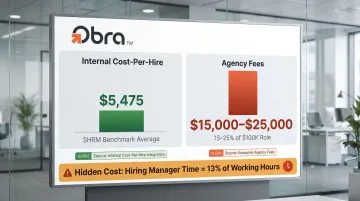
Those numbers assume a functioning pipeline. Teams without AI sourcing either wait on inbound volume that may never arrive for hard-to-fill roles, or pay agency fees that run 3-5x the internal cost-per-hire benchmark.
The fake application problem:
Without AI filtering, the volume problem accelerates. As AI-generated applications increase — 71% of HR professionals have already encountered misleading or false candidate information — recruiters spend more hours screening a larger pile for the same number of qualified candidates. Workload increases; quality doesn't.
How the gaps compound:
Slow reviews lead to longer time-to-fill. Inconsistent follow-up damages employer brand. Missed candidates mean higher agency dependency. Each inefficiency feeds the next — and the hiring environment isn't getting easier. Without tools built for outbound sourcing and application filtering, teams absorb every new pressure manually.
How to Get the Most Value from AI Recruitment Tools
Three practices consistently separate teams that see lasting gains from teams that don't.
1. Connect every stage, not just screening. Teams that automate resume review but handle sourcing and outreach manually capture only a fraction of the available gains. The compounding benefit comes from end-to-end application — sourcing, matching, communication, and analytics working together.
2. Feed outcomes back into the system. Track which sourcing parameters surface the best hires. Adjust skill and competency inputs based on actual results. The tools get sharper when recruiters actively refine criteria — not just at setup, but after every hiring cycle.
3. Keep humans at the decision points that matter. AI handles volume, filtering, and routine communication. Recruiters own candidate relationships, final evaluations, and offer conversations — that division is intentional, not incidental.
Obra Hire is built to fit into existing workflows rather than replace them, with 85+ ATS and HRIS integrations including:
- Workday
- Greenhouse
- iCIMS
- Lever
- SAP SuccessFactors
Teams add AI-powered outbound sourcing without disrupting the processes already in place.
Conclusion
AI recruitment tools give internal recruiters practical control over the variables that most directly affect hiring performance: finding the right candidates faster, filtering for genuine fit over application volume, maintaining a consistent candidate experience at scale, and doing all of it without adding headcount.
Teams that treat these tools as an ongoing operational capability — reviewing outcomes, refining searches, and adjusting criteria over time — see durable improvement in cost-per-hire, time-to-fill, and quality of hire. Those still running manual processes against tripled application volumes are absorbing the same friction that prompted teams to adopt AI tooling in the first place.
Frequently Asked Questions
How do AI recruitment tools work to support internal recruiters?
AI recruitment tools automate specific tasks in the hiring workflow — sourcing, screening, matching, scheduling, and communication — so internal recruiters spend less time on administration and more time on candidate relationships and hiring decisions. Tools handle the volume. Recruiters focus on the decisions that actually determine who gets hired.
How are AI recruitment tools transforming the recruitment process for internal recruiters?
The shift is from reactive inbound screening to proactive outbound sourcing, and from manual task management to automated pipelines. This moves the recruiter's role away from processing applications and toward building candidate relationships and advising hiring managers — the work that most directly improves hiring outcomes.
What are the benefits of AI recruitment tools for internal recruiters?
The key measurable benefits include:
- Reduced time-to-hire through automated screening and scheduling
- Lower cost-per-hire by replacing manual sourcing effort
- Improved candidate quality via competency-based matching
- Broader access to passive talent beyond inbound applicants
- Consistent candidate communication at scale, without added recruiter effort
How do AI recruitment tools enhance the candidate experience?
AI tools ensure every candidate receives timely, consistent communication and status updates throughout the hiring process — reducing the silence and slow follow-up that cause candidates to drop off or decline offers, even when pipeline volume is high.
What is the difference between an ATS and a CRM?
An ATS (Applicant Tracking System) manages active applicants through a defined hiring process. A CRM (Candidate Relationship Management) system builds and nurtures talent pipelines before a role opens. AI recruitment tools can enhance both — improving screening accuracy in an ATS and expanding pipeline reach in a CRM.
Will AI replace internal recruiters?
No. AI handles high-volume administrative and analytical tasks efficiently, but cannot replace the relationship-building, contextual judgment, and negotiation that skilled internal recruiters provide. The most effective teams use AI to handle volume so recruiters can focus on the work that actually determines hiring outcomes.