Introduction
Recruitment agencies are drowning in applications — and a growing share aren't real. LinkedIn reported a 45% surge in job applications between Q2 and Q3 2024, with over 12 million submitted daily on the platform alone. Meanwhile, 91% of recruiters report encountering candidate deception in their pipelines, and fraudulent applicant rates for remote roles are estimated at 30–50%.
The result: recruiters spend more time filtering noise than filling roles.
The right recruitment platform changes this equation. Purpose-built agency tools handle candidate sourcing, client relationship management, and placement tracking simultaneously — cutting time-to-fill without adding headcount. Generic corporate ATS platforms aren't built for this. They're designed around a single company's hiring team — not an agency managing dozens of client pipelines at once.
This guide covers the top recruitment platforms for agencies in 2025 — what each does best, verified pricing, and how to match a platform to your agency's actual bottleneck.
TL;DR
- Agencies need platforms that handle both candidate management and client workflows — standard ATS tools miss the client-side CRM features agencies depend on
- The best options combine outbound sourcing, ATS/CRM functionality, and multi-client pipeline management
- This guide covers five platforms head-to-head: Bullhorn, Recruit CRM, Manatal, Zoho Recruit, and Obra Hire
- Key selection factors: integration depth, candidate data quality, pricing transparency, and outbound sourcing capability
- Sticking to inbound-only job boards puts agencies at a disadvantage against competitors running outbound-first strategies
What Agencies Need in a Recruitment Platform
Recruitment agencies operate differently from in-house HR teams. An internal hiring manager tracks one company's roles. An agency juggles dozens of client accounts, manages candidate relationships across industries, tracks placements, and reports revenue — all simultaneously. That difference defines what software an agency actually needs.
Three Core Workflows Most Platforms Only Partially Cover
A genuine agency platform must support all three of the following:
- Candidate sourcing and database management — building and maintaining a searchable talent pool, not just processing inbound applications
- Client and job order management — tracking multiple client relationships, open roles, submission histories, and feedback loops
- Placement tracking and revenue reporting — connecting placements to billing, commissions, and client performance metrics
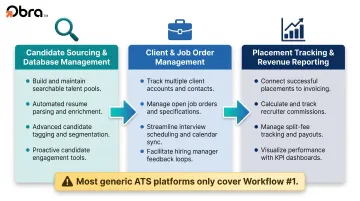
Most generic ATS platforms cover workflow #1. Few handle all three.
The Market Context
The recruiting software market reached $3.02 billion in 2024 and is projected to hit $6.67 billion by 2030, according to Grand View Research — a ~14% annual growth rate. That growth reflects both rising hiring complexity and the inadequacy of legacy tools.
Why Outbound Sourcing Now Matters More Than Inbound
According to LinkedIn's Global Talent Trends report, 70% of the global workforce is passive — not actively browsing job boards. Agencies that wait for applications to come in are fishing in the same 30% pond as every other employer.
Outbound sourcing tools let agencies proactively reach passive candidates, cutting time-to-fill from 30–60 days to 15–30 days.
The rise of AI-generated applications compounds this. When 22% of deceptive candidates embed hidden prompt injections in resumes to bypass automated filters, inbound-only pipelines become unreliable, not merely slow to fill.
Best Recruitment Platforms for Agencies
These platforms were evaluated on candidate database quality, agency-specific CRM features, integration ecosystem, pricing transparency, and real-world fit for agencies of varying sizes.
Bullhorn
Bullhorn is the most widely adopted ATS + CRM platform built specifically for staffing and recruitment agencies. It covers front-office, mid-office, and back-office workflows in a single system — candidate tracking, client management, job order management, and placement analytics.
Over 70% of Bullhorn customers have fewer than 10 users, so smaller agencies use it more than the enterprise reputation suggests. Its depth of features and custom pricing make it most cost-effective for agencies with high placement volume.
| Feature | Details |
|---|---|
| Key Features | ATS + CRM in one platform, automated candidate matching, job order management, placement tracking, reporting dashboards, 300+ integrations including LinkedIn and background check tools |
| Pricing | Custom pricing — contact Bullhorn for a quote |
| Best For | Mid-market to enterprise staffing agencies managing high placement volume and multiple concurrent client relationships |
Recruit CRM
Recruit CRM tightly combines applicant tracking and CRM functionality for staffing and executive search firms. Its GPT integration handles email drafting and candidate summaries, while AI matching surfaces relevant profiles from your existing database. The platform operates in over 100 countries.
The standout for smaller agencies: a never-expiring free trial with no credit card required, plus unlimited training and a dedicated account manager on all paid plans.
| Feature | Details |
|---|---|
| Key Features | Combined ATS + CRM, AI resume parsing, GPT-powered candidate summaries and email drafts, drag-and-drop pipelines, Boolean search, job multiposting, client feedback tools, and invoicing |
| Pricing | From $85/user/month (billed annually); unlimited free trial, no credit card required |
| Best For | Small-to-mid staffing agencies and executive search firms needing candidate tracking and client management in one tool |
Manatal
Manatal offers AI-powered candidate recommendations, drag-and-drop pipelines, social media profile enrichment, and a client portal at a price point that undercuts most competitors. The AI engine scans job descriptions against your candidate database and auto-surfaces top matches — reducing manual screening time without requiring complex setup.
| Feature | Details |
|---|---|
| Key Features | AI candidate recommendations, Kanban pipeline, candidate profile enrichment, client portal, in-app communication, placement monitoring, revenue tracking, LinkedIn sourcing extension |
| Pricing | From $15/user/month (billed annually); 14-day free trial, no credit card required |
| Best For | Small agencies and independent recruiters prioritizing affordability with AI-assisted candidate management |
Zoho Recruit
Zoho Recruit offers separate product editions for corporate HR teams and staffing agencies — the agency edition includes client portals, contact management, in-app communications, and placement tracking. A free-forever plan and a 45-day money-back guarantee on paid tiers make it one of the lowest-risk entry points in the market.
Agencies already using other Zoho tools (CRM, People, Analytics) benefit from native integration across the entire ecosystem, which reduces the cost and friction of expanding their stack.
| Feature | Details |
|---|---|
| Key Features | Dedicated staffing agency edition, client portal, candidate sourcing, resume parsing, multilingual career pages, workflow automation, Zoho suite integration |
| Pricing | Staffing Agency Edition: $30/user/month (Standard) to $90/user/month (Enterprise), billed annually; free plan available; 45-day money-back guarantee |
| Best For | Small-to-mid agencies, especially those already in the Zoho ecosystem or needing a low-cost entry point with scalability |
Obra Hire
Obra Hire takes a different approach from the platforms above. Rather than managing inbound applications, it gives agencies direct access to 800M+ candidate profiles through AI-powered, competency-based matching — letting recruiters proactively find and contact candidates who haven't applied anywhere.
In practice, agencies can search using natural language or job descriptions, preview candidate pool size before spending any credits, then unlock verified contact details (email, phone, LinkedIn, and resume) only when ready to reach out. Credits are consumed at the reveal step — not during search or preview.
A few things separate it from generic sourcing tools:
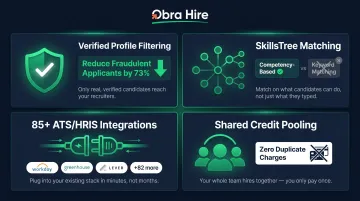
- Filters to verified-only profiles (Explore and Scale plans), reducing exposure to AI-generated or fake candidates — a problem Gartner projects will affect 1 in 4 profiles by 2028
- SkillsTree matching uses structured skill data rather than keyword frequency — a candidate with "React engineering" experience surfaces for a "JavaScript development" search without manual workarounds
- Plugs into existing workflows via 85+ ATS/HRIS integrations — including Workday, Greenhouse, iCIMS, Lever, and SAP SuccessFactors — without replacing anything
- Shared credit pooling (Scale plan) lets the whole team draw from one pool — once a contact is revealed by any team member, that information is accessible to everyone without duplicate charges
| Feature | Details |
|---|---|
| Key Features | 800M+ candidate profiles, AI competency-based matching (SkillsTree), verified profile filtering, preview candidate pools before spending credits, direct contact reveal (email, phone, LinkedIn, and resume), 85+ ATS/HRIS integrations, shared team credits, unlimited searches on all plans |
| Pricing | Free (unlimited searches, 1,000 profile views, 50 contact credits/month); Explore: $109/month; Scale: $169/month; Enterprise: custom — no contract required |
| Best For | Agencies of any size needing proactive outbound candidate discovery, verified profile quality, or a passive sourcing layer to supplement their existing ATS |
How We Chose the Best Recruitment Platforms for Agencies
These platforms were assessed specifically through an agency lens. The most common mistake agencies make is selecting software built for in-house HR teams, then discovering it lacks client portals, multi-account management, or placement revenue tracking.
Evaluation Criteria
Each platform was assessed on five factors tied to measurable agency outcomes:
- Agency-specific CRM and client management — does the platform support multiple client accounts, job orders, and submission tracking?
- Candidate database size and data quality — how large is the searchable pool, and are profiles validated?
- Outbound vs. inbound-only sourcing — can the platform actively surface candidates, or does it only manage inbound applications?
- Integration depth — does it connect with the ATS/HRIS tools agencies already use?
- Pricing transparency and scalability — is pricing published, predictable, and viable for growing teams without sudden per-seat cost cliffs?
Why Fake/AI-Generated Profile Filtering Now Matters
This criterion emerged as a genuine differentiator — not a checkbox item. According to Security Magazine, 41% of organizations have hired and onboarded a fraudulent candidate. Separately, 34% of recruiters spend up to half their workweek filtering spam or low-quality submissions. Manual resume screening alone consumes an average of 23 hours per hire.
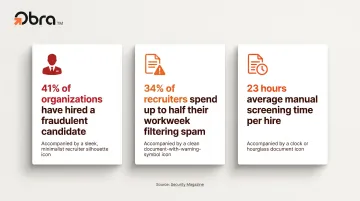
Platforms with no verification layer leave agency recruiters absorbing this problem at full volume. For agencies billing on placement speed, that's a direct hit to margin.
Conclusion
Choosing the right recruitment platform comes down to identifying your agency's actual bottleneck — not chasing brand recognition.
- If your bottleneck is managing multiple client relationships, a purpose-built staffing CRM like Bullhorn or Recruit CRM addresses that directly
- If your bottleneck is cost, Manatal or Zoho Recruit offer strong functionality at accessible price points
- Candidate quality or pipeline volume is a different problem entirely — outbound sourcing tools like Obra Hire address it at the source, before bad applications ever enter your workflow
No single platform covers everything equally. Start with the constraint that's actually slowing you down, and the right tool becomes obvious.
For agencies looking to move beyond inbound-only recruiting, Obra Hire offers a free plan with unlimited searches and no setup required — so you can search 800M+ verified candidate profiles and see real pool sizes before spending a single credit.
Frequently Asked Questions
What are the top recruiting platforms?
Widely used platforms include Bullhorn, Greenhouse, Manatal, Zoho Recruit, and Workable. The best choice depends on your use case — agencies typically need a CRM-first platform, while in-house teams usually prioritize ATS features and employee data integration.
What are the top 5 ATS systems?
By market share, leading ATS platforms include iCIMS, Greenhouse, Workday Recruiting, Oracle Recruiting Cloud, and UKG. Rankings shift by company size; Bullhorn dominates specifically in the staffing agency segment.
What are the top job portals in the USA?
The most-visited US job sites include Indeed, ZipRecruiter, Glassdoor, and LinkedIn Jobs. Job portals attract active applicants; recruitment platforms help agencies manage sourcing, pipelines, and client workflows end to end.
What is the 70/30 rule in hiring?
The 70/30 rule refers to LinkedIn's finding that roughly 70% of the global workforce is passive — employed and not actively job hunting — while 30% is actively searching. For agencies, this means the best candidates often aren't on job boards, making outbound sourcing tools more valuable than posting volume.
What is the difference between an ATS and a recruitment CRM for agencies?
An ATS manages active hiring workflows — applications, interview stages, and pipeline tracking. A recruitment CRM manages long-term candidate relationships and client account data. Agencies need both, which is why purpose-built platforms like Bullhorn and Recruit CRM combine the two in one system.
How do recruitment agencies source passive candidates efficiently?
Efficient passive sourcing uses outbound tools like Obra Hire, LinkedIn Recruiter, or SeekOut to search large profile databases and identify relevant candidates through AI-powered matching. Recruiters then reach out directly via verified contact information — faster and more targeted than waiting on inbound applications.