The stakes of this choice have risen. According to a 2025 Gartner survey, 65% of HR leaders expect flat or decreased budgets in 2025, while AI-generated applications are piling pressure on screening workflows. The platform-vs-agency decision is no longer just a procurement call — it affects your cost structure, pipeline visibility, and ability to scale.
This article breaks down how each model works, what it costs, where each genuinely excels, and how to choose based on your role type, team size, and hiring volume.
TL;DR
- Online platforms give employers direct, self-serve access to candidate databases at subscription or credit-based pricing — far cheaper per hire than agencies
- Traditional agencies manage sourcing, screening, and shortlisting for you, charging 15–25% of first-year salary on placement
- Platforms offer lower cost, faster hiring, and greater control; agencies are better suited for passive candidate access, niche roles, and senior searches that need hands-off management
- The most effective hiring teams use both — platforms for volume roles, agencies for executive or hard-to-fill positions
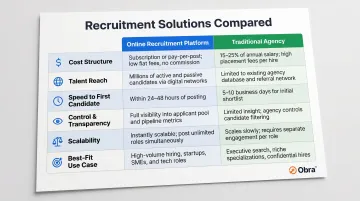
Online Recruitment Platforms vs. Traditional Agencies: Quick Comparison
The right model depends on your specific hiring situation — volume, urgency, budget, and role complexity all factor in. Here's how the two approaches stack up across the dimensions that matter most.
| Dimension | Online Recruitment Platform | Traditional Agency |
|---|---|---|
| Cost Structure | Subscription or credit-based; predictable monthly spend | 15–25% of first-year salary per placement |
| Talent Reach | Large searchable databases (800M+ on some platforms) | Agency-specific candidate networks and passive relationships |
| Speed to First Candidate | Near-immediate search results; same-day outreach possible | Days to weeks for sourcing and initial screening |
| Control & Transparency | Full visibility into pipeline; you manage outreach | Limited visibility; agency controls sourcing and screening |
| Scalability | High — same cost covers 1 or 100 requisitions | Linear — every new hire triggers a new fee |
| Best-Fit Use Case | Recurring, volume, or skills-defined hiring | Senior, niche, confidential, or one-off roles |
What Is an Online Recruitment Platform?
Online recruitment platforms are technology-driven tools that give employers direct access to candidate databases, AI-powered search, and outreach capabilities. The critical distinction from job boards: platforms are outbound. Instead of posting and waiting, you search for candidates who match your requirements and contact them directly.
Core Features
Most platforms include:
- Filter candidates by skills, location, experience, and industry across searchable profile databases
- AI or competency-based matching that surfaces relevant candidates — not just keyword matches
- Direct contact reveal: email, phone number, LinkedIn profile, and resume in one click
- ATS integrations that push candidate data directly into your existing workflows
- Analytics dashboards for tracking sourcing performance and spend
Cost Model
Platforms typically use subscription tiers or credit-based pricing, which means your costs are predictable regardless of how many hires you make in a given month. Compare that to agency contingency fees, where every placement is a new variable expense.
The cost difference is dramatic. SHRM's 2025 Recruiting Benchmarking Report found the median nonexecutive cost-per-hire is now $1,200 — down 27% since 2017, a trend driven in large part by organizations shifting to in-house and platform-led sourcing. Agency fees for the same role at a $60,000–$80,000 salary would run $9,000–$20,000.
The AI-Generated Applicant Problem
Verified profile filtering is becoming a key differentiator. A March 2026 Robert Half survey found 61% of HR leaders report AI-generated applications have slowed their hiring process, with 89% reporting heavier workloads as a result.
Modern platforms are responding with verification layers that flag or exclude fake and AI-padded profiles from search results — saving recruiters from wasting time on candidates who don't actually match their stated credentials.
Use Cases for Online Recruitment Platforms
Platforms work best when:
- Hiring happens regularly across multiple roles — volume needs or ongoing pipelines
- Roles carry defined skill profiles that translate cleanly into search filters
- Internal recruiting capacity exists to manage outreach and evaluation
- You want direct control and visibility over your candidate pipeline
Obra Hire is a practical example of this model in action. It gives hiring teams access to 800M+ candidate profiles with competency-based matching that evaluates candidates against "Must Have" and "Nice to Have" criteria — going beyond keyword search to surface genuinely qualified matches. Users can preview their candidate pool and browse profiles before spending any credits, making it easy to validate search criteria without financial risk.
The platform integrates with 85+ ATS systems including Workday, Greenhouse, and Lever. Pricing starts at $0/month (1,000 profile views and 50 contact credits on the free tier), with paid plans from $109/month.
What Is a Traditional Recruitment Agency?
Traditional recruitment agencies are third-party firms that manage sourcing, screening, and shortlisting on behalf of employers. There are three main models:
- Contingency agencies — paid only when a candidate is successfully placed; most common for mid-level professional roles
- Retained search firms — paid in installments regardless of outcome; standard for C-suite and board-level hiring
- Staffing agencies — focused on contract, temp, or project-based placements
Agency Fee Model
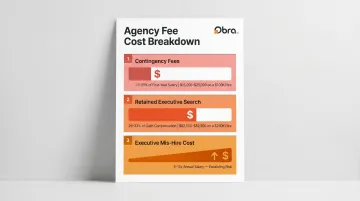
Contingency fees typically run 15–25% of the placed candidate's first-year salary, with 20% being the most common rate. For a $100,000 hire, that's $15,000–$25,000 per placement.
Retained executive search commands more: 25–33% of first-year cash compensation, paid in three installments. For a $250,000 executive, expect $62,500–$82,500 in total fees. The premium is easier to justify when you consider that an executive mis-hire can cost 5–15x the individual's annual salary — factoring in severance, strategic disruption, and turnover. Retained fees effectively function as risk insurance for high-stakes roles.
Where Agencies Genuinely Add Value
Agencies outperform self-serve platforms in specific scenarios:
- C-suite and board searches where retained search is the dominant model
- Confidential searches where the employer's identity can't be disclosed
- Passive candidate engagement — a skill recruiting professionals consistently rank as their most critical capability over the next five years
- Niche or specialized industries where deep sector networks matter more than database size
- Low employer brand recognition in markets where candidates wouldn't respond to cold outreach
The executive search market reflects this sustained demand — projected to reach $64 billion in 2026 and grow to over $103 billion by 2031.
When to Use a Traditional Agency
Agencies are the right call when you're making a single senior or specialized hire, when the search requires confidentiality, or when your organization lacks in-house recruiting capacity.
One key drawback: agencies offer limited transparency into sourcing methods, and the cost model doesn't scale. Every hire triggers a new fee — which makes high-volume agency hiring financially unsustainable for most teams.
Which Model Is Right for Your Team?
The answer comes down to four variables: hiring volume, role complexity, internal recruiting capacity, and budget.
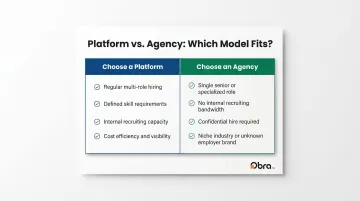
Choose an Online Recruitment Platform When:
- Your team hires regularly across multiple roles — even 3–5 hires per year will make the subscription cost-efficient compared to agency fees
- Roles have defined skill requirements that can be searched and filtered systematically
- You have recruiters or HR staff who can manage outreach and candidate evaluation
- Cost efficiency and pipeline visibility matter — platforms give you full control without proportional cost increases as volume grows
Choose a Traditional Agency When:
- You're filling a single, senior, or highly specialized role where network access matters more than database size
- You lack internal recruiting bandwidth and need hands-off management
- The hire requires discretion or confidentiality
- You're hiring in a niche industry or geography where your brand is unknown and cold outreach would land poorly
The Hybrid Approach
Many mid-to-large teams don't choose one model — they split the work. Platforms handle day-to-day and volume hiring; agencies get called in for executive searches or hard-to-fill niche roles.
The data supports this approach. SHRM's 2025 benchmarks show the median nonexecutive cost-per-hire at $1,200 for organizations using primarily internal and platform-led sourcing, versus $15,000+ per placement via agency for the same role at a $100,000 salary.
For executive roles, the math flips. The $10,625 median executive cost-per-hire often reflects retained agency involvement at some stage — which is exactly where agencies earn their fee.
Platforms with deep ATS integrations make the hybrid model seamless. Obra Hire, for example, connects with 85+ ATS and HRIS systems including Greenhouse and Workday, so candidate data flows into your existing workflow without disruption. You're not managing two disconnected systems; you're choosing the right sourcing channel for each role.
Conclusion
If your hiring needs are frequent, budget-sensitive, and require direct control over your pipeline, a self-serve recruitment platform is the more cost-efficient model. If your needs are episodic, specialized, or require hands-off management, agency relationships remain a justified investment.
Most effective hiring teams use both — matching the tool to the context rather than committing to one channel exclusively. For teams looking to reduce cost-per-hire without sacrificing candidate quality, a platform like Obra Hire lets you preview candidate pools before spending a single credit. The free tier is a practical starting point: no contract, no setup, and direct access to 800M+ verified profiles from day one.
Frequently Asked Questions
What are the key differences between online recruitment platforms and traditional recruitment agencies?
Online platforms give employers direct, self-serve access to candidate databases at a fixed or credit-based cost. Agencies manage the full sourcing and screening process for a placement fee. The core differences are cost structure (predictable vs. percentage-based), control, speed to first candidate, and scalability.
What are the key differences between internal and external recruitment?
Internal recruitment fills roles from within your existing workforce through promotions or transfers. External recruitment sources candidates from outside the organization. Both online platforms and traditional agencies are external recruitment methods — they differ in who manages the process and at what cost.
How much does a traditional recruitment agency charge?
Contingency agencies typically charge 15–25% of the placed candidate's first-year salary, with 20% as the most common rate. Retained search firms charge 25–33% upfront. For a $100,000 role, that's $15,000–$25,000 per placement, significantly more than platform-based sourcing for the same hire.
When should you use an online recruitment platform instead of a recruitment agency?
Platforms are the better choice for recurring, volume, or skills-defined roles where your team has capacity to manage outreach. They offer faster access to candidates, lower cost-per-hire, and full pipeline visibility — compared to agency fees that scale with every placement.
Can online recruitment platforms replace traditional agencies entirely?
For most standard roles, platforms offer comparable or better reach with more control and lower cost. Agencies still add value for niche executive searches, confidential hires, and markets where employer brand recognition is too limited for cold outreach to work.
Do online recruitment platforms work for roles outside of tech?
Modern platforms like Obra Hire cover blue, gray, and white collar roles across 34 industries — including healthcare, manufacturing, logistics, retail, and operations. The assumption that platforms only serve tech hiring is increasingly outdated.