The numbers frame the problem clearly. According to ManpowerGroup's 2024 survey, 75% of employers report difficulty filling roles. Meanwhile, iCIMS data shows that applications rose 13% year-over-year in 2024, yet only 17% of applicants advanced to interview. More volume, less quality — exactly the opposite of what RPO SLAs demand.
This guide covers the sourcing strategies that actually move the needle for RPO teams: outbound-first approaches, scalable talent pool management, and the metrics that connect sourcing activity to client outcomes.
TL;DR
- Inbound-only sourcing is structurally incompatible with RPO at scale — 70% of qualified candidates are passive and unreachable through job postings alone
- Outbound-sourced candidates convert at ~6% versus ~0.5% for inbound applicants, an 8x yield advantage per outreach
- Pre-built talent pools are the highest-ROI investment an RPO team can make — cutting cold-start sourcing time on every new req
- Measuring 90-day retention by source (not application volume) is the metric that separates high-performing RPO programs from average ones
What Is Candidate Sourcing in RPO — and Why It's Different
Candidate sourcing in an RPO context means proactively identifying, engaging, and qualifying candidates on behalf of client organizations — before a requisition opens, never waiting for inbound applications to trickle in.
This is categorically different from how most in-house TA teams operate. Internal recruiters typically manage a single employer brand, a fixed set of role types, and a relatively stable candidate pool. RPO teams don't have that luxury.
The core differences:
- RPO sourcers work across multiple industries, compensation bands, and employer brands simultaneously — role-specific strategies are required, not optional
- RPO engagements carry SLAs: time-to-submit, time-to-fill, candidate quality thresholds, and sometimes DEI targets. Missing them has commercial consequences
- In-house teams can react to open requisitions. RPO teams that react are perpetually behind — sourcing must be continuous and proactive
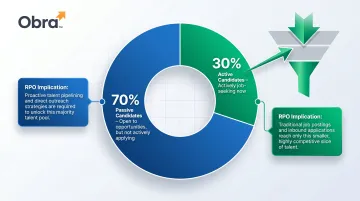
The passive workforce reality makes this non-negotiable. Around 70% of professionals are passive candidates — not actively applying, but open to the right opportunity. Only a small fraction are actively job-hunting at any given moment. An inbound-only RPO operation competes for that narrow slice while missing everyone else — which is why direct outreach isn't optional, it's the job.
Best Candidate Sourcing Strategies in RPO
Effective RPO sourcing is a portfolio — not a single tactic. The right mix depends on role type, client industry, and candidate behavior. Here are the five strategies that consistently deliver.
Outbound and AI-Powered Active Sourcing
Outbound sourcing — finding candidates and reaching out directly rather than waiting for applications — is the foundation of high-performance RPO. The numbers are stark: outbound-sourced candidates are 8x more likely to be hired than inbound applicants, converting at approximately 6% versus 0.5% for job board applicants.
There's also an increasingly serious problem with inbound quality. Gartner predicts 1 in 4 job applications will be fake by 2028, with 6% of candidates already admitting to some form of interview fraud in 2025. For RPO teams managing client SLAs, unverified inbound pipelines carry real risk.
AI-powered platforms make outbound viable at RPO scale. Obra Hire, for example, enables teams to search across 800M+ verified candidate profiles using competency-based matching — returning ranked, skill-matched results rather than keyword-hit lists. The verified profile filtering specifically addresses the fake applicant problem by surfacing profiles with confirmed authenticity, reducing exposure to the fraud risk that increasingly plagues inbound channels.
AI isn't just faster — recruiters using AI in their workflows save approximately 20% of their workweek, and AI-assisted sourcing can reduce time-to-hire by up to 50%.
Boolean Search and Competency-Based Candidate Matching
Boolean search remains a practical tool for narrowing candidate pools across LinkedIn, ATS databases, and sourcing platforms. Structured queries using AND/OR/NOT operators and parenthetical groupings let sourcers filter by title, skills, location, and experience combinations quickly.
The limitation is precision. Boolean search finds profiles that contain the right words — not candidates who demonstrate the right capabilities.
Competency-based matching addresses this directly. Rather than searching for resume text, it evaluates candidates against a defined skills taxonomy with proficiency levels. The output is a shortlist where candidates are matched on what they can actually do, not just what they've written. The practical impact:
- Fewer misaligned candidates advance to screen
- Screen-to-interview drop-off decreases
- Downstream hiring manager satisfaction improves
- Candidate pools expand significantly when degree requirements are replaced with skills criteria
The adoption trend reinforces this shift: 81% of employers used skills-based hiring in 2024, up from 73% the prior year. Among them, 82% reported reduced time-to-hire and 74% reported lower hiring costs.
Multi-Channel Sourcing Diversification
No single channel is sufficient for RPO-scale hiring. Job boards generate volume — but at a 0.4% applicant-to-hire conversion rate, with an average of 180 applicants per hire. That's an enormous screening burden for marginal yield.
RPO teams should distribute sourcing effort across multiple channels simultaneously:
- Direct outbound / Boolean search — primary driver for passive candidates
- Employee and client referral programs — highest quality, fastest time-to-fill
- Niche job boards and industry communities — role-specific reach
- Professional networks and alumni groups — trust-based pipelines
- Social media channels — especially for mid-career and technical roles
- Talent pool re-engagement — warm outreach to pre-screened candidates
The channel mix should vary by role type and seniority. A healthcare RPO engagement requires different sourcing channels than a software engineering build-out.
Track source-of-hire data religiously — without it, budget allocation is guesswork and channel investment drifts toward habit rather than performance.
Passive Candidate Engagement and Personalized Outreach
Once your channel strategy is set, execution quality determines response rates. Passive candidates don't respond to generic InMail blasts — they respond to relevance. An outreach message that clearly explains why this specific person was chosen performs dramatically better than a templated pitch sent to 200 people.
Elements of effective passive outreach:
- Specific hook — Reference something concrete about their background (a skill, a company, a project)
- Role value proposition — What makes this opportunity worth a conversation, not just what the job requires
- Low-barrier CTA — "Would you be open to a 15-minute call this week?" performs better than "Apply here"
- Follow-up sequence — A structured 2–3 touch cadence over 2 weeks; candidates who don't respond to touch one often respond to touch two when it adds new context
Obra Hire reveals direct contact information — email, phone, LinkedIn URL, and resume — when a credit is used, giving sourcers the channel flexibility to reach candidates through whichever method is most likely to get a response.
Employee and Client Referral Programs
Referrals are the highest-performing sourcing channel by nearly every metric that matters to RPO clients:
| Metric | Referrals | Job Boards |
|---|---|---|
| Applicant-to-hire rate | ~30% | ~7% |
| Average time-to-hire | 29 days | 39 days |
| 1-year retention | 46% | 33% |
| 2-year retention | 45% | 20% |
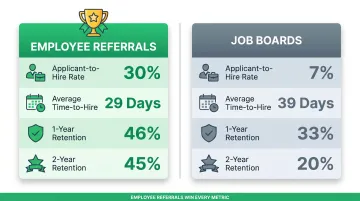
Employee referrals account for 30–40% of all hires and produce hires 55% faster than career site applicants. The pre-vetting effect is real — employees apply a basic cultural and skills filter before referring, reducing early-funnel screening burden for the RPO team.
RPO providers help clients build programs that actually sustain this performance: defined incentive tiers, automated ATS tracking, clear submission workflows, and regular communications that keep employees engaged in the program long-term.
Building Scalable Talent Pools for RPO
The most expensive sourcing model is one that starts from zero on every new requisition. Cold searches eat time, cost money, and produce inconsistent quality. A well-built talent pool inverts this problem.
The value is straightforward: pre-screened, interested candidates who already have some familiarity with the client brand require significantly less time to activate than cold outreach targets. Industry benchmarks suggest RPO models that use pre-built talent pools can deliver cost savings of up to 40% through reduced time-to-fill and improved hire quality.
Structuring Talent Pools by Client and Role Type
A talent pool that isn't segmented is just a database. Segment by:
- Client (separate pipelines for each engagement)
- Function — engineering, operations, sales, clinical, etc.
- Seniority level — entry, mid, senior, leadership
- Geography — critical for roles with location constraints
- Status metadata — last contact date, availability signal, preferred role type, current employer
With proper tagging, a recruiter opening a new requisition can query an existing pool rather than initiating a fresh search. Obra Hire's project-based pipeline organization supports this approach, with teams able to create shared projects by role or search, assign collaborators, and track outreach status across candidates.
Re-engaging Past Candidates and Silver Medalists
Silver medalists — candidates who reached final stages but weren't selected — are among the most underutilized assets in RPO. They've already been screened. They already have brand familiarity with the client. Their re-engagement timelines are significantly shorter than cold outreach.
A reactivation campaign structure that works:
- Personalized message referencing their previous interaction specifically ("We spoke in March about the Senior PM role at [Client]...")
- Updated role context — explain what's new and why the current opportunity is different or better
- Low-barrier response ask — gauge current interest before scheduling anything formal
Don't skip the personalization. A generic "We have a new opportunity!" message to a candidate you ghosted 6 months ago will be ignored.
Maintaining Pool Freshness and Engagement
Talent pool decay is a real operational risk. Approximately 2–3% of contact data becomes outdated each month, which means a pool of 10,000 candidates loses 2,400–3,600 valid records annually without active maintenance.
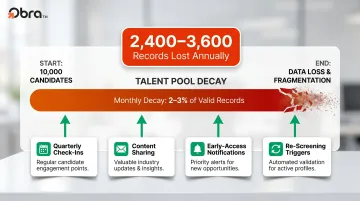
Light-touch maintenance tactics:
- Quarterly check-ins to confirm continued interest and update availability
- Sharing relevant industry content or market insights — keeps candidates engaged without a hard sales pitch
- Early-access notifications for new roles before they're publicly posted
- Re-screening triggers when a candidate's profile signals a job change
An engaged pool of 500 warm candidates consistently outperforms an uncontacted database of 5,000 stale ones — pool quality matters far more than raw size.
Using ATS and CRM Integrations to Put Pools to Work
Keeping a pool fresh is only half the equation. It only creates value when it's embedded in daily workflow. Candidates sitting in a spreadsheet or a disconnected sourcing tool don't reduce time-to-fill — they just add a manual transfer step.
Obra Hire integrates with 85+ ATS/HRIS platforms — including Workday, Greenhouse, iCIMS, Lever, and SAP SuccessFactors — enabling sourced candidates to flow directly into client pipelines. This is particularly important for RPO teams operating within client tech stacks: the sourcing happens in Obra Hire, but the candidate lands where the client's TA team already works, with no duplicate data entry.
Measuring and Optimizing RPO Sourcing Performance
Application volume is not a sourcing metric. It's a sourcing activity log. The metrics that connect sourcing to client outcomes are:
| KPI | Why It Matters | Benchmark |
|---|---|---|
| Time-to-fill by source | Identifies which channels deliver fastest | 41–44 days median (SHRM 2025) |
| Cost-per-hire by channel | Informs sourcing budget allocation | $1,200 median (non-executive) |
| Candidate quality rate | % of sourced candidates advancing past screen | Internal benchmark by client |
| Offer acceptance rate | Signals quality of shortlist and engagement | 80%+ target for RPO |
| 90-day retention by source | Leading indicator of sourcing quality | 90%+ target for RPO |
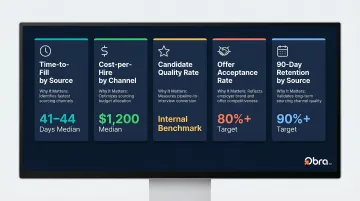
90-day retention by source is the most important long-term signal. It answers the question that matters most to clients: are the people we're placing actually staying? Only 20% of organizations measure quality of hire at all — RPO providers who track this metric have a concrete competitive advantage in client retention conversations.
That data becomes actionable through regular source-of-hire analysis. It surfaces which channels produce retained hires versus which generate volume without quality — and gives RPO teams the evidence to reallocate effort and budget toward higher-performing channels in each engagement.
Sourcing dashboards should map directly to each client's contractual commitments. Configure reporting around the SLA, not around what's easiest to pull:
- Speed-focused clients: surface time-to-fill by channel and offer acceptance rate
- DEI-focused clients: track source diversity ratios and screen-to-offer conversion by demographic segment
- Quality-focused clients: prioritize 90-day retention by source and candidate quality rate
Conclusion
Effective RPO sourcing is a system, not a collection of tactics. The RPO teams consistently outperforming their SLAs share a common operating model: outbound-first and pool-driven, with performance measured at the outcome level rather than the activity level.
Three investment priorities define the difference: build talent pools before you need them, implement competency-based matching to reduce screening waste, and track 90-day retention by source to prove sourcing quality to clients in terms they care about.
For RPO teams looking to upgrade outbound sourcing capability without adding headcount, Obra Hire offers a direct path in: search 800M+ verified candidates, preview talent pool size before committing any credits, and push sourced candidates straight into your existing ATS. The free tier includes unlimited AI-powered searches and 1,000 profile views — enough for any team to validate candidate availability across active requisitions before spending anything.
Frequently Asked Questions
What are the key stages in the recruitment and candidate sourcing process?
Sourcing is the first stage — proactively identifying and qualifying candidates who feed the top of the funnel. It's followed by screening, interviewing, offer management, and onboarding. The quality of sourcing directly determines efficiency at every downstream stage; a weak top of funnel creates compounding problems all the way through to offer.
How do recruiters source candidates?
High-performing recruiters combine Boolean search, outbound outreach to passive candidates, ATS re-engagement, employee referrals, niche job boards, and community pipelines. Single-channel reliance is the most common sourcing weakness. The best sourcers treat channels as a portfolio, not a default.
What are the best candidate sourcing strategies in recruitment process outsourcing?
RPO sourcing is built around outbound hiring at scale, talent pool management across multiple clients, and competency-based matching rather than keyword search. Multi-channel diversification and systematic re-engagement of past candidates round out the approach. The goal is volume, speed, and measurable client ROI, not one-off fills.
What does it mean when someone is sourced by a recruiter?
Being "sourced" means a recruiter proactively identified and reached out to a candidate who did not apply. The candidate was found through a database search, LinkedIn, or another channel, and was contacted because their background matched the requirements of an open role.
How do RPO teams measure the success of their sourcing strategies?
The primary metrics are time-to-fill by source, cost-per-hire by channel, candidate quality rate, offer acceptance rate, and 90-day retention by source. Of these, 90-day retention by source carries the most weight: it ties sourcing activity directly to whether placed candidates stay on the job.