There's a second problem: AI-generated resumes and fabricated profiles are flooding inbound pipelines, making it harder to identify genuinely qualified people from job postings alone.
This guide covers everything you need to shift from reactive to proactive: a clear definition of candidate sourcing, how it differs from recruiting, the strategies that consistently produce results, and the metrics that tell you whether your approach is actually working.
TL;DR
- Candidate sourcing is proactive, outbound identification of talent before they apply — it's a distinct discipline from recruiting
- Effective sourcing combines outbound outreach, talent pool management, referrals, and personalized passive candidate engagement
- Roughly 70% of the global workforce are passive candidates — sourcing is the only way to reach them
- Track source of hire, response rate, qualified candidate rate, and pipeline conversion to diagnose what's working
- Obra Hire lets teams search 800M+ verified profiles and preview candidate pools before committing any credits
What Is Candidate Sourcing (And How It Differs from Recruiting)
Candidate sourcing is the proactive, outbound process of identifying and engaging potential candidates — both active job seekers and passive talent — before a formal application is submitted. It runs continuously in the background, not just when a specific role opens up.
Four terms get used interchangeably in this space, but they mean different things:
| Term | What It Means |
|---|---|
| Talent Acquisition | The overarching strategy for building workforce capacity |
| Candidate Sourcing | Finding and engaging candidates before they apply |
| Recruiting | The end-to-end process: screening, interviews, offer negotiation |
| Hiring | The final selection and onboarding step |
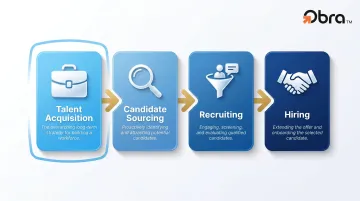
Sourcing sits at the very top of this funnel. It feeds your ATS and CRM systems, generates the initial pipeline, and directly shapes downstream metrics like time-to-fill and quality-of-hire. Without it, everything downstream is limited to whoever self-selected into your inbound pipeline.
Obra Hire addresses exactly this top-of-funnel gap — letting teams search 800M+ candidate profiles and push results directly into 85+ ATS/HRIS systems like Workday, Greenhouse, and Lever, so sourced candidates enter your workflow without any manual hand-off.
Why Outbound Sourcing Outperforms Waiting for Applicants
The passive candidate statistic makes the case clearly: if 70% of the workforce isn't applying anywhere, inbound-only hiring structurally excludes the majority of available talent.
The AI Fraud Problem Making Inbound Worse
The inbound pipeline has a second, growing problem. Gartner predicts that 1 in 4 candidate profiles worldwide could be fake by 2028, driven by AI-generated resumes, fabricated credentials, and interview fraud. In a Q4 2024 survey of 3,290 candidates, 39% admitted to using AI during their applications — and of those, 54% used it to generate resume text.
Outbound sourcing addresses this directly. When your team proactively targets verified professionals rather than waiting for applications to arrive, you control who enters the pipeline. Platforms like Obra Hire include verified profile filtering, which screens out fabricated profiles before your team invests time in any candidate.
Three Measurable Advantages of Proactive Sourcing
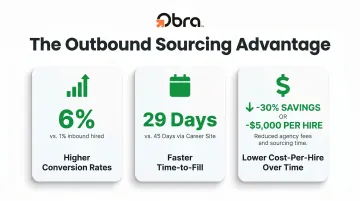
1. Higher conversion rates. Gem's analysis of 41 million candidates across 1,200+ customers found that 6% of outbound candidates are ultimately hired, vs. 1% of inbound applicants. Outbound candidates also pass through the top of the funnel at a 67% rate, compared to 8% for inbound.
2. Faster time-to-fill for repeat roles. Pre-built talent pipelines compress fill time significantly. Employee referrals — a proactive channel — close in 29 days on average, versus 45 days for career site applicants.
3. Lower cost-per-hire over time. Building a warm pipeline for high-frequency roles means less spend on job board postings and external agencies each time the role reopens.
Top Candidate Sourcing Strategies That Work
Align with the Hiring Manager Before You Start
Vague or conflicting role criteria waste sourcing effort on candidates who were never going to fit. Research from Metaview's 2026 study of 505 recruiting leaders found 58% admitted they want to work around their counterpart, and two-thirds of misaligned teams lose qualified candidates every month as a result.
A 30-minute sourcing kick-off meeting prevents this. Come prepared with these questions:
- What does success in this role look like at the 90-day mark?
- What seniority signals and specific skills are non-negotiable vs. trainable?
- Where do strong candidates in this field tend to gather — specific communities, platforms, or events?
- Are there past candidates we should revisit from previous searches?
Clear answers to these questions narrow your search criteria before you start, not after you've sourced 200 people who don't fit.
Tap LinkedIn and Professional Networks for Outbound Search
LinkedIn is the default sourcing channel for good reason — social professional networks rank as the #1 source of quality hires according to LinkedIn Talent Solutions. But most recruiters use only the surface level.
To get more out of it:
- Build Boolean search strings combining titles, skills, and geography (e.g.,
"product manager" AND "SaaS" AND "fintech" NOT "intern") - Filter by tenure patterns, not just current title — someone 3-4 years into a role is more likely open to a move
- Search second-degree connections for warm introduction pathways
- Join active professional groups in the target field — contributors are visible by their expertise, not their job search status
For specialized roles, the right platform isn't always LinkedIn:
- GitHub — software engineers and developers (100M+ developers on the platform)
- Doximity — healthcare and physicians (3M+ verified members; 85%+ of U.S. physicians)
- Behance / Dribbble — designers and creative professionals
Platform selection should follow where your target candidates actually spend time. Tools like Obra Hire let you search across 800M+ verified profiles in one place — useful when your role spans multiple candidate segments or industries.
Build and Reactivate a Talent Pool
A talent pool isn't a folder of old resumes — it's a structured, maintained asset. It should include:
- Past finalists who weren't hired but impressed the team
- Directly sourced candidates from previous searches
- Employee referrals who weren't ready to move at the time
- Event attendees and conference speakers in your target field
- Silver-medal candidates from closed roles
Keeping a talent pool warm doesn't require heavy investment — just a consistent cadence:
- Segment by skill category and readiness signals
- Set reminders to check in every 3-6 months
- Share relevant company news or industry content without making every touch transactional
- When a new role opens, start here before running a cold search
Run a Structured Employee Referral Program
Referrals consistently outperform every other sourcing channel on quality and speed. Referral hires close in 29 days versus 45 days for career site applicants and show 45% retention at two years compared to 20% for job board hires — numbers that hold up across industries and company sizes.
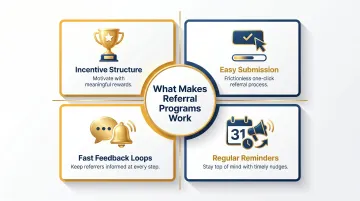
What makes a referral program work in practice:
- Incentive structure — financial rewards matter, but recognition and early access to company updates also drive participation
- Easy submission — a friction-heavy process kills participation; a simple form or Slack submission keeps it active
- Fast feedback loops — employees need to know what happened to their referral, or they stop submitting
- Regular reminders — the program dies if it's mentioned once at onboarding and never again
Engage Passive Candidates with Personalized Outreach
Generic outreach gets ignored. LinkedIn data shows personalized messages achieve a 40% higher response rate than generic templates — and InMail overall generates 3x the response rate of cold email (10-25% vs. ~3.4%).
Three elements consistently separate outreach that earns a reply from outreach that gets archived:
- Relevant hook — reference something specific to their work, not "I saw your profile"
- Why them specifically — name a skill, project, or career trajectory detail that makes the message feel researched
- Low-commitment ask — "Would you be open to a 15-minute call to learn more?" beats "Are you interested in this role?"
Cadence matters too. Many candidates need 2-3 touches across different channels before responding. A spaced sequence — LinkedIn message, follow-up email, second LinkedIn note — increases response rates, especially when each touch is spaced 5-7 days apart.
How to Source Passive Candidates at Scale
Passive candidates aren't opposed to new opportunities — they're just not looking for them. LinkedIn data shows 87% of both active and passive candidates are open to new roles when approached correctly. The constraint isn't willingness; it's reach.
Build a Targeted Ideal Candidate Profile
Start with competencies, not just job titles. A title-only search misses qualified candidates who've done the work under a different label. Define:
- Must-have competencies and demonstrated skills
- Preferred industry backgrounds and company types
- Seniority signals (years of relevant experience, scope of responsibility)
- Location parameters or remote flexibility
Once your ideal candidate profile is defined, use a sourcing platform or database to run the search. Obra Hire's AI-powered search lets you describe your ideal candidate in natural language or paste a job description, then returns competency-ranked results across 800M+ verified profiles.
You can also preview the full candidate pool — work history, experience, and education — before spending a single contact credit.
Social Sourcing Beyond Job Boards
Platform search gets you far, but passive candidates also leave traces of their expertise in places they're not job hunting:
- Professional communities on Slack, Reddit, or Discord relevant to the role's field
- Conference speaker lists — presenters are visible experts, often not job hunting
- GitHub contributor profiles — active open-source contributors show demonstrated skills, not just claimed ones
- Published content — authors of industry articles or newsletter contributors in your target domain
Nurture Candidates Who Aren't Ready Yet
Not every sourced candidate will move immediately. A passive candidate who's "maybe interested in 6 months" has real value — if you stay connected. A structured nurture sequence looks like:
- Periodic touchpoints every 6-8 weeks with relevant content or company updates
- No pressure to apply — the goal is staying top of mind
- When timing aligns, you're already in a warm conversation, not starting cold
Candidate Sourcing Tools and Technology
The right sourcing stack depends on volume and team size. The main categories:
| Tool Type | Best For |
|---|---|
| ATS with sourcing functionality | Managing existing pipelines, tracking applicants |
| Outbound sourcing platforms | Searching new candidates outside your current database |
| LinkedIn Recruiter / premium social tools | Targeted professional network searches |
| Boolean search tools | Refining searches across multiple platforms |
What to Look for in a Sourcing Platform
Not all platforms are built the same. Key criteria:
- Large, verified candidate database — size without verification is noise
- Competency-based AI matching — goes beyond keyword scanning to surface candidates who can do the job, not just candidates whose resume contains the right words
- ATS/HRIS integration — sourced candidates should flow directly into your existing workflow
- Transparent pricing — cost per contact, not per search
Obra Hire is built for outbound sourcing. Key features at a glance:
- 800M+ verified candidate profiles
- AI-powered, competency-based matching (not keyword scanning)
- 85+ ATS/HRIS integrations including Workday, Greenhouse, and iCIMS
- Freemium model — no credit card or sales call required to start
- Free plan: unlimited searches, 1,000 profile views, and 50 contact credits monthly
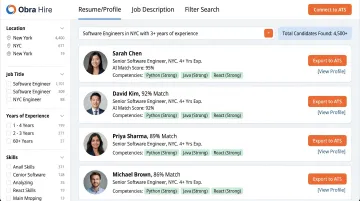
Verified profile filtering — available on Explore and Scale plans — addresses a growing problem: Gartner projects that 25% of candidate profiles will be AI-generated or fabricated by 2028. For teams already dealing with inflated applicant volumes, filtering out fake profiles is no longer optional.
Measuring and Optimizing Your Candidate Sourcing Strategy
The Four Metrics That Matter
Most sourcing teams track the wrong things. Applicant volume is easy to measure and nearly meaningless. Four metrics actually predict hiring outcomes:
- Source of hire — which channel actually produces hires, not just applicants
- Response rate on outreach — a leading indicator of message quality and channel fit
- Qualified candidate rate — what percentage of sourced candidates advance past initial screening
- Pipeline conversion rate — sourced to hired, end-to-end
According to SHRM benchmarking research, only 20% of organizations consistently track quality of hire. Teams that build this measurement habit gain a real edge over those still counting applicant volume.
Use Source-of-Hire Data to Redirect Effort
If LinkedIn outreach produces 10x more qualified candidates than job board postings for a specific role type, that's a clear signal to reallocate time and budget. Adjust your sourcing mix as the data comes in — don't lock into a fixed process.
Diagnose Weak Outreach Quickly
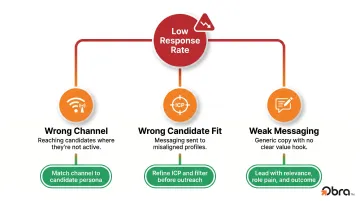
Low response rates usually trace back to one of three causes:
- Wrong channel — the target candidate isn't active where you're reaching out
- Wrong candidate fit — the ICP needs refinement
- Weak messaging — the message isn't specific enough to earn a response
A/B testing subject lines and message frameworks over a 2-3 week window is enough to isolate the variable. Change one element per test cycle, track response rates, and apply what works to every channel in your mix.
Frequently Asked Questions
What is the difference between recruiting and sourcing?
Sourcing is specifically the process of finding and engaging candidates before they apply — it feeds the top of the funnel. Recruiting encompasses the full process: sourcing, screening, interviewing, offer negotiation, and onboarding. Sourcing without recruiting leaves candidates with nowhere to go; recruiting without sourcing limits you to whoever happened to apply.
What is the 70/30 rule in hiring?
The 70/30 rule describes the workforce split: roughly 70% of workers are passive candidates not actively job hunting, while 30% are active seekers. It's a practitioner heuristic, not a formal standard, but it explains why outbound sourcing is necessary to reach the majority of available talent.
What are the most effective candidate sourcing channels?
Effectiveness varies by role and industry, but consistently high-performing channels include LinkedIn outreach, employee referrals, talent pool reactivation, and AI-powered outbound sourcing platforms. Referrals and direct outbound sourcing typically produce the highest quality-of-hire, while job boards generate volume with lower conversion rates.
How do you source passive candidates effectively?
Start with a competency-based candidate profile, then use outbound sourcing platforms or LinkedIn to find verified matches and reach out with personalized messages referencing their specific background. For candidates not ready to move, maintain light-touch periodic outreach until timing aligns.
What metrics should I track to evaluate my sourcing strategy?
Track four: source of hire, response rate on outreach, qualified candidate rate, and pipeline conversion rate from sourced to hired. These together show both the efficiency and the quality of the sourcing effort — volume metrics alone won't tell you whether your sourcing is actually working.
How has AI changed candidate sourcing?
AI has accelerated sourcing through faster database searches, competency-based matching, and automated outreach — but it has also introduced fake AI-generated profiles at scale, with Gartner predicting 1 in 4 profiles could be fraudulent by 2028. Verified data sources and profile filtering are now essential in any serious sourcing stack.