If you're an employer evaluating whether to hire an agency, an HR professional benchmarking your own approach, or a recruiter refining your methods, understanding how sourcing actually works changes how you hire. Not just what you pay for, but what you should demand.
This guide covers the specific methods agencies rely on, why those methods exist, what shapes their effectiveness, and when agency sourcing may not be the right answer for your situation.
TL;DR
- Agencies source from proprietary databases, job boards, LinkedIn, direct headhunting, and AI tools — no single channel dominates
- Their biggest advantage is access to passive candidates — roughly 70% of the global workforce — who will never see your job posting
- Private talent pools built over years contain candidates who have never appeared on any public board
- Sourcing effectiveness depends heavily on role seniority, industry, and the agency's network depth in that specific space
- Knowing this process helps you evaluate whether an agency's sourcing approach fits the role you need filled
What Is Candidate Sourcing in Recruitment Agencies?
Candidate sourcing is the top-of-funnel activity that sits before recruiting — the process of identifying, locating, and initiating contact with potential candidates. It's distinct from recruiting, which covers evaluation, interviewing, and placement. Sourcing ends when a candidate expresses interest and enters the formal process.
Recruitment agencies approach this differently from internal HR teams. Rather than activating sourcing only when a vacancy opens, agencies run continuous sourcing activity across multiple clients and roles simultaneously. They build pipelines before demand exists, which is why an experienced agency can move faster than an in-house team starting from scratch.
That pipeline advantage only holds if sourcing channels are strong. The shortlist an agency delivers depends on channel quality — not just the volume of people contacted.
Why Recruitment Agencies Use Dedicated Sourcing Methods
The core reason is straightforward: the majority of the best candidates for most roles are not looking. According to LinkedIn Talent Solutions, 70% of the global workforce is passive talent — employed professionals who are not browsing job boards and will never see a job posting without being directly reached.
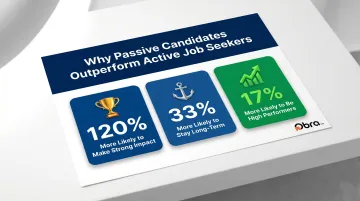
These candidates also tend to perform better. Passive candidates are:
- 120% more likely to make a strong impact at their new company
- 33% more likely to stay long-term
- 17% more likely to be classified as high performers compared to active job seekers
Employers hire agencies specifically because they need speed-to-shortlist, access to candidates outside their own network, and quality filtering before internal time is invested. None of that is achievable by simply posting a job.
Agencies that rely solely on inbound applications face a compounding problem. With job application volumes having tripled since 2017, that candidate pool is crowded — and largely the same pool every competing employer is already reviewing.
How Recruitment Agencies Source Candidates
Agencies use an outbound-first, multi-channel approach. They do not wait for applications. Instead, they actively go out to find, identify, and engage talent through a layered set of methods.
Job Boards and Online Candidate Platforms
Agencies use both generalist boards (Indeed, LinkedIn Jobs) and role-specific niche boards to generate inbound volume for active candidates. This channel works well for:
- High-volume roles with clear, repeatable requirements
- Entry-level and mid-level positions
- Roles where active job-seekers are a genuine fit
The limitation is real, though. Job boards only reach candidates who are actively looking — a minority of the available market. Recruiter-sourced candidates now account for 14% of job offers, double what it was two years ago, while online applications' share of offers has dropped from 73% to 60%. In sectors like IT, referrals and direct recruiter outreach already account for 29% of interviews. Job boards are one layer, not a primary strategy for senior or specialized roles.
Proprietary Talent Databases and Talent Pools
Established agencies maintain private databases built from years of prior placements, past applicants, and direct sourcing activity. This is one of the most significant advantages agencies hold over in-house teams. A strong database means a new role can be matched to candidates who have never been posted to any public board.
These databases aren't static. Agencies actively manage them by:
- Tagging candidates by skills, seniority, industry, and availability
- Re-engaging past candidates when new-fit roles open
- Maintaining ongoing relationships so outreach is warm, not cold
When a role lands, an agency with a well-maintained talent pool isn't starting from zero — they're running a targeted search against years of accumulated sourcing.
Direct Outreach and Headhunting for Passive Candidates
Direct outreach is the primary method for reaching passive candidates and a core competency that separates specialist agencies from generalists. Agencies identify candidates through LinkedIn searches, industry directories, alumni networks, and professional associations, then initiate personalized contact — no application required.
Effective direct outreach at agency level requires more than finding a name:
- Competency-based targeting, not just keyword matching on job titles
- Personalized messaging that references the candidate's background and career trajectory
- Multi-touchpoint follow-up across email, LinkedIn, and phone to achieve meaningful response rates
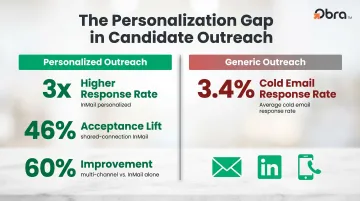
The data on personalization is clear. Personalized InMails generate 3x higher response rates than generic templates, and candidates are 46% more likely to accept an InMail when they share a connection with the recruiter. Multi-channel outreach (LinkedIn + email + phone) improves results by up to 60% compared to InMail alone.
For cold email, signal-based personalized templates average an 18% response rate versus 3.4% for generic outreach. The difference isn't marginal — it's the gap between a productive search and wasted effort.
AI-Powered Sourcing and Technology Tools
Modern agencies increasingly use AI-powered sourcing platforms to search across hundreds of millions of profiles, matching on skills, career progression, and competency signals rather than surface-level keyword matches — reaching candidates no job board ever would.
Platforms like Obra Hire give recruiting teams direct access to 800M+ verified candidate profiles with AI-driven, competency-based matching. Rather than keyword searches that surface whoever used the right resume phrases, Obra Hire uses structured competency data — defining "Must Have" and "Nice to Have" criteria — where Must Haves control who enters the candidate pool and Nice to Haves rank the results.
Recruiters can preview pool size before spending any contact credits, then unlock direct email, phone, LinkedIn URL, and resume for candidates they want to engage. No gatekeepers, no InMail limits.
One issue agencies must now actively navigate: fake and AI-generated candidate profiles are a growing sourcing problem. According to Greenhouse data, 91% of recruiters now report encountering candidate deception, and 34% of recruiters spend up to half their workweek filtering spam or low-quality applications.
Gartner has flagged that 1 in 4 profiles could be AI-generated by 2028. Verified profile filtering — which Obra Hire includes on paid plans — has become a baseline requirement for any serious sourcing operation.
Key Factors That Shape Agency Sourcing Effectiveness
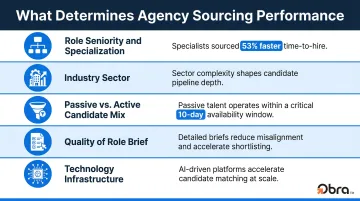
Not all agencies source equally well for all roles. These are the variables that actually determine performance:
- Role seniority and specialization — The more specialized the role, the more the agency's niche network depth matters. Specialist recruiters deliver 53% faster time-to-hire compared to generalist approaches
- Industry sector — Agencies with sector-specific databases outperform generalists for technical or regulated roles. A generalist working a niche role spends roughly 60% of their time on non-sourcing administrative work
- Passive vs. active candidate mix — Senior and niche roles demand higher outbound effort and longer timelines. Top-tier candidates are typically available on the market for only about 10 days, so speed of identification matters
- Quality of the role brief — Vague or shifting requirements directly reduce sourcing precision. Without clear priorities, agencies drift toward candidates who are easier to place — not necessarily the best fit
- Technology infrastructure — Agencies using AI matching and verified profile tools cover more ground with higher accuracy than those relying on manual searches
The employer's engagement matters just as much. Agencies recalibrate their search based on feedback from presented candidates — no feedback means no adjustment, and shortlist quality suffers as a result.
The best agency-sourced hires often come from candidates identified weeks earlier whom the agency nurtured until timing aligned. Sourcing is a process, not a single event.
Common Misconceptions About How Recruitment Agencies Find Candidates
Agencies Post Jobs and Wait for Applicants
Job postings are one input — not the primary one. The majority of quality agency-sourced candidates, especially for senior and competitive roles, come from proactive outbound methods the client never directly sees. According to RecruiterFlow, 63% of agency placements come from existing database data, not LinkedIn or new job board activity.
All Agencies Have Access to the Same Candidates
They don't. Different agencies maintain different proprietary databases, niche networks, and direct relationships built over years. A generalist agency and a specialist boutique in the same sector can differ enormously in sourcing depth.
When evaluating an agency, ask specifically where their candidates for this role type come from — not just what their general process looks like.
Speed of Delivery Equals Quality of Sourcing
Rapid delivery from a poorly targeted channel is less valuable than a smaller shortlist sourced through direct outreach, verified databases, and competency-based matching. Sourcing quality is better measured by conversion rate from shortlist to hire — not by how fast a longlist arrives.
Posting the Job Yourself Gets the Same Results
A job posting reaches people who are actively looking and happen to find your listing. An agency's outbound sourcing reaches people who aren't looking — in talent pools built over years, through personalized outreach a posting can't replicate.
For passive candidates, senior roles, and niche specializations, self-posting typically falls short. Platforms like Obra Hire are narrowing this gap by giving in-house teams direct access to passive candidates — but building that outbound capability still takes consistent investment and time.
Frequently Asked Questions
What is the difference between candidate sourcing and recruiting?
Sourcing is the top-of-funnel process of identifying and engaging potential candidates. Recruiting covers evaluation, interviewing, offers, and onboarding. Sourcing ends when a candidate expresses interest and enters the formal pipeline. Everything after that point is recruiting.
How do recruitment agencies find passive candidates who aren't job searching?
Agencies reach passive candidates through direct LinkedIn outreach, industry directory research, alumni networks, and re-engaging prior candidates from their own databases. AI-powered platforms now let recruiters identify and contact matched profiles at scale, without waiting for anyone to apply.
Do recruitment agencies have access to candidates that employers can't find themselves?
Experienced agencies maintain proprietary talent databases built from years of prior sourcing, along with passive candidate relationships that take time to develop. Modern self-serve platforms like Obra Hire are narrowing this gap by giving in-house teams direct access to 800M+ profiles with outbound search tools, though replicating a specialist agency's network depth still requires significant investment.
How long does it typically take a recruitment agency to source candidates for a role?
For straightforward roles, agencies typically deliver an initial shortlist within one to three weeks. Niche or senior positions requiring deep passive candidate outreach take longer — the timeline depends on role complexity, seniority, and how competitive the candidate market is for that specialization.
Can in-house HR teams replicate recruitment agency sourcing methods themselves?
Yes, many of the same outbound methods are now accessible — particularly through AI-powered platforms, LinkedIn Recruiter, and talent pool management tools. Obra Hire's Scale plan, for example, provides 1,200 contact credits monthly with team collaboration and shared pipelines at $169/month. Building a proprietary network takes time, but in-house teams can run outbound sourcing from day one using the same tools agencies rely on.
What questions should employers ask a recruitment agency about their sourcing process?
Three worth asking directly:
- Where do the majority of your candidates for this role type actually come from?
- How do you source passive candidates beyond job postings?
- What is your process for verifying profiles and filtering out unqualified or fraudulent applications?