
Introduction
The average cost per hire for non-executive roles in the U.S. sits at $5,475 according to SHRM's 2025 Recruiting Benchmarking Report — and that figure excludes post-hire training, productivity ramp time, and the full cost of replacing a bad hire.
Multiply that across ten hires a quarter and you're looking at $54,750 in direct spend before a single new employee reaches full productivity. For CFOs and HR leaders managing headcount growth, that math compounds fast — especially when roles span multiple departments, seniority levels, and timelines.
These costs are not fixed. They're the accumulated result of specific decisions: which sourcing channels you use, how roles are defined, when screening happens, and whether your organization builds structural advantages over time. This article examines where those decisions create waste and what changing them is actually worth.
TL;DR
- Recruitment costs accumulate across sourcing, screening, interviewing, and turnover — most hidden costs only surface once hiring volume scales
- The highest-leverage cost decisions happen upstream: which channels you use, how roles are scoped, and whether your hiring model is built for speed or reaction
- Proactive outbound sourcing converts candidates 5x more efficiently than inbound-only hiring — the clearest high-leverage cost shift available in 2026
- Employer brand, referral programs, and internal mobility reduce paid channel dependency over time
- Cutting costs without cutting quality means redirecting spend toward channels and processes with measurable return
How Recruitment Costs Typically Build Up
Recruitment spend rarely arrives as one visible line item. It builds across multiple functions — sourcing spend, screening hours, interview time — then resets entirely when a hire doesn't work out.
Most teams only notice the scale of it when volume spikes: a sudden resignation, a growth phase that requires ten hires in sixty days, or a new role where three finalists decline the offer. By then, the cost is already embedded.
The Hidden Cost of a Bad Hire
The most significant single cost in recruitment isn't sourcing — it's the mis-hire. SHRM estimates replacement costs at 50–200% of annual salary, with executive roles trending toward the upper end. A 2024 CareerBuilder study found 74% of employers have made at least one bad hire they later regretted.
Process pressure drives most mis-hires. When teams rush to fill a vacancy, job descriptions get vague, screening gets compressed, and structured evaluation gets skipped. The Brandon Hall Group found organizations without a standardized interview process are 5x more likely to make a bad hire.
The compounding effect:
- A $70,000 salary role with a 100% replacement cost equals a $70,000 mis-hire
- Original sourcing costs, lost productivity during the vacancy, and onboarding overhead stack on top
- Real-world total: one wrong hire routinely exceeds $90,000–$100,000
Key Cost Drivers in Recruitment
Sourcing Channel Dependency
Teams that rely exclusively on job boards or staffing agencies pay a structural premium. Agency placements typically run 15–25% of first-year salary — for a $100,000 role, that's $15,000–$25,000 per hire. Job board postings range from $200 to $1,500 per listing, and LinkedIn Recruiter Corporate seats cost $10,800–$15,000 per year per recruiter.
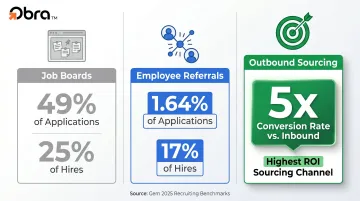
The spend doesn't match the output. According to Gem's 2025 Recruiting Benchmarks Report — covering 140 million applicants — the numbers break down like this:
- Job boards generate 49% of applications but only 25% of hires
- Referrals account for just 1.64% of applications but 17% of all hires
- Outbound sourcing converts candidates at 5x the rate of inbound
Time-to-Hire as a Compounding Cost
Average time-to-hire rose from 31 days in 2023 to 44 days in 2025 (SHRM), with tech roles running 48–89 days. Every open day carries a vacancy cost: an unfilled position costs an estimated $4,129 over a 42-day period, and revenue-generating roles can run $7,000–$10,000 per month in lost output.
The primary driver of lengthening timelines? A 42% increase in interviews per hire between 2021 and 2024 — from 14 to 20 interviews per candidate on average.
Screening Inefficiency and AI-Generated Profiles
Application volume per recruiter surged 2.7x from 2021 to 2024 (925 to 2,479 annually) while recruiter headcount fell 20%. Gartner projects that by 2028, 1 in 4 candidate profiles worldwide will be fake due to generative AI. Separately, 65% of hiring managers already report catching candidates using AI deceptively during the process. Each of these trends compounds screening time — and the cost attached to it.
Cost-Reduction Strategies for Recruitment
Recruitment cost reduction isn't a single fix. The right approach depends on where cost is originating — upstream decisions, active process management, or the broader organizational context around hiring.
Strategies That Change Upstream Decisions
These are choices made before or at the start of a search. They carry the most leverage because they shape every step that follows.
Shift to proactive outbound sourcing. Waiting for inbound applications puts teams at the mercy of paid channels and unfiltered volume. Outbound sourcing, reaching directly into a verified candidate pool, produces fundamentally better funnel economics. Sourced candidates have a 2.0% application-to-hire rate versus 0.4% for inbound (Gem 2025).
Obra Hire gives hiring teams self-serve access to 800M+ verified candidate profiles with AI-powered competency matching, starting at $109/month on the Explore plan — a fraction of a LinkedIn Recruiter Corporate seat at $10,800–$15,000/year.
Match the recruitment model to the role. Common cost drivers include:
- Using an agency for a predictable, repeatable role type better suited to in-house sourcing
- Running an in-house search for an urgent niche role where speed justifies an agency fee
- Applying the same process to both a $45,000 coordinator role and a $150,000 director role
The model mismatch, not the market, is often what inflates spend.
Define role competencies before posting. Vague job descriptions attract high-volume, low-fit applications. A precise, skills-based description tied to clear competency criteria reduces applicant noise, shortens screening time, and improves offer acceptance rates because candidates self-select more accurately.
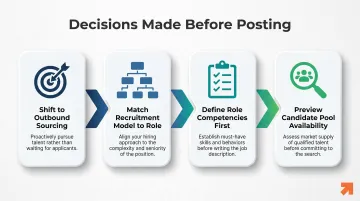
Preview candidate pool availability first. Before committing to a full search or buying job board exposure, validate whether a qualified pool exists. Obra Hire's pool preview feature shows the estimated candidate count and individual profile previews before any credits are spent — so teams can refine criteria or adjust expectations without wasting sourcing budget.
Strategies That Improve Process Management
These reduce cost per hire through better control and consistency while a search is active.
Automate screening and filter unverified profiles. With AI-generated applications flooding inbound funnels, manual review of every submission is no longer viable at scale. Obra Hire's verified profile filtering and competency-based matching (using structured criteria rather than keyword text-matching) ensures teams are evaluating real candidates whose actual skills align with role requirements.
The "Must Have" and "Nice to Have" framework filters the pool first, then ranks results by fit.
Build and maintain a talent pipeline. Starting every search from scratch is expensive. Teams that consistently maintain warm candidate contacts — from previous searches, past applicants, and passive conversations — shorten time-to-fill and reduce sourcing costs when roles open. A pipeline built over six months across ten searches becomes a meaningful asset.
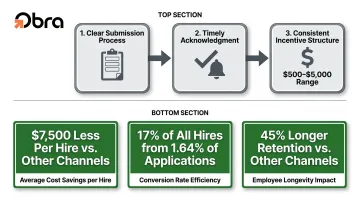
Run a structured referral program. Employee referrals account for 17% of all hires despite just 1.64% of applications. Referred candidates cost roughly $7,500 less per hire in sourcing and productivity costs (ERIN, 2024) and stay 45% longer than hires from other channels. A functional referral program requires three things:
- A clear, simple submission process
- Timely acknowledgment of referrals (even rejections)
- Consistent incentive structure ($500–$5,000 based on role seniority)
Reduce offer rejection and candidate drop-off. Poor hiring experiences multiply cost. A candidate who withdraws two weeks into your process requires restarting the search with the same spend already sunk. Structured communication, clear timelines, and prompt feedback loops reduce this directly.
Strategies That Change Organizational Context
These are structural changes that make every subsequent hire cheaper over time.
Invest in employer branding. Organizations with a strong employer brand see up to a 50% reduction in cost-per-hire and attract 50% more qualified applicants (LinkedIn Talent Solutions). The mechanism is organic inbound interest, which reduces dependence on paid job ads and cold outreach over time. Careers pages, employee content on LinkedIn, and consistent culture messaging each reduce what the next hire costs — without additional spend per role.
Prioritize internal mobility. It costs 3–5x more to hire externally than to move someone internally (Josh Bersin). Internal candidates represent only 0.27% of applications but generate 12.56% of hires — the highest conversion rate of any channel. A simple internal mobility program requires only three things: transparent internal postings, manager alignment, and a backfill plan for the vacated role.
Consolidate recruiting tools. Many teams pay for overlapping sourcing, screening, and contact tools — often per-user — without centralizing usage. Obra Hire's Scale plan ($169/month) pools contact credits across the entire team under one account. When one team member reveals a candidate's contact details, those details are visible to the whole team, eliminating the duplicate purchases that occur when recruiters independently access the same candidate on a per-seat platform.
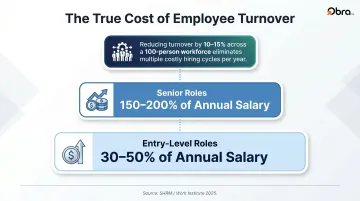
Improve retention to reduce replacement volume. Turnover triggers the most expensive recruitment events. The Work Institute's 2025 Retention Report found 76.3% of all employee exits in 2024 were preventable, with career development (18.9%) as the top driver. Key cost benchmarks:
- Entry-level replacement: 30–50% of annual salary
- Senior role replacement: 150–200% of annual salary
- Reducing turnover by 10–15% across a 100-person workforce eliminates several full hiring cycles per year
Conclusion
Reducing recruitment costs requires knowing where cost originates — not applying uniform cuts to sourcing spend or eliminating process steps that serve quality.
The clearest pattern across the data: organizations that structure their hiring around outbound sourcing, referrals, internal mobility, and verified candidate pools spend less per hire because they've reduced their structural dependence on expensive channels. Employer brand and retention work in the same direction — they lower hiring volume and paid channel dependency over time.
What happens before a search begins matters as much as the search itself. Teams that audit their channel mix, reduce inbound dependency, and build outbound infrastructure — through platforms like Obra Hire or structured referral programs — tend to hire faster and spend less, consistently. That consistency is the goal.
Frequently Asked Questions
Which recruitment method is most cost-effective?
No single method works for every role. Employee referrals and outbound sourcing consistently deliver the lowest cost-per-hire — referrals run roughly $7,500 less per hire and convert 10x better than typical inbound applicants. Agencies carry higher fees but may be worth it for niche or time-sensitive roles; match the method to role type and hiring volume.
What is the average cost per hire in 2026?
SHRM's 2025 Benchmarking Report sets the U.S. average at $5,475 for non-executive roles, with manager and director roles ranging $6,000–$15,000 and executive searches reaching $50,000+. These figures cover recruiter time, job board spend, and agency fees — but typically exclude productivity ramp and internal time opportunity costs.
What hidden costs should companies track in recruitment?
The most commonly overlooked costs include:
- Recruiter and hiring manager time — managers spend roughly 13% of their time on hiring tasks
- Extended vacancies — $4,129+ per open role over 42 days
- Mis-hire replacement — 50–200% of salary to re-fill a failed hire
- AI-generated applicant screening — growing labor cost as fake profiles increase
How do employee referrals reduce recruitment costs?
Referrals cut sourcing spend, compress screening time (employees pre-qualify cultural and skills fit), and produce faster offers. Referred hires also stay 45% longer than candidates from other channels, reducing re-hiring frequency — a compounding cost benefit most organizations underestimate.
How can AI tools reduce recruitment costs without sacrificing quality?
AI reduces cost by automating initial screening, filtering verified and competency-matched candidates, and eliminating time spent on low-fit or fake profiles. Quality is preserved when AI works from structured competency criteria — not keyword matching — so it filters by actual fit rather than resume text similarity.
When does it make sense to switch from inbound to outbound hiring?
Outbound makes sense when inbound volume is high but quality is low, when roles require specific skills passive candidates hold, or when job board spend is rising without better hire quality. Outbound sourcing gives recruiters direct access to qualified candidates and converts at 5x the rate of inbound applicants.