Introduction
Hiring has never been cheap — but it's getting more expensive every year, even as the labor market cools. According to SHRM's 2025 Benchmarking Report, the average cost per hire for non-executive roles now sits at $5,475, up from $4,700 in prior cycles and $4,129 before that. Executive hiring averages $35,879 — a 113% increase since 2017.
Those figures only capture what's easy to invoice. Job board fees and agency costs show up in the budget — but recruiter hours, hiring manager time, and the productivity gap left by an open role rarely do. Those hidden costs frequently exceed the visible ones.
This article breaks down what hiring actually costs in 2026, what's driving prices up, how to calculate your own cost per hire, and where to cut spending without cutting corners on your hiring pipeline.
TL;DR
- Average cost per hire: $5,475 for non-executive roles, $35,879 for executives (SHRM 2025)
- Indirect costs (recruiter time, onboarding, productivity ramp) represent 60–70% of total hiring spend — far outweighing job ads and agency fees
- Executive search fees typically run 25–35% of first-year compensation — higher than most budget assumptions
- The highest-ROI cost-reduction moves: outbound sourcing, structured interviewing, and employee referral programs
How Much Does It Cost to Hire an Employee in 2026?
There's no single number. Cost per hire shifts based on role type, seniority, industry, and how you source candidates. Teams that don't account for this variation end up underbudgeting and scrambling post-offer.
The SHRM baseline of $5,475 is useful context, but it masks wide variation. Appcast's 2026 Recruitment Marketing Benchmark Report found cost-per-hire rose another 6% in 2025 — not because of a tighter labor market, but because of structural cost inflation in job board pricing. Recruiter workloads are up 93% year-over-year, partly driven by AI-generated applications flooding inbound pipelines.
Cost Ranges by Role Type
| Role Tier | Estimated CPH Range | Notes |
|---|---|---|
| Entry-level / high-volume (retail, customer support) | $2,000–$3,000 | Lower sourcing cost; volume strains resources |
| Mid-level professional (marketing, software, ops) | $4,000–$6,000 | Closest to SHRM average |
| Technical / engineering | $6,200–$8,000 | Longer sourcing cycles, competitive market |
| Senior / director-level | $10,000–$20,000 | Often requires agency involvement |
| Executive (C-suite) | $35,879 average | Agency fees alone can exceed $75,000+ |
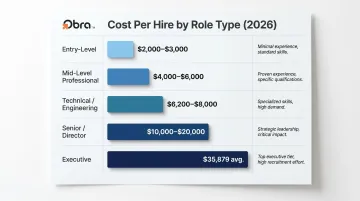
Executive search fees deserve particular attention. The commonly cited 15–25% range is outdated — current authoritative sources place retained executive search fees at 25–35% of first-year total compensation. On a $300,000 package, that's $75,000–$105,000 in agency fees alone, before any internal costs.
How to Calculate Your Cost Per Hire
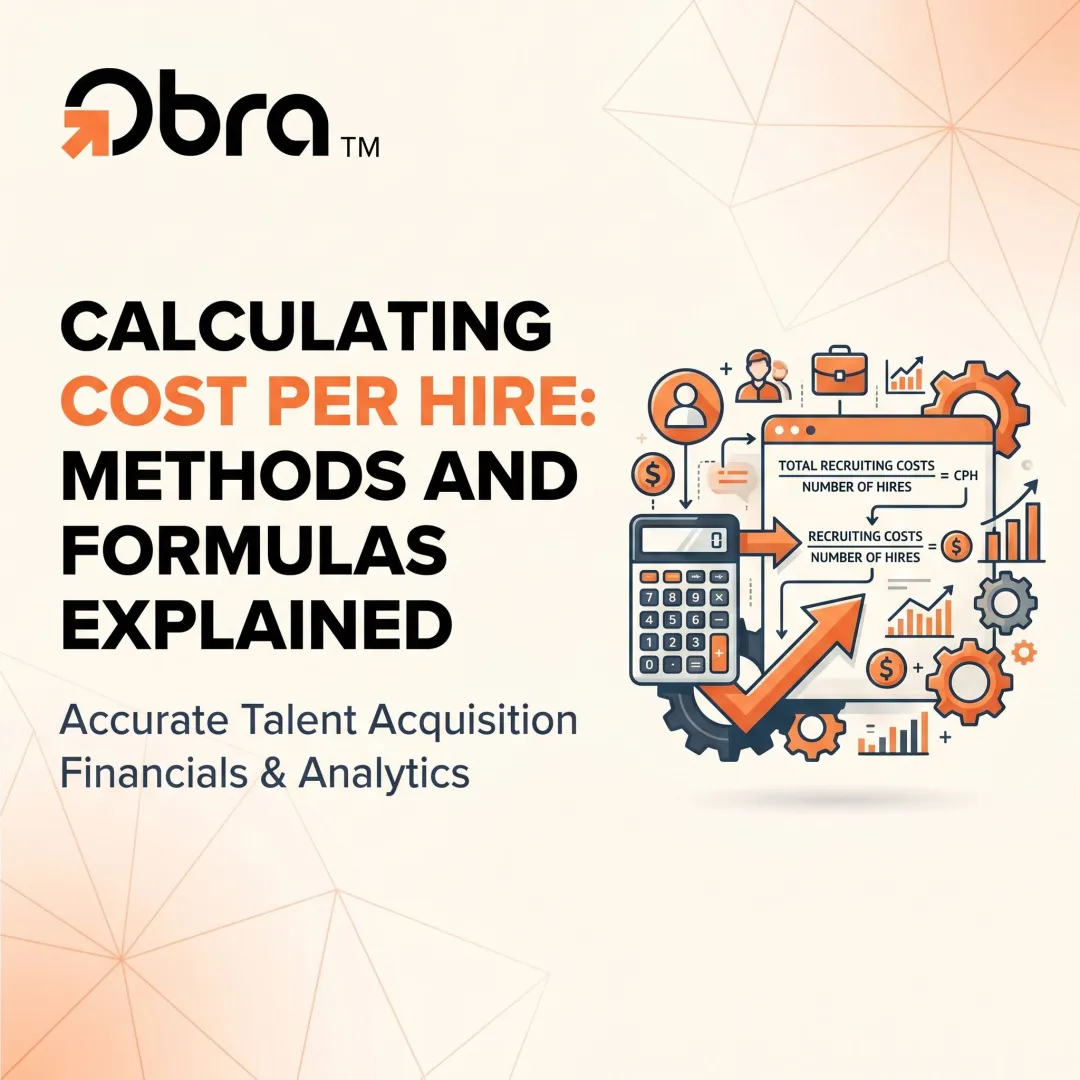
The standard formula:
(Total Internal Costs + Total External Costs) ÷ Number of Hires
A simple example: if a company spends $75,000 on all recruiting activities and makes 15 hires in a quarter, the cost per hire is $5,000.
Calculate quarterly — it's frequent enough to surface trends before they become budget problems. Then segment by department, role level, and sourcing channel. A single company-wide CPH hides which teams are efficient and which are bleeding budget.
One factor that shifts CPH significantly: sourcing strategy. Outbound approaches — reaching passive candidates directly rather than waiting on inbound applications — tend to compress both time-to-fill and cost, particularly for mid-level and technical roles.
Full Cost Breakdown: Direct and Indirect Hiring Costs
Most hiring budgets track the invoices. That's the problem. Direct (hard) costs are easy to quantify — but indirect (soft) costs represent approximately 60–70% of total hiring spend, according to SHRM. Ignoring them means you're managing less than half the picture.
Direct (External) Hiring Costs
These are the line items that show up on credit card statements:
- Job board advertising: LinkedIn contract postings run $200–$1,000/month per slot; ZipRecruiter Standard plans cost $299–$399/month per job slot
- Staffing agency or recruiter fees: 25–35% of first-year compensation for executive roles; 15–20% for mid-level contingency placements
- Background checks: $20–$40 for basic screening; $100+ for comprehensive checks; employment/education verification adds $15–$25 each
- ATS software: $250–$3,000/month depending on platform and team size (prorated per hire based on volume)
- Relocation packages: Average $21,792 for renters, $63,685 for homeowners relocating domestically
- Employer payroll taxes: The IRS confirms the employer FICA obligation at 7.65% of base wages (6.2% Social Security + 1.45% Medicare, with a $184,500 Social Security wage base in 2026) — on a $60,000 salary, that's $4,590 before any state-level taxes
Indirect (Internal) Hiring Costs
These don't generate invoices, but they're real:
- Recruiter and HR staff time: Convert hours to dollar value using hourly rate — a recruiter at $35/hour spending 40 hours on a single role adds $1,400 in internal labor cost
- Hiring manager and interviewer time: Intake calls, resume review, and interviews accumulate fast across multi-round processes
- Onboarding support: Manager and peer hours spent in training sessions, shadowing, and daily check-ins — often 10–20 hours in the first 30 days alone
- Equipment and software setup: Hardware, software licenses, and system access typically run $1,000–$2,500 per new hire depending on role requirements
These internal costs add up — and the meter keeps running after day one. Gallup's onboarding research finds that new employees typically take approximately 12 months to reach full performance potential. During that ramp-up, they cost more than they produce. Vacancy losses run an estimated $500 per day for standard roles and up to $10,000 per month for revenue-generating positions.
What a Mid-Level Hire Actually Costs
Aggregating common line items for a single mid-level hire (no agency):
| Line Item | Estimated Cost |
|---|---|
| Recruiter time (40 hrs @ $35/hr) | $1,400 |
| Job board advertising | $600 |
| Hiring manager interview time (8 hrs) | $480 |
| Background check | $100 |
| Equipment/software setup | $1,500 |
| Onboarding support (manager + peers) | $800 |
| Productivity ramp (partial, first 3 months) | $5,000+ |
| Total | ~$9,880+ |
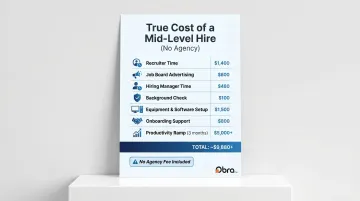
That's nearly $10,000 without a single agency fee.
Key Factors That Affect the Cost of Hiring
Cost per hire isn't fixed — it responds to real operational decisions. Understanding the variables helps you spend where it matters and cut where it doesn't.
Role Seniority and Specialization
Senior and specialized roles — tech, healthcare, legal, executive — require longer sourcing cycles, more interview rounds, and often agency involvement. Those factors compound. A healthcare hire that takes 60 days generates twice the internal labor cost of one that closes in 30.
Entry-level, high-volume roles have lower per-hire costs in isolation, but running 50 of them simultaneously strains recruiting infrastructure in ways that inflate total recruiting costs.
Company Size and Hiring Volume
Larger organizations spread fixed recruiting infrastructure costs across more hires, driving down the per-hire average. Smaller businesses absorb the same fixed costs across fewer hires. The numbers reflect this: smaller organizations average approximately $3,500 per hire, while enterprises with 1,000+ employees average $5,500. Enterprise companies also fill roles faster — 35 days on average versus 46 days for SMBs — pointing to real efficiency gains from scale.
Hiring Channel and Sourcing Model
The inbound vs. outbound distinction matters more in 2026 than it did two years ago. According to StaffingHub, 67% of HR leaders report that AI-generated applications are slowing down their hiring process, and approximately 70% of job seekers admit to using AI to inflate their resumes. Teams relying on inbound job postings are sifting through larger, lower-quality applicant pools — adding screening time and cost.
Alternatives that reduce this overhead include:
- Outbound sourcing — proactively finding and contacting passive candidates
- Employee referrals — typically faster to close and cheaper to source
- Direct sourcing platforms — reduce dependence on expensive intermediaries
Time-to-Fill and Urgency
Channel inefficiency feeds directly into fill times. The median time-to-fill has risen to 44 days, up from 31 days in 2023. Every additional week a role stays open adds recruiter hours, hiring manager time, and widens the productivity gap. Urgent hires compound the problem — pressure to fill fast pushes teams toward premium channels like agencies and sponsored listings, which carry the steepest per-hire fees. Senior leadership roles average 60–90 days to fill.
How to Reduce Your Hiring Costs in 2026
Lower cost per hire doesn't mean cheaper candidates — it means reaching the right people faster through smarter channels.
Shift From Inbound to Outbound Sourcing
Waiting for applications is expensive in 2026. The average role receives over 300 applications, with only 0.5% of applicants typically receiving an offer. Screening that volume consumes significant recruiter time, and a growing share of those applications are AI-generated.
Proactive outbound sourcing targets pre-vetted, passive candidates before they apply anywhere, cutting screening time, agency reliance, and time-to-fill at once. Tools like Obra Hire give hiring teams direct access to 800M+ verified candidate profiles with AI-powered competency matching.
Rather than posting and waiting, teams describe their ideal candidate (or paste a job description) and get ranked, skill-matched results. Built-in verified profile filtering screens out AI-generated and fake profiles, a real advantage as Gartner estimates 1 in 4 profiles could be fake by 2028.
For teams making 10 hires on the Scale plan at $169/month, the prorated platform cost per hire works out to roughly $16.90 — compared to agency fees that can run $9,000–$15,000 per mid-level placement.
Strengthen Employee Referral Programs
Referral hires consistently outperform other sourcing channels on retention. According to iCIMS data:
- Referred employees stay an average of 38 months vs. 22 months for non-referral hires
- Referral hires show a 45% two-year retention rate, compared to just 20% for job board hires
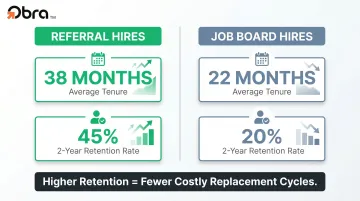
Higher retention directly reduces the frequency of costly replacement cycles.
Build Talent Pipelines
Keep "silver medalist" candidates — finalists who weren't selected — in an active pipeline. These candidates are pre-screened, already interested in the company, and can significantly reduce time-to-fill (and associated cost) when a similar role opens.
Reduce Mis-Hires with Structured Interviewing
Replacing a bad hire can cost 1.5–2x the employee's annual salary for mid-to-senior roles. Structured interviews use consistent, scored questions across all candidates and are approximately 34% more predictive of job performance than unstructured interviews, according to Schmidt and Hunter's meta-analysis. Training hiring managers on structured interviewing is one of the most cost-effective improvements you can make.
What Most Employers Get Wrong About Hiring Costs
Knowing what hiring costs is only useful if you're tracking the right things. A few patterns show up repeatedly in how companies miscalculate or mismanage hiring spend:
Visible costs get tracked; hidden ones don't. Job board invoices and agency fees show up in the budget. Recruiter hours, manager interview time, and onboarding support — which represent 60–70% of total spend — rarely do. That's why hiring costs keep climbing without an obvious explanation.
Cost-per-hire gets optimized; quality doesn't. A $3,000 hire who leaves in 90 days or underperforms for a year easily doubles or triples total cost compared to a $6,000 hire who reaches full productivity in two months and stays for four years. SHRM has noted that recruiting, hiring, and onboarding a single bad hire can reach $240,000 when all downstream impacts are included.
Slow processes look free; they aren't. Every week a role stays open adds internal cost, extends the productivity gap, and increases the odds of losing finalists to employers who move faster. At $500/day in vacancy losses for standard roles, a two-week delay costs $7,000 before anyone even receives an offer.
Frequently Asked Questions
What is the average recruiting cost per hire?
SHRM's 2025 Benchmarking Report puts the average at $5,475 for non-executive roles and $35,879 for executives. Those figures capture direct and indirect costs — when you factor in soft costs (manager time, onboarding, productivity ramp), the true all-in number can easily double.
How much does a recruiter charge per hire?
External staffing agencies typically charge 25–35% of the placed candidate's first-year compensation for executive and senior roles; contingency fees for mid-level roles generally run 15–20%. Internal recruiter costs are calculated by converting hours spent per hire into a dollar value based on the recruiter's hourly rate.
What is the average cost per hire by industry?
Industries with high-volume entry-level roles run lower — retail and hospitality average around $2,700 per hire. Healthcare runs $9,000–$12,000, technology roles $6,200–$8,000, skilled trades $12,000+, and legal/professional services $16,000–$20,000. Healthcare cost-per-application reached $78.12 in 2025, compared to $21.45 for office-based roles.
What are the 5 C's of hiring?
One common practitioner framework uses Competency, Character, Culture Fit, Chemistry, and Commitment — though variations exist (some substitute "Capacity" for "Chemistry"). Applying any consistent multi-dimensional screening framework reduces poor-fit hires and the turnover costs that follow.
Is it cheaper to keep an employee or hire a new one?
Retention is nearly always more cost-effective. Replacing an employee costs a median of 21% of annual salary for standard roles, rising to over 200% for executives, according to a Center for American Progress meta-analysis.
How long does it take for a new hire to become fully productive?
Gallup's research indicates new employees take approximately 12 months to reach full performance potential, depending on role complexity. That ramp-up period represents a real, ongoing cost — in lost output and in the time colleagues invest in training — so factor it into every cost-per-hire calculation.