This isn't a talent shortage story — it's a process problem. Most hiring teams apply the same reactive, inbound-dependent approach to specialized tech roles that they use for everything else. That doesn't work when the candidates you need aren't browsing job boards.
This article covers five practical strategies for cutting time-to-hire on roles that resist the standard playbook: outbound sourcing, job description quality, skills-based screening, process automation, and proactive pipeline building.
TL;DR
- Passive, qualified tech candidates don't browse job boards — you have to reach them directly through outbound sourcing
- Specialists ignore generic job descriptions. Name the actual tech stack and the real problem they'll own.
- Keyword resume screening creates false positives and false negatives. Competency-based assessment filters for actual fit.
- Top candidates leave the market within 10 days — your process needs automation and clear communication to stay competitive
- Start building your talent pipeline before a role opens and cut future time-to-hire by up to 40%
Why Hard-to-Fill Tech Roles Resist the Standard Hiring Playbook
The Time and Cost Problem
Not all tech roles are equally hard to fill. A frontend engineer role closes in roughly 42 days — close to the all-industry average. But an AI/ML engineer search averages 89 days, more than double the national benchmark, according to the SHRM 2025 Recruiting Benchmarking Report.
The financial stakes compound quickly. An unfilled tech role costs approximately $500 per day in lost productivity. Applied to common vacancy lengths:
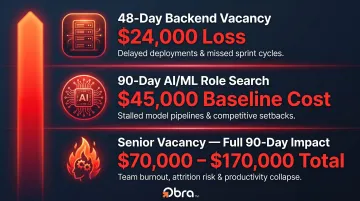
- 48-day backend engineer vacancy: ~$24,000 in productivity losses
- 90-day AI/ML search: ~$45,000 baseline cost
- Total impact of a senior tech vacancy at 90 days (including burnout, secondary departures, delivery delays): $70,000–$170,000
That's before you factor in the human cost. SHRM research found that 36% of employees report heavier workloads due to unfilled positions on their teams — and 61% of those affected experience burnout, making them nearly three times more likely to leave.
The Inbound Trap
Those costs assume you're at least reviewing real candidates. For most specialized tech roles, that's not the case.
When a specialized role gets posted, it typically attracts hundreds of applications — almost none from genuinely qualified people. Recruiters spend days sorting noise instead of talking to real prospects.
The signal-to-noise ratio has gotten dramatically worse. Gartner projects that by 2028, 1 in 4 job candidates globally will be fake — using AI tools to fabricate credentials and generate employment histories. CNBC reported on specific incidents, including a candidate at voice authentication startup Pindrop Security who used deepfake software during a live senior engineering interview.
For specialized tech roles, the inbound model was already slow and inefficient. AI-generated applications have turned a manageable problem into an active liability — and most hiring teams are still running the same playbook.
Shift From Inbound to Outbound Sourcing
Why Passive Candidates Are the Real Target
Approximately 70–73% of professionals are passive candidates — employed, not actively job hunting, but potentially open to the right opportunity. That means the most qualified people for your hardest roles will never show up in your application queue, no matter how good your job posting is.
For hard-to-fill tech roles, this isn't a minor gap. It's structural. You cannot inbound your way to a DevOps engineer with cloud security experience or an AI/ML engineer with production deployment history. Those people aren't looking — but that doesn't mean they're unavailable.
The Outbound Sourcing Workflow
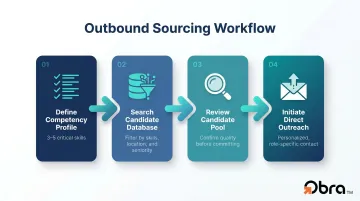
Outbound sourcing flips the model: instead of posting and waiting, you identify and contact candidates who match the role. Done well, this compresses what normally takes weeks into hours:
- Define the competency profile — identify the 3–5 skills that actually determine success in the role, including proficiency level requirements
- Search a candidate database — filter by those competencies, location, seniority, and relevant experience
- Review the candidate pool — confirm the pool size and quality before committing
- Initiate direct outreach — contact matched candidates directly with personalized, role-specific messages
This approach also sidesteps the AI-generated applicant problem. You're reaching out to verified profiles you've selected — not sorting through a flood of inbound submissions.
Obra Hire is built specifically for this workflow. The platform provides access to 800M+ candidate profiles, AI-powered competency-based matching, and the ability to preview a candidate pool before spending any contact credits. For lean hiring teams that don't have a dedicated sourcing function, that removes the upfront infrastructure barrier that makes outbound feel out of reach.
Write Job Descriptions That Actually Attract Specialists
Even with an outbound strategy, job descriptions matter — for direct outreach messaging, for candidates who do engage with your brand, and for the quality of your initial competency brief.
The common mistake: writing a job description as a checklist of requirements rather than a case for why a strong candidate should care. Specialists with in-demand skills have options. A wall of bullet points doesn't differentiate you.
What Specialist-Focused Job Descriptions Include
- Specific tech stack and architecture — not "experience with cloud" but "AWS infrastructure on ECS with Terraform, moving toward platform-level standardization"
- The actual problem the hire will own — what breaks today, what they'll build, what success looks like in 6–12 months
- Team context — how this role interacts with other engineers, who they report to, what the code review culture looks like
- Honest trade-offs — if the codebase has legacy debt, say so; specialists respect transparency
Well-structured, detailed job descriptions produce 35% faster hiring cycles — because they reduce unqualified applicants and give candidates enough information to self-select accurately.
That self-selection only works if the posting doesn't filter out strong candidates before they apply. Drop rigid degree requirements. For roles in AI engineering, MLOps, or cloud security, the strongest candidates are often self-taught, bootcamp-trained, or certification-credentialed. In 2024, 45% of active tech job postings didn't require a four-year degree — yet many teams still screen by credential and lose the candidates they'd actually want to hire.
Replace Keyword Screening With Skills-Based Assessment
Why Keyword Screening Fails Tech Roles
A resume keyword match tells you a candidate typed a tool name somewhere on their CV. It tells you nothing about proficiency level, context, or whether they can actually use it under pressure.
The result: false positives (candidates who list a technology but can't use it) and false negatives (strong candidates who used different terminology or worked at companies that didn't emphasize labeling). Both failures waste time — in opposite directions.
81% of employers now report using some form of skills-based hiring, according to TestGorilla's 2024 report. But Harvard Business School research found only 37% of firms actually changed their hiring behavior after committing to it. The gap between policy and practice is where most time-to-hire problems live.
What Competency-Based Hiring Looks Like in Practice
Instead of filtering for keyword presence, define what the role requires at a specific proficiency level, then evaluate candidates against those competencies directly.
For sourcing, this means searching by competency rather than job title. Obra Hire searches structured competency data rather than raw resume text, returning ranked results with a clear breakdown of where each candidate meets "must have" and "nice to have" criteria. Paste a job description or describe the role in plain language, and you get back a prioritized list based on actual skill alignment.
For screening, the goal is a lean technical assessment focused on the 2–3 competencies that are hardest to train for:
- Async coding exercises scoped to 45–60 minutes, targeting the specific skills that matter most
- Short technical calls (20–30 minutes) with a relevant engineer, not a generic competency screen
- Portfolio or contribution reviews: GitHub history, open source work, or past project walkthroughs
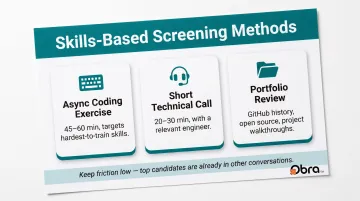
Keep friction low. The candidates you want most are already in active conversations elsewhere — a 5-hour take-home is usually a fast path to losing them.
Speed Up Your Pipeline With Automation and Transparent Communication
The 10-Day Window
Top candidates are off the market within 10 days of becoming available. Many companies take over 27 days to extend an offer. That gap is where good candidates go.
Robert Half research found that 57% of workers lose interest in a role if they haven't heard from an employer within 10 business days. Among those who feel ignored, 21% would blacklist the employer entirely.
For tech candidates fielding multiple conversations simultaneously, response time and process velocity aren't just nice to have — they're decisive.
Where Automation Fits
Tech-savvy candidates understand and appreciate efficient workflows. Automating the administrative layer doesn't feel impersonal; it signals that your organization runs well.
Automate these touchpoints:
- Interview scheduling — eliminate the back-and-forth that causes 42% of candidate drop-off, per Cronofy's 2024 data
- Stage transition updates — confirm next steps immediately after each round
- Task reminders — nudge candidates on assessment completion or background forms
- Status updates — keep candidates informed between stages, even when there's no decision yet
This frees up recruiter bandwidth for the touchpoints that actually convert: a personalized note from the hiring manager, a peer call with a future teammate, or a well-timed offer conversation.
Radical Transparency as a Speed Lever
Automation handles the mechanics — transparency handles the anxiety. Candidates who know exactly what to expect are far less likely to disengage or accept a competing offer mid-process.
Set expectations from the first touchpoint:
- How many interview rounds and who they'll meet
- What each round involves (technical screen, case study, panel)
- The expected timeline from first call to offer
- Exactly when they'll hear back after each stage
Candidates who receive this information upfront move through your pipeline with confidence — and stop shopping elsewhere while they wait.
Build a Proactive Talent Pipeline Before the Vacancy Hits
Most companies start sourcing when a role opens. For hard-to-fill tech roles, that means starting from zero under time pressure — which is exactly when you can least afford it.
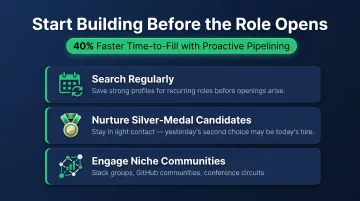
Research suggests proactive talent pipelining can deliver 40% faster time-to-fill and 30% lower hiring costs compared to reactive approaches. In one widely cited example, a Fortune 500 tech company cut average fill time from 212 days to 48 days after building out a structured pipeline program.
What Proactive Pipelining Looks Like
- Search regularly for roles you hire repeatedly — senior engineers, security analysts, data scientists — and save strong profiles even when there's no active opening
- Stay in light contact with silver-medal candidates — someone who was second choice six months ago may be the right hire today
- Engage communities where niche talent congregates — specific Slack groups, GitHub communities, conference circuits for your technical domains
This doesn't require a large recruiting team. Obra Hire's pipeline management tools let teams organize candidates by role, assign collaborators, and track outreach status — and you don't spend contact credits until you're ready to reach out.
A lean HR team can realistically maintain pre-qualified candidate lists across multiple role categories without significant overhead.
When a vacancy opens, you're not starting from zero. You're starting with a shortlist.
Frequently Asked Questions
Which tech role is growing fastest?
Information security analysts are projected to grow 29% between 2024 and 2034, with software developers at 16% — both classified as "much faster than average" by the BLS. AI/ML engineering demand is outpacing supply even faster, making these roles the hardest to fill consistently.
What is a realistic time-to-hire for specialized tech roles?
The U.S. average across all positions is 44 days, but tech-specific roles run significantly longer — DevOps engineers average 60 days, AI/ML engineers average 89 days. Use those benchmarks to measure your own process and pinpoint where delays occur.
What's the difference between active and passive tech candidates?
Active candidates are applying now; passive candidates are employed but open to the right opportunity. For most hard-to-fill tech roles, the strongest candidates are passive — reachable only through direct outreach, not job postings.
How does outbound hiring differ from posting a job and waiting?
Outbound hiring means proactively identifying and contacting candidates who fit the role, rather than waiting for applications to arrive. It's the difference between targeting specific profiles based on defined competencies and sorting through an unpredictable inbound applicant pool.
What is competency-based hiring and why does it matter for tech roles?
Competency-based hiring evaluates candidates against specific, defined skill proficiencies — rather than resume keywords or credential proxies. It matters in tech because the same job title can represent wildly different actual capability levels, and keyword screening can't tell the difference.
How can smaller companies compete with large tech firms for niche talent?
Move faster — fewer interview rounds and quicker decisions matter more than brand recognition to most candidates. Offer meaningful work and real autonomy, which larger companies often can't. And use outbound sourcing tools that give direct access to the same candidate pool as enterprise recruiting teams, without the enterprise budget.