Introduction
The CTO sends a Slack message on Tuesday: "We need an ML engineer with distributed systems experience and solid AWS infrastructure background. Yesterday would've been great." The recruiter opens the ATS. There are 47 applications — none of them close.
This is the default state for most tech hiring teams. The problem isn't recruiter effort. It's that top ML engineers, cloud architects, and DevSecOps specialists aren't sitting in application queues. According to the 2024 Stack Overflow Developer Survey, 84% of developers are already employed — meaning the talent you need most is almost never actively looking.
The answer isn't moving faster on inbound — it's building a pipeline before the role opens.
This guide covers how to design, source, build, and measure a pipeline built specifically for technical roles — and why the generic playbook consistently falls short when you're hiring for niche, high-stakes engineering positions.
TL;DR
- Reactive tech hiring costs more time, money, and quality — building a pipeline in advance changes that equation entirely
- Effective pipelines are built on competency-based role profiles, not just job titles
- Most qualified tech candidates are passive; source them outbound rather than waiting for applications
- Internal mobility and upskilling are critical pipeline sources that most teams consistently underuse
- AI tools can scale sourcing fast — but only verified candidate data keeps that speed from backfiring
Why Tech Talent Pipelines Are Different (and Why Reactive Hiring Fails)
Technical roles don't behave like other hiring categories. Three dynamics make them uniquely difficult.
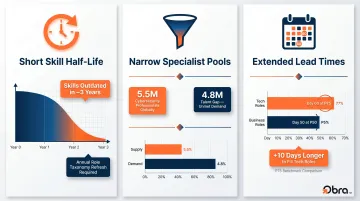
Skills have a short half-life. A cloud engineer's stack from three years ago may no longer match what your infrastructure team runs today. McKinsey has documented how shortening innovation cycles drive rapid change in tech skill requirements within roles. Role taxonomies need annual refreshes, not triennial ones.
Specialist pools are genuinely narrow. The ISC2 2024 Cybersecurity Workforce Study documents a global security workforce of approximately 5.5 million professionals — with a gap of 4.8 million unfilled roles. For roles like AI safety engineer, cloud security architect, or MLOps specialist, no amount of faster screening fixes a talent pool that's simply thin.
Lead times stretch when you're not ready. Ashby's 2026 Talent Trends Report, based on 109 million applications and 247,000 jobs, shows technical roles hit the 75th-percentile time-to-hire at day 60 versus day 50 for business roles. When urgency hits, you're starting from behind.
The "Talent Debt" Problem
There's a longer-term risk most hiring teams miss entirely. When organizations cut junior tech roles — increasingly common as AI handles rote coding tasks — they hollow out the pipeline that produces mid-level engineers two to three years later.
Today's staff engineer was yesterday's junior dev. MIT researcher Andrew McAfee has warned that automating away entry-level work risks breaking the apprenticeship ladder that builds technical depth over time.
A tech talent pipeline is something specific: pre-qualified candidates, competency-matched to defined role families, with relationships already in progress. That's fundamentally different from a broad, unfiltered talent pool.
The pipeline is a long-term asset. If you're building it in response to the CTO's Tuesday Slack message, you've lost the time advantage that makes it valuable.
How to Build Your Tech Talent Pipeline: A Step-by-Step Framework
Steps 1–2: Define and Plan
Step 1 — Build competency-based candidate profiles.
Job titles alone are useless anchors for a tech pipeline. "Software Engineer" could describe a hundred different people with zero overlap in actual skill sets.
Define role profiles around:
- Specific technical skills (Python + distributed systems + cloud infrastructure, not just "backend experience")
- Seniority indicators based on demonstrated capability, not years on a resume
- Non-negotiable vs. nice-to-have competencies, clearly separated
Drop credential-based filters like degree requirements and blanket experience thresholds. What matters is whether someone can do the work.
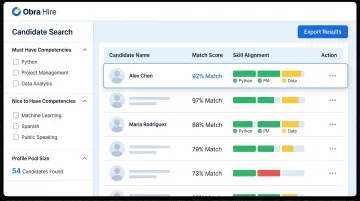
Obra Hire's search interface structures this directly — you define "Must Have" criteria that control who enters the candidate pool and "Nice to Have" criteria that rank and sort results. This forces the discipline of separating requirements from preferences before you start burning time.
Step 2 — Map hiring to the product roadmap.
If the engineering roadmap calls for an ML feature in Q3, the pipeline for ML engineers needs active building in Q1. Not Q2. Not when the sprint kicks off.
Embed talent acquisition into roadmap planning cycles. Ask engineering leadership: what capability gaps will appear in two quarters? Which roles have 3–6 month lead times given how narrow the pool is?
Treat forecasted headcount the same way you'd treat forecasted infrastructure costs — plan ahead, not after the fact.
Steps 3–5: Engage, Manage, and Refine
Step 3 — Segment pipelines by role criticality.
Not all pipelines need equal investment. Classify roles into three buckets:
| Role Type | Example | Pipeline Approach |
|---|---|---|
| High-volume | Full-stack engineers | Scale top-of-funnel outreach |
| Niche | Cloud security architects | Proactive outbound, longer relationship-building |
| Emerging | AI safety engineers | Community-first, educate and develop |
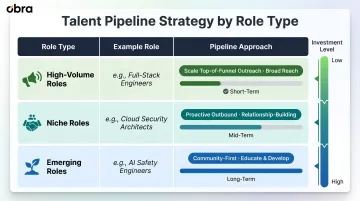
Niche and emerging roles require heavier relational investment and longer timelines. High-volume roles need reach.
Step 4 — Build a structured candidate engagement cadence.
Passive tech candidates don't respond to mass email blasts. Treat each candidate like a sales prospect — track where they are, what they care about, and when they're likely open to a conversation. A structured cadence looks like:
- Initial personalized outreach based on their actual project or contribution history
- Follow-up with genuine value — a relevant technical post, an open-source project invite, a specific insight about your team's work
- Periodic check-ins aligned to their likely availability windows (post-vest, after a funding event, around performance review cycles)
Step 5 — Audit and refresh the pipeline quarterly.
Pipelines decay fast. Candidates accept other offers. Career goals shift. Skills become outdated relative to your evolving role specs.
A quarterly pipeline review should:
- Remove contacts who've been cold for 9+ months without re-engagement
- Re-engage dormant candidates with a specific, personalized prompt
- Add newly identified profiles to fill gaps from role evolution
- Update competency requirements to reflect current tech stack changes
Where to Source Tech Talent Most Companies Overlook
LinkedIn and job boards are table stakes. The candidates worth building pipelines around aren't there waiting for you.
Non-Obvious Technical Sourcing Channels
- GitHub and GitLab — Contribution history, open-source project quality, and language usage patterns reveal actual capability, not just what someone wrote on a résumé
- Stack Overflow — Stack Overflow Careers surfaces candidates who are genuinely active in technical communities — a stronger signal than a polished résumé
- Hackathon platforms — Devpost and HackerEarth surface candidates who build under pressure
- Niche job boards — Wellfound for startup-track engineers, AI-specific boards for ML roles, VC portfolio job boards for high-growth tech companies
- Professional communities — IEEE, ISACA, cloud certification communities (AWS, GCP, Azure user groups)
The Passive Candidate Problem
The Stack Overflow data makes this concrete: most developers are employed. Waiting for inbound applications systematically filters out the best candidates — because the best candidates aren't looking.
The structural fix is moving from inbound ("post and pray") to outbound ("search and engage"). Platforms like Obra Hire let hiring teams search 800M+ verified candidate profiles using competency-based matching — filtering by specific skills, experience, and role fit rather than keyword proximity — and reach candidates directly via email, phone, or LinkedIn.
This is especially important for tech roles, where AI-generated applications and fake profiles have become a measurable problem. Gartner predicts that by 2028, 1 in 4 candidate profiles could be fake, and 41% of IT, cybersecurity, and fraud leaders say their organization has already hired a fraudulent candidate. Outbound sourcing from verified databases sidesteps this entirely.
Educational and Community Pipeline Channels
Coding bootcamps, university CS programs, and CTE pathways are underused early-career pipeline sources. CRA's 2025 CERP Pulse Survey shows growth in cybersecurity and AI enrollments even as traditional CS programs see declining numbers — meaning the pipeline pivot for early-career tech talent has already started.
Building relationships with bootcamp placement offices and university CS departments creates a steady inflow of early-career candidates who can be developed internally — a direct counter to skill gaps that compound over time.
Specialist vs. Generalist Sourcing Balance
Tech teams need both deep specialists (ML researchers, cloud security architects) and expert generalists (engineers who can operate across data, infrastructure, and product). These require different sourcing channels. Specialists are found through community contributions and niche platforms. Generalists surface more readily through broader technical networks and role history patterns. Your pipeline design should account for both archetypes.
Building an Internal Tech Pipeline: Grow Your Own Bench
External sourcing gets most of the attention, but internal pipelines are frequently more valuable — and most organizations leave them chronically underbuilt.
Why Internal Mobility Outperforms External Hiring
LinkedIn's 2024 Workplace Learning Report found that strong learning cultures are associated with 23% more internal mobility and 57% higher retention. For specialized technical roles — where the external market is thin and expensive — developing talent internally is often the more reliable path.
Practical internal pipeline mechanisms:
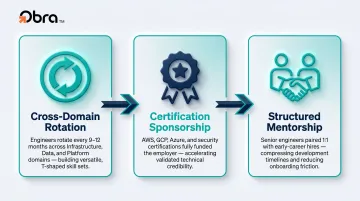
- Rotate engineers across domains (infrastructure to data, backend to platform) every 9-12 months to build broader pattern recognition
- Sponsor AWS, GCP, Azure, or security certifications to signal investment and keep skills current
- Pair senior engineers with early-career hires through structured mentorship to compress development timelines
AI-Augmented Apprenticeships
Cutting junior roles because AI handles simple coding tasks is understandable short-term logic — but it hollows out your future senior bench. The counter-strategy is AI-augmented apprenticeships: early-career engineers develop by supervising, testing, and correcting AI outputs rather than writing rote code.
This preserves the apprenticeship model while adapting it to current tooling realities. The engineers who understand how AI produces code — and where it fails — will be more valuable than those who never learned the underlying craft.
Cross-Functional Talent Identification
Beyond early-career hires, your existing workforce is an untapped talent pool. Your next platform engineer might currently be in ops or finance. Employees with adjacent analytical skills and genuine curiosity about technical work are strong candidates for roles like data analyst, QA engineer, or technical program manager.
Structured upskilling programs that identify and develop these employees expand your pipeline without depending entirely on external sourcing.
Using AI and Technology to Scale Your Pipeline
Competency-Based Matching at Scale
Traditional keyword search returns candidates whose résumés contain the right words. Competency-based matching returns candidates who can actually do the work. This distinction matters most in tech, where role labels are notoriously inconsistent across companies.
Obra Hire's search architecture is built around this — using structured competency data, not text matching, to score candidate fit. Search results show explicit "Must Have" and "Nice to Have" alignment so hiring teams can see exactly where a candidate matches or falls short before spending a contact credit. Teams can also preview the pool size before committing, adjusting filters until the results match target criteria.
For teams managing multiple role pipelines simultaneously, the Scale plan's shared credits and centralized admin controls mean the entire team works from one unified candidate pool — no duplicate purchases, no fragmented sourcing across individual recruiter accounts.
The Fake Candidate Problem Demands a Structural Solution
This deserves direct attention. AI hasn't just helped recruiters source faster — it's enabled a wave of synthetic applications that waste recruiter time and inflate pipeline metrics. CNBC has documented tech CEOs encountering AI-augmented impostors in remote interviews, including deepfake video use. Gartner recommends multi-layered fraud mitigation, including in-person elements for sensitive roles.
The practical response is to go outbound. Prioritizing sourced candidates from verified databases over anonymous inbound applicants reduces exposure before it becomes a problem. Obra Hire's verified profile filtering — available on Explore and Scale plans — surfaces authenticated profiles specifically to cut out AI-generated and fake candidate records.
ATS Integration for Pipeline Continuity
Sourcing data only creates value when it flows into your actual hiring process. Obra Hire integrates with 85+ ATS and HRIS platforms, so candidate records, outreach history, and pipeline stages carry over without manual re-entry. Supported platforms include:
- Workday
- Greenhouse
- Lever
- iCIMS
- SAP SuccessFactors
Measuring the Health of Your Tech Talent Pipeline
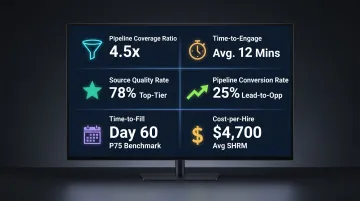
Core Pipeline KPIs for Tech Hiring
| Metric | What It Measures |
|---|---|
| Pipeline coverage ratio | Pre-qualified candidates per open role |
| Time-to-engage | Speed from role forecast to first pipeline contact |
| Source quality rate | Which channels produce the hires that actually stick |
| Pipeline conversion rate | First contact to offer acceptance |
| Time-to-fill | Baseline operational metric; Ashby benchmarks day 60 for tech at P75 |
| Cost-per-hire | SHRM pegs average at $4,700 across roles; specialized tech roles run higher |
Pipeline Size vs. Pipeline Health
A 500-contact pipeline of unresponsive or outdated profiles is not a healthy pipeline. That's a vanity problem.
Evaluate quality signals instead:
- Candidate responsiveness rates to initial outreach
- Profile recency (skills updated within 6-12 months)
- Competency match scores against current role specs
- Engagement patterns across the nurture cadence
Run quarterly audits and cut what isn't working. A tight, warm pipeline of 40 engaged candidates outperforms a bloated cold list of 400.
Connecting Pipeline Health to Business Outcomes
TA earns a seat at the planning table by speaking in product terms. If the engineering roadmap shows a major infrastructure initiative in Q4, leadership needs to know whether the platform engineering pipeline has 3x coverage against projected headcount — not just that recruiting "is working on it."
That readiness ties directly to delivery predictability. Connect your pipeline KPIs to engineering OKRs and sprint velocity metrics. When TA can say "we have 12 pre-qualified cloud architects ready to engage if Q3 hiring accelerates," that's a business conversation, not a recruiting update.
Frequently Asked Questions
What makes a tech talent pipeline different from a general talent pipeline?
Tech pipelines require competency-based profiling rather than credential-based filters, because job titles don't map consistently to actual skills. Specialist pools are genuinely narrow, skill half-lives are shorter, and the majority of strong candidates are passive — requiring outbound engagement rather than inbound application management.
How long does it typically take to build a functional tech talent pipeline?
It depends on role scarcity and your starting point. Niche roles like ML engineers or cloud security specialists typically require 3-6 months of active building before the pipeline is reliably warm, while common roles like full-stack engineers move faster with consistent outbound sourcing.
How do you keep passive tech candidates engaged before a role opens?
Personalized outreach tied to genuine technical value — relevant content, open-source invites, team insights — keeps candidates warm without feeling like spam. Track engagement in a CRM-style tool to identify responsive candidates and time follow-ups around natural availability windows.
What tech skills should companies be building pipelines for right now?
AI/ML, cloud infrastructure, cybersecurity, and platform engineering are the highest-demand categories — Lightcast data shows generative AI engineer postings grew from 55 in January 2021 to nearly 10,000 by May 2025. The right answer depends on your specific roadmap, so forecast 6-12 months ahead and build pipelines accordingly.
How do small companies or startups build a tech talent pipeline without a large recruiting team?
Start with one or two high-priority role pipelines rather than trying to cover everything. Use self-serve outbound sourcing tools, lean on developer community channels, and activate referral networks aggressively. A focused, warm pipeline for your two most critical roles beats a sprawling, cold list spread across ten roles.
How do you eliminate fake or AI-generated candidates from a tech pipeline?
Use platforms with verified profile filtering and prioritize outbound-sourced candidates over anonymous inbound applicants. Cross-reference candidate data across multiple signals — LinkedIn activity, GitHub contributions, portfolio work. Gartner predicts 1 in 4 candidate profiles will be fake by 2028, which makes profile authentication a standard pipeline hygiene requirement.