Introduction
Most hiring teams are still waiting for candidates to come to them. That strategy worked when job boards had captive audiences and inbound pipelines ran deep. It doesn't work anymore.
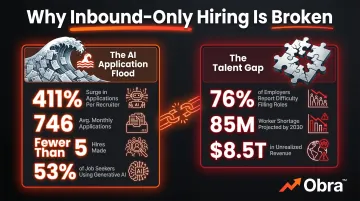
According to ManpowerGroup's 2025 Talent Shortage Survey, 76% of employers globally report difficulty filling roles. The candidates most worth hiring aren't refreshing job boards. They're already employed, doing good work somewhere else, and waiting to be found.
Every day a seat stays empty, productivity drops, teams absorb extra workload, and rushed hires get made. Research from SHRM puts the average cost-per-hire at over $5,000 — and revenue-generating roles can cost $7,000–$10,000 per month vacant.
Building a proactive sourcing function — one that reaches candidates before they're actively looking — is what separates teams that consistently hire well from those stuck in a reactive loop.
This post breaks down how to build that function, from the tools and channels to the step-by-step process that makes outbound hiring repeatable.
TL;DR
- Talent sourcing builds pipelines proactively; recruiting fills active openings — conflating them creates reactive hiring
- Most top candidates are passive — inbound-only strategies structurally miss them
- A repeatable sourcing strategy needs a clear candidate profile, diverse channels, and personalized outreach
- Outbound sourcing platforms give teams direct access to pre-qualified candidates — no waiting for applications
- Tracking sourced-to-hire ratio, response rate, and time-to-fill reveals where to invest sourcing effort
What Is Talent Sourcing and How Does It Differs from Recruiting?
What Is Talent Sourcing and How Does It Differ from Recruiting?
These two functions get used interchangeably. They shouldn't be.
Talent sourcing is the proactive, ongoing process of identifying and engaging potential candidates — particularly passive ones — before a role is urgently open. The goal is a standing pipeline of pre-qualified talent that recruiting can draw from the moment a position opens.
Recruiting is more immediate: evaluating, selecting, and hiring candidates for roles that exist right now. It presumes candidates are already in the funnel. Talent acquisition is the overarching discipline containing both functions, along with employer branding and workforce planning — the strategy layer that sourcing and recruiting execute against.
When sourcing gets skipped, teams start from zero every time a new role opens. That's how you end up with 42-day average time-to-fill, lower candidate quality, and higher cost-per-hire — because there's no pipeline to pull from.
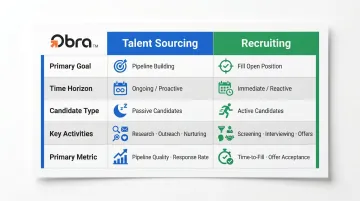
Sourcing vs. Recruiting at a Glance
| Dimension | Talent Sourcing | Recruiting |
|---|---|---|
| Primary goal | Build a talent pipeline | Fill an open position |
| Time horizon | Ongoing, proactive | Immediate, reactive |
| Candidate type | Passive (not applying) | Active (already in funnel) |
| Key activities | Research, outreach, nurturing | Screening, interviewing, offers |
| Primary metric | Pipeline quality, response rate | Time-to-fill, offer acceptance |
Core Components of the Sourcing Function
A functioning sourcing operation relies on three interconnected activities:
- Build and maintain a database of vetted candidates segmented by role type, skills, and engagement level
- Contact passive candidates directly across multiple channels — often before any vacancy exists
- Keep warm candidates engaged through consistent touchpoints (content shares, check-ins, role updates) so conversations resume quickly when openings appear
Obra Hire supports all three through its project-based pipeline management — teams can create shared projects by role, add candidates, assign collaborators, and track outreach status across the team without duplicate work.
Why the Inbound-Only Hiring Model Is Failing Today
LinkedIn data shows 70% of the global workforce is not actively searching for a new job. Roughly 60% of that group is open to hearing about opportunities — but won't apply to a job posting. An inbound model structurally misses all of them.
That's a significant gap on its own. The applications that do arrive compound the problem further.
The AI Application Flood
Greenhouse documented a 411% surge in applications per recruiter, with recruiters processing an average of 746 applications monthly while making fewer than 5 hires. Application volume rose roughly 45% year-over-year in 2024–2025, driven largely by AI-generated resumes. ZipRecruiter found that 53% of job seekers used generative AI in their search — and 64% of recruiters are now seeing more "look-alike" applications that are nearly impossible to differentiate.
More volume, far less signal.
The Talent Gap Isn't Closing
Even before AI flooded inbound pipelines, the structural talent shortage was making passive outreach essential. Korn Ferry projected a global shortage of more than 85 million workers by 2030, representing $8.5 trillion in unrealized annual revenues. In specific industries — healthcare, technology, finance — time-to-fill already exceeds 44–49 days.
In that environment, a passive inbound approach doesn't just slow hiring down — it hands your best candidates to competitors who are actively reaching out to them.
How to Build an Effective Talent Sourcing Strategy
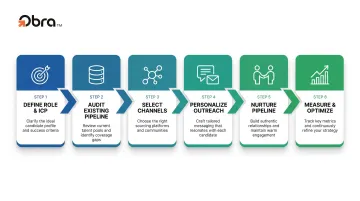
A sourcing strategy doesn't have to be complicated. Six steps, applied consistently, produce better pipelines than most teams have.
Step 1 — Define the Role and Build an Ideal Candidate Profile
Work with the hiring manager to translate the job description into sourcing criteria: must-have skills, preferred backgrounds, seniority signals, and deal-breakers. An ICP built once for a recurring role can be reused. Done right, it pays compound returns across every future search.
Obra Hire's competency-based matching works from structured skill data rather than resume keyword scanning, so your ICP maps directly to how candidates are filtered and ranked.
Step 2 — Audit Your Existing Pipeline First
Before sourcing externally, check your ATS and CRM for silver medalists and warm leads from previous searches. Re-engagement outreach to candidates with an existing relationship consistently outperforms cold outreach, because the context is already there.
Step 3 — Select Channels Based on Candidate Type
Passive senior professionals respond differently than early-career candidates or high-volume roles. Channel selection should be a deliberate decision. Defaulting to LinkedIn every time leaves better candidates on the table.
- Technical roles: GitHub, Stack Overflow, niche Slack communities
- Creative roles: Behance, Dribbble, portfolio platforms
- Senior professionals: LinkedIn, alumni networks, industry associations
- High-volume or broad roles: Outbound candidate databases with verified profiles
Step 4 — Personalize Outreach
Generic templates get ignored. Effective outreach references something specific about the candidate's background, leads with why the opportunity is genuinely compelling, and stays concise. One well-written message outperforms ten boilerplate ones, while protecting your employer brand along the way.
Obra Hire reveals direct contact details (email, phone, LinkedIn URL, and resume) when you're ready to reach out, so outreach happens through the channels you already use.
Step 5 — Nurture the Pipeline Consistently
Not every sourced candidate is ready to move right now. CRM workflows, periodic content shares, and quarterly check-ins keep warm leads engaged across longer cycles. When a role opens, the conversation picks up where it left off, rather than restarting from zero.
Step 6 — Measure and Optimize
Track these four metrics and review them quarterly:
| Metric | What It Tells You |
|---|---|
| Sourced-to-hire ratio | How efficiently sourced candidates convert |
| Outreach response rate | Quality of targeting and personalization |
| Pipeline engagement rate | Health of your nurture strategy |
| Time-to-slating | Speed from sourcing to first interview |
Personalized outreach to well-matched candidates achieves response rates of 25–40%. LinkedIn InMail averages 13%. The gap reflects how much targeting and personalization matter.
Key Sourcing Channels: Where to Find the Right Candidates
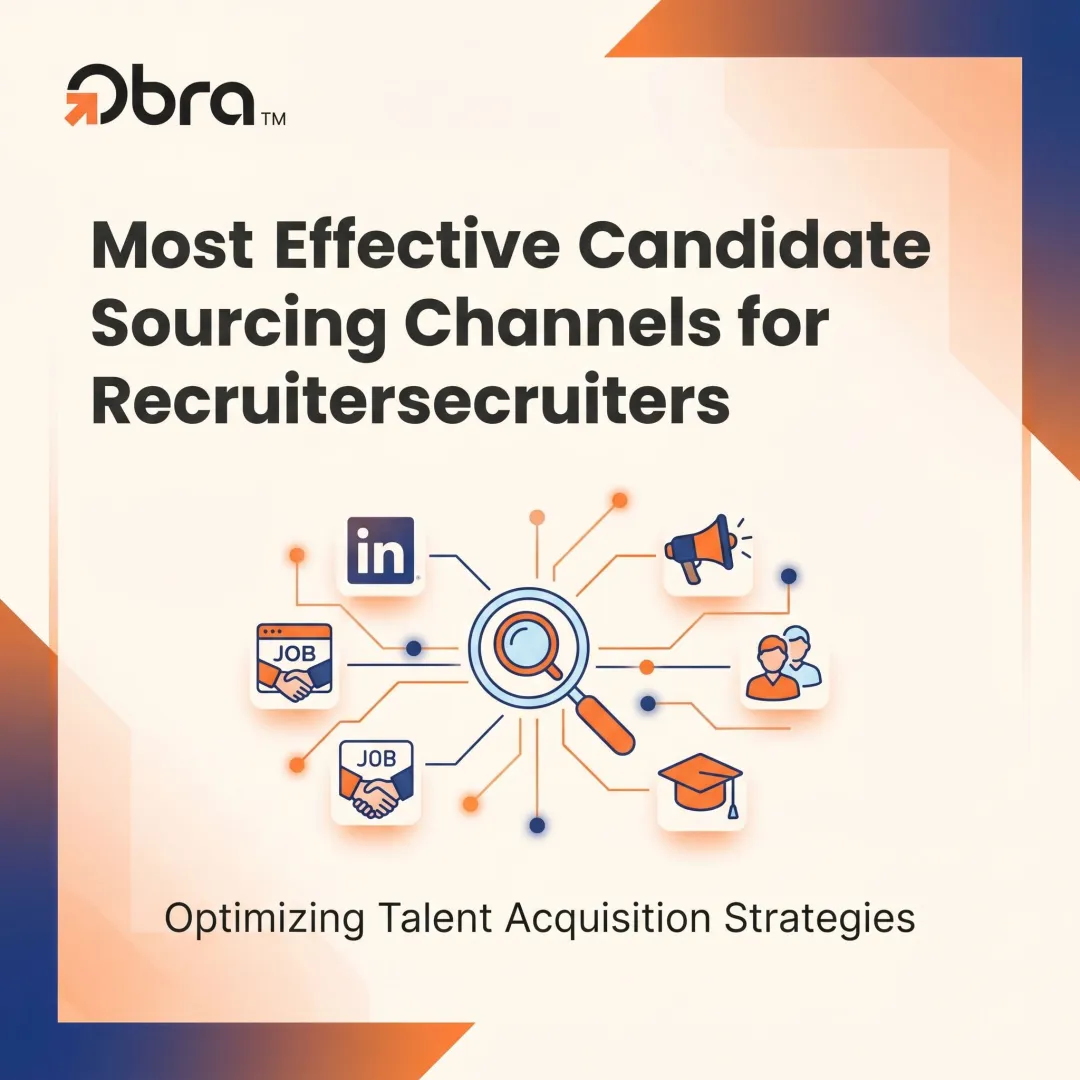
Professional Networks and Niche Platforms
LinkedIn remains the dominant channel for passive senior talent, with over 1.3 billion registered members. But single-channel dependence is one of the most common sourcing mistakes. Engineers surface on GitHub. Designers show up on Behance. Industry practitioners gather in Slack and Discord communities.
The right channel mix is role-specific, not a standing default.
Outbound Candidate Databases
Searchable, verified databases let recruiters proactively identify candidates who match a role's competency profile — without waiting for them to apply. Sourced candidates convert at 4–8x the rate of inbound applicants at every stage of the funnel, while the overall inbound application-to-hire rate sits below 1%.
Obra Hire gives hiring teams direct access to 800M+ verified candidate profiles with AI-powered, competency-based matching across 8,241 skills. Key platform features include:
- Preview candidate pool size and quality before spending a single credit
- Competency-based matching that goes beyond keyword search
- Verified profile filtering (Explore and Scale plans) to screen out AI-generated or fake profiles
Employee Referrals and Alumni Networks
Referral hires fill positions in 29 days versus 45 for career sites, with a 28.2% apply-to-hire conversion rate compared to 2–5% from job boards. They stay longer, onboard faster, and come with context already built in.
Boomerang hires — former employees who return — are a natural extension of this. ADP Research found they now account for 35% of new hires, with 44% higher three-year retention and roughly $50,000 in savings per rehire. Alumni sourcing deserves a standing strategy, not just reactive outreach.
ATS Re-engagement and Internal Mobility
The most underutilized sourcing channel is often already inside your organization. Silver medalists from previous searches and current employees ready for lateral or upward moves reduce both time-to-fill and external hiring costs simultaneously.
Internal hiring consistently outperforms external recruiting across key metrics:
- Saves $3,000–$5,000 per role compared to external hires
- Fills positions up to 20 days faster
- Internal hires outperform external hires by 18% in their first two years
The pipeline already exists — it just needs to be activated.
How Obra Hire Helps You Source and Recruit Smarter
Obra Hire is a self-serve outbound hiring platform built for teams that can't afford to wait for the right candidate to apply. It gives hiring teams direct access to 800M+ verified profiles through AI-powered, competency-based matching — without replacing the ATS and HRIS tools already in place.
Key differentiators that address the challenges covered in this post:
- Filters out AI-generated and fake applicant profiles on Explore and Scale plans
- Matches on 8,241 skills with proficiency levels via SkillsTree — going beyond keyword search to find candidates who actually fit the role
- Previews candidate pool size and quality before spending any credits
- Runs unlimited searches on every plan, including Free — no paywalls
- Pushes sourced candidates directly into Workday, Greenhouse, iCIMS, Lever, SAP SuccessFactors, and 80+ other ATS/HRIS platforms
- Pools team credits and contact reveals in one dashboard, with centralized seat and permissions management
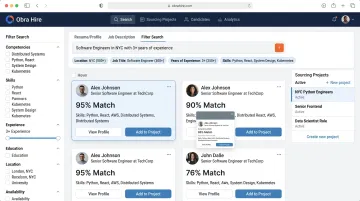
Teams using these features tend to notice the difference quickly. As one People & Culture manager at Canopy put it: "Sourcing and screening pull you into tasks that slow your day. Obra Hire makes it easy to see the qualified candidates you want without digging through piles of profiles."
Sourcing works best as a continuous habit, not a reactive scramble. Teams that build standing pipelines and engage candidates before a role opens consistently fill positions faster, with stronger fits, at lower cost. Start sourcing with Obra Hire for free.
Frequently Asked Questions
What is sourcing in recruiting?
Sourcing is the proactive process of identifying and engaging potential candidates — especially passive ones — before a role urgently needs to be filled. The goal is a pipeline of pre-qualified talent that's ready to move when an opening appears.
What is the difference between talent sourcing and recruiting?
Talent sourcing builds a pipeline of potential candidates proactively, often targeting people who aren't actively applying. Recruiting is the downstream process of evaluating, selecting, and hiring for a role that's open right now. Sourcing feeds the pipeline that recruiting draws from.
What are the 4 pillars of sourcing?
The four core pillars are:
- Identifying target talent pools
- Selecting the right sourcing channels for the role type
- Personalizing outreach and engagement
- Nurturing the pipeline so candidates stay warm until a role opens
Is RPO a good fit for my company?
RPO works well for organizations with high-volume or highly specialized hiring that exceeds internal capacity. Smaller teams or those wanting direct control over candidate relationships typically see better results and lower cost-per-hire from self-serve sourcing platforms with no long-term contracts required.
How do you source passive candidates effectively?
Start with personalized outreach that references the candidate's specific background, pair it with a clear reason to consider the opportunity, and follow up consistently. Verified outbound databases help teams identify best-fit profiles directly rather than waiting for passive candidates to surface.
What sourcing metrics should recruiters track?
The four most important are: sourced-to-hire ratio, outreach response rate, pipeline engagement rate, and time-to-slating. Tracking these by channel reveals where your sourcing effort is actually generating hires.