Introduction
Application volumes are up 25% since January 2023 (iCIMS), yet 66% of recruiters report that more applicants hasn't meant better candidates — with 47% citing a lack of qualified talent as their primary stressor. AI-generated applications are flooding inbound pipelines faster than screening tools can catch them.
The answer isn't working harder on the same channels. It's building a smarter mix: combining inbound channels for active candidates with proactive outbound approaches that reach the 70% of the workforce not browsing job boards.
This article breaks down the most effective candidate sourcing channels — covering how each works, who it's best for, and how to layer them into a system that consistently surfaces qualified talent rather than just more applicants.
TL;DR
- Sourcing channels are the platforms and methods recruiters use to find candidates — both active and passive.
- No single channel dominates; the strongest pipelines blend inbound (job boards, careers pages) with outbound (AI search, direct outreach).
- Employee referrals deliver the highest ROI; AI-powered outbound platforms are the fastest-growing category.
- Track source-of-hire, cost-per-hire, and offer acceptance rate — application volume alone tells you very little.
What Are Candidate Sourcing Channels?
Candidate sourcing channels are the specific pathways recruiters use to identify, attract, and engage potential hires. They fall into two categories:
- Inbound channels — candidates come to you (job boards, careers pages, employer branding)
- Outbound channels: you go to candidates (AI platforms, direct LinkedIn search, professional associations)
Both are necessary. Inbound captures active candidates ready to move now. Outbound reaches the passive majority who are employed and not actively looking — but often open to the right conversation.
Channel selection directly shapes recruiting outcomes. The wrong mix means slower time-to-fill, higher cost-per-hire, and pipelines built entirely on the shrinking active-candidate pool. Three forces are pushing teams toward more proactive sourcing:
- Rising job board costs eating into cost-per-hire budgets
- AI-generated application noise flooding inbound pipelines with unqualified submissions
- Passive talent dominance — most qualified candidates aren't actively applying anywhere
Top Candidate Sourcing Channels for Recruiters
The channels below are selected based on candidate quality, ROI, scalability, and fit across role types and industries.
Employee Referral Programs
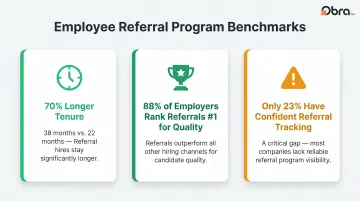
Referrals consistently rank as the highest-ROI sourcing channel — and the data backs it up. Referred hires stay a median of 38 months versus 22 months for non-referral hires — a 70% longer tenure. After two years, referred employees retain at 45% compared to just 20% for job board hires.
The quality story is just as strong: 88% of employers rate referrals above all other sources for quality, and 82% rank them best for ROI (SHRM/CareerBuilder).
The gap between a formal program and an optimized one comes down to a few specifics:
- Clear incentives (monetary bonuses or meaningful recognition)
- A frictionless submission process — one form, not five approval steps
- Executive sponsorship that signals the program matters
- Expansion beyond current employees to alumni and vendors, which increases referral-sourced hires by 28% and improves candidate quality by 8%
The gap between having a program and optimizing one is wide. 77% of organizations have a formal referral program, but only 23% have full confidence in their referral tracking. That's where most of the ROI gets left on the table.
LinkedIn and Professional Social Networks
LinkedIn is the default starting point for most recruiters — 87% use it for talent sourcing — and its value lies in search depth and passive candidate visibility. With over 1 billion users across 200+ countries, the pool is genuinely large.
The limitations are real, though. LinkedIn Recruiter Corporate seats run approximately $10,800 per seat per year, with InMail capped at 150 messages per month and average reply rates of 18–25%. For a team of five, that's $54,000–$65,000 annually — before job postings. Smaller teams can use X-ray searches or Sales Navigator as cost-effective alternatives.
Other social platforms serve niche use cases:
- X/Twitter — thought leaders, developers, journalists, public-facing roles
- Facebook Groups — blue-collar, regional, and hourly talent communities
Either way, social sourcing demands targeted, consistent monitoring — broad searching generates too much noise to be worth the effort.
General and Niche Job Boards
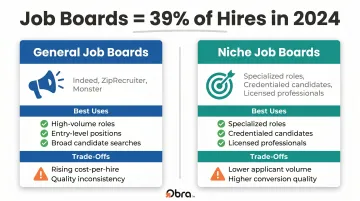
General boards (Indeed, ZipRecruiter, Monster) drive high application volume and remain effective for active-candidate pipelines, high-volume hiring, and entry-level roles. Job boards accounted for 39% of hires in 2024, up from 33% in 2023 (CareerPlug). But costs are climbing — the Appcast 2026 Recruitment Marketing Benchmark Report confirms that cost-per-application and cost-per-hire rose sharply in 2025, driven by shifts in job board pricing models.
Niche boards solve the quality problem. For specialized roles — tech, healthcare, legal, engineering — they attract more relevant applicants and reduce time spent filtering noise. The trade-off is lower volume, but the conversion rates are typically much stronger.
When to use each:
| Board Type | Best For | Trade-Off |
|---|---|---|
| General boards | High-volume, entry-level, broad searches | Rising CPH; quality inconsistency |
| Niche boards | Specialized, credentialed, or licensed roles | Lower volume, higher quality |
Internal ATS/CRM Talent Rediscovery
Your existing database is an underused asset. Rediscovered candidates — previously sourced or interviewed applicants already in your ATS/CRM — already know your brand, have been partially vetted, and cost almost nothing to re-engage.
According to Gem's 2025 platform analysis, rediscovered candidates now represent 1 in 4 sourced hires (25%), up from 1 in 8 four years ago — and show a 30% higher passthrough rate through the recruiting funnel than net-new candidates.
Best practices for making this channel work:
- Tag and segment past candidates by role type, skill, location, and disposition
- Set automated triggers that surface matching profiles when a relevant role opens
- Treat the database as a living pipeline, not an archive of closed requisitions
Professional Associations and Industry Communities
Professional associations and niche online communities — Slack groups, GitHub, LinkedIn groups, industry forums — offer access to engaged, credentialed professionals who are largely invisible on general job boards. The fact that someone actively participates in a professional community signals commitment to their field beyond what a resume shows.
How to use this channel effectively:
- Sponsor local chapter events or webinars
- Access member directories through organizational partnerships
- Participate authentically in community discussions before recruiting
Recruiters who post job links into communities without contributing first get ignored at best, banned at worst. Genuine engagement — answering questions, sharing useful content — builds the credibility that converts to candidate conversations.
Company Careers Page and Employer Branding
A well-optimized careers page functions as a passive inbound channel that works around the clock. What makes it effective:
- Clear culture communication and employee testimonials
- Easy, mobile-friendly application flows
- SEO-optimized job descriptions that surface in organic search
- Behind-the-scenes content and employee spotlights
Company career sites accounted for 31% of hires in 2024 (CareerPlug) — nearly as much as job boards, with far lower ongoing cost. Employer branding content attracts passive candidates and positions the organization as a destination rather than just a place to apply.
This channel requires upfront marketing investment, but it compounds over time in a way paid job board spend does not.
AI-Powered Outbound Sourcing Platforms
AI-powered sourcing platforms are the fastest-growing channel category — and for good reason. 70% of the global workforce is passive talent not actively job searching (LinkedIn Global Talent Trends). These candidates won't appear in a job board search, because they're not applying.
AI platforms aggregate profile data from across the public web, apply competency-based matching, and surface relevant passive candidates at scale. **65% of recruiters now use AI in their recruiting technology**, with 55% reporting faster time-to-hire and 53% reporting improved candidate quality (Employ/Jobvite 2025 Recruiter Nation Report).
Key features to evaluate when choosing a platform:
- Breadth of verified profile coverage — aggregated data vs. profiles with quality signals
- Skill-matching depth — competency-based matching vs. basic keyword search
- Fake/AI-generated profile filtering — increasingly critical as AI-generated applications surge
- ATS integration — does it plug into your existing workflow or require separate management?
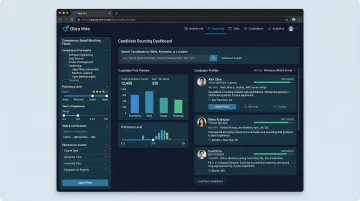
Obra Hire is built around these criteria: 800M+ searchable candidate profiles, competency-based matching using structured skill data, verified profile filtering that screens out AI-generated accounts, and 85+ ATS integrations. One feature worth noting — recruiters can preview candidate pool sizes before spending any contact credits, which makes it easy to validate a search before committing budget to it.
Inbound vs. Outbound Sourcing: Why the Distinction Matters
With inbound sourcing, candidates come to you — through job applications, career site visits, and job board listings. With outbound sourcing, you go to them — proactively identifying and reaching out to people who aren't actively applying.
Relying exclusively on inbound is increasingly risky for two reasons. First, active candidates make up only about 30% of the total workforce. Second, AI-generated applications are flooding inbound pipelines — LinkedIn applications surged more than 45% in the past year, averaging 11,000 submissions per minute (New York Times, June 2025). Volume is up; quality is not.
Outbound sourcing changes who has the advantage. Passive candidates face less competition from other employers, often bring stronger qualifications, and once engaged, they convert at higher rates. According to LinkedIn Global Talent Trends, 94% of all talent says being contacted by a prospective employer can accelerate their decision to accept an offer.
How a blended strategy works in practice:
- Use inbound channels (job boards, careers page) to capture active candidates and keep the top of the funnel moving
- Use outbound channels (AI platforms, direct network outreach, association directories) for harder-to-fill, senior, or specialized roles
- Use verified profile filtering and outbound-first tools to ensure you're engaging real people — not automated submissions designed to pass ATS screening
How to Evaluate Which Channels Are Working
Channel performance must be tracked quantitatively. The key metrics to monitor by channel:
- Source of hire — which channels produce actual hires, not just applications
- Cost-per-hire — median non-executive CPH sits at $1,200 (SHRM 2025)
- Time-to-fill — median is 45 days across role levels
- Application-to-interview conversion rate
- Offer acceptance rate
Only 40% of recruiters pull reports on sourcing channels, and just 20% of organizations measure quality of hire (down from 27% in 2022) — meaning most channel optimization decisions are made on gut feel rather than data.
A simple quarterly channel audit:
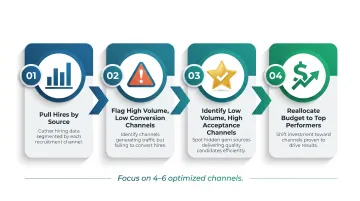
- Pull hires by source for the last 90 days, segmented by role type and seniority
- Flag channels with high application volume but low interview-to-offer conversion
- Identify channels with lower volume but strong offer acceptance — these deserve more investment
- Reallocate budget away from underperformers
That audit typically reveals a common budget mistake: spreading spend across too many channels at once. Concentrate on 4–6 well-optimized channels rather than running 10 channels at 10% effort each — the data almost always shows that a handful of channels drive the majority of quality hires.
Conclusion
Effective sourcing in 2025 requires a deliberate channel mix: inbound to capture active candidates, outbound to reach the passive majority, and measurement infrastructure that shows you which channels are driving real hires — not just applicant volume.
Start by auditing your current channel mix. Where are your hires actually coming from? Which channels produce candidates who accept offers and stay? Once you know what's working, you can invest in the tools that give you direct access to passive talent at scale.
If you're looking to reduce cost-per-hire and cut through AI-generated applicants, Obra Hire's free plan lets you search a verified 800M+ candidate pool before spending a dollar. No contract, no credit card, and no credits required to preview your candidates before committing.
Frequently Asked Questions
What is your primary sourcing channel?
Primary channels vary by organization, but employee referrals consistently rank highest for ROI and hire quality across most industries. High-performing teams typically designate a primary channel per role type — niche job boards for high-volume roles, outbound AI platforms for passive senior candidates — rather than using one channel for every role type.
What are sourcing channels in recruiting?
Sourcing channels are the platforms, tools, and methods recruiters use to find and engage potential candidates. They fall into two main categories: inbound (job boards, careers page, employer branding) and outbound (AI sourcing platforms, direct LinkedIn search, referral programs, and talent database rediscovery).
What are the three types of sourcing?
The three broad types are:
- Inbound sourcing — candidates come to you via job postings and employer brand
- Outbound sourcing — recruiters proactively identify and contact passive candidates
- Internal sourcing — promoting from within or re-engaging past applicants from your talent database
What is the most effective sourcing channel for passive candidates?
AI-powered outbound platforms and direct professional network outreach are most effective for passive candidates, since these individuals aren't actively browsing job boards. Platforms like Obra Hire let recruiters search 800M+ verified profiles and reach out directly. Outreach must be personalized and role-specific, because generic InMail or mass messaging rarely converts passive interest into active engagement.
How do I measure the ROI of different sourcing channels?
Track source-of-hire, cost-per-hire by channel, and quality-of-hire metrics (retention, performance ratings) — not just application volume. Most ATS platforms include source-tracking dashboards. Running quarterly channel audits helps reallocate budget toward top-performing sources and away from high-volume, low-conversion ones.