
Introduction
The average U.S. time-to-fill now sits at 42 days, according to the SHRM 2025 Recruiting Benchmarking Report — up roughly 24% since 2021. For senior roles, that window stretches past 90 days. Every open seat costs an average of $4,129 over the 42-day period, with revenue-generating roles losing $7,000–$10,000 per month.
Most hiring processes are designed reactively — built to respond to open roles rather than anticipate them. That reactive posture is where most of the time goes.
This guide is for HR teams, hiring managers, and recruiters at companies of any size. We'll walk through each stage of the hiring process — sourcing, screening, interviewing, communication, and the offer — and show you exactly where time gets lost and how to reclaim it.
TL;DR
- Build a talent pipeline before roles open — cold-start delays add weeks to every search
- Tighten job descriptions: vague requirements flood your inbox with the wrong candidates
- Compress interview rounds and automate scheduling — fewer steps means fewer drop-offs
- Set stage-level deadlines and communicate with candidates to keep them engaged
- Pre-approve offer bands and use a verbal pre-close call so the final step never stalls
Why Your Hiring Process Is Slower Than It Should Be
Speed problems in hiring rarely have a single cause. Usually it's several smaller inefficiencies stacking up across stages.
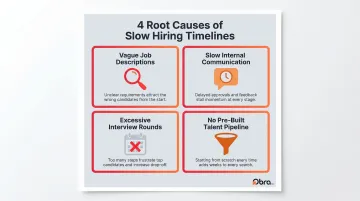
The most common root causes:
- Vague job descriptions that attract high application volume but low candidate quality, forcing more time in screening
- Slow internal communication between hiring managers, recruiters, and interviewers
- Excessive interview rounds added over time without auditing whether each stage serves a distinct purpose
- Starting from zero every time a role opens, with no pre-built pipeline to draw from
The cost of these delays goes beyond the empty seat. According to Forbes, citing SHRM data, vacancies cost an average of $4,129 over 42 days — and revenue-generating roles can reach $7,000–$10,000 per month in lost productivity.
Meanwhile, current team members absorb the extra workload, burning out faster and performing worse.
There's also the candidate side of this equation. The top 10% of candidates go off the market within 10 days of starting a search. Your internal review process likely takes longer than that on its own.
The good news: most of these delays are process problems. Fix the process, and the hiring timeline follows.
Build a Proactive Talent Pipeline Before You Need It
Most companies treat sourcing as something that happens after a role opens. That's the single biggest source of avoidable delay.
Stop Starting From Zero
Every time a position opens and you begin sourcing cold, you're adding days or weeks before a single qualified candidate even enters your funnel. The fix is shifting from reactive to always-on talent pipeline management.
A proactive pipeline looks like this:
- Re-engage strong past candidates you liked but didn't hire — they're already vetted, and they're easier to place than a cold stranger
- Log promising profiles from networking and sourcing events into an organized project, even when no role is open
- Stay in touch with high-performing former employees — ADP payroll data shows 35% of all new hires in March 2025 were returning workers, up from 31% in 2024
For hard-to-fill or frequently recurring roles, keep a short bench list of pre-vetted candidates who've expressed interest. When the role opens, you're making calls that day instead of posting and waiting.
Switch to Outbound Sourcing
Building a pipeline also means going out to find candidates — not waiting for them to find you. Gem's analysis of over 20 million outreach sequences found that outbound candidates are 5x more likely to be hired than inbound applicants (6% hire rate versus 1%).
Platforms like Obra Hire let recruiting teams search across 800M+ verified candidate profiles using AI-powered, competency-based matching. Recruiters describe their ideal candidate in natural language or paste a job description, and the system returns ranked, skill-matched results immediately.
Searches are unlimited on every plan. Teams can also preview the candidate pool size before spending a single contact credit — useful for gauging supply in niche roles before committing.
Activate Employee Referrals
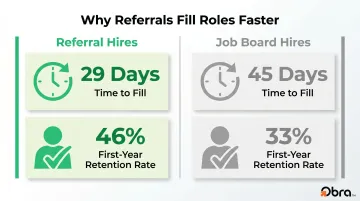
Referrals are another pipeline lever worth structuring intentionally. Referral hires fill in 29 days versus 45 days through career sites, and retention rates back them up: 46% for referral hires versus 33% for job board hires.
Structure your referral program intentionally: make it easy for employees to submit recommendations, communicate open roles internally as soon as they're approved, and provide consistent feedback to employees who refer candidates.
Write Sharper Job Descriptions and Pre-Screen More Efficiently
A vague job description doesn't just attract the wrong applicants. It creates downstream work at every stage: more filtering time, more interviewer calibration, more back-and-forth on whether someone is actually qualified.
Fix the Job Description First
Before investing in sourcing volume, get the requirements right. A peer-reviewed study published in the International Journal of Research Publication and Reviews (November 2025) found that accurate job descriptions reduced time-to-fill by nearly 30% and cut screening time by 40% — while improving candidate fit from 55% to 80%.
The practical fix:
- Separate must-have qualifications from nice-to-haves, explicitly labeled
- Use concrete language: specific tools, measurable outcomes, years of experience in context
- Remove generic buzzwords that attract inflated applicant pools without filtering quality
Pre-Screen Before Manual Review
A short application questionnaire — three to five questions about tool experience, availability, or eligibility — filters out mismatched candidates before anyone opens a single resume. This is especially valuable as application volumes rise. iCIMS reported that average applicants per opening reached 33 in late 2025, up from 30 the year before, while actual hire rates fell.
AI-generated applications are compounding this problem. Mass-apply tools make it effortless for candidates to submit to dozens of roles simultaneously, inflating volume without improving quality.
Platforms with verified profile filtering — like Obra Hire's Explore and Scale plans — surface verified, accurately represented profiles, reducing the noise before it reaches your queue.
Pair that filtering with a consistent scoring checklist for applications. When every reviewer evaluates candidates against the same criteria, shortlisting decisions are faster and require less back-and-forth consensus.
Streamline Your Interview Process
Excessive interview stages are one of the most controllable contributors to a long time-to-fill — and one of the most overlooked.
Audit and Compress Your Rounds
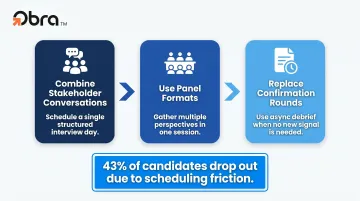
Interview scheduling friction alone causes 43% of candidates to drop out of hiring processes. Roughly 1 in 4 candidates is lost from pipelines specifically due to scheduling-related delays. Before adding another stage, ask whether it serves a distinct decision-making purpose that couldn't be addressed in an existing round.
Two to three well-structured rounds is the right number for most roles. For roles that currently involve four or more stages, consider:
- Combine back-to-back conversations with multiple stakeholders into a single structured interview day
- Use panel formats to gather several perspectives in one session rather than across separate weeks
- Replace late-stage "confirmation" rounds with a written debrief or async Q&A where no new signal is needed
Reduce Scheduling Friction
Interviewer availability is a hidden bottleneck. When a key stakeholder is unavailable, the process stalls for days. Three practical fixes:
- Cross-train backup interviewers so the process doesn't stall on one person's calendar
- Set a 24-hour feedback deadline — impressions fade fast, and delayed feedback leads to second-guessing and extra rounds
- Block standing interview slots each week so scheduling never starts from scratch
For technical or skills-based evaluation, consider asynchronous assessments that candidates complete on their own schedule. This removes a common scheduling constraint while still providing meaningful signal.
Use Structured Interviews
Meta-analytic research shows structured interviews have a predictive validity of 0.51 versus 0.38 for unstructured formats. Higher predictive accuracy means fewer redundant rounds, because your first assessment is more reliable.
Automate Repetitive Tasks and Keep Candidates in the Loop
Two things slow down the middle of a hiring process more than any other: manual scheduling logistics and poor candidate communication.
Automate the Low-Judgment Work
High-volume, low-judgment tasks eat recruiter time without adding value:
- Self-service scheduling tools let candidates book directly from a live calendar, cutting scheduling time by 30–50%
- Automated email triggers fire at each stage transition so candidates never go silent waiting for updates
- Templated FAQ responses handle common questions without pulling recruiters away from higher-priority work
Automation only works if it connects to the tools your team already uses. Obra Hire integrates with 85+ ATS and HRIS platforms — including Workday, Greenhouse, iCIMS, Lever, and SAP SuccessFactors — pushing candidate data directly into existing workflows to prevent duplicate entry and keep hiring on track.
Set a Communication Cadence and Hold to It
Fortune, citing a Criteria report from March 2026, found that 53% of job seekers were ghosted by employers in the past year — up from 38% in 2024. Another study found 54% of candidates abandoned a hiring process specifically due to poor communication.
Set a clear communication cadence and hold to it:
- Acknowledge application receipt within 24 hours
- Confirm interview scheduling within 24 hours of first contact
- Provide a status update within a defined window after each interview stage
Create Internal Deadlines
An informal process drifts. Make every stage deadline visible to all hiring stakeholders — application review, first interview, debrief, offer — and treat those dates as real commitments. When the timeline is visible, accountability follows.
Move Fast at the Offer Stage
Many hiring processes run cleanly through sourcing and interviews, then stall at the finish line. Compensation approvals, offer letter drafting, and unresolved negotiation questions add days that candidates aren't willing to wait through.
Three changes that compress offer stage time:
- Pre-approve salary bands for each role type before the search begins — no mid-process approval chains
- Build offer letter templates segmented by role level and employment type — no drafting from scratch
- Conduct a verbal pre-close call with the finalist before sending the formal letter — surface objections and resolve them in real time rather than via document redlines
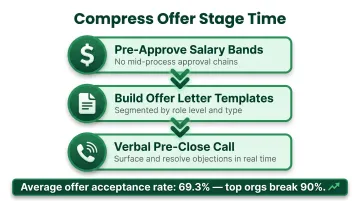
Beyond those three, include a clear offer expiration date in every letter. It gives candidates a defined decision window and keeps your pipeline moving. The average offer acceptance rate sits at just 69.3%, according to Crosschq — organizations that consistently break 90% share one common trait: they get the offer out fast and come to the table already knowing what the candidate needs to say yes.
Frequently Asked Questions
How can I speed up the hiring process?
Build a talent pipeline before roles open, tighten job descriptions to cut screening volume, compress interview rounds, automate scheduling and status updates, and move to offers quickly using pre-approved compensation bands. Addressing all five areas together produces the fastest results.
What stage of the hiring process takes the longest?
Sourcing creates upstream delays when companies start cold with each new role. In the middle of the process, interview scheduling and the feedback cycle are the most common bottlenecks, accounting for 5–8 days of a typical 44-day cycle on their own.
How many interview rounds should a fast hiring process include?
Two to three well-structured rounds is a practical target for most roles. The number matters less than whether each stage serves a distinct purpose; redundant rounds slow hiring and drive candidate drop-off without improving decision quality.
How can you hire faster without sacrificing quality?
A well-designed process is both fast and selective. Competency-based screening criteria, structured interview scorecards, and verified candidate sourcing ensure you evaluate the right people more efficiently, not just more quickly.
What is causing longer hiring timelines today?
The main contributors are AI-generated applications inflating screening volume, interview stages added without clear purpose, slower internal decision-making, and a shortage of qualified candidates in competitive roles. Each factor requires a targeted fix, not just more aggressive posting.