
The distinction worth making upfront: hiring efficiency is about speed and cost (time-to-fill, cost-per-hire), while hiring effectiveness is about quality and fit (performance, retention, role clarity). The mistake most teams make is treating these as a trade-off. They're not. With the right process architecture, you can move faster and hire better.
This article covers the full picture — from writing job descriptions that filter the right people in (and out), to sourcing proactively, running structured interviews, and using data to continuously close the gaps.
TLDR: Key Takeaways
- Unfilled roles average $4,129 in costs over a 42-day vacancy, and top candidates are off the market within 10 days
- Strong job descriptions create self-selection: specific language reduces unqualified applicants before screening even starts
- **70–73% of professionals are passive candidates** — they won't find you through a job board
- Structured interviews predict job performance significantly better than unstructured ones
- Poor candidate experience kills offer acceptance — and candidates talk, which affects every future hire
Why Hiring Efficiency Matters More Than Ever
Slow hiring isn't just an HR inconvenience — it's a business problem with a measurable price tag.
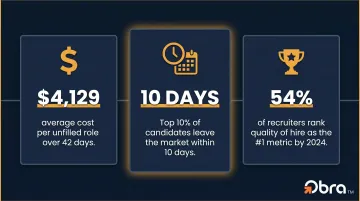
According to SHRM benchmarking data, each unfilled position costs companies an average of $4,129 over a 42-day vacancy period. For revenue-generating or senior roles, that figure climbs much higher. Every open seat represents lost output, increased burden on surrounding team members, and the compounding morale impact of sustained overload.
The candidate side of the equation is equally unforgiving. Research from ERE.net shows the top 10% of candidates are typically off the market within 10 days of starting a search. The average US time-to-fill sits between 36 and 44 days. That math creates a structural problem: your best candidates are gone before most hiring processes even reach the interview stage.
Speed alone isn't the answer, either. According to LinkedIn's Future of Recruiting 2024 report, 54% of recruiting professionals say quality of hire will be the primary metric defining the industry over the next five years — outranking cost reduction, DEI initiatives, and time-to-fill.
The implication is direct: hiring teams need processes that move fast and surface better candidates. The sections below break down exactly how to build one.
Start With Role Clarity and a Targeted Job Description
Most hiring delays don't start with a slow interview process. They start before a single candidate is contacted.
Vague role definitions create a cascade of downstream problems: misaligned expectations from hiring managers, inconsistent screening criteria across reviewers, and interview time spent on candidates who were never right for the role. An intake meeting before posting fixes this. Define:
- Outcomes, not just tasks — what does success look like at 30, 60, and 90 days?
- Required vs. preferred qualifications — be honest about which is which
- Who the role reports to and collaborates with — this shapes candidate fit beyond skills alone
Writing a Job Description That Actually Works
The job description is a filtering tool as much as a marketing one. A few principles the data supports:
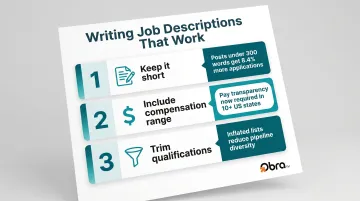
- Keep it focused. LinkedIn research shows short job posts (under 300 words) generate applications at an 8.4% higher rate than longer ones. Brevity signals clarity, not laziness.
- Include the compensation range. Five new US states enacted pay transparency laws in 2025 (Illinois, Minnesota, New Jersey, Vermont, and Massachusetts), joining Colorado, California, Washington, New York, and others. Transparency is increasingly a legal baseline, not a differentiator.
- Trim the qualifications list. Harvard Business Review research found that men apply when they meet 60% of listed qualifications, while women typically apply only when they meet 100%. Inflated requirements don't raise hiring standards — they narrow your pipeline unnecessarily.
When candidates can clearly see the work, the expectations, and the culture, the wrong ones opt out before applying. That means fewer resumes to screen, stronger conversion through the pipeline, and less wasted time on both sides.
Shift From Reactive to Proactive Candidate Sourcing
The traditional model — post a job, wait for applications — has two problems that have gotten dramatically worse.
First, inbound volumes are out of control. Applications per job posting increased 111% from 2022 to 2025, rising from roughly 115 to 244 per posting (Greenhouse data). That surge isn't a sign of better talent pipelines — it's largely driven by AI-generated resumes, mass-apply tools, and inflated profiles. 65% of hiring managers now say AI-enhanced resumes make it harder to verify skills.
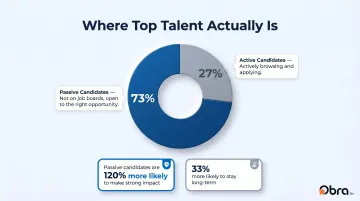
Second, the best candidates aren't in that inbound pool to begin with. Approximately 70–73% of professionals are passive candidates — not actively browsing job boards but potentially open to the right opportunity. Passive candidates tend to outperform their active counterparts — they're 120% more likely to make a strong impact and 33% more likely to stay long-term.
How Outbound Sourcing Works
Instead of waiting for candidates to find you, outbound sourcing means your team proactively identifies and contacts qualified people who match the role — including people who aren't looking.
Platforms like Obra Hire give hiring teams direct access to 800M+ verified candidate profiles with AI-powered, competency-based matching. Rather than relying on keyword scanning, the system uses structured competency data — distinguishing "Must Haves" (which control who enters the candidate pool) from "Nice to Haves" (which rank results).
Recruiters can preview the size and quality of the candidate pool before spending any credits, letting teams validate fit before spending a single credit.
When a contact credit is used, the full contact record is revealed — email, phone, LinkedIn profile URL, and resume — giving recruiters multiple outreach channels in a single transaction.
Making Outreach Actually Work
Generic messages fail. Personalized outreach yields response rates 15–20% higher than bulk messaging, and customized messages produce up to a 40% increase in acceptance rates.
An effective first contact:
- References the candidate's specific background or a relevant achievement
- Explains clearly why this role matches their career trajectory
- Keeps the ask low-friction — a 15-minute call, not an immediate application
- Avoids corporate boilerplate that reads like it was sent to 500 people
That outreach effectiveness is only as good as the candidates behind it. Verified profile filtering eliminates AI-generated and unverified profiles before they enter your pipeline — not after you've already spent time screening them.
Build a Structured, Streamlined Interview Process
Unstructured interviews are expensive in ways most teams don't track. When each interviewer asks different questions and evaluates by different criteria, comparing candidates becomes nearly impossible. Decisions drift toward personal chemistry rather than demonstrated competency — and the process takes longer without producing better outcomes.
The data on structured interviews is clear. Landmark research by Schmidt and Hunter found structured interviews carry a predictive validity of .51 for job performance, compared to .38 for unstructured — a meaningful difference that compounds across every hire.
Designing a Structured Interview Process
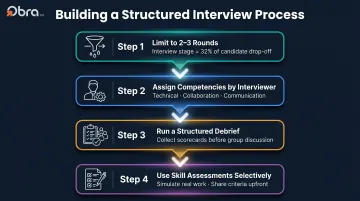
Keep rounds to two or three. The interview stage accounts for 32% of total candidate drop-off — the single largest attrition point in the hiring funnel. Beyond three rounds, evaluation value drops while dropout risk climbs.
Assign competencies by interviewer. Give each person a specific focus — technical depth, collaboration, communication — rather than having everyone cover the same ground. This cuts redundancy, reduces total interview time, and lets each evaluator go deep in one area.
Run a structured debrief. Collect scorecards before the group discussion opens. This prevents the first opinion from anchoring everyone else's judgment. When the group convenes, discussion should reference specific candidate responses — not gut reactions.
Use skill assessments selectively. Practical assessments that simulate real work reveal things resumes and conversation can't. Keep them scoped to what the role actually requires, and share clear evaluation criteria with every reviewer before the assessment begins.
Deliver a Candidate Experience That Wins Top Talent
Candidate experience affects more than whether a specific candidate says yes. It shapes offer acceptance rates, employer brand reputation, and referral quality — all of which feed directly back into future hiring costs.
83% of candidates say poor communication negatively impacts their perception of a company. 57% withdraw from processes due to slow response times. And the downstream effects matter: 72% of job seekers share negative candidate experiences online, and 55% avoid companies after reading negative reviews.
The Three Pillars
A strong candidate experience doesn't require an elaborate program. It requires consistency in three areas:
- Set clear timelines at every stage so candidates know what's coming next. Silence reads as disorganization.
- Reference each candidate's specific background rather than sending generic messages. People notice the difference.
- Cover the logistics: pre-interview briefings, on-time starts, and prompt follow-up after each round all signal that your team is well-run.
The rejection is one of the most overlooked moments in the process. Candidates who receive a respectful, timely "no" are far more likely to speak positively about the company, refer others, and re-engage for future roles. Ghosting causes reputational damage that compounds over time — every ignored candidate is a potential negative review or lost referral.
Use Technology and Data to Drive Continuous Improvement
The right technology handles the administrative work so your team can focus on the decisions that actually require human judgment.
Building the Right Tech Stack
A modern hiring stack typically includes:
- ATS for workflow management, pipeline tracking, and compliance documentation
- Interview scheduling software to eliminate the back-and-forth that accounts for 20% of candidate drop-off
- Outbound sourcing platform to proactively access passive candidates at scale
Obra Hire integrates with 85+ ATS/HRIS systems — including Workday, Greenhouse, iCIMS, Lever, and SAP SuccessFactors — meaning teams can add outbound sourcing capability without rebuilding their existing workflows. Candidate data pushes directly into connected systems.
The business case for ATS adoption alone is substantial: effective implementation can decrease the average hiring cycle by as much as 60%, and 62% of ATS-using teams report finding more high-quality candidates than those relying on traditional inbound methods.
Metrics Worth Tracking
The metrics below tell you where your process is working — and where candidates are walking away:
| Metric | What It Measures |
|---|---|
| Time-to-hire | Application to offer acceptance |
| Time-to-fill | Job opening to start date |
| Cost-per-hire | Total spend divided by hires (SHRM benchmark: ~$4,700) |
| Candidate dropout rate | % who exit the process at each stage |
| Offer acceptance rate | % of offers accepted (industry benchmark: ~90%) |
| Quality of hire | Performance ratings and retention at 90 days and 12 months |
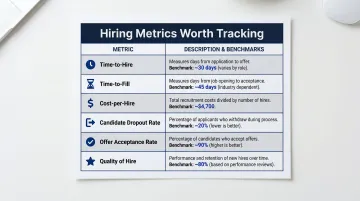
When time-to-hire is long, map where candidates are waiting longest — screening, scheduling, or the final decision. Each bottleneck has a specific fix. Data makes the diagnosis objective rather than anecdotal.
Track a baseline before making any process changes, then compare results at 30, 60, and 90 days. A single fix to your highest-dropout stage often cuts overall time-to-hire faster than sweeping process overhauls.
Frequently Asked Questions
How do I improve recruitment efficiency?
Focus on three levers: shift to proactive outbound sourcing so you're not waiting on job board traffic, standardize your interview process with structured questions and scorecards, and track metrics like time-to-hire and candidate dropout rate to identify where candidates are stalling.
What metrics should I track to measure hiring efficiency?
The six metrics that matter most are time-to-hire, time-to-fill, cost-per-hire, candidate dropout rate, offer acceptance rate, and quality of hire. Quality of hire is measured by early performance ratings and 90-day retention. Start with whichever you currently don't track — that gap is where your biggest bottleneck lives.
What is the difference between time-to-hire and time-to-fill?
Time-to-hire measures from a candidate's application date to their offer acceptance. Time-to-fill covers the full period from when the role was opened — including writing and posting the job description — to when it was filled. Both matter, but they diagnose different problems.
How can I reduce cost-per-hire without sacrificing quality?
Use employee referrals, which consistently produce lower cost and higher retention. Replace agency fees with a self-serve outbound sourcing platform like Obra Hire. Tighten job descriptions to reduce unqualified applicants early. And reduce interview rounds — internal time spent in unnecessary interviews is a real cost that rarely appears on a cost-per-hire calculation.
How does outbound hiring compare to inbound for efficiency?
Outbound hiring puts your team in control of who enters the pipeline rather than waiting to see who applies. It bypasses the surge in AI-generated applications, reaches the 70–73% of professionals who aren't browsing job boards, and typically surfaces higher-quality candidates faster — particularly for specialized or senior roles where high application volume rarely signals high quality.
How many interview rounds is ideal?
Most roles can be thoroughly evaluated in two to three rounds when each interview is structured with a distinct purpose and assigned competencies. Beyond three rounds, the incremental value of additional interviews rarely justifies the time cost or the candidate drop-off risk it creates.