Introduction
Post a job on Indeed or LinkedIn and you'll likely have hundreds of applications within 48 hours. Sounds ideal — until you realize that 84% of HR teams report heavier workloads as AI-tailored applications flood inbound channels, and most of those applicants were never a real fit to begin with.
Meanwhile, the candidates you actually want — the experienced, passive professionals who aren't browsing job boards — never saw your posting.
This tension is forcing hiring teams to reconsider how they source talent. Traditional job boards still dominate recruiting budgets, but the model they're built on was designed for a pre-AI hiring world.
This guide breaks down exactly how AI recruiting platforms differ from job boards, where each delivers real value, and how to decide which approach — or which combination — fits your hiring goals.
TL;DR
- Job boards are inbound (candidates come to you); AI recruiting platforms are outbound (you go find them)
- Job boards reach only active seekers — roughly 30% of the workforce; AI platforms access the other 70%
- AI platforms match on competency and skills; job boards rank by keyword volume, producing more noise than signal
- AI platforms typically reduce cost-per-hire when total recruiter screening time is counted
- Neither is universally better — role type, seniority, and team bandwidth determine the right fit
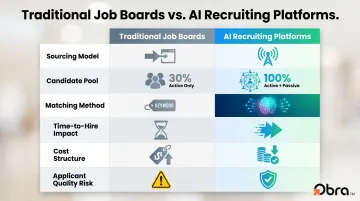
AI Recruiting Platforms vs Traditional Job Boards: Quick Comparison
| Dimension | Traditional Job Boards | AI Recruiting Platforms |
|---|---|---|
| Sourcing Model | Inbound (candidates apply) | Outbound (you search candidates) |
| Candidate Pool | Active job seekers only | Active + passive candidates |
| Matching Method | Keyword filtering | Competency/skills-based AI matching |
| Time-to-Hire Impact | Adds top-of-funnel wait time | Compresses funnel by pre-vetting candidates |
| Cost Structure | Per-post or per-click | Subscription or credit-based |
| Applicant Quality Risk | High — AI-generated spam increasing | Lower — verified profile filtering available |
Note: This comparison assumes a standalone job board versus a dedicated AI recruiting platform. It does not describe an ATS, which manages candidates already in your pipeline rather than sourcing new ones.
What Are Traditional Job Boards?
Job boards like Indeed, ZipRecruiter, and LinkedIn operate on a simple premise: employers post open roles, candidates browse and apply. This model dominated recruiting for two decades when job boards were the primary way candidates found open roles. Two structural problems have since eroded that advantage.
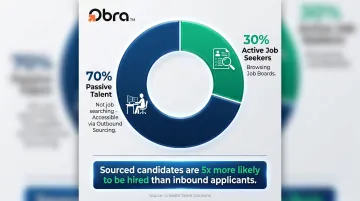
Candidate reach is limited. Job boards only surface active job seekers — roughly 30% of the workforce. The other 70% are passive candidates who simply aren't browsing listings. For roles requiring specific skills or experience, that's a narrow pool to work from.
Application quality has deteriorated. According to a Robert Half survey, 67% of HR leaders say AI-generated applications are actively slowing their hiring process. The average applicant-to-hire ratio for U.S. SMBs has climbed to roughly 180:1, with only about 5% of applicants reaching an interview — a significant screening burden for every single hire.
Where Job Boards Still Make Sense
Job boards aren't obsolete — they're just misapplied when used as a universal solution. They work well for:
- High-volume, entry-level roles — retail, hospitality, food service, warehouse
- Roles with predictable inbound interest — customer service, administrative, sales
- Short time-to-fill requirements — restaurants average just 10.2 days to fill, partly because volume works in their favor at that level
In these contexts, high inbound volume is an asset. The screening bar is straightforward, and a large applicant pool gives teams the pipeline to fill multiple roles quickly.
What Are AI Recruiting Platforms?
AI recruiting platforms flip the job board model. Instead of waiting for candidates to apply, these platforms proactively search aggregated databases of 100M to 800M+ profiles and surface best-fit candidates based on your role's actual requirements — before those candidates ever submit an application.
How AI Matching Works in Practice
Traditional job boards match on keywords: a resume contains "Python" and gets flagged for a Python developer role. The problem is that keyword presence doesn't indicate proficiency level, context, or whether the candidate actually built anything meaningful with the skill.
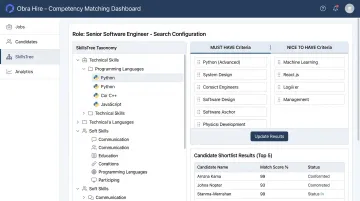
AI recruiting platforms replace this with competency-based matching. Platforms like Obra Hire use structured criteria, separating "Must Have" requirements that filter the candidate pool from "Nice to Have" criteria that rank candidates within it. The result is a shortlist where every profile meets baseline requirements, not just a stack of resumes that mention the right words.
Solving the Fake Profile Problem
One differentiator that's become increasingly important: verified profile filtering. Gartner projects that AI-generated or fake profiles will affect 1 in 4 profiles by 2028. Inbound job boards have no structural defense against this — anyone can apply. AI sourcing platforms with verified profile filtering surface only authenticated candidates, cutting exposure to fraudulent or duplicate profiles before you spend a single contact credit.
Obra Hire takes this approach further with 800M+ verified candidate profiles, competency-based matching through its SkillsTree taxonomy (8,241 skills with proficiency levels), and unlimited search on every plan, including free. Teams can preview their full candidate pool before spending a single contact credit.
Where AI Recruiting Platforms Deliver the Highest ROI
The outbound sourcing model consistently outperforms inbound in four scenarios:
- Specialized or hard-to-fill roles where passive candidates dominate the qualified talent pool
- Mid-to-senior positions where job board postings produce weak signal-to-noise
- Lean in-house recruiting teams replacing expensive agency seats or LinkedIn Recruiter licenses
- Staffing agencies scaling outreach across multiple clients without adding headcount
According to LinkedIn Talent Solutions, **70% of the global workforce is passive talent** — not actively job searching. Sourced candidates are 5x more likely to be hired than inbound applicants. For any role above entry level, that math matters.
Head-to-Head: Which Is Better for Your Hiring Strategy?
Four factors should drive your decision:
- Role complexity and seniority
- Budget and cost-per-hire targets
- Whether your target candidates are active or passive
- Your team's capacity for manual screening
Speed and Time-to-Fill
The U.S. average time-to-hire has climbed to roughly 42 days — up 24% since 2021. Tech roles average 61 days. AI sourcing tools report cutting time-to-hire by 50–70% by eliminating the top-of-funnel wait: instead of waiting for applications and screening a pile, you start with a pre-filtered shortlist.
86.1% of recruiters using AI tools say the technology accelerates the overall hiring process, per SHRM's Workplace Tech Pulse.
Cost and ROI
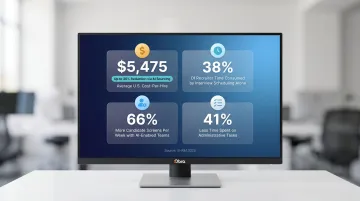
The U.S. average cost-per-hire is $5,475 for non-executive roles (SHRM 2025). AI sourcing can reduce that by up to 30%.
The real hidden cost of job boards isn't the posting fee — it's recruiter time. Interview scheduling alone consumes 38% of total recruiter time. AI-enabled teams complete 66% more candidate screens per week and spend 41% less time on administrative tasks.
Obra Hire's pricing structure keeps those costs in check across team sizes:
| Plan | Monthly Cost | Contact Credits |
|---|---|---|
| Free | $0 | 50 credits + 1,000 profile views |
| Explore | $109/month | 500 credits |
| Scale | $169/month | 1,200 credits (pooled team-wide) |
For context, a single LinkedIn Recruiter seat or a few sponsored Indeed posts can easily exceed those figures without the outbound reach.
Candidate Quality and Fit
Competency-based matching consistently outperforms keyword/volume matching on quality indicators:
- Skills-based hires show ~10% higher retention than degree-required hires (HBR/Burning Glass Institute)
- Candidates sourced through LinkedIn are 40% less likely to leave within the first six months compared to other channels
- Companies using AI-assisted messaging are 9% more likely to make a quality hire (LinkedIn Future of Recruiting 2025)
Outbound-sourced candidates also tend to be more reliable at the interview stage, since they've been contacted based on verified criteria rather than self-selecting on a job title keyword.
Situational Recommendation
| Scenario | Better Choice |
|---|---|
| High-volume, entry-level, or shift work | Traditional job board |
| Standardized roles with predictable inbound interest | Traditional job board |
| Specialized, mid-to-senior, or hard-to-fill roles | AI recruiting platform |
| Passive candidate-heavy talent markets | AI recruiting platform |
| Lean team needing to reduce manual screening | AI recruiting platform |
| Tight cost-per-hire targets on competitive roles | AI recruiting platform |
Real-World Impact: From Job Boards to AI-Powered Hiring
The case for AI sourcing isn't theoretical. Unilever implemented AI-enhanced screening for its 1.8 million annual applications and achieved a 90% reduction in time-to-hire, saving over 50,000 recruiter hours in the process. Mastercard cut interview scheduling time by 85% using automated conversational tools.

These are large enterprise examples, but the underlying dynamic applies to any team: the bottleneck in hiring isn't finding interested candidates — it's finding qualified ones efficiently. Job boards generate volume. AI platforms surface relevance — and for most teams, that distinction decides whether a search takes days or weeks.
For smaller teams, the impact is often sharper. Sabyn Hansen, Manager of People & Culture at Canopy, put it simply: "Sourcing and screening pull you into tasks that slow your day. Obra Hire makes it easy to see the qualified candidates you want without digging through piles of profiles."
Teams still dependent on job boards are working with a structural disadvantage — they're accessing roughly 30% of the talent market while filtering through AI-generated noise to find the signal.
Obra Hire's free plan lets any team test outbound recruiting directly: search 800M+ verified profiles, preview your full candidate pool, and confirm match quality before spending a single credit. No contract or sales call required. Explore Obra Hire's free plan.
Conclusion
If your roles attract motivated, active applicants and you have the bandwidth to manage inbound volume, job boards remain a viable tool. There's no reason to abandon them for entry-level or high-volume hiring where they perform well.
But if you're competing for specialized talent, dealing with application quality issues, or trying to reduce cost-per-hire without sacrificing candidate fit, the evidence favors AI recruiting platforms. Passive candidate dominance, time-to-hire inflation, and AI-generated application noise all push toward the same conclusion: inbound pipelines alone can't fill competitive roles efficiently.
Outbound recruiting gives your team control over who they reach rather than waiting on whoever applies. Job boards show you the 30% who are actively looking. AI platforms give you access to the other 70%. Obra Hire's outbound search across 800M+ verified profiles is one way hiring teams are making that shift without overhauling their existing workflows.
Frequently Asked Questions
How do AI recruitment tools differ from traditional job boards?
Job boards are passive inbound channels — candidates apply to roles you've posted, and you sort through the results. AI recruiting tools proactively search candidate databases and surface qualified matches, including passive candidates, using competency-based matching rather than keyword filtering.
What are the best AI recruitment and sourcing tools for HR professionals?
Leading options include Obra Hire, LinkedIn Recruiter, hireEZ, and Eightfold. The right fit depends on your use case — outbound sourcing volume, role type, ATS integration needs, and budget. Obra Hire offers a freemium entry point with verified profile access, making it a practical starting point for teams new to outbound sourcing.
Is AI replacing talent acquisition?
No — AI is automating the high-volume, repetitive parts of recruiting (sourcing, screening, scheduling), but human judgment remains essential for final selection, culture fit assessment, and candidate relationship management. The Bureau of Labor Statistics projects 6% job growth for HR specialists through 2034, twice the national average.
Do recruiters care if applicants use AI to write their resumes?
Most recruiters are aware of the trend, and some platforms now flag AI-generated content. The bigger concern is volume — AI-written resumes are degrading applicant quality on job boards, which is why verified, outbound-sourced profiles are increasingly valuable to hiring teams.
Can AI recruiting platforms integrate with my existing ATS?
Yes. Most leading platforms offer broad ATS compatibility — Obra Hire integrates with 85+ ATS/HRIS platforms including Workday, Greenhouse, iCIMS, Lever, and SAP SuccessFactors. Teams can layer outbound AI sourcing on top of existing workflows without replacing current systems.
Are AI recruiting platforms cost-effective for small or mid-sized businesses?
Many platforms, including Obra Hire, offer freemium or credit-based entry points that make them accessible to smaller teams. The ROI case is often strongest for lean teams: a one- or two-person HR function gains the most from automation that cuts manual screening time and widens candidate reach without adding headcount.