The cost of that mismatch is real. Healthcare roles average 49 days to fill, and physician searches routinely stretch beyond 90 days — with credentialing adding another 30 to 90 days on top. Meanwhile, approximately 73% of applicants are not qualified for the roles they apply to, meaning recruiters processing hundreds of applications are largely sifting noise.
This article breaks down the specific mechanisms recruiting platforms use to tailor searches to industry context — not just dropdown filters, but the underlying architecture that determines whether a platform can actually find a CNC operator, a licensed RN, or a Series 7-certified broker.
TL;DR
- Industry-specific recruiting requires skills taxonomy depth, verified filtering, and competency matching — keyword search alone won't cut it
- Generic platforms fall short in healthcare, trades, and regulated industries because they can't interpret credentials, licenses, or domain-specific qualifications
- 70% of the global workforce is passive — industries with low active-applicant rates require outbound search capabilities, not just inbound job post management
- Platforms like Obra Hire address this with direct access to 800M+ verified profiles and pool preview before spending credits
- Evaluate platforms on taxonomy depth, passive candidate reach, verified profiles, and blue- and gray-collar coverage
What Is Industry-Specific Talent Search?
Industry-specific talent search is a recruiting platform's ability to filter, rank, and surface candidates not just by job title or keyword, but by the competencies, credentials, licenses, and domain-specific experience that actually define fit in a given sector.
Most ATS and job board platforms were built for professional, white-collar hiring workflows. They apply the same logic to every search — which works reasonably well for a marketing manager role, and breaks down completely when you're sourcing a respiratory therapist or a licensed electrician.
The problem runs deeper than a missing filter or two:
- Skills taxonomies that collapse "healthcare" into a single category rather than distinguishing between care settings, specializations, and license types
- Candidate pools that index resume-submitting professionals but miss trades workers who don't maintain polished LinkedIn profiles
- Matching logic that compares job titles rather than what a candidate can actually do
True industry tailoring means the platform's underlying data structure — how it maps skills, organizes candidate profiles, and interprets what a role requires — was built with industry-specific complexity in mind.
How Recruiting Platforms Tailor Talent Searches
Platform-level industry tailoring operates across four mechanisms. Platforms vary significantly in how thoroughly they implement each.
Industry Skills Taxonomies
The foundation of industry-specific search is the platform's skills taxonomy: a structured map of skills, competencies, and proficiency levels that the system uses to interpret both what a role requires and what a candidate offers.
Taxonomy depth varies considerably across providers:
| Provider | Skills Tracked | Approach |
|---|---|---|
| Lightcast | 34,000+ skills | 3-tier hierarchy with machine-readable identifiers |
| LinkedIn Skills Graph | 41,000+ skills | Graph-based ontology mapping skill relationships |
| Workday Skills Cloud | ~55,000 skills | ML-powered universal ontology inferred from profiles |
| Obra Hire (SkillsTree) | 8,241 skills with proficiency levels | Competency-based matching with Must Have / Nice to Have structure |
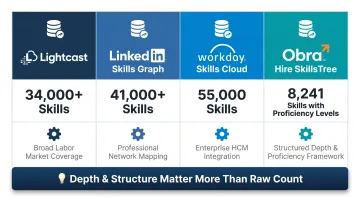
A shallow taxonomy treats "nursing" as a single entry — a deeper one separates ICU certifications, long-term care experience, APRN licensing, and specific care setting requirements. As Josh Bersin noted, a true skills ontology is "a dynamic database where every term is part of a broader, interconnected architecture rather than an isolated, unverified word."
The same principle applies in tech. A search for a fintech Python developer should surface candidates with algorithmic trading experience — not everyone who mentioned Python in a resume five years ago.
Candidate Pool Architecture and Outbound Access
In industries with low active-applicant rates — healthcare, skilled trades, specialized engineering — the platform's ability to reach passive candidates matters as much as its search logic.
70% of the global workforce is passive talent not actively job searching. Outbound-sourced candidates convert to hires at 6% compared to 1% for inbound applicants — a gap that matters when filling low-applicant roles.
Inbound-only platforms aren't built for this — qualified candidates in these fields rarely submit applications.
Outbound-first platforms solve this by letting recruiters search a verified candidate database directly and initiate contact — bypassing the job post entirely. Obra Hire's approach illustrates how this works: recruiters describe their ideal candidate in natural language or paste a job description, the platform searches 800M+ profiles and returns ranked, skill-matched results, and the team can preview the estimated pool size before spending any contact credits.
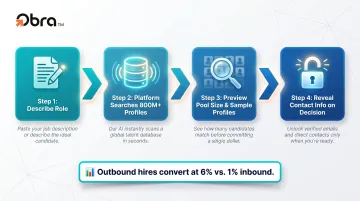
Contact information — email, phone, LinkedIn, resume — is revealed only when the recruiter decides to proceed, keeping costs proportional to actual hiring intent.
Credential and Verification Filtering
In regulated industries, credential filtering isn't optional. A platform that surfaces candidates who lack the required licensure wastes recruiter time by generating structurally ineligible results.
The verification problem has grown more urgent. Gartner predicts that by 2028, 1 in 4 candidate profiles globally will be fake, driven by generative AI tools. In a Gartner survey of 3,000 candidates, 6% admitted to interview fraud. For industries where a misrepresented credential creates legal or operational liability — healthcare, childcare, finance, security — verified profile filtering has become a baseline requirement, not a differentiator.
Obra Hire addresses this directly with verified profile filtering on paid plans, designed specifically to reduce exposure to AI-generated or fake candidate profiles.
Competency-Based Matching Logic
Title-to-title matching breaks down in industries where the same underlying role carries dozens of different labels. Consider two examples:
- A "Maintenance Technician" at one manufacturer may be equivalent to a "Facilities Engineer" at another
- A "Senior Developer" at a startup maps differently than the same title at an enterprise
Competency-based matching interprets what a candidate can actually do — based on structured skills data, proficiency levels, and demonstrated experience — rather than comparing text strings. Obra Hire's matching logic uses a two-tier structure: Must Haves determine which candidates enter the pool, while Nice to Haves rank qualified candidates so the strongest matches surface first.
This reduces the burden on recruiters to know every title variation across organizations and lets the matching system do the interpretive work.
Industries Where Tailored Search Makes the Biggest Difference
Four verticals show the clearest gap between generic and industry-tailored platforms.
Healthcare and Life Sciences
Healthcare hiring is defined by licensure, specialty certifications, and care setting requirements that keyword search cannot reliably interpret. A platform that can't distinguish between an RN and an LPN or between acute care and long-term care experience will surface candidates who are legally ineligible for the role.
The stakes are measurable:
- Primary care physician roles took a median of 93 days to fill in 2024, with credentialing adding 30–90 days after the hire decision
- The U.S. faces a projected shortage of 141,160 FTE physicians by 2038 (HRSA)
- 65,766 qualified RN applicants were turned away from nursing programs in a single year due to capacity constraints
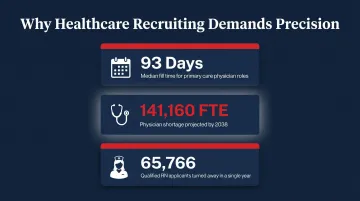
The pipeline itself is constrained. Every sourcing inefficiency compounds the shortage.
Platforms that treat healthcare credentials as hard filters rather than keyword signals compress time-to-fill by days or weeks.
Technology and Software
Tech hiring faces the opposite problem from healthcare: titles are inconsistent across organizations while skill requirements are precise. A "Staff Software Developer" at one company and a "Senior Engineer" at another may be identical in capability.
Competency-based platforms with language- and framework-level proficiency signals (not just title matching) outperform generic tools significantly here. The ability to surface a backend engineer with specific distributed systems experience, regardless of what their current employer calls the role, is the key advantage.
Manufacturing, Skilled Trades, and Blue-Collar Roles
This is the most underserved category in recruiting platform design. Most platforms were built for office-based, resume-submitting candidates , which creates a structural gap for industries hiring welders, CNC operators, electricians, and HVAC technicians.
The numbers reflect the urgency: 1.9 million of 3.8 million projected manufacturing positions could go unfilled by 2033 if current talent trends continue, and 72% of Industrials employers report they cannot find workers with the right skills. These aren't low-value roles : average manufacturing earnings exceed $102,000 annually.
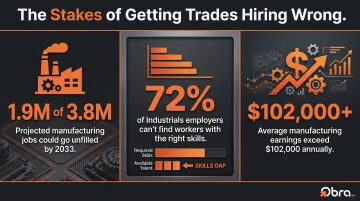
Trades workers aren't submitting applications to job boards. Outbound search platforms like Obra Hire address this directly, indexing skilled trades profiles — electricians, CDL-A drivers, and similar roles — so recruiters can initiate contact rather than wait for applications that won't come.
Finance, Legal, and Regulated Professional Services
Compliance-sensitive industries require platforms that treat certification status and jurisdictional licensing as binary eligibility criteria, not optional search signals. A financial services recruiter searching for a licensed securities broker needs the platform to filter out unregistered candidates before they reach the results , not after reviewing them.
The compliance context reinforces why this matters operationally. FINRA fines reached $75 million in 2025, a 27% increase from the prior year. Hiring someone without the required credentials into a regulated role creates liability that far exceeds any recruiting cost savings.
What to Look for in a Recruiting Platform for Your Industry
Three areas separate platforms that can handle specialized hiring from those that can't.
1. Assess skills taxonomy depth before committing
Ask vendors specifically:
- How many industry-relevant skills does your taxonomy include?
- Do skills carry proficiency levels, or are they flat tags?
- Can the system distinguish credential-based qualifications from general experience?
A taxonomy that treats "nursing" as a single skill won't serve a healthcare team sourcing for ICU-specific roles. The same applies to trades certifications and regulated industry licenses.
2. Verify candidate pool coverage matches your hiring reality
If your industry relies on passive candidates, blue-collar workers, or professionals who don't maintain active profiles, verify that the platform supports outbound search with verified data.
Look for platforms that let you preview pool size before purchasing access. Obra Hire's preview functionality, available on every plan including the free tier, shows estimated candidate count and sample profiles before any credits are spent — so teams can validate fit before committing resources.
3. Confirm verification filtering and integration support
In credential-heavy industries, prioritize platforms that filter AI-generated or unverified profiles. With Gartner projecting 1 in 4 profiles will be fake by 2028, verification filtering directly reduces the time recruiters spend on ineligible candidates.
Integration support matters just as much. Confirm the platform connects with your existing ATS or HRIS without disrupting current workflows. Obra Hire integrates with 85+ platforms — including Workday, Greenhouse, iCIMS, Lever, and SAP SuccessFactors — so teams can source outbound candidates without rebuilding their hiring infrastructure around a new tool.
Conclusion
Industry-specific talent search isn't a feature layer added on top of a generic platform. It comes down to deliberate architecture: how a platform structures its skills taxonomy, whether its candidate database reflects real industry depth, and how its matching logic handles domain-specific qualifications rather than surface-level text strings.
Recruiters who understand which mechanisms their platform actually implements — and which it lacks — are better positioned to close sourcing gaps, reduce time-to-fill, and stop running searches that surface the wrong candidates. For the roles that matter most, the difference between a platform that understands your industry and one that merely searches it shows up directly in candidate quality. Obra Hire's SkillsTree taxonomy — built around 8,241 skills with proficiency levels — is designed precisely to make that distinction work in practice.
Frequently Asked Questions
What makes a recruiting platform truly industry-specific?
Industry specificity comes from the platform's underlying skills taxonomy and matching logic, not filter menus. Platforms with competency-based frameworks that map credentials, proficiency levels, and domain knowledge to role families deliver meaningfully different results than those relying on keyword or title matching.
Can a general recruiting platform work for niche industries?
General platforms work reasonably well for high-volume, low-specialization roles. They consistently underperform for niche industries where credentials, licenses, or domain-specific skills define eligibility; the more regulated the role, the more taxonomy depth matters.
How do recruiting platforms handle regulated industries like healthcare or finance?
Purpose-built platforms for regulated industries incorporate hard filters for licensure, certification status, and jurisdiction-specific credentials, treating these as binary eligibility criteria. Profile verification runs in parallel to confirm candidates meet compliance thresholds before reaching the recruiter's review queue.
What is the difference between keyword search and competency-based matching?
Keyword search matches text strings in resumes; competency-based matching interprets what a candidate can actually do based on structured skills data, proficiency levels, and transferable experience. This surfaces qualified candidates who described the same skills using different terminology across different employers.
Do recruiting platforms cover blue-collar and skilled trades hiring?
Most enterprise recruiting platforms target white-collar, resume-submitting candidates, which creates a structural gap for trades and hourly roles. Platforms that index blue-, gray-, and white-collar candidates with outbound search and trade-relevant skills taxonomies are rare, not the norm.
How do recruiting platforms verify that candidate profiles are accurate?
The most rigorous platforms apply verified profile filtering, cross-referencing public data sources and using behavioral signals to flag AI-generated entries. This matters most in industries where a misrepresented credential creates legal or operational liability.