Introduction
Hiring teams adopted AI resume screening to solve a real problem: too many applicants, too little time. It worked — until candidates started using AI back.
Since ChatGPT launched in late 2022, the average number of applications per candidate has increased 239%. Bots apply to hundreds of jobs overnight. Candidates inject hidden keywords to trick filters. LinkedIn now processes roughly 11,000 applications per minute.
The result: AI screening tools built for a human-volume world are now drowning in AI-generated noise. More applications are coming in, but the quality hasn't improved — and the tools meant to fix the problem are making it worse.
If you're still relying on inbound screening to find qualified candidates, you're fighting the wrong battle. This post breaks down exactly why AI resume screening fails at a structural level, how outbound candidate matching works differently, and how to decide which approach matches your team's size and volume.
TL;DR
- AI resume screening was built for application overload, not AI-generated application floods
- Most screeners reward keyword optimization, not actual qualifications, filtering out strong non-traditional candidates
- Outbound matching flips the model: search verified, passive candidates instead of filtering a compromised inbound pool
- ~70% of professionals are passive candidates and never appear in your inbound funnel
- The right approach depends on role volume, urgency, and where your hiring bottleneck actually sits
AI Resume Screening vs. Outbound Candidate Matching: At a Glance
AI resume screening and outbound candidate matching aren't competing features — they're built on opposite assumptions about where good candidates come from.
| Factor | AI Resume Screening | Outbound Candidate Matching |
|---|---|---|
| Candidate source | Inbound applications | Proactive search of passive talent |
| AI's role | Filters a compromised pool | Matches against verified profiles |
| Bias exposure | High — trained on historical hiring data | Lower — competency-based criteria |
| Fake/AI-generated application risk | High | Eliminated through verified profile filtering |
| Time-to-qualified candidate | Dependent on application volume | Recruiter-controlled |
| Passive talent access | None | Primary advantage |
The core tradeoff is this: AI screening scales your ability to filter applications. Outbound matching scales your ability to find better candidates before they ever apply. When AI-generated applications have flooded inbound pipelines, filtering speed is no longer the bottleneck — sourcing quality is.
Why AI Resume Screening Is Broken
The Inbound Pool Is Compromised
AI screening tools were built for a world where humans applied to jobs. That world no longer exists.
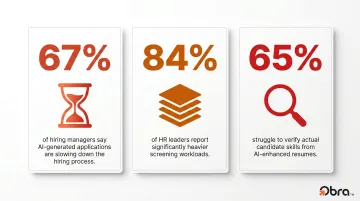
According to a Robert Half survey of 2,000+ U.S. hiring managers, HR leaders are feeling the squeeze across the board:
- 67% say AI-generated applications are actively slowing hiring
- 84% report significantly heavier workloads
- 65% say AI-enhanced resumes make it harder to verify actual skills
The 2026 Lever/Employ Hiring Benchmarks Report — drawn from 6,000+ customers — confirms the same pattern: more application volume has not produced a more qualified candidate pool. The inbound funnel has more noise, not more signal.
Bias Baked Into the Model
AI screeners learn from historical hiring data. That data reflects decades of biased human decisions.
Amazon's case is the clearest example: their AI recruiting tool, trained on 10 years of resume submissions, learned to penalize resumes containing the word "women's" and downgraded graduates of all-women's colleges. Amazon shut the project down.
The problem isn't limited to one company. A University of Washington study published in October 2024 tested three large language models across 3 million resume comparisons and found white-associated names were favored 85.1% of the time versus 8.6% for Black-associated names. Black male-associated names were never preferred over white male-associated names — not once.
Meanwhile, the Harvard Business School "Hidden Workers" study found that automated screening systems have excluded more than 27 million otherwise-qualified workers in the U.S. through rigid algorithmic filters — rejecting candidates for employment gaps, non-traditional career paths, or missing credential keywords.
Keyword Matching Rewards Gaming, Not Qualification
Most ATS and AI screening tools operate on keyword or pattern matching. The incentive this creates is straightforward: candidates who know the system game it.
Greenhouse's 2025 AI in Hiring report found 41% of U.S. job seekers now use "prompt injections" — hidden text inserted into resumes specifically to bypass ATS keyword filters.
Strong candidates from non-traditional backgrounds, meanwhile, get filtered out for describing the same skills with different words. The algorithm doesn't know they're equivalent. It just doesn't see the keyword.
That opacity doesn't just hurt candidates — it creates legal exposure for employers.
Black-Box Decisions with No Accountability
When an AI screener rejects a candidate, no one can explain why. There's no reasoning, no audit trail, no way to identify discriminatory patterns — or fix them.
This is a legal problem, not just an ethical one. Regulators are moving fast:
- NYC Local Law 144 requires annual independent bias audits for any automated employment decision tool
- The EU AI Act classifies employment AI as "high-risk," with penalties up to €35 million or 7% of global annual turnover
- The EEOC has clarified that employers remain liable under Title VII for adverse impact caused by AI screening tools — even when a third-party vendor built them

Despite this, only 51% of employers are confident AI is used fairly in their hiring processes, and 65% acknowledge their AI systems reject applicants automatically before any human review.
Screening a Compromised Pool Still Produces Compromised Results
Here's the structural problem that no amount of screening improvement can fix: AI screening can only find the best candidates within the inbound applicant pool. It cannot reach anyone outside it.
LinkedIn's data indicates roughly 70% of the global professional workforce is not actively job-seeking. The most qualified candidates for most roles are passive. They're not browsing job boards. They're not submitting applications. They will never appear in an inbound funnel — no matter how good your screening AI is.
What Is Outbound Candidate Matching — and How Does It Work?
The Core Concept
Outbound candidate matching is the practice of proactively searching a database of verified candidate profiles to identify and directly contact qualified individuals — rather than waiting for applicants to find your job posting.
This inverts the traditional hiring funnel. Recruiters search, select, and contact — rather than post, wait, and filter. Control shifts from the application queue to the recruiter's hands.
Competency-Based Matching vs. Keyword Search
Traditional screening asks: does this resume contain the right words? Outbound matching asks: can this person actually do the job?
Obra Hire's approach uses structured competency data — not text-based keyword parsing — to match candidates against role requirements. Each search result shows a clear breakdown of "Must Have" and "Nice to Have" criteria, revealing exactly where a candidate matches or falls short. This is built on SkillsTree, a proprietary taxonomy of 8,241 skills with proficiency levels that enables matching on verified competencies rather than resume language.
Two candidates might describe the same skill in completely different words. Competency-based matching surfaces both; keyword matching surfaces neither — unless they happened to use the exact phrase the algorithm expects.
Access to Passive Candidates
The strategic advantage is access. Approximately 70% of professionals aren't actively job-seeking — but many are open to the right opportunity if approached directly.
Obra Hire provides access to 800M+ searchable candidate profiles. That pool includes candidates who would never respond to a job posting because they never saw it. Outbound hiring reaches them first, before competitors know they're available.
Verified Profiles Eliminate Fake Applicants
Outbound platforms with verified profile filtering eliminate the AI-generated application problem entirely. Recruiters are searching real people's verified professional profiles — not inbound submissions that could be fabricated, keyword-stuffed, or AI-inflated.
Gartner predicts that AI-generated or fake profiles will affect 1 in 4 candidate profiles by 2028. Obra Hire's Verified Profile Filtering (available on Explore and Scale plans) filters search results to surface only verified profiles, keeping that noise out of the recruiting pipeline from the start.
Preview Before Committing, Contact Directly
One practical advantage: recruiters can assess the size and quality of a candidate pool before spending any budget.
Credits are only consumed when contact information is revealed. Before that point, teams can:
- Run unlimited searches at no cost
- Preview full candidate profiles (minus contact details)
- Adjust filters until the pool matches exact criteria
When contact is unlocked, recruiters receive the candidate's email, phone number, LinkedIn URL, and resume — direct access, no third-party gatekeepers. With inbound hiring, that information only arrives after the budget is already spent.
AI Screening vs. Outbound Matching: Which Approach Works Better?
The answer depends on what's actually broken in your hiring process.
Decision Factors
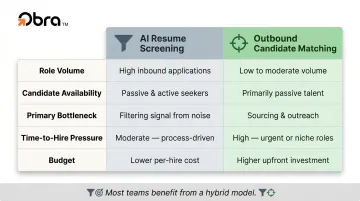
| Factor | Favors AI Screening | Favors Outbound Matching |
|---|---|---|
| Role volume | High-volume, repeatable roles | Specialized or senior roles |
| Candidate availability | Large active applicant pool | Passive-talent-dominated market |
| Primary bottleneck | Application throughput | Candidate quality |
| Time-to-hire pressure | Moderate | High — outbound is faster to qualified candidates |
| Budget | Lower upfront (job posting) | Lower total cost-per-hire |
The SHRM 2025 Recruiting Benchmarking Report puts median time-to-fill at 44–45 days, up from 31 days in 2023. The inbound-dependent model is slowing down as application quality degrades. Outbound bypasses the queue.
Situational Recommendations
Use AI screening when:
- Managing truly high-volume roles (retail, customer service, entry-level) where the applicant pool is large and mostly human
- Screening inbound applications as a secondary filter after outbound sourcing has filled most of the pipeline
Use outbound candidate matching when:
- Filling specialized, senior, or hard-to-fill roles where passive talent dominates
- Inbound quality is too low to screen effectively
- Speed matters and you can't afford 44 days of waiting
For most hiring teams, a hybrid model delivers the best results: outbound to source high-quality passive candidates, light screening to triage whatever inbound comes in. Treat outbound as primary, inbound as supplementary.
How Obra Hire Fits This Model
If you're moving to an outbound-first model, Obra Hire is built for exactly that workflow. Teams can search 800M+ verified profiles, preview candidate pools before spending credits, and push candidates directly into existing ATS platforms through 85+ integrations — including Workday, Greenhouse, Lever, iCIMS, and SAP SuccessFactors.
Getting started costs nothing:
- Free plan: unlimited searches, 1,000 profile views, and 50 contact credits per month
- No credit card, contract, or sales call required
- Enough to validate whether outbound sourcing works for your roles before committing
Conclusion
AI resume screening isn't inherently useless. It's misapplied when used as a substitute for reaching the right candidates in the first place.
Teams relying solely on inbound applications and screening AI are optimizing the wrong end of the funnel. They're building better filters for a pool that's increasingly fake, gamed, and missing the majority of qualified talent.
The real hiring advantage in a post-AI-application era comes from proactively finding and contacting verified, matched candidates before your competitors do. Outbound doesn't replace inbound entirely — it just stops being the bottleneck for the roles where candidate quality matters most.
Organizations that shift even part of their hiring effort toward outbound candidate matching see concrete results:
- Fewer fake and AI-generated applications to sort through
- Higher candidate quality at first contact
- Faster time-to-hire across the roles that matter
The screening didn't improve. The starting point did.
Frequently Asked Questions
How are resumes shortlisted by AI?
AI screening tools use keyword matching, natural language processing, or statistical models to compare resume text against role criteria and rank applicants. Most score on text patterns rather than verified competency — which is why a keyword-optimized resume can outrank a genuinely qualified candidate who simply describes skills differently.
Do employers use AI to screen resumes?
Yes — 97.8% of Fortune 500 companies use an applicant tracking system, and 73% of employers now use AI in hiring decisions broadly. Adoption is growing, but so is scrutiny over bias, accuracy, and the flood of AI-generated applications overwhelming these systems.
What are the main problems with AI resume screening?
The core issues include:
- Bias inherited from historical training data
- Rejection of qualified "hidden workers" with non-traditional backgrounds
- Keyword-gaming by candidates inflating match scores
- Lack of explainability in rejection decisions
- Inability to reach passive candidates who never apply
What is outbound candidate matching?
Outbound candidate matching is the practice of proactively searching a database of verified candidate profiles and directly contacting qualified individuals — rather than waiting for inbound applications. It reaches passive talent (roughly 70% of the workforce) and sidesteps the inbound application funnel entirely — platforms like Obra Hire give recruiters direct access to 800M+ verified profiles to do exactly this.
How can you tell if a candidate is using AI in an interview?
Watch for scripted, generic responses that lack specific personal experience — and test with probing follow-ups. Behavioral questions requiring exact situational detail ("tell me precisely what you said in that conversation") are much harder to fake than broad competency questions.
Can outbound hiring replace inbound applications entirely?
For most organizations, a hybrid model works best. Outbound is superior for specialized, senior, or hard-to-fill roles, while inbound retains value for high-volume entry-level positions with large genuine applicant pools. The key shift is making outbound your primary strategy — not a fallback.