Introduction
Recruiting teams are drowning — not from a shortage of applicants, but from too many of the wrong ones. 51% of employers globally report increased job applications since AI tools went mainstream, and Gartner predicts 1 in 4 job candidates will be fake by 2028. Traditional resume screening — already unreliable for high-volume roles — is collapsing under that weight.
AI candidate matching is the layer that separates signal from noise. Rather than filtering text, it evaluates meaning, competency, and fit — ranking candidates by predicted relevance before a recruiter spends a single second on a profile.
If you're an HR team, in-house recruiter, or staffing agency trying to hire faster without drowning in unqualified applicants, this guide covers what actually works — and where it breaks down.
TL;DR
- AI candidate matching uses machine learning and NLP to rank candidates by role fit, not just keyword presence
- The biggest advantage is consistency at scale: objective screening across hundreds of profiles in seconds
- Match quality depends on two inputs: job description clarity and profile data integrity
- Outbound AI matching unlocks passive talent (70% of the workforce) — not just inbound applicants
- AI reduces workload, not human judgment; recruiters still make the final call
What Is AI Candidate Matching?
AI candidate matching is the automated process of evaluating candidate profiles against job requirements using machine learning and natural language processing — then assigning a fit score or ranking without manual resume review.
The goal is straightforward: surface the highest-probability candidates faster and more consistently than any human screener can manage alone.
Two things it is commonly confused with:
- Basic ATS keyword filtering — legacy systems match text strings, not meaning. A candidate with "Python development" in their resume may never appear for a search using "backend engineering," even when the skills are directly equivalent.
- AI resume screening — this only evaluates people who already applied. AI candidate matching goes further, ranking candidates across an entire talent pool, including people who haven't applied at all.
Treating these as interchangeable means solving the wrong problem — outbound matching surfaces candidates who would never show up in an inbound filter, no matter how well-tuned.
Why Traditional Candidate Matching Falls Short
The Volume Problem
Recruiters spend an average of 23 hours per hire on screening activities — time that compounds fast across open roles. Initial resume scans average just 11 seconds each, which means high-volume hiring becomes a series of snap judgments, not thoughtful evaluation.
The result is inconsistency. Two recruiters reviewing the same stack of applications will produce different shortlists. One recruiter reviewing the same stack on different days will, too.
The Keyword Trap
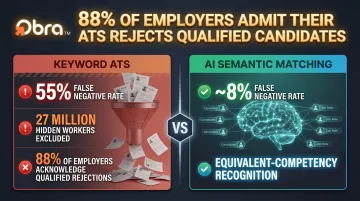
Keyword-based ATS screening produces a 55% false negative rate — rejecting more than half of qualified candidates simply because they used different terminology. A candidate with "client relationship management" experience may never surface for a "customer success manager" search. The competency is identical; the keywords aren't.
The Harvard Business School "Hidden Workers" study identified approximately 27 million U.S. workers systematically excluded by automated filters, with 88% of employers acknowledging their own ATS tools reject qualified candidates this way.
The AI-Generated Application Problem
Inbound pipelines have a newer problem: fake volume. With AI tools enabling candidates to generate polished, keyword-optimized applications at scale, inbound applicant pools are noisier than ever. Faster keyword screening doesn't help — it just processes garbage more efficiently.
What actually helps is shifting the screening model — from filtering noisy inbound applications to proactively searching verified, pre-qualified candidates outbound.
How AI Candidate Matching Works
Step 1: Job Requirement Parsing
The process begins when the system ingests a job description and breaks it into structured components: required skills, experience level, seniority signals, and industry context. Modern systems use NLP to interpret meaning, not just extract text.
This step is where vague job descriptions cause the most damage. If the input is muddled — inflated requirements, buzzword-heavy language, no clear must-haves — the matching model has no clean signal to work from. Writing match-optimized job descriptions:
- List specific skills by name, not vague categories
- Separate must-haves from nice-to-haves explicitly
- Include seniority signals (years of experience, scope of responsibility)
- Avoid redundant requirements that pad the list without adding signal
Step 2: Candidate Profile Analysis
The system analyzes candidate profiles — resumes, career history, role progression — and maps extracted attributes to the same structured taxonomy used in job parsing. Skills, tenure, and career trajectory are all evaluated in context, not just scanned for presence.
Profile completeness directly determines matching accuracy. Sparse or outdated profiles produce weak signals — incomplete data forces the system to guess at fit rather than confirm it.
Obra Hire's approach uses competency-based matching rather than text-based keyword scanning. Structured criteria clearly distinguish "Must Have" requirements (which control who enters the candidate pool) from "Nice to Have" preferences (which influence ranking within that pool).
Step 3: Scoring and Ranking
The system calculates a match score by comparing candidate attributes to job requirements across multiple dimensions — hard skills, experience depth, industry context, and role progression — and returns a ranked shortlist, not an unfiltered applicant pile.
The gap between competency-based and keyword-density systems becomes visible in the results:
| System Type | How It Scores | Common Output |
|---|---|---|
| Keyword-density | Counts term frequency in resume text | False positives — right words, wrong skills |
| Competency-based | Evaluates skill presence at required depth | Ranked candidates matched on actual criteria |
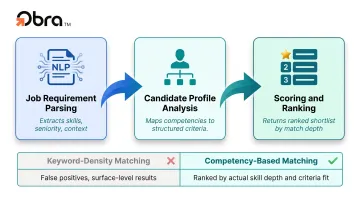
Obra Hire's platform displays a clear breakdown per candidate showing exactly where they meet or fall short on defined criteria — giving recruiters the transparency to audit results, not just accept them.
Key Factors That Affect AI Matching Accuracy
Outbound vs. Inbound Architecture
This is the factor most teams underestimate. AI matching applied only to inbound applicants limits you to the 30% of the workforce actively job searching. 70% of the global workforce is passive talent — not on job boards, not submitting applications — yet 87% remain open to new opportunities.
Outbound AI matching platforms search verified databases of passive candidates and surface profiles that would never appear in an inbound pipeline. Passive candidates are also 120% more likely to want to make an impact in their next role and 33% more likely to stay long-term. Those retention and motivation figures are why outbound architecture matters beyond simple pool size.
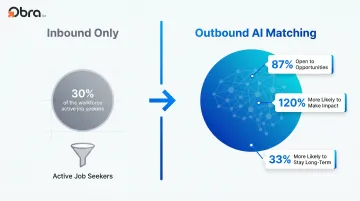
Obra Hire operates on this outbound-first model — searching across 800M+ profiles rather than waiting for applicants to arrive.
Model Sophistication
Architecture determines who you can reach. But once candidates are surfaced, the matching engine determines whether the right ones rise to the top. The gap between keyword-density matching and competency-based taxonomy matching is measurable: semantic matching reduces the false negative rate from 55% to approximately 8% — a roughly 7x improvement in qualified candidate identification.
Systems built on deep skills taxonomies evaluate whether a candidate demonstrates a competency at the required proficiency level, not whether they happened to mention the keyword. Obra Hire's SkillsTree — a proprietary taxonomy of 8,241 skills with defined proficiency levels — is designed specifically for this depth of evaluation.
Candidate Data Integrity
Matching accuracy degrades when profiles are fake, sparse, or artificially inflated. This is the central problem with inbound pipelines flooded by AI-generated applications.
Platforms that filter for verified profiles protect matching quality at the source. When evaluating any AI matching tool, look specifically for how it handles profile verification — this is often the difference between a shortlist you trust and one you have to manually audit from scratch.
Common Misconceptions About AI Candidate Matching
"AI matching is unbiased by default"
This is the most dangerous assumption in the space. AI models inherit the biases present in their training data. Amazon's now-infamous internal recruiting tool (scrapped in 2018) penalized resumes containing the word "women's" because it had been trained on a decade of male-dominated hiring data.
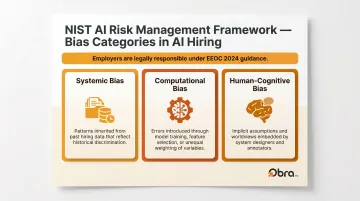
The EEOC's 2024 guidance is direct: employers are legally responsible for discrimination resulting from AI tools, even when provided by third-party vendors. The NIST AI Risk Management Framework identifies three categories of AI bias that can embed themselves in matching models:
- Systemic bias — patterns inherited from historical hiring data
- Computational bias — errors introduced during model training or feature weighting
- Human-cognitive bias — assumptions baked in by the people who designed the system
Bias-free matching requires intentional design: protected-attribute removal, fairness monitoring, and regular bias audits. Automation alone doesn't provide any of that.
"AI candidate matching replaces recruiters"
AI adoption in HR tasks reached 43% in 2025, up from 26% the prior year. But adoption isn't replacement. A Stanford field experiment with 36,862 applicants found that AI-assisted pipelines reduced recruiter workload from roughly 160 hours to 82 hours per hiring cycle, freeing capacity rather than eliminating roles.
SIOP (the Society for Industrial and Organizational Psychology) recommends AI as a decision-support tool, not a sole decision-maker. AI handles pattern recognition at scale. It cannot evaluate culture fit, negotiate expectations, or build candidate relationships. Those remain human work.
"A higher match score always means a better hire"
Match scores measure profile-to-job-description alignment: not potential, adaptability, or long-term fit. Over-indexing on scores means passing over candidates with strong transferable competencies who scored slightly lower because their background doesn't map perfectly to the job description as written.
Treat a match score as a prioritization signal — one input among several, not a hiring decision. The strongest candidates are often the ones a score ranks second.
When AI Candidate Matching May Not Be the Right Fit
AI matching underperforms in specific situations:
- Thin candidate databases — too little data to rank meaningfully, regardless of model quality
- Novel or emerging roles — no historical matching data to learn from; the model is essentially guessing
- Values-dominant hiring — when creative judgment, leadership style, or cultural alignment drive the decision more than skills, algorithmic ranking adds limited value
- Poorly defined roles — if the organization itself hasn't clarified what success looks like, no matching system can define it either

These gaps aren't just operational — they're structural. SIOP notes that many AI hiring tools lack clear definitions of what they measure relative to Knowledge, Skills, Abilities, and Other characteristics (KSAOs). Without that grounding, the system risks "operationalizing homogeneity rather than organizational values."
Signs AI matching is running off the rails:
- Match scores function as a hard pass/fail gate rather than a ranking input
- Low-scored candidates who look strong on review are never investigated or overridden
- No feedback loops or audits track whether ranked candidates actually become successful hires
When these patterns appear, the tool has stopped serving the hiring process and started replacing judgment. Regular accuracy reviews, conversion tracking, and periodic adjustments to search inputs and scoring criteria are what keep AI matching useful rather than automatic.
Frequently Asked Questions
What is the difference between AI candidate matching and traditional ATS screening?
Traditional ATS screening filters by keyword presence — if the exact term isn't in the resume, the candidate gets excluded. AI matching uses NLP and machine learning to evaluate semantic meaning and competency depth, making it significantly less likely to reject qualified candidates who use different terminology for the same skills.
How accurate is AI candidate matching?
Accuracy depends on job description clarity, profile data quality, and model sophistication. Semantic matching systems reduce false negative rates from ~55% to ~8% compared to keyword-based systems. No system is perfectly accurate, which is why human review of ranked shortlists remains essential.
Can AI candidate matching help find passive candidates?
Yes. Outbound AI matching platforms like Obra Hire search large databases of passive talent and surface candidates who haven't applied anywhere — unlike inbound tools, which only work with people who already submitted an application. Since passive candidates represent 70% of the workforce, this distinction matters.
Does AI candidate matching reduce bias in hiring?
AI can reduce certain biases (resume format preference, name-based bias) but can amplify historical bias if trained on skewed data — Amazon's 2018 hiring tool failure is the clearest documented case. Bias reduction requires explicit design choices like protected attribute removal and fairness monitoring, not just AI adoption.
What data does AI use to generate a candidate match score?
Most systems analyze skills, job titles, career progression, experience depth, and education. More sophisticated platforms — like Obra Hire's SkillsTree, which maps 8,241 skills to defined proficiency levels — go beyond raw text comparison by evaluating structured competency taxonomies.
When should a recruiter override an AI candidate match recommendation?
Override when the algorithm can't capture the full picture. Common scenarios include:
- A lower-scored candidate has strong transferable competencies not reflected in their profile
- The job description was vague or inflated, skewing match scores at the input stage
- Qualitative context (a strong referral, portfolio work, or a direct conversation) outweighs what the model can see