](https://file-host.link/website/obra-617n0m/assets/blog-images/6a605b2c-5c8f-492f-aaf5-12927f352826/1779124266261423_fe2224ce799f41ca8ad9c13e27c88470/360.webp)
Introduction
HR and talent acquisition teams are under pressure from multiple directions. Hiring cycles stretch longer — SHRM's 2025 benchmarking data puts the median time-to-fill at roughly 45 days, with large organizations averaging 61 days for non-executive roles. Meanwhile, recruiting budgets are tightening, and the average cost-per-hire sits around $4,700.
The tool sprawl problem makes both issues harder to solve. Only 13% of organizations run a single paid HR solution; nearly half manage two to four tools, and more than a quarter run five or more. Each additional tool adds integration overhead, manual re-entry, and data inconsistency.
A unified talent acquisition platform addresses these pressures directly by eliminating the friction that inflates costs and stretches timelines. What follows is a breakdown of the specific, measurable advantages that come with consolidating TA workflows into one connected system.
TL;DR
- A unified talent acquisition platform connects sourcing, outreach, pipeline tracking, and reporting into one system — eliminating tool-switching and manual re-entry.
- Teams see faster time-to-fill and lower cost-per-hire when data flows seamlessly across every stage of the hiring process.
- Fragmented stacks create invisible costs: duplicate subscriptions, error-prone reporting, and recruiters spending more time on tools than on candidates.
- Data-focused TA teams are 2.5x more likely to exceed hiring goals than those without centralized data.
- ROI compounds over time: consistent use of a unified platform produces measurable gains across every key hiring metric.
What Is a Unified Talent Acquisition Platform?
A unified talent acquisition platform is a single system that connects all core hiring functions — candidate sourcing, outreach, applicant tracking, and pipeline management — so data and workflows move without requiring tool-switching or manual re-entry at each stage.
In practice, it's used by in-house recruiting teams, HR departments, and staffing agencies to manage hiring from first candidate contact to offer. Most modern platforms integrate with existing HRIS and ATS systems, so teams can adopt them without dismantling what's already in place.
The point isn't unification for its own sake. It's that connecting these functions is what makes faster, more affordable, higher-quality hiring repeatable — at any volume.
What It Typically Includes
A fully unified TA platform covers:
- Searchable candidate databases with AI-powered matching and outbound discovery
- Direct contact information, messaging workflows, and outreach tracking
- Shared candidate lists, stage tracking, and team collaboration tools
- Sourcing performance, funnel conversion, and hiring metrics in one dashboard
- Data sync into existing ATS/HRIS systems — no duplicate entry required
Obra Hire, for example, covers all of this in one platform: 800M+ searchable candidate profiles, direct contact reveal, shared team pipelines, and integrations with 85+ ATS/HRIS systems.
Key Advantages of a Unified Talent Acquisition Platform
The advantages below focus on operational outcomes tied to metrics HR and business leaders actually track: cost-per-hire, time-to-fill, candidate quality, data accuracy, and recruiter productivity.
Faster Access to the Right Candidates
Fragmented sourcing forces recruiters to search multiple platforms, compile results manually, and re-enter candidate data before any outreach begins. Time evaporates before the first conversation.
A unified platform eliminates those handoffs. Sourcing, outreach, and pipeline tracking happen in one place — so the path from search to first contact is direct, not indirect.
Why this matters:
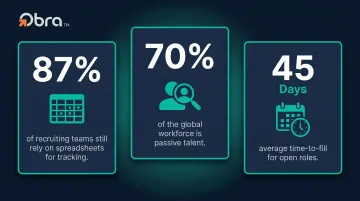
- The Employ Recruiter Nation 2024 report shows 87% of recruiting teams still rely on spreadsheets for tracking, despite 84% claiming to use analytics — a clear sign that manual re-entry is eating recruiter time across the industry
- Approximately 70% of the global workforce is passive, meaning they're not submitting inbound applications. Reaching them requires outbound sourcing tools built into the platform, not bolted on through a separate subscription
- Unfilled roles carry a measurable financial cost — every day a position stays open represents lost productivity, delayed project timelines, or revenue impact that compounds over a 45-day average fill cycle
Platforms built for outbound-first sourcing — like Obra Hire, which lets recruiting teams search 800M+ verified profiles and reach pre-vetted passive candidates directly — compress the gap between opening a req and having qualified candidates in the pipeline.
KPIs impacted: time-to-fill, time-to-slate, candidate quality rate, sourcing cost per candidate, recruiter hours per hire
When it matters most: High-volume hiring, tight labor markets, and lean recruiting teams that can't afford to manually source across multiple disconnected platforms.
Lower Cost-Per-Hire by Eliminating Tool and Process Redundancy
The cost of a fragmented TA tech stack is mostly invisible until someone does the math. Teams pay overlapping subscriptions, spend recruiter time managing integrations, and absorb quiet costs from data errors that require correction downstream.
With sourcing, tracking, and outreach unified in one system, those costs shrink quickly.
The stack fragmentation reality:
| Tools in Stack | % of Organizations |
|---|---|
| Single paid solution | 13% |
| 2–4 tools | 49% |
| 5–7 tools | 21% |
| 11+ tools | 7% |
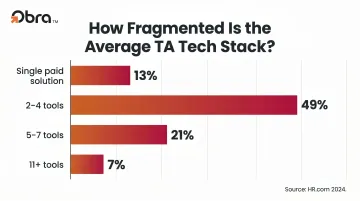
Source: HR.com State of Today's HR Tech Stack, 2024
Most organizations are paying for multiple overlapping tools — and spending recruiter capacity managing the friction between them.
Why consolidation reduces cost:
- Redundant vendor contracts drop off when sourcing, outreach, and pipeline management are covered by one platform
- Less time on manual data entry means more time on candidate engagement — which is where hires actually come from
- One platform, one budget line, one set of metrics — evaluating recruiting ROI stops requiring a finance deep-dive
With SHRM citing an average cost-per-hire of $4,700, even modest efficiency gains across hiring volume have material budget impact. Platforms like Obra Hire that pool team credits centrally — so any contact revealed is visible to the entire team — directly prevent duplicate purchases and wasted spend.
KPIs impacted: cost-per-hire, total TA tool spend, recruiter time-on-admin, number of active vendor contracts
When it matters most: Growing organizations scaling hiring across teams or regions, and companies that have accumulated tool sprawl without evaluating ROI per platform.
Better Hiring Decisions Through Unified Data and Insights
When candidate data is scattered across disconnected tools, accurate reporting requires manual consolidation. Spreadsheet gymnastics become a job function. Bottlenecks go undetected. Bad decisions get made with incomplete information.
A unified platform fixes the root cause: all data — sourcing activity, pipeline stages, outreach results, hiring outcomes — lives in one system. Reporting is accurate, real-time, and doesn't require a custom export to be useful.
What the data shows:
- Data-focused TA teams are 2.5x more likely to exceed hiring goals, 2.3x more likely to improve candidate quality, and 2.1x more likely to reduce time-to-hire than those without centralized data (Lighthouse Research, 2024)
- Skills-based candidate searches are 12% more likely to yield quality hires and 33% more likely to surface in-demand talent, according to LinkedIn data — but that only works when skills data is structured and unified, not scattered across keyword-filtered resumes
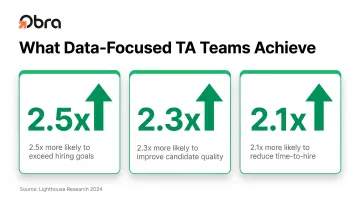
TA leaders who can show concrete metrics — sourcing ROI, funnel conversion rates, quality-of-hire trends — carry more weight in budget conversations. That leverage disappears when the underlying data is fragmented across five platforms.
Despite this, only 20% of organizations measured quality of hire in 2025, down from 27% in 2022 (SHRM). That gap isn't a measurement philosophy problem. It's a data infrastructure problem.
KPIs impacted: data accuracy rate, offer acceptance rate, quality-of-hire, pipeline conversion rate, time-per-stage, hiring manager satisfaction
When it matters most: Organizations managing multiple open roles simultaneously, teams evaluating tech stack consolidation, and any TA function expected to report ROI to leadership.
What Happens When Talent Acquisition Stays Fragmented
Fragmented stacks tend to produce the same problems. Here's what that looks like in practice:
- Duplicate outreach and missed follow-ups. Inconsistent candidate data across tools means two recruiters contact the same candidate, or no one follows up because the status lives in a spreadsheet no one updated.
- Distorted reporting. Manual data entry between tools introduces errors that make sourcing channel analytics unreliable. Teams can't identify which sources produce hires because the data trail breaks mid-funnel.
- Recruiter time going to the wrong place. With 87% of teams still relying on spreadsheets for analytics despite having dedicated tools, the administrative burden is real — and it crowds out candidate-facing work.
- Scaling costs more than it should. Without a unified system, growing hiring volume means adding headcount or tool subscriptions. Output grows linearly while cost grows faster.
The dysfunction doesn't stay internal. HCI research shows 72% of candidates share negative experiences with others — and Radancy's data shows candidate resentment has risen 40% since 2016. Slow response times and inconsistent communication, both byproducts of a fragmented stack, are among the primary drivers.
How to Get the Most Value from a Unified Talent Acquisition Platform
Adopting a unified platform delivers the most value when it's applied consistently across the full hiring cycle — not just one stage. Sourcing, outreach, pipeline tracking, and reporting all need to flow through the same system for the benefits to compound.
A few practical points:
Metrics to track from day one: Time-to-fill, cost-per-hire, source quality, and pipeline conversion signal whether the platform is working. Without these benchmarks, even a capable platform won't show measurable improvement.
Integration over replacement: The most accessible entry points connect with existing ATS and HRIS workflows. Obra Hire integrates with 85+ systems — including Workday, Greenhouse, iCIMS, and SAP SuccessFactors — so teams can add unified sourcing and outreach without disrupting current processes.
Start with the free tier: Obra Hire's free plan includes unlimited searches and 1,000 profile views — enough to validate candidate pool quality before committing. No contract, no setup cost, and no obligation until the value is clear.
Consolidate team usage under one account: Shared credits, centralized admin controls, and pooled candidate data keep the entire team aligned on the same sourcing pipeline — and eliminate redundant spending.
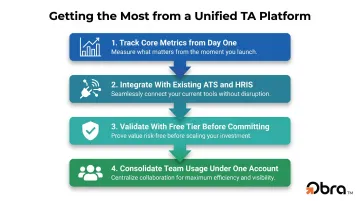
Getting these fundamentals right early means the platform pays off faster and compounds with each new hire cycle.
Conclusion
A unified talent acquisition platform doesn't just cut tool sprawl — it changes what's possible with the data you already have. Hiring becomes faster and cheaper not because of any single feature, but because everything feeding into decisions comes from the same source.
The advantages compound. As data accumulates in one system, patterns become visible, decisions improve, and cost-per-hire trends downward. The teams that see the most sustained improvement are those that treat platform unification as an ongoing practice — regularly reviewing metrics, refining workflows, and following through on what the data reveals.
Teams still running on five disconnected point solutions face a compounding cost: recruiter time lost to manual reconciliation, data gaps that distort decisions, and hiring delays that show up in every metric except the right ones. Consolidation isn't a one-time win — it's what lets good hiring teams become consistent ones.
Frequently Asked Questions
What are the benefits of talent acquisition?
Talent acquisition delivers reduced time-to-fill, lower cost-per-hire, and access to better-fit candidates — building a stronger employer brand over time. Those results improve further when supporting tools are unified, giving TA teams accurate data and faster pipelines without the manual overhead.
What is unified talent?
Unified talent refers to managing all talent-related data and workflows — sourcing, hiring, development, and retention — through connected systems rather than siloed tools. The result is more consistent, data-driven workforce decisions — candidate information stays intact across every stage instead of getting lost between platforms.
What is the difference between a unified talent acquisition platform and an ATS?
An ATS manages inbound applicants through a defined tracking workflow. A unified talent acquisition platform goes further — covering sourcing, outreach, candidate engagement, and analytics. Recruiters get one system from first contact to hire, not just a tool for managing applicants who've already applied.
How does a unified platform reduce cost-per-hire?
Cost reduction comes from three areas: eliminating redundant tool subscriptions, cutting recruiter time lost to manual data entry and system-switching, and improving candidate quality upfront. Better-fit candidates entering the funnel means fewer resources wasted screening people who were never a good match.
Can a unified talent acquisition platform work with existing HR systems?
Yes — most modern unified platforms are built to integrate with, not replace, existing HRIS and ATS workflows. The key is choosing a platform with strong native integrations so candidate data flows automatically without custom development or manual exports.
What are the signs that a talent acquisition process is too fragmented?
Watch for these warning signs:
- Recruiters juggling five or more separate tools daily
- Candidate data that varies across different reports
- No reliable way to pull time-to-fill or source quality metrics without manual work
- Cost-per-hire rising while candidate quality stays flat or drops