Centralized job history tracking is often treated as a "nice to have." In practice, it shows up as fewer audit scrambles, faster screening decisions, and clearer succession pipelines.
This article breaks down five practical, measurable benefits — not abstract promises — and explains when each one matters most.
TL;DR
- Centralized job history tracking consolidates all role data — titles, tenures, promotions, transfers — into one accessible system
- HR teams spend less time retrieving and reconciling employment records scattered across siloed tools
- Compliance documentation becomes instantly retrievable — no more scrambling to assemble records under pressure
- Internal talent gets surfaced for advancement before roles turn into urgent vacancies
- Covers five key benefits: faster hiring decisions, compliance readiness, smarter workforce planning, lower admin costs, and better candidate assessment
What Is Centralized Job History Tracking?
Centralized job history tracking means maintaining a single, unified record of every role, title change, department transfer, promotion, and employment status update for each employee or candidate — stored in one system rather than distributed across multiple platforms.
It applies in two primary contexts:
- Employee lifecycle management — within HRIS platforms tracking promotions, reclassifications, and transfers
- Candidate databases — within ATS or sourcing platforms used during outbound recruiting and background verification
In both contexts, the point is the same: centralized records let HR teams make faster, more accurate decisions at every stage of hiring and workforce management — without chasing down data across disconnected systems first.
5 Key Benefits of Centralized Job History Tracking for HR
These aren't theoretical gains. Each benefit directly affects the metrics HR teams are held accountable for: time-to-hire, compliance risk, workforce planning accuracy, cost-per-hire, and candidate quality.
Benefit 1: Faster, More Confident Hiring Decisions
When job history is centralized, hiring managers see a candidate's full career progression immediately — titles held, tenure at each role, promotions earned — without cross-referencing multiple systems or waiting on manually compiled summaries.
In practice, recruiters can filter candidates by verified role history rather than relying solely on self-reported resumes, cutting time spent on unqualified outreach.
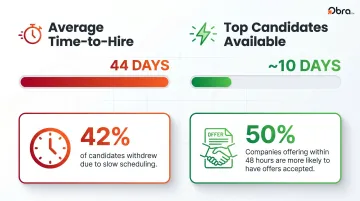
The global average time-to-hire reached 44 days in 2023, while top candidates typically remain available for only about 10 days. That gap is where quality candidates disappear. In 2024, 42% of candidates withdrew from hiring processes because interview scheduling took too long, and 71% of employers who lost candidates to competing offers reported the other employer simply moved faster.
Companies that extend offers within 48 hours of a final interview are 50% more likely to have those offers accepted. Fragmented data adds days to each decision point. Centralization removes those delays.
KPIs impacted: Time-to-hire, time-to-fill, offer acceptance rate, quality-of-hire
When it matters most: High-volume hiring, regulated industries requiring precise experience verification, and outbound sourcing strategies where screening speed is a competitive differentiator.
Benefit 2: Compliance and Audit Readiness Without the Scramble
Centralized job history tracking creates a complete, timestamped record of every role change, classification update, and employment status shift — making compliance documentation retrievable in minutes, not days.
When an audit or legal inquiry arrives, HR can generate a full employment history report immediately rather than piecing together records from payroll, a separate HRIS, and physical filing cabinets.
The cost of getting this wrong is concrete. FLSA violations alone resulted in $149.9 million in recovered back wages in FY 2024, affecting more than 125,000 workers. Employment record gaps — missed reclassifications, undocumented transfers, incomplete termination records — are among the most common triggers for these exposures.
Federal retention requirements add another layer of urgency:
| Regulation | Record Type | Minimum Retention |
|---|---|---|
| EEOC (Title VII, ADA) | All personnel records | 1 year from creation |
| FLSA / EPA | Payroll records | 3 years |
| ADEA | Benefit plans, seniority systems | Duration + 1 year |
| Any active charge | All relevant records | Until final disposition |
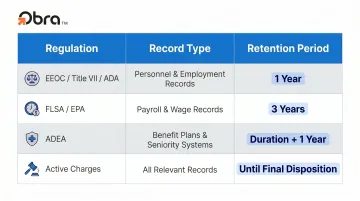
A centralized system with role-level audit trails ensures these requirements are met automatically — not scrambled for at the worst possible moment.
KPIs impacted: Audit preparation time, compliance violation rate, documentation error rate, regulatory penalty risk
When it matters most: Multi-location organizations, regulated industries (healthcare, finance, government contracting), and companies that have recently undergone rapid growth, restructuring, or layoffs.
Benefit 3: Smarter Workforce Planning and Succession Management
When every employee's job history is centralized — lateral moves, cross-functional projects, performance-linked promotions — HR leaders can identify internal talent ready for advancement rather than defaulting to external hiring for every open role.
HR can run reports on employees who have held multiple relevant roles, spot emerging leadership candidates, and flag succession gaps before they become urgent vacancies.
The financial case for internal mobility is clear. External hires are paid 18–20% more than internal promotees yet receive notably lower performance evaluations for their first two years. Filling roles internally is 30–50% faster and costs 30–70% less per hire.
Retention is the other half of the equation. Employees who advance internally are nearly 20% more likely to remain with their organization after two years. Yet 44% of HR leaders say their organizations don't offer compelling career paths — often because the data to have those conversations simply isn't visible in one place.
Centralized job history gives managers the specificity to say "here's where you've been, here's where you could go" — not just "we value your growth."
KPIs impacted: Internal mobility rate, time-to-fill for internal promotions, succession readiness score, employee retention rate
When it matters most: Growing organizations managing rapid headcount expansion, companies facing skill shortages in specialized roles, and HR teams accountable for reducing voluntary turnover.
Benefit 4: Lower Recruitment Costs and Administrative Overhead
Disconnected job history data forces HR teams into repetitive manual work at every stage:
- Re-entering candidate information across multiple systems
- Reconciling conflicting records from payroll and HRIS sources
- Manually compiling employment summaries for each hiring decision or onboarding handoff
Centralization eliminates the loop. A single record updated once propagates across connected systems, reducing duplicate data entry, shortening background check timelines, and accelerating new hire setup.
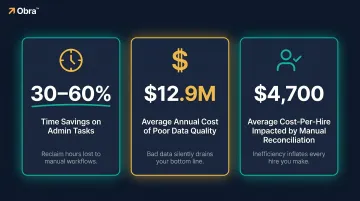
HR teams implementing centralized HRIS platforms see 30–60% time savings on administrative tasks. Poor data quality costs organizations an average of $12.9 million per year across all functions — a figure that scales directly with the number of disconnected systems in use.
With an average cost-per-hire of approximately $4,700, every hour of manual reconciliation that a centralized system eliminates compounds across open roles and hiring cycles.
KPIs impacted: Cost-per-hire, administrative hours per open role, onboarding completion time, data error rate
Benefit 5: Stronger Candidate Quality Assessment Through Verified Job History
Self-reported resumes are increasingly unreliable. According to a ResumeLab survey cited by Forbes, 70% of workers admit to lying on resumes — with 37% overstating employment length, 45% fabricating the number of people managed, and 31% misrepresenting employer names outright.
In 2024, 6 in 10 resume fraudsters successfully landed a job. In a post-AI environment where candidates can generate polished but inaccurate career narratives at scale, verified job history data is a genuine quality filter — not an optional upgrade.
Rather than relying on keyword matches or unverified claims, HR teams with centralized job history can assess actual career trajectory, tenure stability, functional breadth, and role progression patterns.
Platforms like Obra Hire give recruiting teams direct access to 800M+ candidate profiles with structured job history data — current and past titles, date ranges, employer names, and years of experience — enabling outbound sourcing decisions grounded in actual career progression.
Obra Hire's verified profile filtering surfaces authenticated profiles, reducing exposure to AI-generated or fabricated candidate records. The result: sourcing decisions based on what candidates have actually done, not what they claim.
Outbound candidates sourced through verified profile data convert at a 5x higher hire rate than inbound applicants — 6% versus 1% — largely because the data driving the outreach is more reliable from the start.
KPIs impacted: Quality-of-hire, new hire 90-day retention, time-to-productivity, offer-to-acceptance ratio
What Happens When Job History Tracking Is Fragmented
Fragmented job history tracking creates a predictable set of operational problems — each one costly in its own way:
- Incomplete or inconsistent records create compliance liability during audits, disputes, and regulatory inquiries
- Duplicate and mismatched entries across payroll, HRIS, and ATS systems produce reporting errors and compensation mistakes
- HR teams spend urgent hours reconstructing employment histories instead of using data proactively
- Staff manually reconcile records that a centralized system would maintain automatically — raising admin overhead
- Without a single source of truth, workforce planning and hiring decisions default to guesswork
As Deloitte notes, workforce analytics teams frequently grapple with disparate datasets with limited documentation, resulting in complex reconciliations that produce insights that "hardly justify the effort." Integration failures often go unnoticed until payroll runs, audits, or leadership reporting expose the gaps.
How to Get the Most Value from Centralized Job History Tracking
Centralized job history pays off most when it's treated as an ongoing operational standard. The quality of every downstream decision — hiring, succession planning, compliance — depends on the consistency of the data feeding it.
Three conditions determine whether it actually works:
- Connect it to existing workflows — integrate with your ATS and HRIS so data flows automatically without manual re-entry. Platforms with broad integration support reduce adoption friction; Obra Hire, for example, offers 85+ pre-built connections including Workday, Greenhouse, iCIMS, and SAP SuccessFactors
- Update at every milestone — job history records should be reviewed and updated at each employment event, not reconstructed after the fact when you need them
- Use the insights actively — data stored passively in a system doesn't improve hiring or retention; the value comes from surfacing it in planning conversations, succession reviews, and sourcing decisions
In practice, organizations that integrate job history into regular HR workflows — rather than pulling it only during audits or departures — see faster sourcing decisions, fewer compliance gaps, and stronger internal mobility over time.
Conclusion
Centralized job history tracking doesn't deliver one isolated win — it changes how the entire HR function operates, from daily recordkeeping to long-term workforce planning.
Each of the five benefits compounds the others:
- Faster decisions reduce time-to-hire pressure before roles go stale
- Stronger compliance documentation cuts audit risk and legal exposure
- Clearer succession data reduces unnecessary external hiring costs
- Lower administrative overhead frees HR teams to focus on higher-value work
- Verified candidate data improves the quality of every hire downstream
The compounding effect is the point. A well-maintained centralized record grows more useful over time — and the cost of operating without one increases every quarter it's put off.
Frequently Asked Questions
What are the benefits of centralized job history tracking?
The primary gains are faster hiring decisions, reduced compliance risk, lower administrative costs, and stronger workforce planning. These gains compound as records become more complete and current over time.
What is centralized job history tracking in HR?
It's the practice of maintaining a single, structured record of every role change, title update, transfer, and employment status shift for each employee or candidate — accessible across HR functions without cross-referencing multiple platforms or manually reconciling conflicting data.
How does centralized job history tracking improve compliance?
A complete, timestamped employment record makes audits faster and reduces the risk of documentation gaps that trigger penalties or legal exposure. Rather than assembling records under pressure, HR can generate full employment history reports on demand.
What HR metrics does centralized job history tracking impact most?
Time-to-hire, cost-per-hire, compliance violation rates, internal mobility rate, and quality-of-hire are the primary metrics directly influenced by centralized job history data.
How does centralized job history tracking support succession planning?
Visible career progression data lets HR identify internally ready candidates before roles become vacant, reducing reliance on external hiring and giving managers the context for career development conversations that actually improve retention.
What happens when job history data is stored in siloed systems?
Conflicting records, compliance exposure, excessive administrative time, and an inability to make data-driven workforce or hiring decisions. Integration failures typically go unnoticed until an audit, payroll run, or leadership report surfaces the gaps.