Introduction
The average job posting now draws 257.6 applications according to Employ's 2025 Hiring Benchmarks Report — a 24% year-over-year increase — while cost-per-hire has climbed to $5,475 for non-executive roles. More volume, higher costs, and most qualified candidates are passive, meaning they're not applying to anyone.
Hiring teams are being squeezed from every direction.
Talent acquisition software gets pitched as the fix, but most descriptions stop at vague promises about streamlining hiring. That tells you nothing about what actually changes on a Tuesday morning when a recruiter sits down to fill a hard-to-hire role.
This article breaks down 5 specific, measurable benefits of talent acquisition software, the features behind each one, and what to look for when evaluating platforms — so you can decide whether a platform is worth the investment.
TL;DR
- 70% of the workforce consists of passive candidates invisible to inbound-only hiring strategies
- The 5 core benefits: proactive sourcing, lower cost-per-hire, better candidate quality, data-driven decisions, and seamless ATS integrations
- Teams without TA software spend more per hire, miss top candidates, and lose offers to faster-moving competitors
- Look for platforms with competency-based matching, verified profile filtering, and ATS integrations beyond basic job board posting
- Candidate preview before spending credits is an underrated must-have feature
What Is Talent Acquisition Software?
Talent acquisition software is a platform that helps hiring teams find, evaluate, and engage candidates — often before a role is formally posted. It combines candidate sourcing, screening tools, workflow automation, and analytics in one place.
The key distinction worth understanding:
| Traditional ATS | Talent Acquisition Platform | |
|---|---|---|
| Focus | Manages inbound applications | Sources + manages candidates |
| Direction | Reactive (candidates come to you) | Proactive (you go to candidates) |
| Coverage | ~30% of workforce (active seekers) | Up to 100% (active + passive) |
| Primary Output | Organized applicant tracking | Hired candidates, faster |
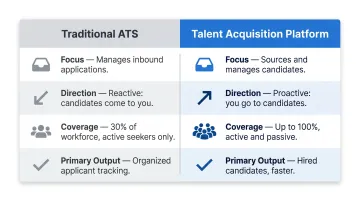
A traditional ATS organizes the applications that land in your inbox. A full talent acquisition platform also searches for candidates who are qualified but not actively looking — passive talent that inbound hiring never reaches. For teams filling niche roles, operating in competitive markets, or fighting recurring skills gaps, access to that passive majority is what separates a fast hire from a months-long search.
5 Benefits of Talent Acquisition Software
These benefits are measured in operational outcomes — time-to-fill, cost-per-hire, quality-of-hire — not feature checklists.
Benefit 1: Proactive Candidate Sourcing — Reach Talent Before the Competition Does
Waiting for applications means competing for the same 30% of the workforce actively looking for work. The other 70% — passive candidates — never see your job post, according to LinkedIn Talent Solutions research.
Talent acquisition software flips this. Instead of posting and praying, recruiters search verified databases, identify candidates by skills and experience level, and initiate contact directly — before a role is even formally open.
How it works in practice:
Platforms like Obra Hire give recruiters access to 800M+ verified candidate profiles. Using competency-based matching (not keyword search), recruiters define what a qualified candidate actually looks like, preview the matching pool size, then reveal direct contact details — email, phone, LinkedIn, and resume — when ready to reach out.
No agency middleman. No job board algorithm deciding who sees your posting.
Why this matters for your KPIs:
- Proactive pipelining reduces time-to-fill by 30–50% compared to reactive job posting
- Passive candidates are 120% more likely to want to make an impact in their next role
- Most impactful for: niche roles, competitive markets, and positions that historically don't attract strong inbound applicants
Benefit 2: Lower Cost-Per-Hire Through Automation and Self-Serve Access
SHRM's 2025 Recruiting Benchmarking Report puts average non-executive cost-per-hire at $5,475. Executive hires average $35,879. Recruiting agencies typically charge 15–25% of first-year base salary — meaning a single $80,000 hire through an agency costs $12,000–$20,000 in placement fees alone.
Self-serve TA software cuts into both numbers simultaneously.
Where the savings come from:
- Scheduling, follow-up messaging, and candidate tracking are automated — freeing recruiters from tasks that consume the majority of their week
- Direct candidate access eliminates per-placement agency markups
- Shared credits across teams (Obra Hire's Scale plan) prevent duplicate purchases and wasted spend
- Scalable pricing means hiring volume can grow without headcount growing proportionally
For a mid-market company running 20–30 hires per year, reducing agency dependency on even half those roles can represent six figures in savings. It's typically the benefit that gets CFO buy-in fastest.
KPIs affected: cost-per-hire, agency spend as % of recruiting budget, recruiter capacity (requisitions per recruiter)
Benefit 3: Better Candidate Quality — Including Protection from Fake and AI-Generated Applications
Quality problems now come from two directions at once: too few strong candidates in the matching pool, and too many fraudulent or AI-generated applications flooding the inbound funnel.
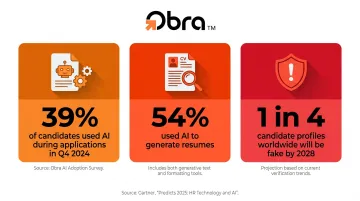
Gartner's 2025 research found 39% of candidates used AI during the application process in Q4 2024 — including 54% using it for resumes and 50% for cover letters. Gartner also predicts 1 in 4 candidate profiles worldwide will be fake by 2028.
Good talent acquisition software addresses both problems:
On the sourcing side:
- Competency-based matching evaluates depth of skill and proficiency, not just keyword overlap
- Recruiters define "Must Have" vs. "Nice to Have" criteria — the platform surfaces candidates who genuinely meet requirements
On the screening side:
- Verified profile filtering cross-references candidate data to flag synthetic or fraudulent profiles before they reach a recruiter's queue (available on Obra Hire's Explore and Scale plans)
KPIs affected: quality-of-hire score, 90-day retention rate, recruiter hours spent on unqualified screens
Benefit 4: Data-Driven Hiring Decisions and Continuous Process Improvement
Most recruiting teams run on gut feel and anecdote. "That job board hasn't been working lately." "This role always takes forever." Without structured data, those observations never become decisions.
Talent acquisition software generates data at every stage: which sourcing channels produce hires that stay, where candidates drop off, how long each stage takes, which interviewers move candidates forward versus stall them.
The maturity gap is stark:
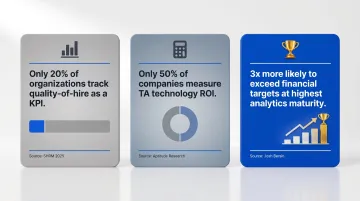
- Only 20% of organizations track quality-of-hire as a KPI (SHRM 2025)
- Only 50% of companies measure TA technology ROI (Aptitude Research, 2023)
- Organizations at the highest analytics maturity are 3x more likely to exceed financial targets (Josh Bersin Company)
The teams outperforming peers aren't necessarily spending more on recruiting. They're making faster corrections because they can see what's actually happening.
In practice, that means reviewing sourcing channels weekly instead of annually during budget season — and reallocating spend in real time based on what's actually producing hires versus noise.
KPIs affected: source-of-hire ROI, time-in-stage, interview-to-offer ratio, hiring manager satisfaction scores
Benefit 5: Seamless Scalability Without Replacing Your Existing HR Stack
The average company uses more than 10 different technology solutions to manage recruiting (Aptitude Research, 2023). Adding another tool that doesn't talk to the others creates more problems than it solves — duplicate candidate records, inconsistent data, and recruiters manually re-entering information across systems.
The best TA platforms plug into what you already have.
What integration depth actually looks like:
Obra Hire connects with 85+ ATS and HRIS platforms, including Workday, Greenhouse, iCIMS, Lever, SAP SuccessFactors, SmartRecruiters, and Oracle Recruiting Cloud. Candidates sourced outbound flow directly into existing workflows — no manual export/import, no parallel systems.
The business case for integration:
Organizations with integrated HR systems report:
- 73% faster time-to-hire
- 42% reduction in administrative costs
- 38% higher employee satisfaction scores
(Source: IgniteHCM, 2025)
Meanwhile, 68% of companies still operate disconnected HR systems, spending 23% more time on admin as a result.
KPIs affected: system adoption rate, recruiter time on data entry, compliance audit readiness
Key Features to Look For in Talent Acquisition Software
When evaluating platforms, match features to the specific benefits you need — not the longest feature list.
Core features that drive real outcomes:
- AI-powered candidate search with competency/skills-based filtering — not just resume keyword matching
- Verified or authenticated candidate profiles — especially important as AI-generated applications grow
- Outbound contact information access — email, phone, direct LinkedIn, and resume in one reveal
- ATS/HRIS integration depth — check that your specific platforms are supported, not just "integrations available"
- Team-wide shared credits and pooled licenses — prevents duplicate spend across recruiters
- Analytics dashboards — sourcing ROI, time-to-fill, pipeline health tracking
Two features buyers most often underweight deserve specific attention.
Candidate preview capability — the ability to see pool size and sample profiles before spending credits — is easy to miss in a demo but critical in practice. It lets your team confirm a role is sourceable in a target market before committing any spend. Obra Hire includes this on every plan, including Free.
Industry coverage matters just as much. Many platforms skew heavily toward tech and professional roles. If your team hires CDL-A drivers, nurses, or service workers alongside office roles, verify that coverage before signing. Obra Hire spans 34 industries across blue, gray, and white collar positions in the US, Canada, and Mexico.
What Happens When You Skip Talent Acquisition Software
The costs of staying manual add up faster than most teams expect.
The time cost: Recruiters currently spend 52% of their time on administrative tasks — scheduling, follow-up, data entry — and only 28% on actual sourcing and candidate engagement. Without automation, every increase in hiring volume means a proportional increase in admin burden.
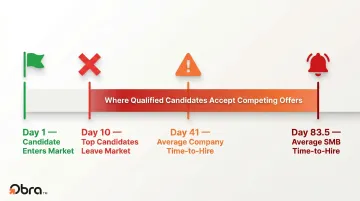
Slow to close: Top candidates are off the market within 10 days. Average time-to-hire is 41 days. That 31-day gap is where most qualified candidates accept a competing offer. SMBs without mature TA infrastructure average 83.5 days to fill — nearly triple what enterprise companies achieve.
The quality cost: Without verified sourcing and structured screening, teams face:
- Growing exposure to fraudulent or AI-generated applications
- No data on which channels produce hires that last versus hires that churn
- Bad hires that cost at least 30% of first-year salary to recover from, according to the U.S. Department of Labor
The result: slower offers, inconsistent candidate experiences, and passive talent going to whoever reached out first.
How to Get the Most Value from Talent Acquisition Software
TA software isn't a one-time fix. The teams that get the most from it treat it as an ongoing system — one that improves as data accumulates and workflows tighten.
High-ROI teams consistently do three things differently:
- Review sourcing channel data regularly — not just at budget time. Act on pipeline insights in real time rather than collecting data that sits in dashboards unread
- Integrate with your ATS/HRIS from day one — the longer consistent data accumulates, the better your time-to-fill forecasting and budget justification become
- Start with your hardest roles — use historically difficult or expensive-to-fill positions as the test case for validating platform ROI before scaling across all requisitions
Obra Hire's free plan includes unlimited searches, 1,000 profile views, and 50 contact credits per month — no credit card or sales call required. Testing with hard-to-fill roles first lets teams confirm sourcing quality and candidate pool depth before moving to a paid tier.
Conclusion
The real value of talent acquisition software shows up across the full hiring cycle — faster sourcing, lower cost, stronger candidate quality, and better decisions that compound with every hire you make.
In a market where AI-generated applications are already affecting 39% of inbound submissions and passive talent makes up 70% of the workforce, a reactive inbound-only approach doesn't just cost you time and budget. It puts you at a direct competitive disadvantage against employers who are already reaching candidates before they ever hit the job boards.
Obra Hire is designed for hiring teams — whether in-house recruiters, HR departments, or agencies — who want direct access to verified, pre-matched candidates from day one. No contract required, no setup needed, and 85+ integrations mean your existing workflows stay intact. You can start for free, preview your candidate pool, and only spend credits when you're ready to reach out.
Frequently Asked Questions
What are the benefits of a talent acquisition platform?
The core benefits are faster sourcing through proactive outbound access, reduced cost-per-hire by replacing agency fees and manual work, improved candidate quality through competency-based matching, and scalable workflows. The best platforms go beyond basic ATS tracking to include verified candidate databases and direct outbound contact access.
What are the features of a talent acquisition platform?
Key features include AI-powered candidate search with competency-based filtering, verified profile filtering to flag fake or AI-generated applications, direct contact information access (email, phone, LinkedIn, resume), ATS/HRIS integrations, shared team credits, and analytics dashboards for sourcing ROI and pipeline health.
What is the difference between talent acquisition software and a traditional ATS?
A traditional ATS manages inbound applications after candidates apply — it's a tracking system. Talent acquisition software also enables outbound sourcing, proactively finding and engaging candidates alongside the application process, giving teams access to the 70% of the workforce that isn't actively applying anywhere.
How does talent acquisition software reduce cost-per-hire?
It replaces agency fees (typically 15–25% of first-year salary) with direct self-serve candidate access and automates administrative tasks that currently consume over half of recruiter time. Shared team credits let hiring volume scale without costs scaling proportionally.
Can small businesses and mid-market companies use talent acquisition software effectively?
Yes. Modern platforms like Obra Hire offer freemium entry points with no contract or setup required, so any team can start hiring without upfront commitment. The ROI argument is often stronger for smaller organizations where the cost of a bad hire — or a slow hire — hits harder relative to overall budget.
How does talent acquisition software handle AI-generated or fake candidate profiles?
Leading platforms use verified profile filtering to authenticate candidate data and flag synthetic or fraudulent profiles before they waste recruiter time. This is increasingly critical: Gartner forecasts 1 in 4 profiles globally will be fake by 2028, and 39% of candidates already used AI to generate application materials in 2024.