What makes it harder: most teams try to solve bulk hiring by doing more of the same thing. More job posts. More screening calls. More emails. That approach breaks down at volume, and the data shows it. According to SHRM's 2025 Recruiting Benchmarking Report, the median time-to-fill for nonexecutive roles is 44 days — and for large organizations, that stretches to 61 days. When you need to hire 50 people in six weeks, that timeline simply doesn't work.
Bulk recruitment requires a different strategy, not just a faster version of your existing one. This guide breaks it down into 10 actionable steps — from defining goals and building a sourcing engine to onboarding at scale and tracking what actually matters.
TL;DR
- Bulk recruitment means filling many similar roles within a compressed timeframe — often weeks, not months.
- Speed without a structured process produces poor hires that cost more than the time you saved.
- These 10 steps cover every phase: from goal-setting and sourcing to screening, onboarding, and post-hire analytics.
- Technology — outbound sourcing platforms and ATS integrations in particular — is what separates a scalable process from a chaotic one.
What Is Bulk Recruitment (and When Do You Need It?)
Bulk recruitment means hiring a significant number of employees within a compressed timeframe, typically for roles that share similar skill profiles — think dozens to hundreds of hires in weeks, not months.
Common triggers include:
- Rapid business growth requiring fast team expansion
- Seasonal demand spikes (retail, hospitality, logistics)
- Geographic expansion or new market launches
- High turnover in frontline roles requiring constant backfill
- New client contracts or business unit launches
Turnover data explains why so many industries run in near-permanent bulk hiring mode. Contact centers average 39% annual agent turnover. Retail runs at 32.9%. Healthcare nursing homes hit 53.3%. These aren't one-time events — they're structural, recurring hiring needs.
Bulk recruitment also differs from traditional hiring in how you measure success. A 44-day median fill time is unacceptable when you need 80 warehouse workers by month-end. You're managing candidate volume — not individual profiles — which demands different processes and tools from the ground up.
Steps 1–3: Lay the Groundwork Before You Hire
Step 1: Define Your Hiring Goals and Volume Targets
Before any recruiting begins, you need quantified targets. Total headcount, role types, locations, and a firm timeline. Without these, your team will optimize for the wrong things — filling the easiest roles first, ignoring the hardest-to-fill locations, or burning budget on sourcing channels that don't match your candidate profile.
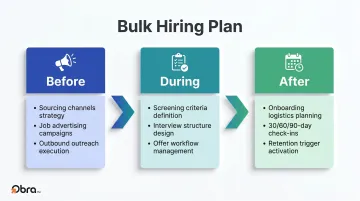
Build a hiring plan that covers three phases:
- Before: Sourcing channels, job advertising, outbound outreach strategy
- During: Screening criteria, interview structure, offer approval workflow
- After: Onboarding logistics, 30/60/90-day check-ins, early retention triggers
Key questions to answer upfront: Who has decision-making authority at each stage? What qualifications are truly non-negotiable? What tools are already in place, and what gaps need to be filled?
Step 2: Create a Standardized Recruitment Framework
Standardization is a competitive advantage when dozens of candidates are moving through your pipeline simultaneously. Consistent job descriptions, defined interview stages, shared scoring rubrics, and clear decision-making authority prevent the bottlenecks that kill bulk campaigns.
Your framework should be flexible enough to adapt if volume surges mid-campaign, and it must align with your existing ATS and HRIS workflows — so recruiting accelerates without disrupting what already works.
Step 3: Define Role Competencies and Must-Have Selection Criteria
Generic job postings generate generic applicants. Work with hiring managers before screening begins to define what success actually looks like in each role — specific skills, behaviors, and experience levels that predict performance.
Then rank those criteria:
- Must-have: Non-negotiable qualifications that disqualify candidates if absent
- Nice-to-have: Differentiators that inform ranking, not elimination
That distinction speeds up decision-making dramatically at high volumes — and keeps every reviewer on your team scoring against the same standard.
Steps 4–6: Build Your Sourcing and Selection Engine
Step 4: Go Beyond Inbound — Add Outbound Sourcing
Relying solely on job postings means waiting for candidates to come to you. That model fails during competitive hiring periods and for hard-to-fill roles. The math is brutal: according to CareerPlug's 2025 Recruiting Metrics Report, only 3% of inbound applicants progress to interview. For every 100 applications, 97 go nowhere.
Meanwhile, **70% of the global workforce is passive talent** — people who aren't actively applying but are open to the right opportunity. Outbound sourcing is the only way to reach them.
Platforms like Obra Hire are built for this. Recruiting teams can search 800M+ candidate profiles, apply filters, and preview pool sizes before spending a single contact credit — confirming that a qualified pool exists for each role before committing budget. For bulk campaigns spanning blue, gray, and white collar roles, that kind of pre-campaign visibility prevents wasted spend.
Run multiple sourcing channels in parallel:
- Outbound candidate outreach (proactive, direct)
- Employee referral programs
- Job boards and aggregators
- Social media targeting
- Career fairs for high-volume frontline roles
No single channel fills a bulk pipeline on its own — running them in parallel is what generates consistent volume.
Step 5: Upgrade Your Screening Process
Bulk recruiting generates an influx of low-quality, duplicate, and increasingly fraudulent applications — especially through inbound channels. Crosschq's 2025 research found that 46% of job applicants used AI tools to write or enhance their resumes. Gartner predicts that by 2028, one in four candidate profiles globally will be fake.
Without a filtering layer, your recruiters spend the majority of their time on applications that should never have passed initial review.
Technology addresses this at the source. ATS automation, competency-based screening questions, and verified profile filtering eliminate fabricated and misrepresented candidates before they reach a recruiter's desk. Obra Hire's verified profile filtering is built specifically for this — surfacing pre-screened profiles and reducing exposure to AI-generated submissions that most traditional platforms pass through unchecked.
Effective screening layers include:
- Competency-based pre-screening questions tied to must-have criteria
- Verified profile filtering to reduce fake applicants
- ATS automation rules to flag duplicates and disqualify non-matches
- Minimum threshold scoring before human review begins
Step 6: Optimize the Interview Process for Scale
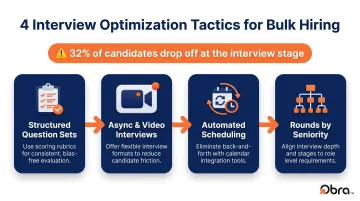
Over-engineered interviews are a top drop-off trigger in bulk hiring. Pin.com's analysis of 10M+ applications found that 32% of candidates drop off at the interview stage, with another 20% lost at scheduling. That's over half your pipeline, gone before an offer is made.
Structured interviews help on both fronts. Meta-analyses consistently show they're two to three times more predictive than unstructured conversations — yet fewer than 30% of employers currently use them.
To reduce attrition without sacrificing evaluation quality:
- Use structured interview question sets with predefined scoring rubrics
- Offer asynchronous or video interview options candidates can complete on their own schedule
- Implement automated scheduling tools that sync calendars and send reminders
- Define interview rounds upfront and align them to role seniority — frontline roles rarely need more than two stages
Steps 7–10: Engage, Onboard, and Continuously Improve
Step 7: Maintain Proactive Candidate Communication
Candidates in a bulk hiring campaign are almost always considering multiple opportunities. Silence — even for a few days — drives drop-offs. Employers are losing this battle: in 2025, 48% of applicants were ignored by employers, a three-year high.
The fix isn't sending personalized messages to every candidate. It's building automated but consistent communication touchpoints:
- Application confirmation within hours of submission
- Status updates at each stage transition
- Interview reminders 24 hours in advance
- Post-interview follow-ups within 48 hours
Candidates don't expect a hand-written note. They expect to know where they stand. Meeting that expectation alone separates you from most employers running bulk campaigns.
Step 8: Build and Maintain a Talent Pool for Future Cycles
Not every strong candidate from a bulk campaign gets hired. That's not a failure — it's an asset, if you capture it.
A searchable talent pool of pre-screened silver medalists significantly cuts time-to-hire for your next campaign. You're not starting from zero; you're starting with a shortlist of people who already cleared your criteria.
Obra Hire supports this through its project-based pipeline management: teams can organize candidates by role or search, tag profiles for future re-engagement, and share that pool across the recruiting team without re-spending credits on already-revealed contacts.
From there, keep pool candidates warm with periodic role alerts and re-engagement messages. Over time, this compounds: SHRM benchmarks place median nonexecutive cost-per-hire at $1,200, and that figure doesn't include the cost of early attrition when a hire doesn't stick.
Step 9: Automate and Standardize Onboarding
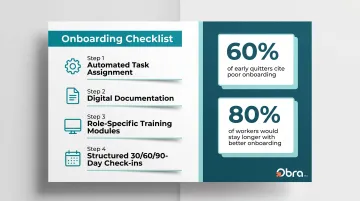
The offer letter isn't the finish line. Poor onboarding is one of the leading causes of early turnover among bulk hires — 60% of new hires who quit within their first three months cite disorganized or insufficient training as the primary reason.
Scalable onboarding at volume requires:
- Automated task assignment so new hire steps don't get missed under volume
- Digital documentation to process dozens of hires without manual bottlenecks
- Role-specific training modules new hires can complete independently
- Structured check-ins at 30, 60, and 90 days to catch disengagement early
80% of workers say they would stay longer if they experienced a better onboarding process. At the cost of replacing frontline employees — Gallup estimates roughly 40% of their annual salary — that investment pays for itself quickly.
Step 10: Track Key Metrics and Iterate After Every Campaign
Each bulk campaign is a dataset. Use it.
Core KPIs to track:
| Metric | What It Tells You |
|---|---|
| Time-to-hire | Speed of your pipeline end-to-end |
| Cost-per-hire | Budget efficiency by channel |
| Offer acceptance rate | Quality of candidate experience and compensation fit |
| Funnel drop-off by stage | Where your process is breaking down |
| 90-day retention rate | Whether you hired the right people |
| Quality of hire | Hiring manager satisfaction, early performance ratings |
Only 20% of organizations track quality-of-hire metrics, according to SHRM's 2025 data. For teams willing to close it, that's a real advantage over competitors still flying blind after each campaign.
After every campaign, run a structured debrief: which sourcing channels produced the best candidates, where did people drop off, which screening criteria predicted performance? Document it. Teams that do this consistently compress their time-to-hire and cost-per-hire with each successive cycle — turning bulk hiring from a scramble into a repeatable system.
Common Bulk Recruitment Mistakes to Avoid
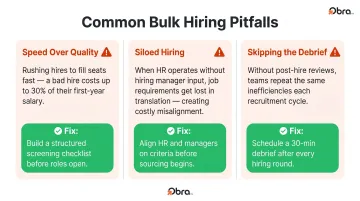
Three patterns consistently derail bulk hiring campaigns — and all three are avoidable with the right structure in place:
- Prioritizing speed over quality. Skipping reference checks or lowering standards to hit headcount targets creates a downstream problem. The U.S. Department of Labor estimates a bad hire costs at least 30% of that employee's first-year earnings — and early attrition from a bulk campaign multiplies that cost across dozens of decisions.
- Siloed hiring. When HR builds the recruitment process without input from department heads, misaligned expectations about skills and culture create a backlog of poor fits. Get hiring managers involved in defining competency criteria before screening starts, not after.
- Skipping the post-campaign debrief. Teams that don't capture lessons learned repeat the same inefficiencies. A structured 60-minute review with clear documentation after each campaign compounds improvement over time.
Frequently Asked Questions
What is the best way to do bulk hiring?
Combine a clear upfront plan — headcount targets, competency criteria, and defined timelines — with technology for outbound sourcing, automated screening, and structured interviews. The teams that do this well don't wait for inbound applications; they build candidate pools before campaigns begin.
What are common recruitment frameworks like the 4 P's and 5 C's?
The 4 P's (People, Pay, Process, and Promotion) structure employer brand and recruiting strategy. The 5 C's — Character, Competency, Culture, Chemistry, and Congruence — give interviewers a consistent framework for evaluating candidates against defined selection criteria.
What is the difference between bulk recruitment and traditional recruitment?
Traditional recruitment fills one or a few roles over weeks or months with relatively individualized processes. Bulk recruitment fills many similar roles within a compressed timeframe and demands automation, standardization, and proactive sourcing strategies to work at that scale.
How do you maintain quality when hiring in bulk?
Define role competencies before screening begins, use structured evaluation methods across all interviewers, and track post-hire performance at 30, 60, and 90 days. Consistent process discipline — not individual judgment calls — is what keeps quality high at scale.
What tools are most useful for bulk recruitment?
ATS platforms, outbound sourcing tools (like Obra Hire), automated scheduling software, video interview platforms, and communication automation form the core stack. The most effective setups connect these tools directly so data moves automatically — no manual transfers between systems.
How do you measure the success of a bulk recruitment campaign?
Track time-to-hire, cost-per-hire, offer acceptance rate, funnel conversion rates by stage, and 90-day retention. After each campaign, review these metrics together — funnel drop-off points and retention rates usually reveal the clearest opportunities to improve the next hire cycle.